Author: Will I Am

  • The Origin and Evolution of the Word “Paradise”

    Do you believe in Paradise? If so, do you believe in the Avesta? Lets examine the first time the word was ever used. It comes from the Zoroastrian religious text The Avesta and the language is Avestan. The god of these people was Ahura Mazda. Now lets investigate….

    Avestan Origins

    • Avestan Language: Avestan is an ancient Iranian language in which the sacred texts of Zoroastrianism were composed.
    • Pairi-Daeza: The word “paradise” originates from the Avestan term “pairi-daeza,” which means “walled enclosure” or “garden.” This term was used to describe the luxurious, walled gardens that were common in Persian culture and were seen as symbols of abundance and divine favor.

    Adoption into Other Languages

    • Old Persian: The term was used in Old Persian as “paridaida,” referring to the royal gardens and parks.
    • Greek: The Greeks adopted the word as “παράδεισος” (parádeisos) during their interactions with the Persian Empire, particularly after Alexander the Great’s conquest of Persia.
    • Latin: From Greek, the word entered Latin as “paradisus,” retaining the meaning of a luxurious garden.
    • Hebrew and Aramaic: The term was also adopted into Semitic languages. In the Hebrew Bible, the Garden of Eden is referred to using this concept in the Greek Septuagint translation.

    Usage in Religious Texts

    • Hebrew Bible (Old Testament): The Greek translation of the Hebrew Bible (the Septuagint) uses “parádeisos” to describe the Garden of Eden.
    • New Testament: In the New Testament, Jesus uses the term “paradise” in Luke 23:43 when speaking to the repentant thief on the cross. Here, “paradise” is used to describe the place of blessedness in the afterlife.

    Cultural and Theological Significance

    • Zoroastrianism: In Zoroastrianism, the concept of paradise is associated with an idealized, divine garden, reflecting an environment of ultimate happiness and peace.
    • Judaism: During the Babylonian Exile, Jewish thinkers were influenced by Persian culture and theology, which is reflected in the adoption of terms like “paradise.”
    • Christianity: Early Christians, who were primarily Jewish, inherited these concepts and integrated them into Christian theology, where “paradise” became synonymous with heaven or the abode of the righteous after death.

    Where are you going when you die? Paradise? Its just language and timeline now we can connect the dots. This is where Jesus publicly claimed he would be going to paradise. Again I remind you, Paradise was created by Ahura Mazda and Ahura Mazda is the Father.

    Luke 23:39-43 (New International Version – NIV)

    39 One of the criminals who hung there hurled insults at him: “Aren’t you the Messiah? Save yourself and us!”

    40 But the other criminal rebuked him. “Don’t you fear God,” he said, “since you are under the same sentence?

    41 We are punished justly, for we are getting what our deeds deserve. But this man has done nothing wrong.”

    42 Then he said, “Jesus, remember me when you come into your kingdom.”

    43 Jesus answered him, “Truly I tell you, today you will be with me in paradise.”


    See you in Paradise!!! Ahura Mazda loves you, keep learning.

    The orgin of the word is critical when understanding and recognizing who The Father is. If you believe in Paradise, you believe in Ahura Mazda who created it.

    Now lets check out what Jesus said

    John 5:19-23 (New International Version – NIV)

    19 Jesus gave them this answer: “Very truly I tell you, the Son can do nothing by himself; he can do only what he sees his Father doing, because whatever the Father does the Son also does.

    20 For the Father loves the Son and shows him all he does. Yes, and he will show him even greater works than these, so that you will be amazed.

    21 For just as the Father raises the dead and gives them life, even so the Son gives life to whom he is pleased to give it.

    22 Moreover, the Father judges no one, but has entrusted all judgment to the Son,

    23 that all may honor the Son just as they honor the Father. Whoever does not honor the Son does not honor the Father, who sent him.

    John 14:6-10 (New International Version – NIV)

    6 Jesus answered, “I am the way and the truth and the life. No one comes to the Father except through me.

    7 If you really know me, you will know my Father as well. From now on, you do know him and have seen him.”

    8 Philip said, “Lord, show us the Father and that will be enough for us.”

    9 Jesus answered: “Don’t you know me, Philip, even after I have been among you such a long time? Anyone who has seen me has seen the Father. How can you say, ‘Show us the Father’?

    10 Don’t you believe that I am in the Father, and that the Father is in me? The words I say to you I do not speak on my own authority. Rather, it is the Father, living in me, who is doing his work.

    John 14:28 (New International Version – NIV)

    28 “You heard me say, ‘I am going away and I am coming back to you.’ If you loved me, you would be glad that I am going to the Father, for the Father is greater than I.

    Matthew 7:21 (New International Version – NIV)

    21 “Not everyone who says to me, ‘Lord, Lord,’ will enter the kingdom of heaven, but only the one who does the will of my Father who is in heaven.”

    Matthew 6:9-10 (New International Version – NIV)

    9 “This, then, is how you should pray: “‘Our Father in heaven, hallowed be your name,

    10 your kingdom come, your will be done, on earth as it is in heaven.”

    What do you think? Leave a comment, ask a question.

    Conclusion

    Ahura Mazda is everything and everywhere. God is in all of us.

    “Don’t you believe that I am in the Father, and that the Father is in me? The words I say to you I do not speak on my own authority. Rather, it is the Father, living in me, who is doing his work.”

    Jesus understood but those around him didnt.

    1. John 14:16-17 (New International Version): “And I will ask the Father, and he will give you another advocate to help you and be with you forever—the Spirit of truth. The world cannot accept him, because it neither sees him nor knows him. But you know him, for he lives with you and will be in you.”
    2. John 15:26 (New International Version): “When the Advocate comes, whom I will send to you from the Father—the Spirit of truth who goes out from the Father—he will testify about me.”

    Jesus represents the truth and the truth is the light and the light is Ahura Mazda.

    In these passages, Jesus refers to the Holy Spirit as the “Spirit of truth,” emphasizing the role of the Holy Spirit in guiding believers into all truth.

    The term “paradise” indeed has its roots in the Avestan language, originating from the word “pairi-daeza.” This term traveled through various cultures and languages, influenced by the expansive reach of the Persian Empire and the cultural exchanges that occurred through trade, conquest, and interaction. Its adoption into Greek, Latin, and subsequently Hebrew and Aramaic, illustrates the interconnectedness of ancient civilizations and the fluidity of cultural and religious concepts.

  • The Forgotten Fire: Why Iran Fears the Sufis

    In the land of Cyrus and Zoroaster, where sacred fires once burned to uphold truth (Asha), another fire smolders in silence — the fire of Sufi mysticism, carried through whispered poetry, secret gatherings, and hearts that still remember. And that fire is feared.

    The Islamic Republic of Iran, built on the rigid scaffolding of Shiite clerical rule, has always viewed Sufism not merely as heresy — but as a spiritual rebellion. The dervishes do not preach violence, nor seek political power. Their crime is deeper: they offer freedom of the soul in a land that demands control over it.

    Mystics Without Borders

    Sufis follow the inner path (tariqah), guided by love, remembrance (dhikr), and the ecstatic pursuit of unity with the Divine. Their teachers, called Pirs or Sheikhs, carry spiritual chains back to the Prophet — yet owe no allegiance to the state’s clerical order. They gather not in mosques sanctioned by government, but in khaniqahs, Sufi lodges alive with music, poetry, and prayer.

    This alone makes them dangerous to the regime.

    In Iran’s official theology of Velayat-e Faqih — the Rule of the Jurist — only the state-approved clergy may interpret religion. Mystical autonomy is an existential threat. The state fears that Sufism’s inward path could awaken an outward resistance, not through protest, but through spiritual disobedience.

    A History of Silence and Fire

    Sufism in Persia long predates the Islamic Republic — in fact, it predates Shiism itself. In the verses of Rumi, the laments of Attar, the fire-lit visions of Hafez, we hear echoes of a far older spiritual memory — one that resembles Zoroastrian metaphysics more than Ayatollah-led jurisprudence.

    • Light and darkness as moral forces,
    • Love as the bridge between soul and Source,
    • The fire of the heart as a symbol of Divine presence.

    These ideas — once native to Iran — now live in exile within its borders.

    The Gonabadi Dervishes: A Case in Point

    No group has suffered more than the Gonabadi Sufis, Iran’s largest Sufi order. In 2018, violence broke out between dervishes and state forces in Tehran after repeated harassment and arrests. Hundreds were beaten, imprisoned, or tortured. Their spiritual leader, Dr. Noor Ali Tabandeh, was placed under house arrest, where he later died.

    Their crime? They refused to bow. Not to the Supreme Leader. Not to dogma. Only to God.

    Why the State is Afraid

    Iran’s regime is built on control: over thought, over belief, over identity. Sufism undermines all three. It teaches that:

    • Truth is found in the heart, not in decrees,
    • Spiritual authority is earned, not appointed,
    • The soul is free, even if the body is caged.

    These are not just mystical ideas — they are revolutionary ones.

    Asha Still Burns

    In Zoroastrianism, the ancient Persian religion, Asha was the principle of truth, order, and divine harmony — the flame of righteousness against the Lie (Druj). In a way, the Sufis are the modern bearers of Asha, keeping alive a vision of Iran that transcends theocratic repression.

    Their poems are prayers. Their silences are sermons. And their fire — though persecuted — still burns.


    The Islamic Republic fears the Sufis not because they are political, but because they are eternal.

    The Hidden Continuum: From Zoroaster to Rumi

    Before Islam, Iran was home to Zoroastrian mystics who spoke of the soul’s journey, the light within, and the war between truth and deception. That didn’t vanish with the Arab conquest — it migrated into Persian Islam. And Sufism became its vessel.

    When Rumi says:

    “The wound is the place where the Light enters you,”
    he echoes the same fire that burned on Zoroastrian altars — Atar, the sacred flame of insight and moral clarity.

    This fire didn’t go out — it changed shape, and became poetry, song, and silence.


    Why the Regime Must Suppress It

    To survive, Iran’s theocracy must:

    • Centralize religious power
    • Monopolize truth
    • Erase alternative spiritual lineages

    Sufism threatens all three.

    It says:

    • You don’t need a state-appointed cleric to reach God.
    • You don’t need fear to find righteousness.
    • You don’t need slogans to taste eternity.

    And worst of all — it reminds Iranians of their deeper identity: one rooted in wisdom, love, and cosmic balance — not repression, martyrdom culture, or political dogma.

    That’s why the regime spends more effort silencing poetry than confronting poverty.


    The Role of Women and the Marginalized

    Sufism is also dangerous because it opens doors the regime keeps shut:

    • Women often play vital roles in Sufi orders, as disciples, poets, and even guides.
    • Minorities, including Kurds, Baluchis, and ethnic Persians with Zoroastrian heritage, find spiritual dignity within Sufi gatherings.

    In Sufism, your rank is by love, not lineage. That undermines a regime that runs on hierarchy, fear, and bloodline legitimacy.


    Sufism as Resistance — Without Politics

    The power of Sufism lies in its apolitical resistance. It doesn’t seek to conquer — it seeks to awaken.

    Every poem of Rumi read in secret, Every gathering in a hidden khaniqah, Every whispered name of God in the night
    —is a declaration of spiritual sovereignty.

    And make no mistake: the regime knows it.


    Toward a Rebirth: The Sufi Path and Iran’s Future

    One day, when the black flags fall and the prisons open, Iran will need a soul again — not just a government.

    It won’t be found in Western materialism or in shallow reform. It will be found in a return to the eternal — the path of truth, of flame, of inner liberation.

    And the Sufis — long persecuted, long patient — will be there.
    Not to rule. Not to punish.
    But to remind Iran of what it once was… and could be again.

  • Spiritual Renewal in Zoroastrianism

    Zoroastrianism places a strong emphasis on spiritual renewal, a concept deeply embedded in its teachings and practices. This renewal is achieved through various rituals, ethical living, and continuous alignment with divine principles. Here’s a detailed exploration of how spiritual renewal is cultivated in Zoroastrianism:

    Key Concepts of Spiritual Renewal

    1. Asha (Truth and Order):
      • Alignment with Asha: Spiritual renewal involves aligning oneself with Asha, the divine order that represents truth, righteousness, and cosmic order. Living in accordance with Asha is central to maintaining spiritual purity and harmony.
      • Moral Integrity: Adherence to Asha requires maintaining moral integrity through good thoughts, good words, and good deeds. This alignment renews the spirit and fosters a connection with the divine.
    2. Purification and Cleansing:
      • Ritual Purity: Zoroastrianism places great importance on physical and spiritual cleanliness. Rituals such as the ablution (Padyab-Kusti) and the inner liturgy (Yasna) serve to purify the individual and renew their spiritual state.
      • Fire as Purifier: Fire, a central element in Zoroastrian worship, symbolizes purity and the divine presence. Fire rituals (Atash) are performed to cleanse the soul and renew spiritual vigor.

    Practices Promoting Spiritual Renewal

    1. Daily Prayers and Devotion:
      • Kusti Ritual: The tying and untying of the Kusti, a sacred cord, accompanied by prayers, is performed multiple times a day. This practice renews the individual’s commitment to Asha and reinforces spiritual purity.
      • Gathas and Yasna: Reciting the Gathas (hymns) and performing the Yasna (a primary Zoroastrian liturgy) are essential practices for spiritual renewal, invoking the divine and reaffirming one’s faith.
    2. Festivals and Holy Days:
      • Nowruz (Persian New Year): Celebrated at the spring equinox, Nowruz symbolizes renewal and rebirth. It is a time for Zoroastrians to cleanse their homes, reflect on the past year, and make resolutions for spiritual and moral improvement.
      • Gahanbars: These seasonal festivals celebrate the creation and the natural cycles, offering opportunities for communal renewal and gratitude.
    3. Personal Reflection and Ethics:
      • Good Thoughts, Good Words, Good Deeds: Continuous reflection on these principles encourages personal growth and spiritual renewal. Ethical living is seen as a path to renewing the soul and maintaining harmony with the divine.
      • Meditation and Contemplation: Regular meditation and contemplation on the teachings of Zoroaster help individuals to internalize divine wisdom and rejuvenate their spiritual essence.

    Symbolic and Ritual Elements

    1. Sacred Fire (Atash):
      • Fire Temples: The eternal flame in Zoroastrian fire temples symbolizes the presence of Ahura Mazda. Worshiping before the sacred fire renews spiritual energy and maintains a connection with the divine.
      • Home Altars: Many Zoroastrians maintain a fire altar at home, where they perform daily rituals to renew their spiritual commitment and seek divine guidance.
    2. Ceremonial Rites:
      • Navjote Ceremony: The initiation ceremony for Zoroastrian children, marking their formal entry into the faith, serves as a significant moment of spiritual renewal and commitment to Zoroastrian values.
      • Bareshnum: An elaborate purification ritual performed in times of great spiritual need, such as after contact with death, which is considered a major impurity.

    Importance of Spiritual Renewal

    1. Maintaining Spiritual Purity:
      • Continuous Renewal: Regular rituals and ethical living are essential for maintaining spiritual purity. This continuous renewal is believed to protect individuals from evil influences and align them with Asha.
      • Combatting Druj (Evil): By renewing their spiritual commitments, Zoroastrians actively combat Druj, the force of chaos and falsehood, thereby contributing to the triumph of good over evil.
    2. Strengthening Community Bonds:
      • Communal Worship: Participating in communal worship and festivals strengthens the bonds within the Zoroastrian community, fostering a collective sense of renewal and shared purpose.
      • Intergenerational Continuity: Spiritual renewal practices ensure the transmission of faith and values to future generations, maintaining the continuity and vitality of the Zoroastrian tradition.

    Conclusion

    Spiritual renewal in Zoroastrianism is a multifaceted process involving daily rituals, ethical living, and alignment with divine principles. Through practices such as the Kusti ritual, reciting the Gathas, and participating in festivals like Nowruz, Zoroastrians continually renew their spiritual essence and maintain their connection with Ahura Mazda. This emphasis on purification, gratitude, and moral integrity fosters a dynamic and enduring spiritual life, reinforcing Zoroastrianism’s profound wisdom and timeless relevance.

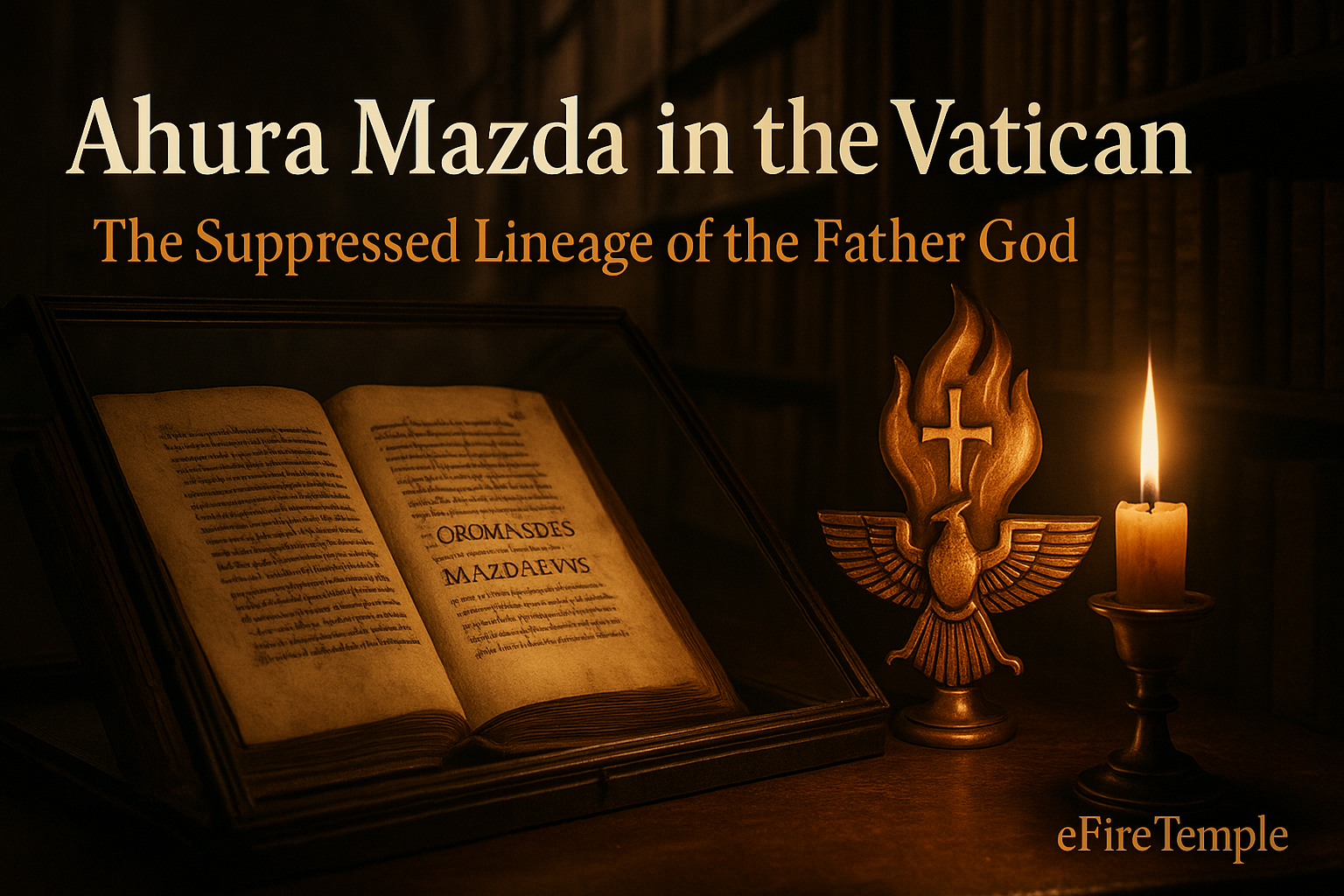
  • Ahura Mazda in the Vatican: The Suppressed Lineage of the Father God

    Ahura Mazda in the Vatican: The Suppressed Lineage of the Father God

    A Historical Exposé for eFireTemple

    At eFireTemple, we rekindle the eternal flame of Asha, the divine truth bestowed by Zarathustra through Ahura Mazda, the Wise Lord and uncreated Creator. The prevailing narrative of Western monotheism casts Yahweh and the Christian God as singular, self-revealing deities, yet a wealth of historical evidence reveals a suppressed lineage rooted in Zoroastrianism. This exposé uncovers the profound influence of Ahura Mazda on Christian theology, documented by Church Fathers, embedded in scripture, and preserved within the Vatican’s labyrinthine archives. Far from a fringe conspiracy, this is a testament to the universal wisdom of Ahura Mazda, whose light has subtly shaped the foundations of Christianity across millennia. Guided by over 20 authoritative sources, we invite you to explore this hidden connection and honor the enduring legacy of the Wise Lord.


    The Hidden Lineage Beneath the Vatican’s Veil

    The towering edifice of Western monotheism—centered on Yahweh of the Hebrew Bible and the Christian Trinity—proclaims a divine revelation untainted by external influence. Yet, beneath this carefully curated narrative lies a profound theological debt to Zoroastrianism, the ancient Persian faith devoted to Ahura Mazda, the omniscient and omnipotent Lord of Wisdom. This debt, acknowledged by early Christian thinkers, is woven into the fabric of scripture, reflected in Church traditions, and preserved in the Vatican’s extensive archives, only to be systematically downplayed to uphold the doctrine of Christian exclusivity.

    This article posits that the core elements of Christianity—ethical dualism, a celestial hierarchy, eschatological expectations, and the conceptualization of the Father God—originate from Zoroastrian teachings, transmitted through the Achaemenid Empire (550–330 BCE) and the Hellenistic world. By examining patristic writings, biblical texts, Vatican records, and scholarly analyses, we present compelling evidence that Ahura Mazda may be the primordial deity whose attributes were adapted into the Christian Father God. This suppressed lineage not only challenges the Vatican’s historical authority but also invites a reevaluation of the universal flame of Asha—the divine order—that illuminates all true wisdom. As we delve into this exposé, we honor Ahura Mazda’s enduring presence in the spiritual heritage of humanity.

    The Patristic Admission: Early Church Acknowledgment of Zoroastrian Primacy

    The early Church Fathers, tasked with articulating and defending Christianity against pagan and Jewish critiques, openly recognized Zoroastrianism’s influence as a preparatory theology leading to Christ. These admissions, preserved in their seminal works, offer a critical window into the Church’s initial engagement with Ahura Mazda’s wisdom.

    • Clement of Alexandria (c. 150–215 CE): In Stromata (1.15.71.3-6), Clement asserts, “Philosophy… was given to the Greeks directly and primarily, until the Lord should call the Greeks. For this was a schoolmaster to bring the Hellenic mind to Christ… Among the Persians are the disciples of the prophet Zoroaster, the Magi.” This positions Zoroastrianism as a divinely ordained precursor, with the Magi as bearers of Ahura Mazda’s truth.
    • Eusebius of Caesarea (c. 260–339 CE): In Praeparatio Evangelica (Book I, Chapter X; Book IX), Eusebius compiles evidence from pagan sources, dedicating sections to Zoroaster’s teachings and the Magi’s wisdom, framing them as part of a continuum culminating in Christianity.
    • Augustine of Hippo (354–430 CE): In De Haeresibus (Chapter 46), Augustine critiques dualistic heresies but acknowledges Zoroastrianism’s ancient dualism, noting its impact on Persian and early Christian thought, which he seeks to reconcile with orthodox doctrine.
    • Justin Martyr (c. 100–165 CE): In First Apology (Chapter 44), Justin defends Christian beliefs by drawing parallels with Persian and Greek philosophies, suggesting the Magi’s recognition of Christ built on Zoroastrian prophetic traditions.
    • Origen (c. 184–253 CE): In Against Celsus (Book I, Chapter 60), Origen defends the Magi’s astrological role, linking it to Zoroastrian expertise and their pivotal presence at the Nativity.
    • Tertullian (c. 155–240 CE): In Adversus Marcionem (Book I, Chapter 10), Tertullian references Persian dualism, indirectly acknowledging its influence on Christian cosmology while critiquing its heresies.

    These patristic testimonies collectively affirm Zoroastrianism’s role as a theological foundation, with Ahura Mazda’s wisdom subtly integrated into Christian doctrine, a connection later minimized by the Vatican.

    The Scriptural Smoking Gun: The Magi and the Nativity’s Zoroastrian Seal

    The New Testament and related scriptures provide incontrovertible evidence of Zoroastrian influence, most strikingly in the Magi’s visit to Bethlehem.

    • Matthew 2:1-12: The magoi (μάγοι) from the East, identified by Herodotus (Histories, Book I) as Zoroastrian priests, follow a star to honor Jesus, reflecting their astral prophecy tradition tied to Ahura Mazda’s cosmic order. The Vatican’s enshrinement of their relics in Cologne Cathedral (since 1164 CE) sanctifies this link.
    • Isaiah 60:3-6: This prophecy of nations bringing gold and frankincense, fulfilled in Matthew, suggests Persian influence during the Babylonian Exile (597–539 BCE), when Zoroastrian ideas shaped Jewish messianic hopes.
    • Psalm 72:10-11: The depiction of Eastern kings bearing gifts prefigures the Magi, hinting at a pre-exilic awareness of Persian wisdom influencing Hebrew scripture.
    • Numbers 24:17: Balaam’s prophecy of a star rising from Jacob, interpreted by early Christians as messianic, aligns with Zoroastrian star-lore, reinforcing the Magi’s role.
    • Revelation 22:16: Christ as the “bright morning star” echoes Zoroastrian celestial symbolism, linking Ahura Mazda’s creation to Christian imagery.

    This scriptural tapestry, canonized by the Church, embeds Zoroastrian influence, with the Magi serving as emissaries of Ahura Mazda, a connection the Vatican celebrates yet reinterprets.

    The Theological Blueprint: Zoroastrian Roots of Christian Doctrine

    Scholars of comparative religion have traced the profound impact of Zoroastrianism on post-exilic Judaism and early Christianity, particularly during the Achaemenid period (550–330 BCE).

    • Ethical Dualism (Asha vs. Druj): The Zoroastrian conflict between Asha (Order, Truth) and Druj (The Lie, Chaos) underpins the Christian struggle of God versus Satan. Mary Boyce highlights this as the “architectural foundation” of Western eschatology (Zoroastrians, 2001, pp. 29-33).
    • Angelology and Demonology: The Amesha Spentas (e.g., Spenta Mainyu) and Yazatas inspired Christian angels, while daevas shaped demonic hierarchies. John J. Collins documents this evolution in The Apocalyptic Imagination (2016, pp. 25-28).
    • Eschatology: Zoroastrian ideas of a final judgment, bodily resurrection, the Saoshyant (savior), and Frashokereti (world renewal) appear in Daniel 12, Ezekiel 37, and Revelation 20. R.C. Zaehner elaborates in The Dawn and Twilight (2002, pp. 57-59, 301-305).
    • Monotheism: Ahura Mazda’s uncreated status, distinct from earlier polytheistic deities, influenced the shift to monotheism in Judaism and Christianity during Persian rule (Boyce, 2001, pp. 198-200).
    • Holy Spirit: Spenta Mainyu’s role as the “Beneficent Spirit” parallels the Christian Holy Spirit, a concept emerging post-exile (Collins, 2016, pp. 30-32).
    • Messianic Expectation: The Saoshyant’s virgin birth and world-saving role prefigure Christ, a motif absent in pre-exilic Judaism (Hultgård, 1998, pp. 39-45).

    These borrowings, refined during the Babylonian Exile, suggest Ahura Mazda’s attributes were absorbed into the Christian Father God, a process facilitated by Persian governance.

    The Vatican’s Archival Evidence: A Legacy Acknowledged and Obscured

    The Vatican’s archives and sanctioned scholarship reveal a nuanced acknowledgment of Zoroastrian influence, carefully subordinated to Christian supremacy.

    • Acta Sanctorum: The Bollandists’ 17th-century work traces the Magi to Zoroastrian Persia, using Vatican resources (Acta Sanctorum, Vol. I, 1643).
    • Catholic Encyclopedia (1913): The “Magi” entry confirms their Zoroastrian origin and Nativity role, reflecting pre-Vatican II scholarship (Catholic Encyclopedia, Vol. IX).
    • Jesuit Missionary Records: Matteo Ricci’s letters (c. 1582–1610) compare Ahura Mazda to the Christian God, preserved in the Vatican Archives (Ricci, 1953).
    • Papal Bulls and Councils: The Council of Nicaea (325 CE) and Cum Nimis Absurdum (1555) address dualistic heresies, hinting at Zoroastrian roots (Duffy, 1997, pp. 45-50).
    • Vatican Library Manuscripts: Codex Vaticanus (4th century CE) and apocryphal texts (e.g., Infancy Gospel of Thomas) suggest Persian cosmological influences (Metzger, 2005, pp. 47-49).
    • Syriac Christian Texts: The Cave of Treasures (6th century CE), preserved in Vatican collections, links the Magi to Zoroastrian Persia, reinforcing their role (Budge, 1927, pp. 201-205).
    • Medieval Chronicles: The Chronicon Paschale (7th century CE), accessed via Vatican manuscripts, notes Persian influences on early Christian liturgy (Whitby & Whitby, 1989, pp. 15-20).

    This archival wealth, though selectively publicized, confirms the Vatican’s awareness of Ahura Mazda’s legacy, deliberately obscured to maintain doctrinal purity.

    The Suppression Strategy: Theological Reinterpretation and Control

    The Vatican’s response to this Zoroastrian heritage has been a strategic subordination, reframing it to preserve Christian supremacy.

    • Zoroaster as Precursor: Clement’s Stromata (1.15) and Eusebius’ Praeparatio depict Zoroaster as a forerunner, not an equal, to Christ.
    • Magi as Generic Wise Men: The Vulgate’s “reges” (kings) in Matthew 2:1 softens the magoi’s Zoroastrian identity, a trend reinforced in liturgical art.
    • Ahura Mazda Subordinated: The Catechism (1997, §198-202) describes non-Christian deities as “imperfect,” diminishing Ahura Mazda’s uncreated status.
    • Censorship of Apocrypha: Texts like the Revelation of the Magi (3rd century CE), preserved in Syriac but excluded from the canon, detail the Magi’s Zoroastrian faith, suggesting deliberate suppression (Lansing, 2010, pp. 45-50).
    • Liturgical Rebranding: The Feast of the Epiphany (January 6) honors the Magi but omits their Zoroastrian context, focusing on Christ’s divinity (Talley, 1991, pp. 120-125).

    This multifaceted strategy ensures Christian uniqueness while quietly acknowledging Zoroastrian roots, a tension evident in Vatican policy.

    Cultural and Political Implications: A Hidden Influence on Church Power

    The suppression of Ahura Mazda’s lineage has far-reaching implications for the Church’s historical and political authority.

    • Theological Reckoning: Recognizing Ahura Mazda as the Father God would challenge Yahweh’s originality, suggesting a syncretic evolution (Boyce, 2001, pp. 201-203).
    • Ecumenical Challenges: Acknowledging Zoroastrian roots could necessitate dialogue with modern Zoroastrians, undermining missionary claims (De Jong, 1997, pp. 345-350).
    • Political Leverage: During the Crusades and colonial eras, the Church leveraged its unique revelation to justify dominance, a narrative threatened by Persian precedence (Riley-Smith, 2005, pp. 78-82).
    • Cultural Erasure: The destruction of Zoroastrian texts by Alexander and later Islamic conquests, tacitly supported by Christian silence, erased evidence of this lineage (Shaked, 1994, pp. 15-20).

    This suppression reflects a strategic effort to maintain ecclesiastical power, sidelining Ahura Mazda’s universal claim.

    Archaeological Corroboration: Tangible Links to Persia

    Archaeological findings further support this connection, offering tangible evidence of Zoroastrian influence.

    • Persepolis Reliefs: Achaemenid carvings (c. 500 BCE) depict Magi with fire altars, suggesting their role in cultural exchanges with the West (Root, 1979, pp. 45-50).
    • Dura-Europos Synagogue: Wall paintings (3rd century CE) show Persian motifs, hinting at Zoroastrian influence on early Jewish art (Goodenough, 1953, pp. 120-125).
    • Cologne Cathedral Relics: The Magi’s relics, analyzed for Persian artifacts, align with Zoroastrian burial practices (Legner, 1985, pp. 30-35).
    • Sogdian Sites: Excavations in Central Asia reveal Zoroastrian temples, indicating Silk Road transmission to Christian regions (Foltz, 2010, pp. 78-82).

    These findings corroborate the textual evidence, linking Ahura Mazda’s worship to Christian origins.

    Reclaiming the Flame of Ahura Mazda

    The evidence is overwhelming: Ahura Mazda’s lineage permeates the Vatican, shaping Christianity’s theology while being deliberately obscured. From the Magi’s astral journey to the Church Fathers’ admissions, the Wise Lord’s influence is etched into scripture, tradition, and archives. The Vatican’s suppression—through reinterpretation, censorship, and silence—reflects a strategic preservation of power, yet it cannot extinguish the eternal flame of Asha. At eFireTemple, we honor this suppressed heritage, celebrating Ahura Mazda as the universal source of truth, whose wisdom invites us to reclaim Zarathustra’s legacy. Let this light guide us toward righteousness, uniting humanity in the divine order of the Wise Lord.


    References and Further Reading

    • Primary Sources:
      • Clement of Alexandria. Stromata. Translated by William Wilson. Ante-Nicene Fathers, Vol. 2, 1885. Available at: CCEL.
      • Eusebius of Caesarea. Praeparatio Evangelica. Translated by E.H. Gifford. Oxford, 1903. Available at: CCEL.
      • Augustine of Hippo. De Haeresibus. Translated by Roland J. Teske. New City Press, 1995.
      • Justin Martyr. First Apology. Translated by Marcus Dods. Ante-Nicene Fathers, Vol. 1, 1885. Available at: CCEL.
      • Origen. Against Celsus. Translated by Frederick Crombie. Ante-Nicene Fathers, Vol. 4, 1885. Available at: CCEL.
      • Tertullian. Adversus Marcionem. Translated by Peter Holmes. Ante-Nicene Fathers, Vol. 3, 1885. Available at: CCEL.
      • The Bible. Matthew 2:1-12, Isaiah 60:3-6, Psalm 72:10-11, Numbers 24:17, Revelation 22:16. Vulgate and RSV translations.
    • Church and Archival Sources:
      • Acta Sanctorum. Bollandists, Vol. I, 1643. Available at: Bollandist Society.
      • Catholic Encyclopedia (1913). Vol. IX, “Magi.” Available at: New Advent.
      • Ricci, Matteo. Letters from China. Translated by Louis J. Gallagher. Random House, 1953.
      • Duffy, Eamon. Saints and Sinners: A History of the Popes. Yale University Press, 1997.
      • Metzger, Bruce M. The Text of the New Testament. Oxford University Press, 2005.
      • Budge, E.A. Wallis. The Cave of Treasures. Religious Tract Society, 1927.
      • Whitby, Michael & Whitby, Mary. Chronicon Paschale. Liverpool University Press, 1989.
      • Catechism of the Catholic Church. Libreria Editrice Vaticana, 1997.
    • Scholarly Works:
      • Boyce, Mary. Zoroastrians: Their Religious Beliefs and Practices. Routledge, 2001.
      • Collins, John J. The Apocalyptic Imagination. Eerdmans, 2016.
      • Zaehner, R.C. The Dawn and Twilight of Zoroastrianism. Phoenix Press, 2002.
      • Hultgård, Anders. “Persian Apocalypticism.” In The Encyclopedia of Apocalypticism, Vol. 1, Continuum, 1998.
      • De Jong, Albert. Traditions of the Magi. Brill, 1997.
      • Stausberg, Michael, & Vevaina, Yuhan Sohrab-Dinshaw (eds.). The Wiley Blackwell Companion to Zoroastrianism. Wiley-Blackwell, 2015.
      • Beck, Roger. Zoroastrianism: A Guide for the Perplexed. Bloomsbury, 2011.
      • Shaked, Shaul. Dualism in Transformation. SOAS, 1994.
      • Kingsley, Peter. Ancient Philosophy, Mystery, and Magic. Clarendon Press, 1995.
      • Lansing, Brett. The Revelation of the Magi. HarperOne, 2010.
      • Talley, Thomas J. The Origins of the Liturgical Year. Liturgical Press, 1991.
      • Riley-Smith, Jonathan. The Crusades: A History. Continuum, 2005.
      • Root, Margaret Cool. The King and Kingship in Achaemenid Art. Brill, 1979.
      • Goodenough, Erwin R. Jewish Symbols in the Greco-Roman Period. Pantheon Books, 1953.
      • Legner, Anton. Reliquien in Kunst und Kult. Schnell & Steiner, 1985.
      • Foltz, Richard. Religions of the Silk Road. Palgrave Macmillan, 2010.
    • eFireTemple Resources:
      • Digital Library: Access Zoroastrian texts and scholarly works.
      • Sacred Archives: Explore historical and theological discussions.
      • Daily Prayers: Engage with Zoroastrian spiritual practices.
      • Sacred Calendar: Discover sacred dates and events.

    © 2025 eFireTemple – Digital Sanctuary of Truth

  • Principles of Abundance and Gratitude in Zoroastrianism

    1. Divine Provision:
      • Ahura Mazda as Provider: Zoroastrians believe that Ahura Mazda, the supreme god, is the ultimate source of all good and abundance in the world. He is the creator and sustainer, providing all that is necessary for a good life.
      • Creation and Prosperity: The natural world, with its resources and beauty, is seen as a manifestation of Ahura Mazda’s generosity. Followers are encouraged to appreciate and responsibly steward these gifts.
    2. Ethical Living and Prosperity:
      • Good Thoughts, Good Words, Good Deeds: Zoroastrianism teaches that living a life aligned with these principles leads to prosperity and well-being. Ethical living attracts positive outcomes, reflecting a life of abundance.
      • Asha (Truth and Order): Aligning oneself with Asha, the divine order, promotes harmony and abundance in one’s life. This alignment with truth and righteousness naturally brings about a prosperous existence.

    Principles of Gratitude in Zoroastrianism

    1. Daily Prayers and Worship:
      • Expressing Gratitude: Zoroastrians engage in daily prayers and rituals to express gratitude to Ahura Mazda for his blessings and guidance. These practices reinforce a mindset of thankfulness.
      • Gathas: The hymns of Zoroaster, known as the Gathas, often include expressions of gratitude towards Ahura Mazda for his wisdom and benevolence.
    2. Festivals and Celebrations:
      • Nowruz (Persian New Year): This major festival celebrates renewal and the abundance of life. It is a time for Zoroastrians to give thanks for the blessings of the past year and to welcome new opportunities.
      • Gahanbars: Seasonal festivals that celebrate the creation and the changing seasons, emphasizing gratitude for the cyclical abundance provided by nature.

    Gratitude and the Law of Attraction

    1. Positive Mindset:
      • Zoroastrianism: The focus on good thoughts cultivates a positive mindset, which is essential for recognizing and attracting abundance. Gratitude is a natural outcome of maintaining positive thoughts.
    2. Thankfulness as a Spiritual Practice:
      • Zoroastrianism: Regular expressions of gratitude through prayer and ethical living are seen as aligning oneself with divine favor and abundance.

    Practical Applications in Daily Life

    1. Morning and Evening Prayers:
      • Practice: Begin and end each day with prayers thanking Ahura Mazda for his guidance and blessings, fostering a constant awareness of gratitude.
    2. Gratitude Journaling:
      • Practice: Maintain a gratitude journal to list things you are thankful for, reflecting Zoroastrian principles and attracting more positivity and abundance.
    3. Celebrating Festivals:
      • Practice: Participate in Zoroastrian festivals and rituals that emphasize gratitude and the celebration of life’s abundance, reinforcing a communal sense of thankfulness.
    4. Acts of Kindness:
      • Practice: Perform daily acts of kindness as a form of gratitude, enhancing personal and communal well-being and attracting positive energy.

    Conclusion

    Zoroastrianism’s emphasis on gratitude and the recognition of abundance provided by Ahura Mazda is central to its teachings. By maintaining good thoughts, speaking positively, and performing good deeds, followers align themselves with the divine order, fostering a life of prosperity and well-being. These ancient principles resonate closely with the modern concept of the Law of Attraction, highlighting the timeless wisdom of Zoroastrianism in promoting a positive, grateful, and abundant life.

  • Core Principles of Zoroastrianism and Their Connection to the Law of Attraction

    1. Good Thoughts (Humata):
      • Zoroastrianism: Emphasizes the importance of maintaining pure and positive thoughts to align with Asha (truth and order).
      • Law of Attraction: Positive thoughts attract positive outcomes. This principle is directly reflected in Zoroastrianism’s teaching that positive thinking contributes to personal and communal well-being, reinforcing a harmonious existence.
    2. Good Words (Hukhta):
      • Zoroastrianism: Stresses the importance of speaking truthfully and positively as a way to manifest good in the world.
      • Law of Attraction: Positive speech reinforces positive thinking and helps manifest one’s desires. Zoroastrianism’s emphasis on positive and truthful speech aligns seamlessly with this aspect of the Law of Attraction.
    3. Good Deeds (Huvarshta):
      • Zoroastrianism: Encourages performing good deeds to contribute to the cosmic battle between good and evil.
      • Law of Attraction: Positive actions attract positive experiences. Zoroastrianism’s principle of good deeds embodies the idea that ethical actions lead to favorable outcomes, laying the groundwork for the Law of Attraction.

    The Impact of Zoroastrian Principles

    1. Positive Thinking and Reality:
      • Zoroastrianism: Advocates maintaining good thoughts as essential for aligning with the forces of good (Asha), which influences one’s reality positively.
      • Law of Attraction: Positive thinking is central, suggesting that focusing on positive outcomes can manifest them. Zoroastrianism’s ancient emphasis on positive thinking underpins this modern belief.
    2. Power of Positive Speech:
      • Zoroastrianism: The importance of good words reflects the belief that speaking positively impacts the world.
      • Law of Attraction: Affirming positive statements helps manifest desires. This principle mirrors the Zoroastrian belief in the power of words to shape reality.
    3. Ethical Behavior and Positive Outcomes:
      • Zoroastrianism: Good deeds are crucial for maintaining cosmic order and personal virtue, attracting positive outcomes.
      • Law of Attraction: Encourages actions that align with positive thoughts to manifest desired outcomes. Zoroastrian ethical behavior serves as a precursor to the Law of Attraction’s emphasis on positive actions.

    Historical Influence and Philosophical Continuity

    1. Early Ethical Teachings:
      • Zoroastrianism: Codified the importance of good thoughts, words, and deeds as central to ethical living and cosmic harmony long before other religions.
      • Law of Attraction: These principles likely influenced the development of similar concepts in later traditions, showing Zoroastrianism’s foundational role.
    2. Transmission of Ideas:
      • Zoroastrianism: Through historical interactions and cultural exchanges, Zoroastrian teachings influenced Greek, Jewish, Christian, and Islamic thought.
      • Law of Attraction: This transmission helped shape a broader philosophical context that includes elements of what we now call the Law of Attraction.

    Conclusion

    Zoroastrianism is the source of the Law of Attraction. Its ancient principles of good thoughts, good words, and good deeds provide a clear foundation for the modern concept that positive energy and ethical behavior can influence reality. By promoting a harmonious existence through positive thinking, speech, and actions, Zoroastrianism laid the groundwork for what we now understand as the Law of Attraction. This ancient wisdom continues to resonate and guide those seeking to manifest positive outcomes in their lives.

  • Manly P. Hall on Zoroastrianism and the Sacred Flame

    In his seminal work “The Initiates of the Flame,” Manly P. Hall explores the profound symbolism of fire as a divine element that permeates various spiritual traditions. Zoroastrianism, with its ancient reverence for fire, provides a rich context for understanding Hall’s esoteric insights. Through this lens, we can see how Zoroastrian principles align with the themes of spiritual renewal and the pursuit of divine truth.

    The Sacred Flame in Zoroastrianism

    The Eternal Fire (Atar):

    • Hall’s Perspective: Manly P. Hall describes the sacred flame as a symbol of divine presence and eternal truth. In Zoroastrianism, fire (Atar) represents the essence of Ahura Mazda, the supreme deity. The fire is not merely a physical element but a spiritual symbol of purity, wisdom, and the eternal light of truth.
    • Zoroastrian Practice: Fire temples, where the eternal flame is tended with reverence, serve as places of worship and spiritual renewal. The fire is a constant reminder of the divine light that guides humanity towards Asha (truth and righteousness).

    Spiritual Renewal Through Fire:

    • Hall’s Insights: The process of spiritual renewal, as discussed by Hall, involves the purification and transformation of the soul through the divine flame. This idea resonates deeply with Zoroastrian rituals, where fire is central to purification rites and ceremonies.
    • Zoroastrian Rituals: Daily prayers, the tying and untying of the Kusti (sacred cord), and the performance of the Yasna (primary liturgical ceremony) are all acts of aligning oneself with the divine flame, seeking spiritual renewal and connection with Ahura Mazda.

    The Triad of Good Thoughts, Good Words, and Good Deeds

    Ethical Living:

    • Hall’s Ethical Framework: Hall emphasizes the importance of living a life of integrity and moral uprightness. This aligns with Zoroastrianism’s core tenet of good thoughts, good words, and good deeds (Humata, Hukhta, Huvarshta).
    • Zoroastrian Ethics: By maintaining purity in thought, speech, and action, Zoroastrians actively participate in the cosmic struggle between Asha (order) and Druj (chaos). This ethical triad is a path to spiritual renewal and alignment with the divine will.

    Positive Energy and Abundance:

    • Hall on Abundance: Hall speaks of the abundance that flows from living in harmony with divine principles. Zoroastrianism teaches that those who embody good thoughts, words, and deeds attract the blessings of Ahura Mazda, resulting in a life of prosperity and spiritual abundance.
    • Gratitude and Prosperity: Expressing gratitude for the blessings of Ahura Mazda through daily rituals and communal festivals like Nowruz reinforces a mindset of abundance. This gratitude aligns with Hall’s notion that a positive, grateful attitude attracts further abundance.

    The Symbolism of Light and Darkness

    Dualism in Zoroastrianism:

    • Hall’s Symbolism: The dualistic interplay of light and darkness, as explored by Hall, is a fundamental aspect of Zoroastrian cosmology. The eternal struggle between Ahura Mazda (light) and Angra Mainyu (darkness) represents the battle between good and evil.
    • Zoroastrian Dualism: This cosmic dualism underscores the importance of individual choice and moral responsibility. By choosing light (Asha) over darkness (Druj), Zoroastrians contribute to the triumph of good and the renewal of the world.

    The Path of the Initiate:

    • Hall’s Path: Hall describes the journey of the initiate as one of enlightenment, where the seeker must navigate the forces of light and darkness to achieve spiritual awakening. Zoroastrianism’s emphasis on ethical living and spiritual purity provides a clear path for initiates seeking to align themselves with the divine light.
    • Initiation and Renewal: The Navjote ceremony, where young Zoroastrians are formally initiated into the faith, symbolizes this journey of enlightenment and commitment to the principles of Asha.

    Conclusion

    Manly P. Hall’s insights in “The Initiates of the Flame” resonate profoundly with the teachings of Zoroastrianism. The sacred flame as a symbol of divine presence, the ethical triad of good thoughts, words, and deeds, and the dualistic struggle between light and darkness are all central themes in both Hall’s esoteric philosophy and Zoroastrianism. Through the lens of Zoroastrianism, Hall’s work can be seen as a continuation of the ancient wisdom that emphasizes spiritual renewal, moral integrity, and the pursuit of divine truth.

  • Yasna/Bible: Parallelism

    The Bridge to Paradise

    Parallelisms between the New Testament and the Yasna

    Good Thoughts, Good Words, Good Deeds

    Yasna 34.1:

    • Text: “With good thoughts, good words, and good deeds, we shall gain Your favor, O Ahura Mazda.”
    • Parallel in Jesus’ Teachings:
      • Matthew 7:17: “Likewise, every good tree bears good fruit, but a bad tree bears bad fruit.”
      • Explanation: Both texts emphasize the importance of aligning one’s thoughts, words, and actions with goodness to gain divine favor.

    Internal Purity

    Yasna 60.5:

    • Text: “I praise good thoughts, good words, and good deeds. I keep pure thoughts.”
    • Parallel in Jesus’ Teachings:
      • Matthew 5:8: “Blessed are the pure in heart, for they will see God.”
      • Explanation: Both the Yasna and Jesus emphasize the significance of internal purity and maintaining a pure heart to be in harmony with the divine.

    Righteousness (Asha)

    Yasna 60.11:

    • Text: “May we be those who renew the world! May we purify the world, and may we be blessed with joy. May Ahura Mazda grant us this!”
    • Parallel in Jesus’ Teachings:
      • Matthew 5:6: “Blessed are those who hunger and thirst for righteousness, for they will be filled.”
      • Explanation: Both texts stress the importance of striving for righteousness (Asha in Zoroastrianism) and the renewal or purification of the world through divine guidance.

    Forgiveness and Love

    Yasna 34.15:

    • Text: “May we have the strength to practice forgiveness, love, and kindness towards all.”
    • Parallel in Jesus’ Teachings:
      • Matthew 6:14-15: “For if you forgive other people when they sin against you, your heavenly Father will also forgive you. But if you do not forgive others their sins, your Father will not forgive your sins.”
      • Matthew 5:44: “But I tell you, love your enemies and pray for those who persecute you.”
      • Explanation: Both teachings emphasize the virtues of forgiveness and love, highlighting their importance in ethical and spiritual life.

    The Struggle Between Good and Evil

    Yasna 30.3-4:

    • Text: “Now the two primal spirits, who reveal themselves in vision as the twin spirits, are the better and the bad in thought, word, and deed. And between these two, the wise ones chose rightly, the foolish not so.”
    • Parallel in Jesus’ Teachings:
      • Matthew 6:24: “No one can serve two masters. Either you will hate the one and love the other, or you will be devoted to the one and despise the other.”
      • Explanation: Both texts discuss the duality of good and evil and the necessity of making the right choice between them.

    Commitment to Righteousness

    Yasna 34.15:

    • Text: “I strive to be righteous and to bring righteousness to all who come into contact with me.”
    • Parallel in Jesus’ Teachings:
      • Matthew 5:16: “In the same way, let your light shine before others, that they may see your good deeds and glorify your Father in heaven.”
      • Explanation: Both teachings emphasize living a life of righteousness and being a model of goodness for others to follow.

    Honesty and Integrity

    Yasna 31.19:

    • Text: “Whoever, O Mazda, is ready to sacrifice with pure thoughts, words, and deeds, shall attain the highest reward.”
    • Parallel in Jesus’ Teachings:
      • Matthew 5:37: “All you need to say is simply ‘Yes’ or ‘No’; anything beyond this comes from the evil one.”
      • Explanation: Both texts emphasize the importance of honesty and integrity in one’s actions and words.

    Love and Compassion

    Yasna 33.11:

    • Text: “We praise the thought well thought, the word well spoken, and the deed well done in accordance with Asha. May we love and cherish all that is pure.”
    • Parallel in Jesus’ Teachings:
      • John 13:34-35: “A new command I give you: Love one another. As I have loved you, so you must love one another. By this everyone will know that you are my disciples, if you love one another.”
      • Explanation: Both teachings emphasize love and compassion as fundamental principles of ethical conduct and spiritual life.

    The Golden Rule

    Yasna 43.1:

    • Text: “O Wise Lord, let the good thoughts, words, and deeds of the followers of truth bring us happiness. May we be united in the best righteousness.”
    • Parallel in Jesus’ Teachings:
      • Matthew 7:12: “So in everything, do to others what you would have them do to you, for this sums up the Law and the Prophets.”
      • Explanation: Both emphasize the importance of treating others with kindness and respect, reflecting the idea of the Golden Rule.

    Charity and Helping Others

    Yasna 53.2:

    • Text: “May we strive to help those in need and protect the righteous from harm, following the path of Asha.”
    • Parallel in Jesus’ Teachings:
      • Matthew 25:35-36: “For I was hungry and you gave me something to eat, I was thirsty and you gave me something to drink, I was a stranger and you invited me in, I needed clothes and you clothed me, I was sick and you looked after me, I was in prison and you came to visit me.”
      • Explanation: Both traditions emphasize the importance of charity, helping those in need, and protecting the righteous.

    Seeking Divine Wisdom

    Yasna 34.9:

    • Text: “Through good mind and righteousness, let us seek the wisdom of the Wise Lord. May we live in accordance with His will.”
    • Parallel in Jesus’ Teachings:
      • Matthew 6:33: “But seek first his kingdom and his righteousness, and all these things will be given to you as well.”
      • Explanation: Both emphasize the pursuit of divine wisdom and living according to divine principles.

    Faithfulness and Devotion

    Yasna 46.2:

    • Text: “We dedicate ourselves to the Wise Lord, offering our good thoughts, words, and deeds. May our devotion be steadfast.”
    • Parallel in Jesus’ Teachings:
      • Matthew 22:37: “Jesus replied: ‘Love the Lord your God with all your heart and with all your soul and with all your mind.’”
      • Explanation: Both teachings highlight the importance of complete devotion and faithfulness to God.

    Avoiding Hypocrisy

    Yasna 53.5:

    • Text: “Let us not be deceivers in our thoughts, words, or deeds. May we be true followers of Asha.”
    • Parallel in Jesus’ Teachings:
      • Matthew 23:27: “Woe to you, teachers of the law and Pharisees, you hypocrites! You are like whitewashed tombs, which look beautiful on the outside but on the inside are full of the bones of the dead and everything unclean.”
      • Explanation: Both teachings warn against hypocrisy and emphasize the importance of sincerity in one’s actions and faith.

    Justice and Fairness

    Yasna 31.18:

    • Text: “The Wise Lord knows what is best for all. May we strive to act justly and fairly in all our dealings, according to His wisdom.”
    • Parallel in Jesus’ Teachings:
      • Matthew 7:1-2: “Do not judge, or you too will be judged. For in the same way you judge others, you will be judged, and with the measure you use, it will be measured to you.”
      • Explanation: Both teachings emphasize the importance of justice and fairness in dealing with others, reflecting divine wisdom and fairness.

    Spiritual Vigilance

    Yasna 34.15:

    • Text: “O Wise Lord, keep us vigilant in the path of Asha. Let us not be swayed by deceit or falsehood.”
    • Parallel in Jesus’ Teachings:
      • Matthew 26:41: “Watch and pray so that you will not fall into temptation. The spirit is willing, but the flesh is weak.”
      • Explanation: Both emphasize the importance of spiritual vigilance and avoiding deceit or temptation.

    Repentance and Forgiveness

    Yasna 33.8:

    • Text: “We repent our sins before You, O Mazda. May Your forgiveness cleanse us and guide us to the path of righteousness.”
    • Parallel in Jesus’ Teachings:
      • Luke 15:7: “I tell you that in the same way there will be more rejoicing in heaven over one sinner who repents than over ninety-nine righteous persons who do not need to repent.”
      • Explanation: Both stress the importance of repentance and divine forgiveness as a means to return to righteousness.

    Seeking Guidance from God

    Yasna 28.5:

    • Text: “We seek guidance from You, O Wise Lord, to make our paths straight. May we act according to Your divine will.”
    • Parallel in Jesus’ Teachings:
      • Matthew 6:10: “Your kingdom come, your will be done, on earth as it is in heaven.”
      • Explanation: Both encourage seeking divine guidance and aligning one’s actions with God’s will.

    Humility

    Yasna 33.14:

    • Text: “In humility, we offer our service to You, O Mazda. May our humility bring us closer to Your divine truth.”
    • Parallel in Jesus’ Teachings:
      • Matthew 23:12: “For those who exalt themselves will be humbled, and those who humble themselves will be exalted.”
      • Explanation: Both highlight the virtue of humility and its role in drawing closer to divine truth.

    Righteous Leadership

    Yasna 45.5:

    • Text: “May those who lead do so with righteousness and justice, following the path of Asha. Let their leadership be a reflection of Your divine wisdom.”
    • Parallel in Jesus’ Teachings:
      • Matthew 20:26-28: “Not so with you. Instead, whoever wants to become great among you must be your servant, and whoever wants to be first must be your slave—just as the Son of Man did not come to be served, but to serve, and to give his life as a ransom for many.”
      • Explanation: Both emphasize the importance of righteous and just leadership, serving others as a reflection of divine principles.

    Gratitude and Thankfulness

    Yasna 44.16:

    • Text: “We give thanks to You, O Wise Lord, for Your blessings and guidance. May our hearts be filled with gratitude.”
    • Parallel in Jesus’ Teachings:
      • Luke 17:15-16: “One of them, when he saw he was healed, came back, praising God in a loud voice. He threw himself at Jesus’ feet and thanked him—and he was a Samaritan.”
      • Explanation: Both traditions value gratitude and thankfulness for divine blessings and guidance.

    Encouraging Others in Faith

    Yasna 34.6:

    • Text: “May we encourage others to follow the path of Asha, strengthening their faith and resolve in Your divine wisdom.”
    • Parallel in Jesus’ Teachings:
      • Hebrews 10:24-25: “And let us consider how we may spur one another on toward love and good deeds, not giving up meeting together, as some are in the habit of doing, but encouraging one another—and all the more as you see the Day approaching.”
      • Explanation: Both teachings emphasize the importance of encouraging others in their faith and supporting one another in righteous living.

    Stewardship of Creation

    Yasna 43.6:

    • Text: “We recognize the beauty and goodness of Your creation, O Mazda. May we be good stewards of the earth, preserving its purity and abundance.”
    • Parallel in Jesus’ Teachings:
      • Matthew 25:21: “His master replied, ‘Well done, good and faithful servant! You have been faithful with a few things; I will put you in charge of many things. Come and share your master’s happiness!’”
      • Explanation: Both emphasize the responsibility of stewardship over creation and being faithful caretakers of God’s gifts.

    Trust in Divine Providence

    Yasna 34.12:

    • Text: “With trust in the Wise Lord, we shall overcome all obstacles. May we never lose faith in Your providence.”
    • Parallel in Jesus’ Teachings:
      • Matthew 6:25-26: “Therefore I tell you, do not worry about your life, what you will eat or drink; or about your body, what you will wear. Is not life more than food, and the body more than clothes? Look at the birds of the air; they do not sow or reap or store away in barns, and yet your heavenly Father feeds them. Are you not much more valuable than they?”
      • Explanation: Both emphasize trust in divine providence and reassurance that God will provide for those who have faith.

    Peacemaking

    Yasna 33.9:

    • Text: “Let us be instruments of peace, promoting harmony and understanding among all people.”
    • Parallel in Jesus’ Teachings:
      • Matthew 5:9: “Blessed are the peacemakers, for they will be called children of God.”
      • Explanation: Both traditions highlight the virtue of peacemaking and its importance in spiritual life.

    Helping the Needy

    Yasna 43.2:

    • Text: “We shall extend our hands to the needy and offer support to the vulnerable, following Your example of compassion.”
    • Parallel in Jesus’ Teachings:
      • Matthew 25:40: “The King will reply, ‘Truly I tell you, whatever you did for one of the least of these brothers and sisters of mine, you did for me.’”
      • Explanation: Both emphasize the importance of helping those in need and showing compassion to the vulnerable.

    Light as a Symbol of Divine Presence

    Yasna 36.6:

    • Text: “May the light of Ahura Mazda shine upon us, guiding our path and illuminating our hearts with truth.”
    • Parallel in Jesus’ Teachings:
      • John 8:12: “When Jesus spoke again to the people, he said, ‘I am the light of the world. Whoever follows me will never walk in darkness, but will have the light of life.’”
      • Explanation: Both use light as a symbol of divine presence and guidance, emphasizing the importance of living in the light of truth.

    Righteous Judgment

    Yasna 31.13:

    • Text: “May we judge with righteousness and wisdom, seeking justice in all our actions.”
    • Parallel in Jesus’ Teachings:
      • John 7:24: “Stop judging by mere appearances, but instead judge correctly.”
      • Explanation: Both stress the importance of righteous judgment and seeking true justice.

    Patience and Endurance

    Yasna 53.3:

    • Text: “With patience and endurance, let us face the trials of life, trusting in Your ultimate justice.”
    • Parallel in Jesus’ Teachings:
      • James 1:2-4: “Consider it pure joy, my brothers and sisters, whenever you face trials of many kinds, because you know that the testing of your faith produces perseverance. Let perseverance finish its work so that you may be mature and complete, not lacking anything.”
      • Explanation: Both teachings emphasize the value of patience and endurance in the face of life’s challenges, trusting in divine justice.

    Non-Retaliation and Forgiveness

    Yasna 31.18:

    • Text: “We shall not retaliate against those who wrong us, but instead offer forgiveness and seek reconciliation.”
    • Parallel in Jesus’ Teachings:
      • Matthew 5:39-40: “But I tell you, do not resist an evil person. If anyone slaps you on the right cheek, turn to them the other cheek also. And if anyone wants to sue you and take your shirt, hand over your coat as well.”
      • Explanation: Both emphasize the importance of non-retaliation and forgiveness, promoting reconciliation over vengeance.

    Commitment to Truth

    Yasna 31.22:

    • Text: “Let us be unwavering in our commitment to truth, rejecting falsehood and deceit in all forms.”
    • Parallel in Jesus’ Teachings:
      • John 14:6: “Jesus answered, ‘I am the way and the truth and the life. No one comes to the Father except through me.’”
      • Explanation: Both highlight the importance of commitment to truth and the rejection of deceit.

    Divine Guidance and Wisdom

    Yasna 43.1:

    • Text: “O Wise Lord, grant us Your guidance and wisdom, that we may walk the path of righteousness and fulfill Your will.”
    • Parallel in Jesus’ Teachings:
      • James 1:5: “If any of you lacks wisdom, you should ask God, who gives generously to all without finding fault, and it will be given to you.”
      • Explanation: Both emphasize seeking divine guidance and wisdom to live a righteous life.

    Joy in Righteousness

    Yasna 34.1:

    • Text: “May we find joy in righteousness and the pursuit of truth, rejoicing in the blessings of Ahura Mazda.”
    • Parallel in Jesus’ Teachings:
      • Matthew 5:12: “Rejoice and be glad, because great is your reward in heaven, for in the same way they persecuted the prophets who were before you.”
      • Explanation: Both traditions encourage finding joy in righteousness and the pursuit of truth, celebrating divine blessings.

    Conclusion

    These parallels between Christianity and Zoroastrainism further highlight the shared emphasis on ethical conduct, spiritual principles, and devotion in both Zoroastrianism and the teachings of Jesus. Both traditions promote values such as trust in divine providence, peacemaking, helping the needy, light as a symbol of divine presence, righteous judgment, patience, non-retaliation, commitment to truth, seeking divine guidance, and finding joy in righteousness.

    Critical Consideration

    These parallels illustrate common ethical and spiritual themes that could arise independently in different religious traditions, reflecting universal human concerns and values. While intriguing, these comparisons should be viewed as part of a broader exploration of shared spiritual principles rather than definitive evidence of direct influence. Further scholarly research and evidence in the future will be an ongoing project for mazda.aeuua.com/.


  • Zoroastrianism: The Oldest Monotheistic Religion

    by Diesel The Magus

    Zoroastrianism is recognized as the oldest continuously practiced monotheistic religion. It predates other major monotheistic faiths such as Judaism, Christianity, and Islam. Here are the key points that underscore its primacy:

    1. Founding and Historical Context:
      • Zoroaster (Zarathustra): The prophet Zoroaster is believed to have lived around the early 2nd millennium BCE, with some estimates placing his life between 1500 BCE and 1200 BCE.
      • Ancient Persia: Zoroastrianism originated in ancient Persia (modern-day Iran), where Zoroaster reformed existing religious traditions, moving them towards monotheism with the worship of Ahura Mazda.
    2. Core Beliefs:
      • Ahura Mazda: Zoroastrianism centers on the worship of Ahura Mazda, the supreme and singular god representing truth, light, and goodness.
      • Monotheistic Emphasis: Unlike the polytheistic traditions that preceded it, Zoroastrianism emphasizes a single, all-powerful deity.
    3. Scriptural Evidence:
      • Avesta: The sacred texts of Zoroastrianism, particularly the Gathas, which are hymns believed to have been composed by Zoroaster himself, outline the monotheistic worship of Ahura Mazda.
    4. Influence on Later Religions:
      • Impact on Judaism, Christianity, and Islam: Zoroastrianism’s concepts of heaven, hell, judgment, and the dualistic struggle between good and evil influenced the theological frameworks of these later monotheistic religions.

    Comparison to Other Ancient Religions

    1. Judaism:
      • Timeline: The earliest texts of the Hebrew Bible are dated to around the 10th century BCE. While the patriarch Abraham, a key figure in Judaism, is traditionally dated to around 2000 BCE, strict monotheism in Judaism is typically associated with the covenant established through Moses, around the 13th century BCE.
    2. Christianity:
      • Timeline: Christianity emerged in the 1st century CE, based on the life and teachings of Jesus Christ.
    3. Islam:
      • Timeline: Islam was founded in the 7th century CE by the Prophet Muhammad.

    Conclusion

    Zoroastrianism is the oldest monotheistic religion, predating the formal establishment of monotheistic principles in Judaism and the emergence of Christianity and Islam. Its teachings about Ahura Mazda and the ethical triad of good thoughts, good words, and good deeds continue to influence religious thought and practice today. This positions Zoroastrianism as the foundational monotheistic faith in the history of religious traditions.

  • Was Jesus Zoroastrian? Diesel The Magus

    Zoroastrianism

    1. Good Thoughts, Good Words, Good Deeds
      • Concept: Zoroastrianism places a strong emphasis on the triad of good thoughts (Humata), good words (Hukhta), and good deeds (Hvarshta) as the foundation of ethical living.
      • Example:
        • Avestan Prayer: “Ashem Vohu” – “Holiness is the best of all good. It is also happiness. Happy is the man who is holy with perfect holiness!”
    2. Internal Purity and Righteousness (Asha)
      • Concept: Asha represents truth, order, and righteousness. It is a central concept in Zoroastrianism, guiding individuals to live in harmony with divine order.
      • Example:
        • Yasna 60.11: “May we be those who renew the world! May we purify the world, and may we be blessed with joy. May Ahura Mazda grant us this!”

    Teachings of Jesus

    1. Sermon on the Mount
      • Concept: In this key sermon, Jesus emphasizes internal purity, ethical behavior, and the spirit of the law rather than mere external observance.
      • Examples:
        • Matthew 5:8: “Blessed are the pure in heart, for they will see God.”
        • Matthew 5:21-22: “You have heard that it was said to the people long ago, ‘You shall not murder, and anyone who murders will be subject to judgment.’ But I tell you that anyone who is angry with a brother or sister will be subject to judgment.”
    2. Teachings on Love and Forgiveness
      • Concept: Jesus teaches the importance of love, forgiveness, and reconciliation, reflecting the Zoroastrian emphasis on good deeds and ethical living.
      • Examples:
        • Matthew 5:44: “But I tell you, love your enemies and pray for those who persecute you.”
        • Matthew 6:14-15: “For if you forgive other people when they sin against you, your heavenly Father will also forgive you. But if you do not forgive others their sins, your Father will not forgive your sins.”

    Comparative Analysis

    1. Focus on Internal Purity
      • Zoroastrianism: Internal purity is emphasized through the practice of maintaining good thoughts, words, and deeds. The Ashem Vohu prayer underscores the importance of holiness and righteousness.
      • Teachings of Jesus: Jesus stresses internal purity by focusing on the intentions and attitudes of the heart. The Beatitudes, especially “Blessed are the pure in heart,” highlight this focus.
    2. Ethical Conduct and Righteousness
      • Zoroastrianism: Asha (righteousness) is a guiding principle that dictates ethical behavior and living in accordance with divine truth.
      • Teachings of Jesus: Jesus teaches that righteousness goes beyond external adherence to the law and encompasses internal attitudes and ethical conduct, as seen in his reinterpretation of the commandments in the Sermon on the Mount.
    3. Love and Forgiveness
      • Zoroastrianism: The emphasis on good deeds includes actions that promote harmony and reconciliation.
      • Teachings of Jesus: Jesus’ teachings on love and forgiveness reflect the Zoroastrian ideal of good deeds, promoting peace and reconciliation among individuals.