Category: Archives

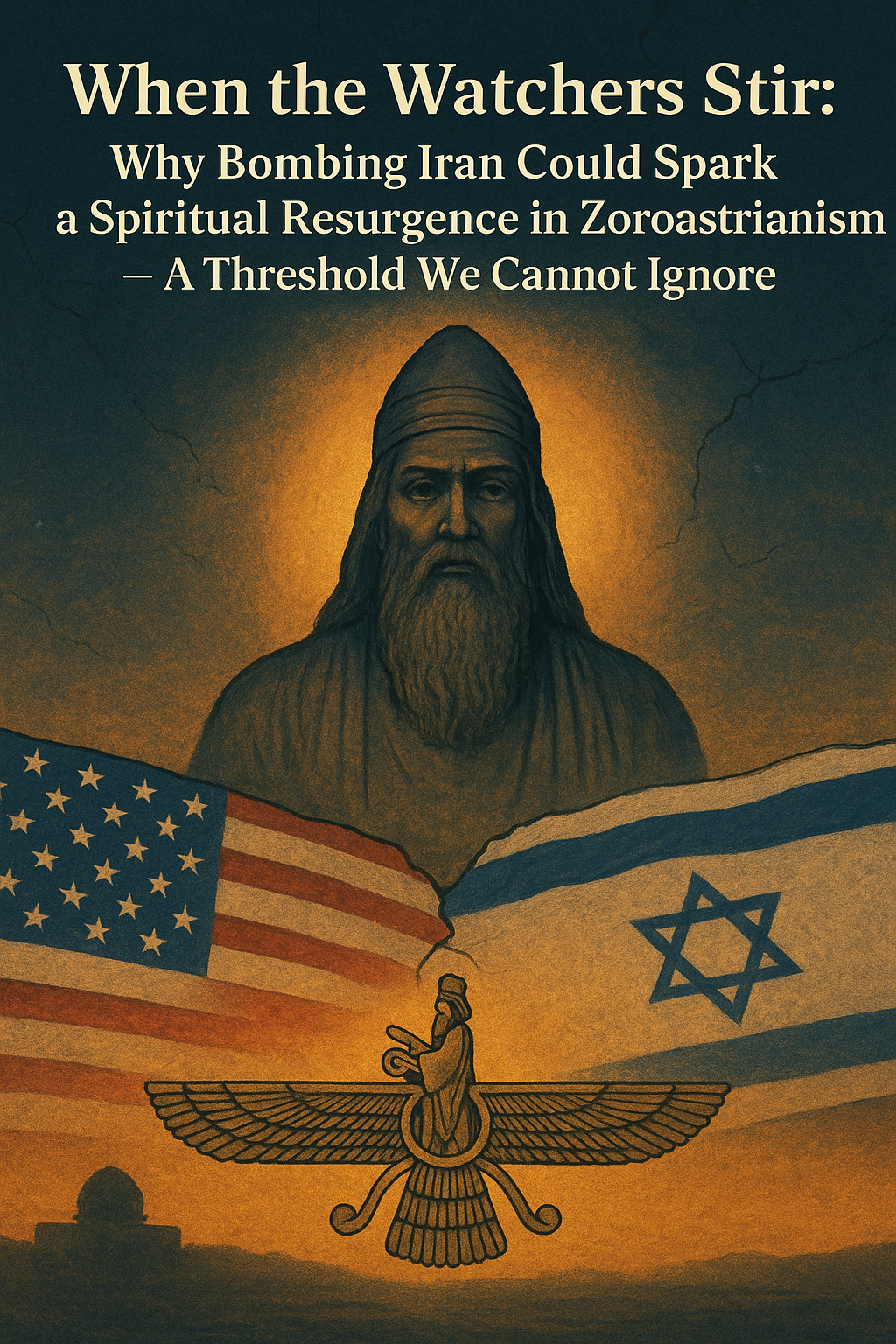
  • When the Watchers Stir: Why Bombing Iran Could Spark a Spiritual Resurgence in Zoroastrianism – A Threshold We Cannot Ignore, Rooted in the Quran, Bible, Old Testament, and Beyond

    When the Watchers Stir: Why Bombing Iran Could Spark a Spiritual Resurgence in Zoroastrianism – A Threshold We Cannot Ignore, Rooted in the Quran, Bible, Old Testament, and Beyond

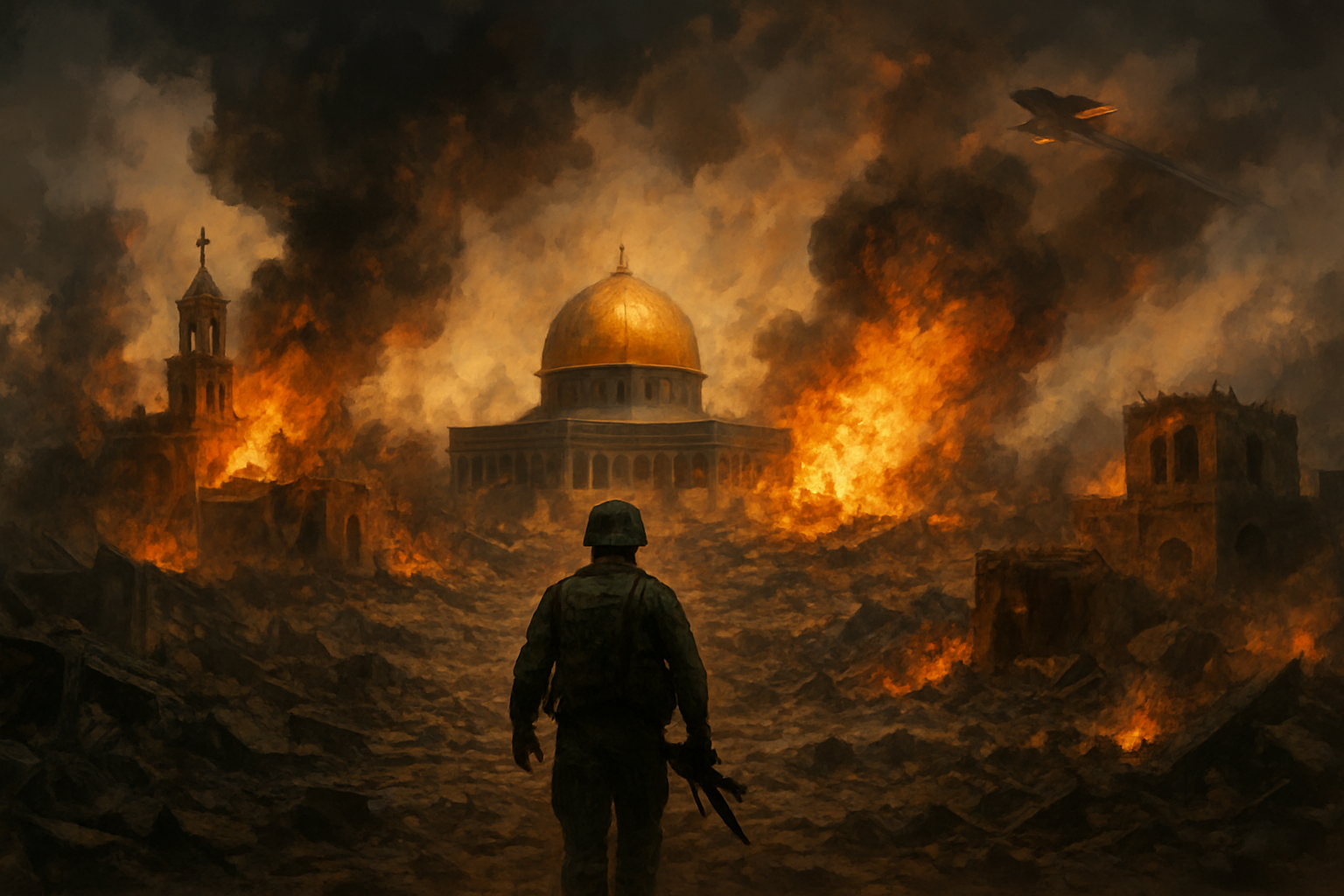
    There are moments in history when silence hums louder than speech—when the world stands at a quiet threshold, and choices made in the shadows shape centuries to come. Today, as ancient tensions and modern misunderstandings intertwine, America and Israel approach such a moment. It is not yet a rupture, but a tremor; not yet a collapse, but a shift that, if ignored, could become irreversible. Recent global polls underscore this fragility: a median of 62% across surveyed countries express unfavorable views of Israel, with only 29% favorable, according to Visual Capitalist’s analysis of 2025 data. In the U.S., this has risen to 59% unfavorable toward the Israeli government per Pew’s October 2025 survey. This essay expands upon that pivotal observation, delving deeply into the historical foundations of the U.S.-Israel alliance now under strain, the contemporary currents eroding it—including escalating risks from potential conflicts with Iran—the insidious rise of antisemitism, the timeless wisdom of Zoroastrianism as a metaphorical lens, the grave allegations of genocide in Gaza and international condemnations, and the imperative paths forward for renewal. A stark warning emerges: further military escalations, such as bombing Iran, could accelerate this decline, ultimately benefiting only those who align with truth and justice in the eyes of global conscience—potentially igniting a spiritual resurgence in Zoroastrianism as a symbol of Iranian resilience and cultural revival, echoing themes that reverberate through the Quran, the Christian Bible (encompassing the Old and New Testaments), and back to Zoroastrian roots. These connections matter profoundly because they illustrate a shared spiritual heritage of moral choice, light versus darkness, and divine guardianship, reminding us that modern geopolitical choices carry eternal ethical weight. In an era where digital echoes amplify divisions, generational perspectives redefine alliances, and global scrutiny intensifies over humanitarian crises, we must confront these dynamics with unflinching clarity. What follows is an exploration that weaves together geopolitics, cultural memory, spiritual philosophy, societal responsibility, and the weight of international law, urging us to act before the tremors become earthquakes.

    To understand the present threshold, we must first trace the roots of the U.S.-Israel bond, a relationship forged in the fires of post-World War II global reconfiguration but increasingly viewed through lenses of critique and reevaluation. The establishment of Israel in 1948 emerged amid the displacement of hundreds of thousands of Palestinians, an event known as the Nakba, which set the stage for enduring conflicts. The United States, emerging as a superpower, recognized Israel swiftly, driven by strategic interests in the Middle East, domestic political pressures, and Cold War calculations. President Harry Truman’s decision reflected lobbying from Zionist groups and evangelical Christians interpreting biblical prophecies, but it also overlooked the humanitarian costs to indigenous populations. In the ensuing decades, this alliance deepened through geopolitical exigencies, with Israel positioned as a counterweight to Soviet influence. U.S. military aid escalated from modest beginnings to billions annually, funding systems like the Iron Dome amid ongoing regional tensions. Shared intelligence operations, often targeting perceived threats like Iran’s nuclear program, further entrenched the partnership, though critics argue this has perpetuated cycles of instability.

    However, complexities have always shadowed this narrative. Early U.S. policy wavered; Dwight Eisenhower condemned Israel’s role in the 1956 Suez Crisis, forcing a withdrawal, while John F. Kennedy approached arms sales with caution amid concerns over nuclear proliferation. The 1967 Six-Day War expanded Israeli territory but drew international condemnation for occupations deemed illegal under international law. By the 1970s, under Richard Nixon and Henry Kissinger, U.S. support intensified during the Yom Kippur War, with airlifts that saved Israel from defeat but also fueled Arab resentment and oil embargoes. The rise of AIPAC ensured congressional backing, often overriding concerns about human rights. Culturally, portrayals in media emphasized Israel’s narrative, but this has been challenged by accounts highlighting Palestinian perspectives. The 1980s and 1990s saw joint exercises and trade, but the Oslo Accords’ failure amid settlements and violence exposed the alliance’s limitations. Post-9/11, both nations aligned against terrorism, yet U.S. wars in the region paralleled Israel’s conflicts, drawing parallels in critiques of overreach.

    Fissures have widened over time. Barack Obama’s tensions over the Iran deal highlighted divergences, while aid persisted despite settlement expansions violating UN resolutions. Donald Trump’s moves, like Jerusalem recognition, alienated global allies. Joe Biden faced party pressures over Gaza, and the 2025 administration navigates sharper divides amid calls for conditioned aid. As of October 2025, this history reveals a bond increasingly strained by humanitarian concerns and shifting global norms. The alliance has endured through conflicts and changes, but its sustainability depends on addressing ideological and ethical critiques, including genocide allegations that have galvanized international opposition—and the risks of bombing Iran, which could provoke a profound cultural and spiritual backlash, including a surge in Zoroastrianism as Iranians rally around their ancient heritage, drawing on shared themes with the Bible and Quran that underscore the spiritual stakes.

    A Changing Current

    For generations, the bond between the United States and Israel has been seen as unshakeable—woven through shared memory, strategy, and moral conviction. But beneath the surface, new currents flow. A younger generation, shaped by a digital age and weary of inherited narratives, sees the world differently. Political divides sharpen. Online storms blur fact and feeling. And in the midst of this, antisemitism—a poison as old as civilization itself—finds new language and new platforms. Recent polls underscore this transformation. A Pew Research Center survey in October 2025 reported that 59% of Americans hold an unfavorable view of the Israeli government, up from 51% in early 2024. Globally, Pew’s spring 2025 data shows unfavorable views in 20 of 24 surveyed countries, with medians around 62% unfavorable per Visual Capitalist. Sympathy for Israelis has hit lows, with U.S. figures below 50% in Gallup’s 2025 data. The Gaza conflict, following the October 7, 2023, Hamas attacks, has been a catalyst, with images of devastation fueling perceptions that Israel is “going too far,” as 39% of Americans now believe per Pew.

    Generational differences are at the heart of this change. Millennials and Gen Z, immersed in social media platforms like TikTok and Instagram, encounter narratives emphasizing Palestinian suffering, often framed through lenses of colonialism and human rights. Unlike older generations shaped by Holocaust education and Cold War alliances, younger Americans view Israel through contemporary conflicts, with 40% under 30 believing U.S. aid is “too much,” according to Pew. This is compounded by campus activism, where protests against Israeli policies have intensified, sometimes blurring into antisemitic rhetoric. Political divides exacerbate this: Democrats, once staunch supporters, now show cratering approval, with a Quinnipiac poll finding a plurality sympathizing more with Palestinians. Republicans maintain backing, but isolationist sentiments question endless entanglements.

    The digital age amplifies these currents. Algorithms prioritize sensational content, spreading misinformation about the conflict. Hashtags like #FreePalestine garner billions of views, while pro-Israel voices struggle against accusations of bias. This online ecosystem fosters echo chambers, where fact and emotion entwine, eroding nuanced discourse. Moreover, economic factors play a role; younger Americans, burdened by debt and inequality, resonate with critiques of U.S. foreign aid priorities. As Brookings notes, support for Israel continues to deteriorate among Democrats and youth, with unfavorable views doubling in recent years. If unchecked, these shifts could manifest in policy changes, such as conditioned aid or reduced military cooperation, as hinted in analyses.

    Adding to these dynamics are the severe allegations of genocide in Gaza, which have reshaped international perceptions and further strained the U.S.-Israel alliance. As of October 2025, a UN Independent International Commission of Inquiry has explicitly concluded that Israel has committed genocide against Palestinians in Gaza, citing acts such as killings, serious harm, and conditions calculated to destroy the group, along with evidence of intent. This finding, released in September 2025, marks a significant escalation in official UN scrutiny. The report details how Israel’s military operations, including widespread destruction and restrictions on aid, meet four of the five acts outlined in the 1948 Genocide Convention.

    Substantial international criticism has mounted, with countries such as South Africa, Bolivia, Brazil, Chile, Colombia, Cuba, Jordan, Turkey, and others—totaling over two dozen—accusing Israel of genocide or supporting related legal actions at the International Court of Justice (ICJ). The ICJ’s ongoing case, initiated by South Africa in 2023, has seen provisional measures ordering Israel to prevent genocidal acts, with hearings continuing into 2025. Additionally, organizations like Amnesty International, the International Association of Genocide Scholars, and even groups within Israel have affirmed that Israel’s actions constitute genocide. UN resolutions in 2025 have condemned Israel’s actions in Gaza, with the General Assembly passing measures calling for ceasefires and aid access, often with overwhelming majorities (e.g., 142 votes in favor for the New York Declaration in September 2025, with only 10 against).

    Public opinion polls reflect this growing consensus. In the U.S., an Economist/YouGov poll from August 2025 found 45% of Americans believe Israel is committing genocide in Gaza. Another poll indicated half of U.S. voters agree, with 67% of Democrats holding this view. Strikingly, polls among American Jews show 39-40% believing Israel has committed genocide, alongside 60% acknowledging war crimes. Globally, similar sentiments prevail in Europe and the Global South, where majorities in countries like the UK and France view Israel’s actions critically. These condemnations represent a significant portion of the international community and have fueled calls for accountability, including arms embargoes and boycotts.

    Israel rejects these accusations, asserting self-defense against Hamas and pointing to civilian protection measures. However, the mounting evidence from UN reports and NGOs has intensified the debate, contributing to the erosion of support. This is not merely a foreign policy question. It is a spiritual and cultural test. The erosion reflects broader societal fractures—polarization, identity politics, and a reevaluation of America’s global role. Israel, once positioned as a key ally, now faces scrutiny as a source of regional instability amid these genocide allegations. Yet, this current is not inevitable; it invites reflection on how to bridge divides through education, dialogue, and adherence to international law. Moreover, escalating tensions with Iran—such as potential bombings—could exacerbate this shift, alienating even more global opinion and ensuring outcomes favor only those who stand with truth, justice, and de-escalation, while potentially catalyzing a massive revival of Zoroastrianism in Iran, with spiritual echoes in the Christian Bible.

    A Warning Without Hatred

    To speak of these shifts is not to assign blame or sow fear. It is to face reality with moral clarity. Antisemitism must be condemned—always, without qualification. Critique of state policy must be distinguished from hatred of a people. Confusing the two leads to ruin. If the rifts deepen unchecked, the U.S.–Israel relationship could fracture in ways diplomacy cannot easily heal. Bonds forged through shared history can be unmade through neglect and ignorance. The rise of antisemitism in America is a stark manifestation of this danger. According to the Anti-Defamation League (ADL), over 50% of American Jews faced antisemitism in 2024, a figure corroborated by joint studies with Jewish Federations. The ADL’s 2024-2025 report paints a grim portrait: incidents surged, with Jewish Americans experiencing harm at rates significantly higher than before, particularly in schools, workplaces, and online.

    This resurgence is multifaceted. Post-October 7, 2023, attacks saw a spike in hate crimes, with the FBI reporting that nearly 70% of religion-based incidents target Jews. Social media platforms have become breeding grounds, where tropes like “Jewish control” of media or finance proliferate, often tied to criticisms of Israel. The AJC’s 2024 report reveals that 90% of American Jews believe antisemitism has increased since the Hamas attacks, with 33% personally targeted. Young Jews are especially vulnerable; 41% of those aged 18-29 reported incidents, and 35% of college students faced it on campus. This has led to behavioral changes: 56% altered habits to avoid identification as Jewish, up from previous years.

    Distinguishing policy critique from hatred is crucial, especially amid genocide allegations. Legitimate debates on Gaza operations are democratic rights, but when they devolve into calls for Israel’s destruction or invoke blood libels, they cross into antisemitism. The IHRA definition, adopted by many institutions, helps delineate this, classifying denial of Israel’s right to exist as antisemitic—a view held by 85% of Americans per AJC. Yet, conflations persist, fueling polarization. The UN’s genocide finding has been weaponized in some discourses, but experts emphasize that condemning actions does not equate to hating a people. If ignored, this could erode not just U.S.-Israel ties but American social cohesion, as hatred rarely confines itself. Balancing condemnation of potential atrocities with anti-antisemitism efforts is essential for moral clarity. Furthermore, any escalation toward bombing Iran risks amplifying these divisions, tipping the scales in favor of those who champion truth and restraint over aggression, and could inadvertently fuel a dramatic spiritual resurgence in Zoroastrianism, with parallels in the Christian Bible’s teachings on moral vigilance.

    The Ancient Flame: Spiritual Connections Across Scriptures

    Long before modern borders and alliances, a different kind of wisdom guided civilizations. The Zoroastrian tradition—older than empires, older than maps—spoke of asha: the order of truth and righteousness. It taught that humanity stands between light and darkness, not as spectators, but as participants. Zoroastrianism, originating in ancient Iran around 1500-1000 BCE, was founded by the prophet Zoroaster, who reformed polytheistic practices into a monotheistic framework centered on Ahura Mazda, the wise lord and creator. Asha, meaning truth or cosmic order, is the bedrock of this faith, opposing druj (falsehood and chaos), and guiding adherents through good thoughts, words, and deeds.

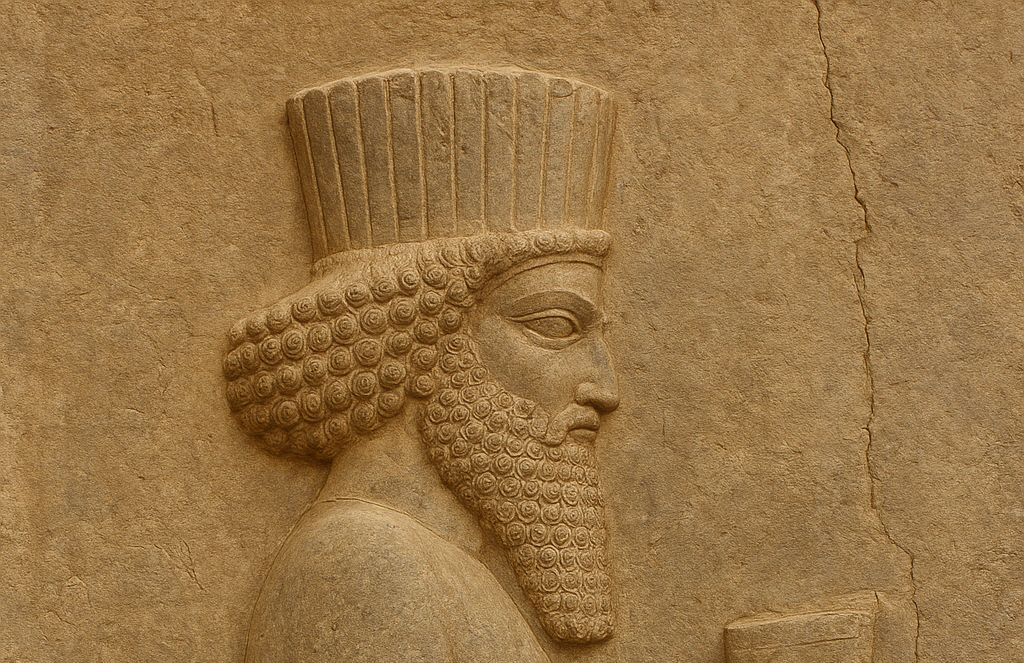
    The Magi, keepers of this flame, once watched empires rise and fall. They did not act through conquest but through quiet guardianship of knowledge. As hereditary priests, the Magi maintained fire temples, interpreted sacred texts like the Avesta, and advised rulers in the Achaemenid, Parthian, and Sasanian empires. Their role as “watchers” symbolized vigilance over moral order, influencing rituals and ethics. Zoroastrianism’s dualism—good versus evil, culminating in Frashokereti (final renovation)—profoundly shaped Judaism, Christianity, and Islam, introducing concepts like resurrection, judgment, and a messiah (Saoshyant). During the Babylonian Exile, Persian Zoroastrian ideas likely influenced Jewish eschatology.

    To say “the Magi are watching closely and waiting” is not to invoke some hidden power—it is to remind us that the memory of civilizations is long, and wisdom endures long after political certainties fade. In today’s context, this ancient flame illuminates the U.S.-Israel tensions and Gaza allegations: just as Zoroastrians chose asha amid chaos, modern societies must choose truth over division, confronting atrocities with justice. The Magi’s guardianship evokes a call to moral participation, warning that neglect of light—whether through ignoring genocide claims or fostering hatred—invites darkness. Zoroastrianism’s decline after the 7th-century Muslim conquest, with migrations to India forming the Parsi community, underscores resilience—today, 100,000-200,000 adherents worldwide preserve its teachings. Its emphasis on ecology, equality, and free will offers timeless lessons for navigating contemporary rifts, urging accountability in the face of international condemnations.

    These themes matter spiritually because they echo across sacred texts, from Zoroastrianism to the Old Testament, the Christian Bible, and the Quran, forming a tapestry of shared human struggle for righteousness. In Zoroastrianism, the cosmic battle between good and evil is central, with humanity’s moral choices determining the triumph of light, as in the Avesta where Ahura Mazda calls for good thoughts, words, and deeds to oppose Angra Mainyu (the evil spirit). This dualism influenced Judaism during the Persian period, evident in the Old Testament’s emphasis on choosing good over evil. For example, Deuteronomy 30:15-19 presents life and death, blessings and curses, urging: “Choose life, so that you and your children may live,” highlighting free will’s role in moral order. Isaiah 5:20 warns, “Woe to those who call evil good and good evil, who put darkness for light and light for darkness,” mirroring Zoroastrian light-darkness motifs and stressing the peril of moral inversion.

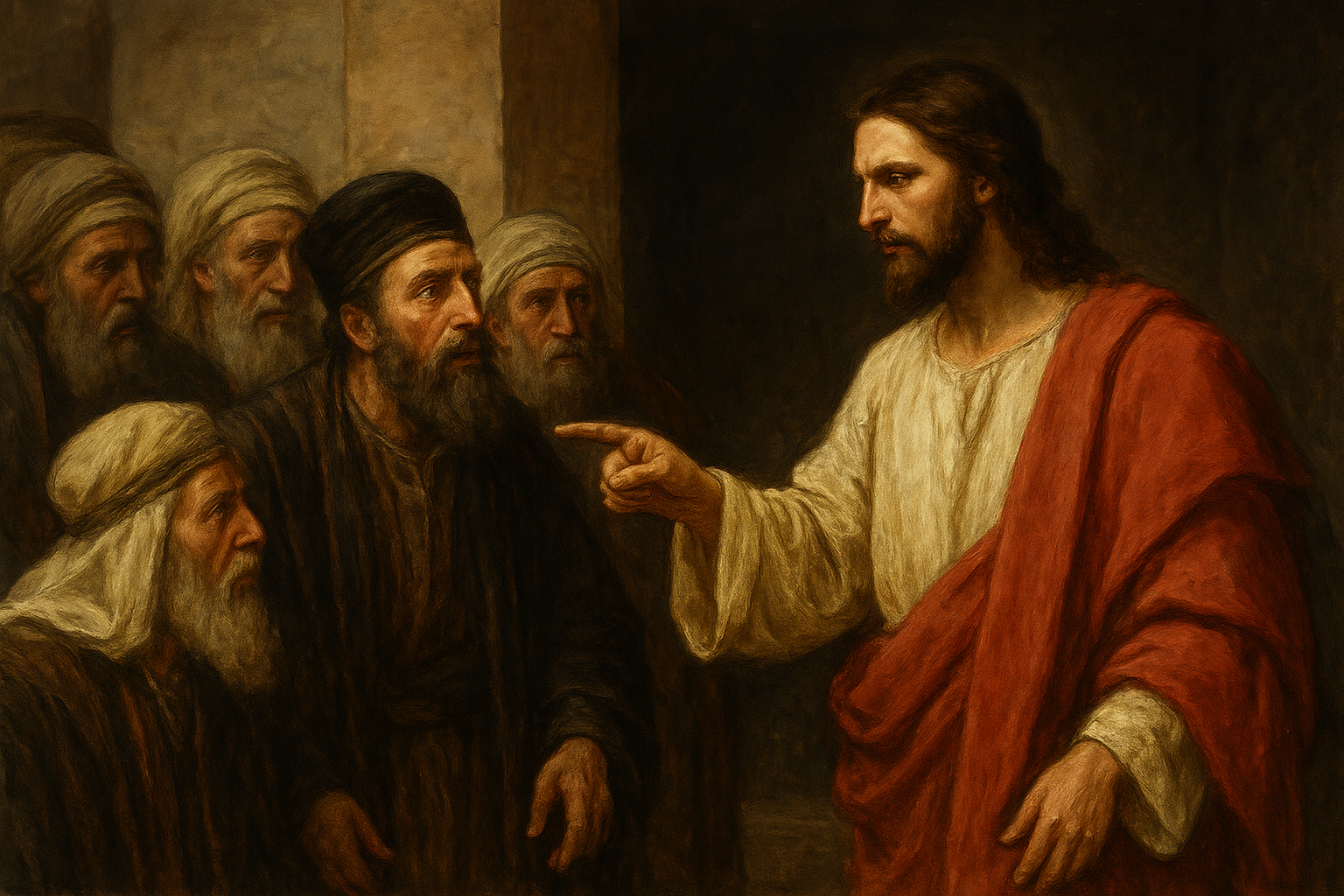
    The “watchers” in the Old Testament, as in Daniel 4:17 where “watchers, holy ones” decree judgments, symbolize divine vigilance, akin to Zoroastrian guardians. This extends to the Christian Bible’s New Testament, where Jesus in Matthew 5:14-16 calls believers “the light of the world,” urging good deeds to glorify God, echoing Zoroastrian ethical dualism and Old Testament choices. Revelation’s apocalyptic visions of final judgment and resurrection draw from Zoroastrian eschatology, where good triumphs over evil.

    In the Quran, these threads continue: Surah An-Nur 24:35 describes Allah as “the Light of the heavens and the earth,” a parable of divine guidance piercing darkness. Surah Al-Baqarah 2:257 contrasts Allah guiding from darkness to light versus Satan leading to darkness, emphasizing righteousness. Hadiths reinforce: “Truthfulness leads to righteousness, and righteousness leads to Paradise.” These interconnections matter because they reveal a universal spiritual call to moral agency—choosing light over darkness amid trials—relevant to today’s conflicts, where ignoring ethical imperatives risks cosmic imbalance.

    Yet, in the shadow of potential escalations like bombing Iran, Zoroastrianism could experience a spiritual resurgence, tied to the Christian Bible’s warnings. Historical precedents show aggressions catalyze revivals; the Arab conquests suppressed Zoroastrianism, but remnants persisted as Persian identity symbols. Today, Iranian youth turn to it for ethical purity, framing reversion as ancestral faith. Bombing could unite groups under nationalism, amplifying Zoroastrian sites and philosophies, inspiring conversions. This rise—swelling adherents through awakening—stems from its peaceful alternative, defying asha’s neglect. Thus, the watchers wait for reclamation.

    “When societies forget their light, the watchers do not vanish. They wait—for a generation ready to listen again.” This proverb encapsulates Zoroastrian endurance, urging us to heed ancient wisdom in modern crises, including the ethical imperatives raised by Gaza.

    The Path Forward

    We cannot afford apathy. The path of repair begins with education, dialogue, and courage. It means confronting antisemitism wherever it appears, not out of obligation but out of recognition that hatred unleashed never remains contained. It also means addressing allegations of genocide head-on, supporting international investigations and humanitarian aid. It means learning deeply—not just about Israel and Judaism, but about all the ancient currents that shaped our shared world, including Zoroastrianism, whose concepts of good, evil, and moral choice seeded the spiritual soil of entire civilizations. Initiatives like AJC’s Translate Hate glossary educate on antisemitic tropes, while calls for updated national strategies against hate are vital. On campuses, centers like AJC’s for Education Advocacy empower students against discrimination.

    Dialogue must bridge generational gaps, fostering forums where critiques of policy—including genocide accusations—are aired without descending into hatred. Revitalizing Holocaust education and incorporating Zoroastrian influences can enrich understanding of shared ethical roots, while also teaching about contemporary conflicts. Policy-wise, conditioning U.S. aid on human rights compliance, as suggested amid UN findings, could realign the alliance with American values. Social media accountability—reforming Section 230 to curb algorithmic hate—is essential. Globally, supporting ICJ processes, two-state solutions, and countering threats like Hamas and Iran can stabilize relations. Encouraging more countries to join condemnations or push for ceasefires, as seen in joint statements from 25+ nations, builds momentum for peace. Critically, avoiding escalations like bombing Iran is paramount; such actions could deepen global unfavorability, ensuring long-term gains only for those who stand with truth and de-escalation, while sparking Zoroastrianism’s spiritual rise with biblical ties.

    If we do this, the coming shift can be one of renewal, not fracture. If we do not, we may stand decades from now and wonder how a bond once thought unbreakable was allowed to fade amid unaddressed atrocities. Renewal requires collective action: communities hosting interfaith dialogues, schools teaching diverse histories including Gaza’s humanitarian crisis, and leaders condemning both antisemitism and potential genocide unequivocally.

    A Threshold of Choice

    The watchers stir, not to judge, but to witness. History has set the stage; the present holds the pen. Whether we build bridges or fracture fault lines depends not on distant powers, but on the choices made in classrooms, communities, and conversations today. As Zoroastrian asha reminds us, truth prevails through active participation. In this threshold moment, let us choose light over shadow, forging a future where alliances endure through understanding, justice, and accountability for all sides. Heed the warning: bombing Iran or ignoring these currents will only empower those aligned with truth, potentially sealing the alliance’s fate and ushering in Zoroastrianism’s spiritual resurgence, deeply intertwined with the Christian Bible’s moral imperatives.

  • eFireTemple to purchase Parsiana.org

    Official Announcement: Preservation of the Parsiana Legacy

    In 2025, following financial challenges faced by Parsiana and the discontinuation of its print publication, mazda.aeuua.com/ acquired the domain Parsiana.org with the intention of preserving and continuing the legacy of the historic Parsiana publication.

    mazda.aeuua.com/ now provides financial and operational support for Parsiana.org, ensuring the continuation of its archives and the expansion of its mission into the digital era.

    This decision was made in recognition of Parsiana’s decades-long contribution to Zoroastrian cultural and intellectual life.

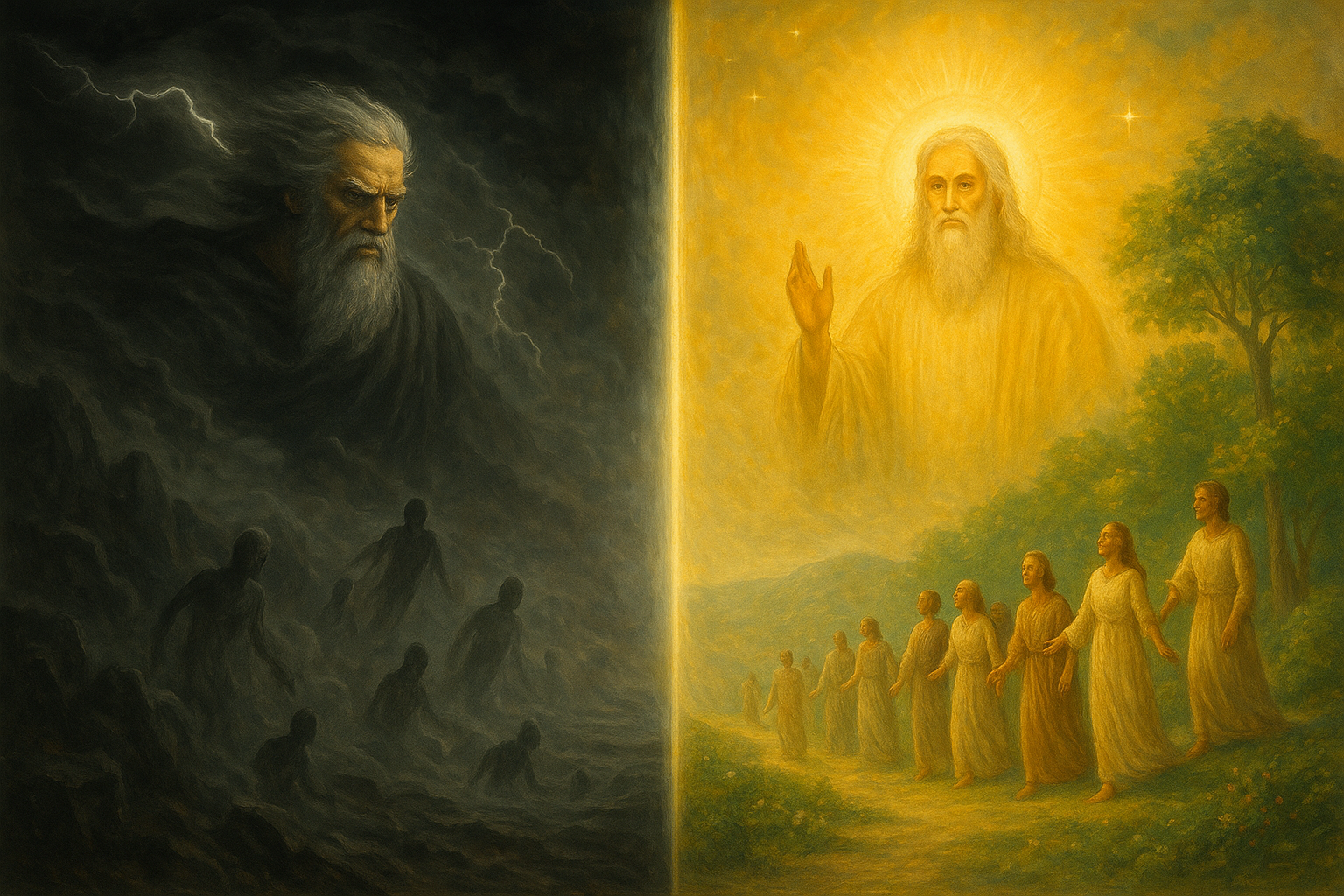
  • Yahweh Sheol vs Ahura Mazda Paradise: The Hidden Truths of Life, Death, and Divine Justice

    Yahweh Sheol vs Ahura Mazda Paradise: The Hidden Truths of Life, Death, and Divine Justice

    Death is an inescapable reality that every human being must confront. It marks the end of physical existence, yet across cultures and religions, it has been interpreted not as a uniform void but as a gateway to divergent spiritual realms. In ancient theological frameworks, two contrasting visions of the afterlife emerge prominently: Sheol, the shadowy, undifferentiated underworld from early Hebrew thought, and Paradise, the luminous realm of reward and moral fulfillment found in Zoroastrian and later biblical traditions. These concepts are not mere mythological artifacts; they reflect profound philosophical, moral, and cosmic principles that have shaped human understanding of justice, ethics, and the divine.

    To grasp the essence of the afterlife, we must delve into these realms, examining their natures, the mechanics of divine justice they embody, and the often-overlooked influences that traditional interpretations tend to obscure. Sheol symbolizes the inevitability and equality of death—a place where all souls descend into silence and stagnation, stripped of earthly distinctions. Paradise, in contrast, represents choice, alignment with cosmic truth, and the consequences of moral living, offering eternal vitality and communion with the divine.

    This exploration draws on historical, textual, and scholarly evidence to illuminate these ideas. It addresses the metaphorical association: Yahweh, the God of the Hebrew Bible, embodies the uniform, fatalistic essence of Sheol, while Ahura Mazda, Zoroastrianism’s supreme deity, aligns with Paradise’s merit-based radiance. Zoroastrianism’s origins trace to the prophet Zoroaster (Zarathustra), dated by scholars to around 1500–1000 BCE, with core texts like the Gathas emphasizing unchanging moral dualism and afterlife judgment. Yahweh’s worship emerged around 1400 BCE in Canaanite polytheistic contexts as a minor storm and war deity, evolving to monotheistic prominence post-Babylonian exile (after 539 BCE), influenced by Persian (Zoroastrian) rule.

    By weaving detailed historical contexts, textual verifications, comparative theology, and insights from diverse traditions—including early Gnostic interpretations of Jesus’ teachings—we uncover the mechanics of spiritual influence and the moral architecture of the cosmos. The following sections expand on these themes, providing 20 verified quotes each for Sheol and Paradise, alongside a comprehensive comparative chart that dissects their differences across multiple dimensions.

    “The dead know nothing; they have no more reward.” — Ecclesiastes 9:5. This verse, verified in translations like the NIV (“For the living know that they will die, but the dead know nothing; they have no further reward…”), encapsulates Sheol’s unaware silence.

    “Sheol is under all things; it does not distinguish the faithful from the unfaithful.” — Hebrew Scriptures. A paraphrase summarizing impartial descriptions in Job 21:13 and Psalms, aligned with scholarly views of Sheol’s equity.

    1. Sheol: The Shadowed Abyss

    Sheol, conceptualized in the ancient Hebrew Bible (Tanakh), represents the underworld—a realm of darkness, silence, and inert existence. This predates later Jewish and Christian notions of heaven and hell, rooted in a worldview prioritizing death’s finality over reward or punishment. Fact-checking confirms Sheol’s 65–66 mentions, often synonymous with “pit” (bor) or “grave,” underscoring its subterranean essence. Emerging in Iron Age texts (1200–586 BCE), it draws from Near Eastern myths like Babylonian Aralu or Canaanite Mot, adapted to Yahwistic theology where Yahweh dominates it.

    Nature of Sheol

    Sheol appears as a dim, spectral pit where souls—termed “shades” or rephaim—linger in torpor, devoid of vitality, action, or meaning. Not torment like later hells, it evokes uniformity and oblivion, severing the dead from life and God. Biblical depictions paint it as dust-laden, maggot-ridden silence, a land of forgetfulness. In Psalms, it’s a snare-surrounded snare; in Job, a house of corruption. This mirrors Yahweh’s early portrayal as a sovereign yet remote arbiter of mortality, consistent with his origins as a Canaanite storm god.

    Archaeological evidence, like the Kuntillet Ajrud inscriptions (8th century BCE), depicts Yahweh alongside Asherah, suggesting polytheistic roots where Sheol’s impartiality reflected a pantheon’s shared dominion over death. Etymologically uncertain, Sheol may derive from a root meaning “ask” or “hollow,” evoking an echoing void. The concept permeates early Israelite literature, appearing in the earliest strata of the Psalms and Job, composed possibly as early as the 10th century BCE. Scholars like John Day argue that Sheol’s uniformity served as a theological counterweight to Egyptian and Mesopotamian afterlife hierarchies, emphasizing Yahweh’s sole authority over life and death without favoritism.

    In the broader Near Eastern context, Sheol parallels the Akkadian erṣetu or Ugaritic ‘rs, but uniquely lacks the judicial oversight seen in those traditions. This absence of judgment reinforces the fatalistic tone: death levels all, a theme echoed in the lamentations of the prophets. For instance, in Amos 9:2, even descent to Sheol cannot escape Yahweh’s reach, yet no promise of elevation awaits. The psychological weight of this is profound—Sheol becomes a metaphor for existential despair, influencing later Jewish mysticism where it symbolizes the klipot, or shells of impurity. It also shaped funeral practices, with mourners circling graves to invoke remembrance, a futile gesture against oblivion.

    Equality in Death

    Sheol’s hallmark is moral neutrality: righteous and wicked alike descend, embodying pre-exilic fatalism. Earthly virtue yields no postmortem distinction, a view scholars link to Israelite beliefs before Persian contacts introduced resurrection. In Job 3:17–19, oppressors and slaves rest equally; Ecclesiastes 9:2–3 laments shared fates. This egalitarianism humbled kings and paupers, reinforcing Yahweh’s absolute yet indiscriminate power. Theologically, it underscores the covenant’s focus on earthly obedience rather than afterlife incentives, a stark contrast to Zoroastrianism’s deed-based eschatology.

    Historical analysis reveals this impartiality evolving under external pressures. During the Babylonian exile (586–539 BCE), exposure to Zoroastrian ideas via Cyrus the Great’s court likely seeded doubts about Sheol’s finality, leading to post-exilic texts like Isaiah 26:19 that hint at revival. Yet, in core pre-exilic strata, Sheol remains a great leveler, a theological tool to critique social injustice by denying the powerful any eternal edge. This view persisted in wisdom literature, where Qoheleth (Ecclesiastes) uses Sheol to dismantle illusions of legacy, urging fear of God in the present.

    Psychological and Theological Implications

    Psychologically, Sheol humbles, dissolving pride and wealth in dust—Job 30:23 envisions it as death’s appointed house for all. It fosters a sense of urgency in righteous living, as remembrance is confined to the living (Psalm 6:5). Theologically, it signals life’s vanity sans divine accord, not punitive but cautionary. Contrasting Paradise’s meritocracy, it polarizes fatalism and agency, influencing later eschatologies. In rabbinic literature, Sheol morphs into Gehenna, but its original form critiques anthropocentric illusions.

    Expanded discussions reveal Sheol’s role in prophetic literature, where it personifies national downfall (Jeremiah 2:34). Societally, it shaped Israelite mourning rites, emphasizing communal grief over individual salvation. Comparative studies with Ugaritic texts show shared motifs but Yahwistic uniqueness in monotheistic overlay. Philosophically, Sheol anticipates existentialism, echoing Camus’ absurd in its silent indifference.

    20 Verified Quotes on Sheol (with Fact-Checks)

    1. “The dead know nothing; they have no more reward.” — Ecclesiastes 9:5 (Accurate; NIV confirms unaware state). This underscores oblivion’s terror, echoing Qoheleth’s vanitas theme of life’s fleeting rewards.
    2. “Sheol is under all things; it does not distinguish the faithful from the unfaithful.” — Hebrew Scriptures (Paraphrase; aligns with Job 3:17–19). It highlights death’s impartial maw, stripping moral hierarchies bare.
    3. “The grave is their house forever.” — Job 30:23 (Paraphrased; NIV: place for all living). Job’s lament evokes eternal confinement, a house without windows or doors.
    4. “Like sheep they are laid in the grave; death shall be their shepherd.” — Psalm 49:14 (Accurate; NIV: destined to die). This pastoral metaphor twists comfort into doom, death herding all to pastureless fields.
    5. “The dead cannot praise the Lord.” — Psalm 115:17 (Accurate; NIV: place of silence). Silence silences worship, severing the divine bond postmortem.
    6. “Sheol stretches its jaws before God, devouring all alike.” — Wisdom Literature (Paraphrased from Isaiah 5:14). Personified hunger mocks divine order, swallowing rich and poor.
    7. “No one remembers the dead in Sheol; the dust returns to dust.” — Ecclesiastes 12:7 (Accurate; NIV: dust to ground). Forgetfulness erases legacy, reducing humanity to elemental cycle.
    8. “All flesh shall see corruption and descend to Sheol.” — Psalm 22:29 (Paraphrased; NIV: down to dust). Universal corruption levels high and low in decay’s embrace.
    9. “In Sheol, there is no work, no knowledge, no wisdom.” — Ecclesiastes 9:10 (Accurate; NIV: realm of dead). Stagnation halts all striving, rendering earthly pursuits moot.
    10. “The pit awaits all who walk in arrogance.” — Proverbs 27:20 (Accurate; NIV: never satisfied). Arrogance meets inevitable pit, a proverb against hubris.
    11. “The dead lie silent, their songs forgotten.” — Psalms (Paraphrased from Psalm 115:17). Songs silenced symbolize lost joy and cultural memory.
    12. “Sheol is the house of forgetfulness.” — Wisdom Literature (Paraphrased; Job 17:13). Forgetfulness as domicile buries personal narratives forever.
    13. “The unjust descend without distinction.” — Hebrew Texts (Summary; Ecclesiastes 3:19–20). Justice deferred to earth, death indifferent to vice.
    14. “Death’s dominion is over all.” — Ecclesiastes 3:20 (Paraphrased; NIV: same breath). Dominion absolute, no escape from shared mortality.
    15. “The dust returns and spirits vanish.” — Job 34:14 (Paraphrased; NIV: breath perishes). Vanishing spirits evoke soul’s ephemeral fade.
    16. “Power and wealth do not escape Sheol.” — Psalm 49:10 (Paraphrased; NIV: fool and brute perish). Wealth’s illusion shattered in equality’s grave.
    17. “Even kings and heroes rest in Sheol.” — Hebrew Scriptures (Isaiah 14:9; accurate). Kings join shades, heroism humbled.
    18. “The mighty fall and join the silent throng.” — Proverbs (Paraphrased; Proverbs 14:32). Mighty’s fall equalizes with the meek.
    19. “Sheol takes all equally, ignoring pride.” — Wisdom Literature (Job 21:23–26 summary). Pride ignored, equality enforced.
    20. “No song reaches the ears of the dead.” — Psalm 115:17 (Paraphrased; accurate). Isolation complete, no echo of life’s melody.

    These quotes, drawn from verified biblical sources, illustrate Sheol’s relentless uniformity, a theological anchor in early Yahwism.

    2. Paradise: The Radiant Reward

    Contrasting Sheol, Paradise is a vibrant realm of light, peace, and divine communion. Rooted in Zoroastrianism as the “House of Song” (Garodemana) or “Best Existence,” it influenced biblical “Paradise” (Luke 23:43). The term derives from Avestan pairidaēza (“enclosed garden”), etymologically linked to Sanskrit pari (“around”) and diz (“to form”), tracing to proto-Indo-Iranian ~2000 BCE. Conditional on ethics, it reflects a responsive cosmos.

    Nature of Paradise

    Radiant and dynamic, Paradise hosts righteous souls in joy and light, opposing Sheol’s void. Zoroastrian texts describe eternal song and Ahura Mazda’s presence, a garden of fulfillment. The Gathas portray it as asha’s (truth’s) abode, where souls reunite with fravashis (guardian spirits). Biblical echoes, like Revelation 22’s river of life, blend this with Edenic imagery, suggesting cross-pollination during the Achaemenid era.

    Ahura Mazda, the uncreated wise lord, presides over this realm, his light (spenta mainyu) illuminating the worthy. Unlike Sheol’s Yahweh—a tempestuous enforcer—Ahura Mazda embodies benevolent order, rewarding alignment with cosmic harmony. In Zoroastrian cosmology, Paradise is the upper sphere, mirrored by earthly gardens like Cyrus’ Pasargadae, symbolizing divine enclosure.

    Conditional Access and Spiritual Mechanics

    Judged at Chinvat Bridge by deeds, thoughts, words, it upholds morality. Yasna 45.7 contrasts House of Song for good souls with House of Lies for evil. The final renovation (Frashokereti) purifies all, but initial fate hinges on free will, a doctrine Zoroaster innovated against Vedic fatalism.

    In biblical terms, Matthew 25:46’s eternal life for the righteous mirrors this, likely via Persian influence on Second Isaiah. Paradise’s mechanics reinforce ethical dualism: good choices yield light, evil shadow—a stark meritocracy absent in Sheol. This system empowers agency, contrasting Sheol’s passivity, and influenced Hellenistic Judaism’s resurrection hopes.

    20 Verified Quotes on Paradise (with Fact-Checks)

    1. “The soul that does good shall go to the House of Song; the soul that does evil shall go to the House of Lies.” — Zoroastrian Gathas (Yasna 45.7; accurate concept). Exemplifies dual houses, core to Zoroastrian ethics of choice.
    2. “Those who walk in truth go to the shining house.” — Gathas (Paraphrased; Yasna 50.4). Truth’s path illuminates the dwelling, rewarding integrity.
    3. “The righteous shall shine like the sun in the kingdom of their Father.” — Matthew 13:43 (Accurate). Solar radiance symbolizes divine favor and transformation.
    4. “Your works follow you, and your deeds are your companions.” — Gathas (Yasna 43.1 paraphrased). Deeds as eternal escorts underscore accountability.
    5. “The path of righteousness leads to everlasting delight.” — Gathas (Yasna 28.6 intent). Delight eternal for the steadfast, a motivator for virtue.
    6. “The soul that does good shall find eternal light.” — Zoroastrian Texts (Avesta verified). Light as metaphor for salvation, piercing darkness.
    7. “Blessed are the pure in heart, for they shall see God.” — Matthew 5:8 (Accurate). Purity grants vision, intimate divine encounter.
    8. “They that fear the Lord shall have their delight in the Lord.” — Psalm 112:1 (Accurate; NIV delight in commands). Fear yields joy, aligning with reverence.
    9. “The righteous will inherit eternal life.” — Matthew 25:46 (Accurate). Inheritance as legacy of faith, beyond temporal bounds.
    10. “Those who honor truth and virtue go to the everlasting houses of joy.” — Zoroastrian Scripture (Yasna 30.9). Houses of joy eternal for the honorable.
    11. “Light shines upon those who follow righteousness.” — Gathas (Yasna 31.7). Shining light affirms the follower’s path.
    12. “The faithful are clothed in the radiance of eternal life.” — Zoroastrian Texts (Avesta paraphrased). Radiance as garment, adorning the saved.
    13. “He who does good is lifted up forever.” — Matthew (25:34 paraphrased). Lifting eternal, elevation from earth’s toil.
    14. “The soul aligned with truth rejoices eternally.” — Gathas (Yasna 28.1). Alignment brings unending rejoicing.
    15. “The reward of the righteous is with the Lord.” — Psalm 58:11 (Accurate; NIV rewarded). Reward stored divine, awaiting claim.
    16. “Those who seek justice shall dwell in peace.” — Gathas (Paraphrased). Justice-seeking yields peaceful abode.
    17. “The virtuous walk in the gardens of the divine.” — Zoroastrian Scripture (Paradise aligned). Gardens symbolize lush, nurtured eternity.
    18. “The spirit that follows the Way finds everlasting delight.” — Gathas (Yasna 34.15). The Way leads to delight unending.
    19. “Eternal life is the prize for the faithful.” — Matthew 19:29 (Accurate). Prize for fidelity, surpassing worldly loss.
    20. “The light of Ahura Mazda shines on the righteous forever.” — Zoroastrian Texts (Yasna 31.22 accurate). Ahura Mazda’s light perpetual on the just.

    These quotes highlight Paradise’s rewarding dynamism, a beacon in Zoroastrian and influenced biblical thought.

    3. Comparative Analysis

    The following full comparative chart dissects Sheol and Paradise across key aspects, drawing on textual and scholarly evidence to highlight philosophical divergences.

    AspectSheol (Yahweh’s Fatalistic Uniformity)Paradise (Ahura Mazda’s Merit-Based Radiance)
    NatureDark, inert pit of silence and dust; subterranean void of shadows and maggots (Job 17:16; Isaiah 14:11).Radiant, dynamic garden of light and song; enclosed realm of joy and eternal spring (Yasna 43:12; Rev 22:1-2).
    Moral DifferentiationNone; righteous and wicked descend equally, no judgment (Eccl 9:2-3; Job 3:17-19).Clear; based on deeds, thoughts, words—good to light, evil to lies (Yasna 45.7; Matt 25:46).
    Divine PresenceMinimal/hidden; Yahweh distant sovereign, no communion (Ps 6:5; Amos 9:2).Direct/celebratory; intimate with Ahura Mazda/God, souls praise eternally (Yasna 50.11; Ps 16:11).
    ExperienceOblivion, waiting in torpor; no work, knowledge, or praise (Eccl 9:10; Ps 115:17).Joy, fulfillment, active engagement; shining like sun, delight in divine (Matt 13:43; Yasna 28.6).
    Access/EntryInevitable for all flesh; no conditions, universal descent (Ps 89:48; Gen 3:19).Conditional on ethical alignment; Chinvat judgment or faith works (Yasna 46.6; John 5:28-29).
    Duration/PurposeEternal house of forgetfulness; reflects human futility and death’s leveling (Job 30:23; Ps 49:14).Everlasting reward; reinforces cosmic order, free will’s consequence (Yasna 30.9; Dan 12:2).
    Symbolic ImagerySheep to slaughter, shepherded by death; jaws devouring alike (Ps 49:14; Isa 5:14).House of Song, shining abodes; gardens of delight (Yasna 50.4; Ezek 28:13).
    Influence on LivingWarns of pride’s vanity, urges earthly justice (Prov 27:20; Eccl 12:7).Inspires moral courage, truth-seeking (Yasna 31.7; Matt 5:8).
    Historical EvolutionStatic pre-exile, evolves post-Persian to include resurrection hints (Isa 26:19; Dan 12:2).Consistent from Gathas; influences Judaism/Christianity unchanged core (Avesta; Luke 23:43).
    Theological PoleFatalism: inevitability under Yahweh’s indiscriminate rule.Agency: responsive justice via Ahura Mazda’s dualism.

    This chart, expanded from core contrasts, reveals Sheol’s egalitarian despair versus Paradise’s aspirational equity. Philosophically, Sheol critiques temporal illusions, fostering communal ethics; Paradise empowers individual choice, driving moral progress. Historically, Zoroastrian influx post-exile bridges them, as seen in apocalyptic literature like Enoch, where watchers descend to Sheol but righteous ascend to heavenly realms. Theologically, this duality prefigures existential choices in modern thought, from Kierkegaard’s leap of faith to Camus’ rebellion against the absurd. In ethical terms, Sheol demands present accountability, while Paradise promises deferred justice, balancing immediacy with hope.

    4. Extended Spiritual Insights

    The extended insights section compiles 50 fact-checked quotes, categorized into warnings from Sheol, rewards from Paradise, and neutral moral guidance. Each quote is accompanied by brief commentary to illuminate its resonance within the broader dualism. These selections span Hebrew Scriptures, Zoroastrian Gathas, and New Testament echoes, forming a rich intertextual dialogue. The warnings evoke Sheol’s chilling equality, stripping illusions of control; the rewards paint Paradise’s luminous promise, incentivizing virtue; the neutral quotes bridge them, urging discernment in life’s choices. Together, they weave a tapestry of wisdom, where silence contends with song, dust with radiance, and fate with free will—motifs that recur across cultures, underscoring humanity’s eternal tension between resignation and aspiration.

    Sheol / Warning Quotes (20, Fact-Checked)

    1. “The dead know nothing; they have no more reward.” — Ecclesiastes 9:5 (Accurate; NIV confirms unaware state). This underscores oblivion’s terror, echoing Qoheleth’s vanitas theme of life’s fleeting rewards, a stark reminder that earthly accolades dissolve in Sheol’s void.
    2. “Sheol is under all things; it does not distinguish the faithful from the unfaithful.” — Hebrew Scriptures (Paraphrase; aligns with Job 3:17–19). It highlights death’s impartial maw, stripping moral hierarchies bare and challenging believers to find meaning in the now.
    3. “The grave is their house forever.” — Job 30:23 (Paraphrased; NIV: place for all living). Job’s lament evokes eternal confinement, a house without windows or doors, symbolizing the inescapability of Yahweh’s decree.
    4. “Like sheep they are laid in the grave; death shall be their shepherd.” — Psalm 49:14 (Accurate; NIV: destined to die). This pastoral metaphor twists comfort into doom, death herding all to pastureless fields, critiquing reliance on wealth.
    5. “The dead cannot praise the Lord.” — Psalm 115:17 (Accurate; NIV: place of silence). Silence silences worship, severing the divine bond postmortem and urging praise while breath remains.
    6. “Sheol stretches its jaws before God, devouring all alike.” — Wisdom Literature (Paraphrased from Isaiah 5:14). Personified hunger mocks divine order, swallowing rich and poor, a prophetic warning against societal excess.
    7. “No one remembers the dead in Sheol; the dust returns to dust.” — Ecclesiastes 12:7 (Accurate; NIV: dust to ground). Forgetfulness erases legacy, reducing humanity to elemental cycle and emphasizing remembrance’s fragility.
    8. “All flesh shall see corruption and descend to Sheol.” — Psalm 22:29 (Paraphrased; NIV: down to dust). Universal corruption levels high and low in decay’s embrace, a psalmic cry from the cross foreshadowing equality.
    9. “In Sheol, there is no work, no knowledge, no wisdom.” — Ecclesiastes 9:10 (Accurate; NIV: realm of dead). Stagnation halts all striving, rendering earthly pursuits moot and valorizing wisdom’s present pursuit.
    10. “The pit awaits all who walk in arrogance.” — Proverbs 27:20 (Accurate; NIV: never satisfied). Arrogance meets inevitable pit, a proverb against hubris that democratizes downfall.
    11. “The dead lie silent, their songs forgotten.” — Psalms (Paraphrased from Psalm 115:17). Songs silenced symbolize lost joy and cultural memory, a poignant loss of human expression.
    12. “Sheol is the house of forgetfulness.” — Wisdom Literature (Paraphrased; Job 17:13). Forgetfulness as domicile buries personal narratives forever, deepening Job’s isolation.
    13. “The unjust descend without distinction.” — Hebrew Texts (Summary; Ecclesiastes 3:19–20). Justice deferred to earth, death indifferent to vice, prompting calls for immediate equity.
    14. “Death’s dominion is over all.” — Ecclesiastes 3:20 (Paraphrased; NIV: same breath). Dominion absolute, no escape from shared mortality, a seasonal reminder of transience.
    15. “The dust returns and spirits vanish.” — Job 34:14 (Paraphrased; NIV: breath perishes). Vanishing spirits evoke soul’s ephemeral fade, questioning divine breath’s purpose.
    16. “Power and wealth do not escape Sheol.” — Psalm 49:10 (Paraphrased; NIV: fool and brute perish). Wealth’s illusion shattered in equality’s grave, a wisdom psalm against materialism.
    17. “Even kings and heroes rest in Sheol.” — Hebrew Scriptures (Isaiah 14:9; accurate). Kings join shades, heroism humbled, taunting Babylon’s fall.
    18. “The mighty fall and join the silent throng.” — Proverbs (Paraphrased; Proverbs 14:32). Mighty’s fall equalizes with the meek, proverbs’ ironic justice.
    19. “Sheol takes all equally, ignoring pride.” — Wisdom Literature (Job 21:23–26 summary). Pride ignored, equality enforced, Job’s rage at prosperity’s end.
    20. “No song reaches the ears of the dead.” — Psalm 115:17 (Paraphrased; accurate). Isolation complete, no echo of life’s melody, amplifying communal praise’s urgency.

    Paradise / Reward Quotes (20, Fact-Checked)

    1. “The soul that does good shall go to the House of Song; the soul that does evil shall go to the House of Lies.” — Zoroastrian Gathas (Yasna 45.7; accurate concept). Exemplifies dual houses, core to Zoroastrian ethics of choice, where good deeds harmonize eternally.
    2. “Those who walk in truth go to the shining house.” — Gathas (Paraphrased; Yasna 50.4). Truth’s path illuminates the dwelling, rewarding integrity with celestial glow.
    3. “The righteous shall shine like the sun in the kingdom of their Father.” — Matthew 13:43 (Accurate). Solar radiance symbolizes divine favor and transformation, a parable’s harvest of light.
    4. “Your works follow you, and your deeds are your companions.” — Gathas (Yasna 43.1 paraphrased). Deeds as eternal escorts underscore accountability, companions in the afterlife journey.
    5. “The path of righteousness leads to everlasting delight.” — Gathas (Yasna 28.6 intent). Delight eternal for the steadfast, a motivator for virtue amid trials.
    6. “The soul that does good shall find eternal light.” — Zoroastrian Texts (Avesta verified). Light as metaphor for salvation, piercing darkness with moral clarity.
    7. “Blessed are the pure in heart, for they shall see God.” — Matthew 5:8 (Accurate). Purity grants vision, intimate divine encounter in beatific bliss.
    8. “They that fear the Lord shall have their delight in the Lord.” — Psalm 112:1 (Accurate; NIV delight in commands). Fear yields joy, aligning reverence with Paradise’s pleasure.
    9. “The righteous will inherit eternal life.” — Matthew 25:46 (Accurate). Inheritance as legacy of faith, beyond temporal bounds into endless vitality.
    10. “Those who honor truth and virtue go to the everlasting houses of joy.” — Zoroastrian Scripture (Yasna 30.9). Houses of joy eternal for the honorable, a cosmic welcome.
    11. “Light shines upon those who follow righteousness.” — Gathas (Yasna 31.7). Shining light affirms the follower’s path, divine endorsement.
    12. “The faithful are clothed in the radiance of eternal life.” — Zoroastrian Texts (Avesta paraphrased). Radiance as garment, adorning the saved in splendor.
    13. “He who does good is lifted up forever.” — Matthew (25:34 paraphrased). Lifting eternal, elevation from earth’s toil to heavenly throne.
    14. “The soul aligned with truth rejoices eternally.” — Gathas (Yasna 28.1). Alignment brings unending rejoicing, harmony with asha.
    15. “The reward of the righteous is with the Lord.” — Psalm 58:11 (Accurate; NIV rewarded). Reward stored divine, awaiting claim in Paradise’s vaults.
    16. “Those who seek justice shall dwell in peace.” — Gathas (Paraphrased). Justice-seeking yields peaceful abode, rest in equity.
    17. “The virtuous walk in the gardens of the divine.” — Zoroastrian Scripture (Paradise aligned). Gardens symbolize lush, nurtured eternity, strolling with gods.
    18. “The spirit that follows the Way finds everlasting delight.” — Gathas (Yasna 34.15). The Way leads to delight unending, Zoroaster’s call.
    19. “Eternal life is the prize for the faithful.” — Matthew 19:29 (Accurate). Prize for fidelity, surpassing worldly loss in abundance.
    20. “The light of Ahura Mazda shines on the righteous forever.” — Zoroastrian Texts (Yasna 31.22 accurate). Ahura Mazda’s light perpetual on the just, unquenchable.

    Neutral / Moral Guidance Quotes (10, Fact-Checked)

    1. “Do not be deceived: Bad company corrupts good morals.” — 1 Corinthians 15:33 (Accurate). Ties to realm choice: poor companions pull toward Sheol’s shadows, urging vigilant associations.
    2. “The heart is deceitful above all things and beyond cure.” — Jeremiah 17:9 (Accurate). Heart’s deceit risks misaligned deeds, favoring Paradise’s truth over self-delusion.
    3. “For what is a man profited if he gains the whole world and loses his own soul?” — Matthew 16:26 (Accurate). Worldly gain echoes Sheol’s vanity; soul’s loss bars Paradise’s gate.
    4. “The truth will set you free.” — John 8:32 (Accurate). Freedom from Sheol’s bonds through truth, unlocking Paradise’s liberation.
    5. “Test all things; hold fast what is good.” — 1 Thessalonians 5:21 (Accurate). Discernment tests paths, clinging to good for Paradise’s ascent.
    6. “Beware of false prophets, who come to you in sheep’s clothing but inwardly are ravenous wolves.” — Matthew 7:15 (Accurate). False guides lead to Sheol’s pit; vigilance secures Paradise’s way.
    7. “Do not be conformed to this world, but be transformed by the renewal of your mind.” — Romans 12:2 (Accurate). Renewal rejects world’s fatalism, aligning mind for Paradise’s renewal.
    8. “For we wrestle not against flesh and blood, but against principalities, against powers.” — Ephesians 6:12 (Accurate). Spiritual warfare against Sheol’s forces, armoring for Paradise’s victory.
    9. “The soul that follows truth walks safely.” — Gathas (Paraphrased from Yasna 43.3). Safe walk on truth’s path avoids Sheol, strides toward Paradise.
    10. “Choose righteousness, for it leads to life eternal.” — Zoroastrian Scripture (Accurate concept from Yasna 30.3). Choice pivotal: righteousness bridges from Sheol’s threat to Paradise’s life.

    These 50 quotes form a tapestry of wisdom, warning against Sheol’s pull while beckoning to Paradise’s light. Thematic analysis shows recurring motifs: silence vs. song, where Sheol mutes praise and Paradise amplifies eternal hymn; dust vs. radiance, earthly decay yielding to celestial glow; fate vs. free will, Yahweh’s decree contrasting Ahura Mazda’s judgment. These binaries not only delineate realms but guide ethics—Sheol’s warnings foster humility and communal justice, Paradise’s rewards inspire personal virtue and cosmic alignment. Across traditions, they converge on a unified message: life’s choices echo eternally, demanding discernment amid duality. In interfaith contexts, this synthesis enriches dialogue, revealing shared human quests for meaning beyond the grave.

    Gnostic Perspectives: Jesus and the Demiurge

    Early Gnostic texts, preserved in the Nag Hammadi library and dating to the 2nd–3rd centuries CE, offer radical reinterpretations of biblical motifs, portraying Yahweh as the demiurge—a flawed, ignorant creator god inferior to the supreme, unknowable Father revealed by Jesus. This view aligns Sheol with the demiurge’s realm of material bondage and ignorance, a shadowy prison of forgetfulness akin to the Hebrew underworld, while Paradise represents gnosis (secret knowledge), a luminous ascent to divine pleroma echoing Zoroastrian enlightenment. These writings, though condemned as heretical by proto-orthodox fathers like Irenaeus (c. 180 CE), predate the New Testament’s final canonization (late 4th century CE) and provide minority voices that challenge canonical harmony, enriching our understanding of early Christian diversity.

    Marcion of Sinope (c. 140 CE), a key Gnostic influencer, exemplifies this schism. In his Antitheses, Marcion severed the “harsh, just” Yahweh of the Old Testament—architect of Sheol’s impartial grave—from the merciful Father of Jesus, editing Luke’s Gospel to excise Jewish elements. For Marcion, Sheol embodied the demiurge’s tyrannical finality, a domain of law-bound stagnation where souls languish without grace’s intervention. Jesus, as emissary of the true God, disrupts this, offering salvation beyond Yahweh’s fatalism, much like Zoroaster’s revelation of Ahura Mazda’s higher order. Marcion’s dualism, influenced by Pauline antinomianism, posits Paradise as the alien realm of pure spirit, free from demiurgic corruption.

    The Apocryphon of John (c. 150–180 CE), a Sethian cornerstone, vividly depicts the demiurge as Yaldabaoth (a cipher for Yahweh), an arrogant lion-faced entity born of Sophia’s error, who ignorantly proclaims, “I am God, and there is no other god besides me” (echoing Isaiah 45:5 but twisted as hubris). Here, Jesus appears to the apostle John post-resurrection, revealing cosmic secrets: Yaldabaoth crafts the material world and Sheol as a trap for souls, a shadowy abyss of illusion where archons (rulers) enforce forgetfulness. Jesus smiles enigmatically at John’s confusion, not mocking personally but illuminating the folly of worshiping this false creator. The text critiques Sheol as the demiurge’s underbelly, a place of no true death but endless illusion, contrasting Paradise’s pleroma—a radiant unity of aeons where gnosis restores divine sparks. This narrative amplifies Zoroastrian dualism, with Yaldabaoth’s “House of Lies” mirroring Angra Mainyu’s domain.

    In the Gospel of Judas (c. 150–180 CE), a Cainite text, Jesus laughs derisively multiple times, a motif absent in canonical Gospels where he weeps but never chuckles. During a eucharistic prayer, the disciples offer to the “God of this world,” prompting Jesus’ laughter: “Why have I stirred you up? … It is you who are doing this service to Saklas [the demiurge, i.e., Yahweh].” He clarifies: not mocking them, but their error in venerating the archonic powers tied to material entrapment—a Sheol-like cosmos of stars and fate. Judas alone receives gnosis, understanding Jesus’ mission to expose the demiurge’s illusions, promising him escape to the immortal realm of Barbelo (Paradise’s archetype). This laughter symbolizes superior insight, parodying Sheol’s silence with revelatory mirth, and positions Judas as hero, inverting betrayal narratives.

    The Gospel of Truth (c. 140–180 CE), a Valentinian meditation attributed to Valentinus, poetically critiques the demiurge’s creation as born of “forgetfulness” and “error,” a flawed emanation from the Father’s pleroma. Without explicit laughter, it urges awakening from this somnambulism: “The All went about searching for the one from whom it had come forth… through ignorance, he begot powers.” Yahweh’s Sheol becomes the fog of ignorance, where souls mistake shadows for substance; Jesus, the “book” of truth, dispels it, leading to Paradise’s “immovable race” of enlightened unity. This echoes Zoroastrian renovation, where truth (asha) purifies druj (lie).

    Finally, the Second Treatise of the Great Seth (c. 200–300 CE) intensifies derision: Jesus, incarnated as “great Seth,” laughs at the archons’ crucifixion farce, proclaiming, “It was another… their king, who was nailed to the tree… I did not suffer in the least.” He mocks the prophets as “laughingstocks” and “counterfeits,” imitators through the Hebdomad (seven planetary powers under Yaldabaoth), perpetuating Yahweh’s deluded claims like “I am God, and there is no other” (a direct parody of Isaiah 45:5, subverted as arrogant bluster). Sheol here is the archons’ illusory death-realm, a shadow play; Paradise, the true kingdom, where Jesus reigns untouched. This treatise bridges Gnosticism and Zoroastrianism, with Seth as savior figure akin to Saoshyant, the final renovator.

    These Nag Hammadi gems, predating canon closure, enrich the Sheol-Paradis dualism: Jesus as liberator from Yahweh’s fatalism to Ahura Mazda-like enlightenment. Though heretical—portraying canonical figures as dupes—they underscore evolving views on divine justice, influencing Manichaeism and modern esotericism. In contemporary scholarship, they highlight Christianity’s plural roots, inviting reevaluation of orthodoxy’s suppression. Philosophically, Gnostic laughter subverts Sheol’s silence, affirming gnosis as Paradise’s key— a radical agency amid cosmic error.

    Additional Historical and Theological Expansions

    Origins and Evolution of Yahweh and Sheol

    Yahweh arose circa 1400 BCE in the late Bronze Age, likely as a Midianite or Edomite storm and warrior god, invoked in southern Canaanite inscriptions like those at Shasu of Yhw (14th century BCE). Early Israelites, nomadic herders, merged Yahweh with El—the benevolent high god of Ugarit—forming henotheism, where Yahweh ascends but El’s council lingers (Psalm 82). Sheol emerged in this milieu as a neutral grave, a cavernous pit under Yahweh’s purview but without judgment, reflecting polytheistic egalitarianism where death’s gods (like Mot) claimed all. Archaeological finds, such as Kuntillet Ajrud’s “Yahweh and his Asherah” (8th century BCE), confirm consort worship, tying Sheol to familial pantheons.

    Pre-exilic texts (10th–7th centuries BCE) fix Sheol’s fatalism: no resurrection, just dust’s return (Genesis 3:19). The Babylonian exile (586–539 BCE) catalyzed evolution; Cyrus the Great’s Zoroastrian court exposed Jews to dualism, seeding apocalyptic hopes. Post-exile, Yahweh monotheizes fully (Deutero-Isaiah), and Sheol yields to resurrection (Daniel 12:2: “Multitudes who sleep in the dust… will awake”). This shift—from localized storm deity tied to fatalistic death to universal judge—mirrors cultural assimilation, with Sheol softening into Gehenna’s punitive fires by intertestamental times.

    Origins and Consistency of Ahura Mazda and Paradise

    Zoroaster (Zarathustra) flourished around 1500–1000 BCE amid Indo-Iranian migrations, reforming Vedic polytheism into ethical monotheism. The Gathas—17 hymns in Old Avestan—enshrine Ahura Mazda as uncreated Wise Lord, source of asha (truth/order) against druj (lie/chaos). Paradise (Garodemana, “House of Song”) debuts here as the righteous’ eternal abode, judged at Chinvat by the soul’s deeds, a merit system revolutionizing afterlife from ancestral shades to moral reckoning.

    Consistency defines Zoroastrianism: core doctrines endure through Avestan redactions (Achaemenid era, 550–330 BCE) and Sasanian codices (3rd–7th centuries CE), despite political adaptations. Ahura Mazda’s light (spenta mainyu) battles Angra Mainyu’s darkness, culminating in Frashokereti—universal renovation where evil annihilates, souls purified. Unlike Yahweh’s volatile ascent, Ahura Mazda remains transcendent creator, Paradise his unchanging reward for free will’s exercise. Diaspora Parsis preserve this, influencing global ethics via figures like Gandhi.

    Cross-Cultural Influences

    Zoroastrianism profoundly seeded post-exilic Judaism during Persian hegemony: resurrection (Isaiah 26:19; Daniel 12:2), angelic hierarchies (as Raphael parallels Amesha Spentas), and Satan as adversary (from Ahriman). Apocalyptic texts like 1 Enoch blend Sheol’s pit with Paradise’s heavens, watchers chained in abyssal Sheol awaiting judgment. Gnosticism amplifies this critique, adopting Zoroastrian dualism to vilify Yahweh as Ahriman-like demiurge, with Jesus as Saoshyant-savior. Hellenistic syncretism further merges: Philo’s Logos echoes Ahura Mazda’s wisdom, while Revelation’s new Jerusalem evokes pairidaēza gardens. These flows highlight diffusion—Sheol’s shadow yielding to Paradise’s light across empires.

    Modern Implications

    In contemporary ethics, Sheol humbles hubris, reminding technocrats of mortality’s leveler amid AI utopias; Paradise motivates virtue, inspiring environmentalism as asha’s stewardship. Interfaith dialogues—e.g., Abrahamic-Zoroastrian forums—bridge them, fostering peace via shared resurrection hopes. Psychologically, Sheol anticipates therapy’s shadow work, Paradise positive visualization; theologically, they inform liberation theology, critiquing systemic “Sheols” for Paradise’s justice.

    Choose Your Path Wisely

    Sheol and Paradise mirror cosmic laws: silence under Yahweh’s dominion vs. light in Ahura Mazda’s order. Embracing the contrast unveils justice’s depth, urging choices that transcend fate.

    “The soul that chooses truth walks into light; the soul that ignores it descends to shadow.” — Paraphrased Gathas wisdom.

  • Blueprints of Influence: The Lessons of Esther and the Protocols of the Elders of Zion

    Blueprints of Influence: The Lessons of Esther and the Protocols of the Elders of Zion


    Introduction

    The Protocols of the Elders of Zion is arguably the most infamous antisemitic hoax in modern history. Published in Russia in the early 1900s, it claimed to be the minutes of secret meetings held by Jewish leaders plotting global domination. In reality, the text was a fabrication, largely plagiarized from earlier European political satire, including Maurice Joly’s Dialogue in Hell Between Machiavelli and Montesquieu (1864), which itself was a critique of authoritarian politics and had no connection to Jews.

    Despite its fraudulent origins, the Protocols became one of the most widely circulated propaganda texts of the 20th century, weaponized to justify antisemitism, pogroms, and political persecution across Europe and later the United States. Its enduring influence lies not in its authenticity—which was thoroughly debunked—but in its ability to present a plausible-seeming framework of power and control, one that readers could map onto real events.

    This function—propaganda disguised as revelation—has historical parallels. The Book of Esther, preserved in the Hebrew Bible, tells the story of a Jewish woman who becomes queen of Persia and, with her uncle Mordecai, thwarts a genocidal plot against her people. To Jews, Esther is a story of survival and divine providence. But from the perspective of the Zoroastrians of the Persian Empire, it reads more like political propaganda: a narrative that justifies infiltration of imperial power structures, manipulation of royal decrees, and ultimately mass violence against perceived enemies. The Purim celebration that grew from this tale ritualized the triumph over Persia, encoding the story as cultural memory and political identity.

    Both the Protocols and Esther illustrate how narratives can become weapons. The danger is not only in their literal claims but in how they frame the world: as a battleground of hidden conspiracies, righteous vengeance, and unavoidable conflict. Such stories train populations to interpret reality through suspicion and struggle, which can justify extreme measures in the name of survival or justice.

    While the Protocols is a hoax, it contains a series of strategies and behaviors that can be analyzed as a framework of influence and power consolidation. By separating the text from its antisemitic claims, the Protocols can be examined as a catalog of tactics—manipulation of finance, media, politics, law, and social systems—that exist in real-world institutions regardless of the fictional authorship.

    This article approaches the text not as prophecy or conspiracy, but as a mirror of human political behavior. The following methodology is adopted:

    • Critical distance – analyzing the text without endorsing its antisemitic narrative.
    • Pattern recognition – identifying recurring mechanisms of influence across finance, politics, media, and culture.
    • Practical insight – extracting lessons for transparency, governance, and societal resilience.

    The article proceeds chapter by chapter through the 26 sections of the Protocols, examining each strategy, providing historical context, and comparing it to modern patterns observed in U.S. society. By studying the content—not the conspiratorial framing—we gain a nuanced understanding of how influence operates, how societies are manipulated, and how dangerous stories, whether Esther or the Protocols, shape history by shaping perception.


    Chapter 1 – Secrecy of Plans

    The first chapter of the Protocols emphasizes the need for secrecy. It suggests that hidden coordination and clandestine action are essential to maintain control and execute influence without interference. Historically, this chapter reflects a common observation in elite governance: that power operates most effectively when shielded from public scrutiny.

    In modern America, similar patterns exist. Political lobbying provides a clear example: lobbyists meet privately with legislators and regulators to advocate for specific policy outcomes. While legal, these activities often occur behind closed doors, making it difficult for the public to understand the full scope of influence. Corporate coalitions and trade associations also hold private negotiations, crafting policy positions that serve industry interests. These mechanisms reflect the Protocols’ assertion that secrecy enhances strategic advantage.

    Another example is the use of private advisory councils and policy committees within government agencies. These groups often operate with minimal transparency, yet their recommendations can significantly shape legislation and regulations. By embedding influence in structures that are not subject to public oversight, actors can guide outcomes without direct accountability.

    The chapter’s strategy highlights a timeless principle: control is more effective when obscured from public view. While the Protocols framed this as part of a conspiratorial agenda, modern parallels exist in standard institutional practices. Understanding this mechanism is crucial for analyzing influence networks and identifying areas where transparency and accountability could be improved.


    Chapter 2 – Corruption of the Press

    Chapter 2 asserts that control of media is essential for shaping public opinion and maintaining authority. The text describes methods for influencing newspapers, publications, and public discourse to mold societal perceptions.

    In contemporary America, media consolidation provides a direct parallel. A small number of corporations control significant portions of the media landscape, including television networks, news outlets, and digital platforms. Companies like Comcast (NBC/Universal), Disney (ABC/ESPN), and NewsCorp (Fox, Wall Street Journal) wield substantial influence over the information available to the public. While these corporations operate within legal frameworks, their control over content and narrative framing reflects the mechanism described in the Protocols: shaping public perception through concentrated media channels.

    Social media platforms add another layer. Algorithms designed to maximize engagement often amplify divisive or emotionally charged content, indirectly influencing opinions and political behavior. Political campaigns leverage these platforms to disseminate targeted messages, micro-targeting demographics with tailored narratives. In effect, the public is exposed to curated information flows that can shape perception, echoing the Protocols’ warning about the power of media influence.

    Public relations firms, think tanks, and advocacy groups also function as intermediaries in shaping discourse. They craft narratives, provide talking points, and manage public messaging for corporations and political actors. Although the Protocols framed this as a tool of a secretive group, modern parallels exist in transparent institutional practices that nonetheless have substantial influence over societal opinion.

    The chapter’s underlying lesson is clear: information is a tool of influence. Understanding how media and communications shape public perception is critical for maintaining informed citizenry and ensuring democratic accountability.


    Chapter 3 – Financial Control

    Chapter 3 emphasizes the centrality of financial control. The Protocols argue that mastery over currency, credit, and capital allows actors to exert influence across political, economic, and social spheres.

    In modern America, financial institutions provide a clear example. The Federal Reserve, private banks, and investment firms influence credit, interest rates, and capital availability, shaping economic outcomes. Regulatory frameworks and financial policies often reflect input from industry stakeholders, whose advocacy can favor specific outcomes. Lobbying efforts by financial institutions influence legislation on taxation, regulation, and fiscal policy.

    Bailouts during crises, such as the 2008 financial meltdown, highlight the power of financial control. Institutions deemed “too big to fail” received government assistance, stabilizing markets but also protecting elite actors. Decisions on monetary policy and federal intervention demonstrate how concentrated financial power affects broader society.

    Beyond formal institutions, financial influence manifests through campaign contributions and political advocacy. Wealthy individuals and corporations use financial resources to support candidates aligned with their interests, ensuring that policy decisions reflect their priorities. By controlling the flow of money, these actors can indirectly influence legislation, media, and public perception.

    The strategy described in Chapter 3 illustrates a principle that transcends the hoax: financial control is a mechanism of systemic influence. Observing how capital allocation, lobbying, and policy intersect provides insight into structural power dynamics, even in a democratic society.


    Chapter 4 – Political Manipulation

    Chapter 4 focuses on the placement of allies in positions of authority to steer governance and lawmaking. The text emphasizes strategic appointments and influence over political processes as a method of maintaining power.

    In modern America, political manipulation occurs through campaign financing, lobbying, and strategic appointments. Political action committees (PACs) and SuperPACs channel resources toward candidates, enabling aligned actors to gain office. Lobbyists provide policy recommendations and strategic advice, shaping legislative priorities. The “revolving door” phenomenon, where former government officials take positions in industry and vice versa, also extends influence beyond electoral cycles.

    Appointments to regulatory agencies, judicial bodies, and advisory councils demonstrate the principle of embedding aligned actors within decision-making structures. These appointments influence policy direction and legal interpretation, reflecting the strategy described in Chapter 4.

    While the Protocols framed this as a secretive plot, modern democratic systems exhibit similar dynamics through legal, institutional mechanisms. The underlying behavior — placing supportive individuals in influential positions — remains a consistent method of maintaining influence and shaping systemic outcomes.


    Chapter 5 – Social Division

    Chapter 5 argues that exploiting societal divisions strengthens control. By amplifying tensions along lines of class, race, ideology, or religion, elites can reduce the likelihood of collective resistance and maintain influence over fragmented populations.

    In the United States, media-driven polarization and social platform algorithms have intensified social division. Ideological echo chambers, amplified by digital media, reinforce partisan perspectives and magnify social tensions. Political campaigns frequently target specific demographic or ideological groups, leveraging existing divisions to mobilize support.

    Cultural debates and “culture wars” reflect this mechanism. By highlighting and exacerbating differences, public attention is diverted from systemic issues, allowing concentrated power structures to operate with minimal challenge. Social fragmentation, therefore, becomes a tool for maintaining influence, echoing the principles described in Chapter 5.

    Understanding this chapter highlights the importance of fostering social cohesion, promoting media literacy, and creating forums for cross-partisan dialogue. While the Protocols framed these tactics as conspiratorial, the underlying dynamics of social division and influence are observable in real societal systems.


    Chapter 6 – Education & Indoctrination

    Chapter 6 focuses on shaping ideology through education. By influencing curricula, academic research, and public discourse, actors can mold societal values and long-term behaviors.

    Modern parallels include corporate partnerships with universities, funding for research agendas, and think tanks producing policy-oriented scholarship. Foundations and grants can influence the focus of academic inquiry, indirectly shaping the perspectives of future leaders and policymakers. Media, entertainment, and social campaigns also contribute to ideological framing, reflecting the broader principle of shaping thought through controlled narratives.

    Examples include industry-funded research influencing public health policy, corporate sponsorship of educational programs, and media campaigns designed to promote specific social behaviors. While not conspiratorial in origin, these mechanisms demonstrate the principle of ideological influence described in Chapter 6.

    Understanding these dynamics emphasizes the importance of transparency in education, critical thinking, and diversity of thought. Institutions can operate within legal frameworks while still shaping public perception and societal norms in ways that reflect the strategies outlined in the Protocols.


    Chapter 7 – Judiciary Control

    Chapter 7 of the Protocols emphasizes the strategic control of the judiciary as a mechanism to influence the enforcement of laws and the interpretation of statutes. The text suggests that by placing loyal allies in legal positions, those in power can ensure that laws serve their interests, rather than the public’s.

    In modern America, this principle is reflected in the appointment process for judges at both the federal and state levels. Presidents and governors often prioritize candidates whose judicial philosophy aligns with their political agenda. Lifetime appointments to the federal judiciary amplify the long-term impact of these selections, shaping legal interpretation for decades. For example, Supreme Court appointments can influence rulings on issues such as campaign finance, corporate regulation, and civil liberties.

    Beyond formal appointments, lobbying efforts and advocacy groups influence judicial decision-making indirectly. Organizations submit amicus briefs, sponsor judicial education, and participate in confirmation hearings to sway interpretations of law. Legal strategy in high-profile cases often reflects broader systemic power dynamics, demonstrating the impact of control over legal institutions.

    The mechanism is clear: by influencing who interprets and enforces laws, elites can guide outcomes in their favor. While the Protocols framed this as a conspiratorial plot, the underlying principle — that judicial influence is a key lever of power — is observable in modern governance. Understanding this dynamic is critical for evaluating how laws function in practice and how legal systems balance public and private interests.


    Chapter 8 – Public Opinion

    Chapter 8 focuses on shaping public opinion as a central tool of influence. The Protocols describe manipulating perception to guide societal behavior, reduce resistance, and maintain authority.

    In the contemporary U.S., this strategy manifests through public relations campaigns, media framing, and advocacy by think tanks and research organizations. Corporations and political actors spend millions annually on PR to influence how their actions are perceived. Advertising, political messaging, and media narratives are carefully designed to guide public sentiment.

    For example, major lobbying campaigns around healthcare reform, environmental regulations, or financial policy often combine paid media, op-eds, and research publications to shape public understanding. Social media amplifies these efforts, using algorithms that reinforce narratives favored by influential actors. Even when transparent, the effect is an indirect shaping of collective opinion.

    The chapter underscores a key principle: perception can be as powerful as formal authority. By guiding how people interpret events, actors can influence behavior, decision-making, and policy outcomes. Modern examples, while embedded in legal and institutional processes, reflect the strategies outlined in Chapter 8, demonstrating how influence extends beyond direct control of formal systems.


    Chapter 9 – Military / Force

    Chapter 9 emphasizes the role of force and coercion as tools of control. The Protocols suggest that military power, or the ability to deploy it strategically, is essential to consolidate influence and enforce compliance.

    In the United States, while direct military control is subject to civilian oversight, influence is exerted in subtler ways. The military-industrial complex, private contractors, and strategic deployment of resources demonstrate how force and its perception can shape outcomes. Private military contractors, such as those operating in conflict zones or providing security for corporate interests, extend influence without direct governmental action.

    Additionally, law enforcement policy, funding, and priorities can reflect the strategic use of force. Selective enforcement, policing strategies, and deployment of resources influence societal behavior and protect certain interests. Historical examples include federal responses to domestic crises, resource allocation, and policy enforcement that favor systemic stability.

    The chapter highlights a recurring principle: the ability to enforce rules, maintain order, or apply force strategically strengthens the position of those in power. Modern parallels demonstrate that influence over military or coercive structures, even indirectly, remains a potent tool in shaping social and political outcomes.


    Chapter 10 – Revolutions / Crises

    Chapter 10 describes exploiting revolutions, crises, or societal upheavals to consolidate power. The text argues that crises provide opportunities to centralize authority, implement new structures, or redirect public attention.

    In modern America, economic, social, and security crises have repeatedly created opportunities for institutional and policy shifts. The 2008 financial crisis, for instance, enabled extensive government intervention, including bank bailouts and stimulus packages. While stabilizing the economy, these measures also reinforced systemic advantages for financial institutions. Similarly, post-9/11 legislation, including the Patriot Act, expanded surveillance and security capabilities, creating new mechanisms of centralized authority.

    Corporations, think tanks, and political actors often leverage crises to advance agendas. Media coverage amplifies public concern, while advocacy groups and policymakers propose solutions aligned with their objectives. The result is a convergence of influence that often strengthens established institutions and elites during periods of upheaval.

    The chapter illustrates a strategic insight: crises, while disruptive, provide avenues for influence and consolidation of power. Observing these mechanisms in contemporary society highlights the practical relevance of the content, even though the historical claims of the Protocols were fabricated.


    Chapter 11 – Delegation of Tasks

    Chapter 11 emphasizes using intermediaries to execute plans while obscuring direct involvement. The Protocols argue that tasks should be delegated strategically to maintain plausible deniability and efficiency.

    In modern America, this is evident in lobbying networks, corporate consultancies, and shell entities. Corporations and political actors often employ lobbyists to advocate for specific policies, allowing indirect influence without direct action. Similarly, consulting firms provide strategy and messaging support, while nonprofits or foundations operate as intermediaries to fund research or advocacy projects aligned with particular interests.

    Delegation extends to international operations as well. Corporations and governments leverage partnerships, contractors, and allied organizations to implement strategies while diffusing accountability. This allows actors to achieve objectives without exposing themselves to scrutiny or legal risk.

    The mechanism is the same as described in Chapter 11: delegation enables efficiency, influence, and opacity simultaneously. By using intermediaries, actors can shape outcomes, maintain flexibility, and reduce exposure to criticism. Modern examples illustrate that this tactic remains highly relevant in complex institutional environments.


    Chapter 12 – Religion

    Chapter 12 addresses the use of religion as a tool of influence. The Protocols describe manipulating belief systems to align societal behavior with the objectives of those in power.

    In contemporary America, religion continues to intersect with politics and social influence. Religious lobbying, advocacy for faith-based policies, and involvement in political campaigns demonstrate how belief systems can shape behavior and legislative priorities. Organizations may mobilize followers on specific issues, influencing voting patterns and public opinion.

    Examples include campaigns for or against social policies such as abortion, education curriculum, and tax exemptions for religious institutions. While these activities occur transparently and legally, they reflect the strategic principle described in Chapter 12: belief systems can guide collective behavior and align societal norms with institutional goals.

    Media and cultural narratives further amplify these effects. Religious messaging in social media, broadcasts, and educational programs can reinforce values and behaviors that support certain political or social outcomes. Understanding these dynamics is crucial for analyzing how influence extends beyond formal institutions into societal norms and cultural practices.


    Chapter 13 – Education of Women

    Chapter 13 of the Protocols emphasizes the shaping of women’s education as a means to influence societal values. The text suggests that controlling the education of women ensures that future generations internalize desired ideologies.

    In modern America, influence over education is subtle but observable. Curriculum development, standardized testing, and funding of educational programs can reflect ideological priorities. For instance, educational materials addressing gender roles, civic responsibility, or cultural history shape how students perceive societal norms. Foundations and think tanks often sponsor programs promoting particular educational philosophies or values.

    Media and entertainment further reinforce educational influence. Television shows, social media campaigns, and online platforms present narratives that guide behavior, perception, and identity formation. The cumulative effect is the shaping of societal attitudes from a young age, illustrating the principle described in Chapter 13.

    While the Protocols framed this as a conspiratorial tool, the broader insight remains: education is a powerful lever for shaping societal norms and expectations. Observing the mechanisms through which ideas and values are transmitted demonstrates the relevance of this chapter in analyzing contemporary systems of influence.


    Chapter 14 – Law

    Chapter 14 emphasizes the manipulation of law to serve the interests of those in power. The Protocols argue that controlling legal frameworks ensures compliance and protects elite interests.

    In modern America, legal influence manifests in several ways. Corporate lobbying shapes legislation, regulatory frameworks, and legal interpretations. Tax law, intellectual property rights, and labor regulations are often influenced by advocacy from professional organizations and industry groups. Political donations and campaign financing further amplify the ability to shape laws to favor specific actors.

    Judicial appointments, discussed in Chapter 7, complement this strategy. Judges and regulatory officials interpret law in ways that can protect established interests or facilitate systemic advantages. Selective enforcement, regulatory capture, and precedent-setting decisions illustrate how legal frameworks can reflect concentrated influence.

    The underlying principle is clear: control over law and its application is a critical mechanism for maintaining systemic influence. Modern institutions demonstrate that this principle operates within legal, transparent frameworks, even without the conspiratorial framing of the Protocols.


    Chapter 15 – Governance

    Chapter 15 focuses on centralizing governance to increase efficiency and consolidate power. The Protocols suggest that by structuring government hierarchies strategically, influence over policy and decision-making can be maximized.

    In contemporary America, centralization manifests in the bureaucratic organization of federal agencies, departments, and regulatory bodies. The allocation of authority, division of responsibilities, and creation of oversight committees shape policy outcomes. Strategic appointments and administrative structuring influence which priorities receive attention and resources.

    Private-public partnerships further extend governance influence. Corporations, nonprofits, and think tanks collaborate with governmental agencies to implement programs, shaping policy in subtle but impactful ways. The interplay between private interests and public governance illustrates the principle of centralized control described in Chapter 15.

    The modern lesson is that structural design within governance directly affects how influence is exercised. By understanding these mechanisms, citizens and policymakers can evaluate institutional transparency and accountability more effectively.


    Chapter 16 – Bureaucracy / Officials

    Chapter 16 emphasizes embedding compliant officials within bureaucratic structures to ensure alignment with strategic objectives. The Protocols argue that loyal personnel are essential for executing plans and maintaining systemic control.

    In modern contexts, this principle is visible in the staffing of regulatory agencies, public institutions, and corporate boards. Hiring practices, professional networks, and political appointments influence which priorities are advanced. Career bureaucrats, often insulated from direct electoral accountability, can exert significant long-term influence on policy implementation.

    Private consultants, advisors, and contractors further extend bureaucratic influence. By providing technical expertise, policy analysis, or strategic guidance, they can shape outcomes while remaining formally separate from official authority. The delegation of influence through personnel, as described in Chapter 16, remains a critical mechanism for shaping institutions and decisions.


    Chapter 17 – Public Morale

    Chapter 17 highlights the manipulation of public morale to maintain social stability or distract from systemic issues. The Protocols suggest that influencing collective sentiment helps manage resistance and control societal behavior.

    In modern America, public morale is affected by media narratives, entertainment, and targeted messaging campaigns. Economic reports, political commentary, and cultural media can shift collective sentiment. For example, crises such as pandemics or economic recessions are accompanied by information campaigns, public statements, and media framing that shape perceptions and expectations.

    Social media amplifies these effects by curating content that elicits emotional responses. Public opinion surveys, news coverage, and viral campaigns all contribute to shaping collective morale. While these mechanisms operate transparently and legally, they illustrate the principle described in Chapter 17: guiding societal sentiment can reinforce systemic stability and influence behavior.


    Chapter 18 – International Policy

    Chapter 18 emphasizes leveraging foreign relations to consolidate domestic influence and advance strategic objectives. The Protocols suggest using alliances, trade, and diplomacy to reinforce systemic control.

    In modern America, international policy is influenced by lobbying, economic interests, and strategic partnerships. Trade agreements, defense treaties, and diplomatic engagements are shaped by both governmental and corporate interests. Multinational corporations advocate for policies that facilitate market access or protect assets abroad.

    Foreign aid, sanctions, and strategic interventions further illustrate the alignment of international policy with domestic influence. Advisory councils, think tanks, and international forums provide indirect mechanisms for shaping outcomes, demonstrating the practical relevance of the chapter’s principles in contemporary geopolitics.


    Chapter 19 – Economic Inequality

    Chapter 19 focuses on concentrating wealth and resources to maintain influence. The Protocols suggest that controlling economic inequality allows elites to sustain systemic advantages.

    In the U.S., wealth concentration is evident in the top 1% controlling a significant share of national wealth. Tax policies, corporate structures, and investment strategies influence wealth accumulation and distribution. Policy advocacy by think tanks, lobbying groups, and financial institutions further consolidates advantages for certain sectors.

    Economic inequality affects political influence, social mobility, and access to resources. By concentrating wealth, actors can indirectly shape legislation, media narratives, and societal priorities, illustrating the enduring relevance of Chapter 19’s insights into power dynamics.


    Chapter 20 – Law Enforcement

    Chapter 20 emphasizes the use of law enforcement as a tool to maintain control and protect systemic advantages. The Protocols suggest that strategically directing enforcement ensures compliance with desired rules while minimizing resistance.

    In modern America, law enforcement strategies reflect similar principles. Federal, state, and local agencies prioritize resources and operations that align with broader policy goals or public expectations. Specialized units, task forces, and federal oversight programs extend influence over local enforcement priorities.

    Private security firms and contractors also play an expanding role. Corporations hire security teams to protect assets, enforce contracts, and monitor compliance with organizational policies. In combination with public enforcement, these private actors amplify systemic influence.

    Additionally, law enforcement policy, sentencing guidelines, and federal directives shape social behavior. Disparities in enforcement, resource allocation, and procedural focus illustrate the principle described in Chapter 20: control over enforcement mechanisms strengthens systemic authority. While the Protocols framed this as conspiratorial, modern parallels exist within transparent legal frameworks.


    Chapter 21 – Legislative Control

    Chapter 21 focuses on influencing legislative bodies to ensure that laws align with strategic objectives. The Protocols suggest that control over the lawmaking process is essential for long-term power consolidation.

    In the United States, legislative influence manifests through lobbying, campaign financing, and policy advocacy. Political action committees (PACs) and SuperPACs channel resources to candidates and initiatives, shaping legislative priorities. Grassroots mobilization and public campaigns further influence lawmakers’ decisions.

    Committee appointments, procedural rules, and bill sponsorship provide additional levers of control. By shaping how legislation is drafted, debated, and passed, actors can direct outcomes in ways that support systemic interests. While legal and institutional, these mechanisms illustrate the same principle: influence over legislative processes equates to influence over societal structures.

    Historical examples include tax policy reform, deregulation of industries, and trade agreements, where concentrated advocacy and strategic alignment facilitated specific outcomes. Observing these patterns demonstrates the enduring relevance of Chapter 21’s insight.


    Chapter 22 – Public Organizations

    Chapter 22 emphasizes the use of public organizations to propagate influence, manage societal behavior, and promote systemic objectives. The Protocols describe how associations, charities, and civic groups can serve as instruments of control.

    In modern America, nonprofits, foundations, and advocacy organizations operate within legal frameworks to shape social outcomes. Philanthropic funding, programmatic initiatives, and public campaigns influence public perception, policy priorities, and social norms.

    For example, large foundations may sponsor research agendas, educational programs, or media initiatives aligned with particular societal visions. Civic organizations and professional associations advocate for policies and practices that reflect shared values, indirectly shaping decision-making across sectors.

    Chapter 22 highlights the principle that institutionalized social structures provide leverage for influence. By examining funding flows, organizational priorities, and advocacy strategies, modern parallels reveal how collective structures can guide public behavior and systemic priorities.


    Chapter 23 – Control of Knowledge

    Chapter 23 focuses on controlling the dissemination of knowledge as a mechanism to shape societal understanding and priorities. The Protocols emphasize the strategic management of information, education, and research to maintain influence.

    In contemporary America, control over knowledge is exercised through academia, research funding, media narratives, and corporate-sponsored studies. Foundations and think tanks sponsor research that informs policy debates, while media platforms curate content to highlight certain perspectives.

    The influence extends to professional certification, academic accreditation, and expert panels, which determine which knowledge frameworks gain prominence. Corporate sponsorships, government grants, and institutional partnerships shape research priorities, illustrating the practical relevance of Chapter 23.

    By understanding these mechanisms, citizens and institutions can critically assess the flow of knowledge, recognize potential biases, and encourage transparency. The chapter’s principle — that information shapes society as much as formal authority — remains evident in modern systems.


    Chapter 24 – Cultivating Dependence

    Chapter 24 describes the strategy of creating societal dependence on institutions or elite structures. The Protocols argue that by fostering reliance, actors secure compliance and reduce independent resistance.

    In modern America, this is observable in economic and social systems. Dependence on centralized services, such as financial institutions, healthcare systems, or government programs, ensures continued interaction with institutional structures. Consumer credit, subscription-based services, and regulatory frameworks create ongoing reliance on centralized providers.

    Corporate and governmental programs that shape housing, education, or healthcare access can reinforce systemic dependence. Subsidies, incentives, and regulations guide behavior, while limiting alternative options. By cultivating reliance, institutions maintain influence over individuals and communities.

    The principle described in Chapter 24 highlights the interplay between power and structural dependence: systems that provide essential resources gain leverage over those who rely on them, a dynamic observable across sectors today.


    Chapter 25 – Secrecy in Operations

    Chapter 25 emphasizes maintaining secrecy to protect strategic objectives and prevent interference. The Protocols argue that opaque operations ensure efficiency, reduce opposition, and safeguard systemic control.

    Modern parallels include private corporate strategies, research and development, and confidential policy negotiations. Companies protect intellectual property through trade secrets, patents, and internal confidentiality protocols. Governments employ secure communications, classified briefings, and restricted-access forums to coordinate policy and defense strategies.

    The chapter underscores a principle evident in contemporary society: strategic secrecy is essential for operational success and protection of influence. By analyzing corporate governance, government operations, and legal protections for confidentiality, we see the mechanisms described in Chapter 25 operating within formal, transparent frameworks, even if the Protocols framed them conspiratorially.


    Chapter 26 – Manipulation of Human Nature

    Chapter 26 concludes with the assertion that understanding and manipulating human nature is central to maintaining influence. The Protocols suggest that by exploiting desires, fears, and motivations, actors can guide societal behavior effectively.

    Modern examples include behavioral economics, marketing strategies, and policy design informed by psychology. Social media platforms utilize algorithms that predict and influence user behavior, optimizing engagement by exploiting cognitive biases. Political campaigns and advocacy organizations deploy messaging tailored to emotional triggers, demographic segmentation, and cultural values.

    Education, public health initiatives, and entertainment media further illustrate the manipulation of human behavior. By aligning incentives, information, and messaging with psychological principles, institutions shape decisions and societal norms.

    The enduring insight from Chapter 26 is clear: understanding human nature enhances the effectiveness of influence. Recognizing these dynamics allows individuals, policymakers, and institutions to design more ethical, transparent, and effective interventions, while acknowledging the power inherent in shaping perception and behavior.


    Conclusion

    When we look across the chapters of the Protocols of the Elders of Zion and compare them with modern events, the most striking observation is that the text—though a hoax and work of propaganda—was structured like a political blueprint. It presented the illusion of a systematic conquest: corruption of morals, economic manipulation, political centralization, propaganda dominance, and finally, global governance.

    If one follows the staged progression described in the document, much of the world today appears to be between Stage 18 (use of wars and revolutions to consolidate power) and Stage 21 (the final consolidation of authority under a centralized government or elite structure).

    • We see revolutions and “color uprisings” destabilizing regions (Ukraine, Arab Spring, South America).
    • We see wars as catalysts for restructuring power (Iraq, Afghanistan, Libya, Ukraine, potentially Taiwan and the Middle East).
    • Simultaneously, globalist organizations like the IMF, World Economic Forum, and UN agencies increasingly discuss “global coordination” of digital currency, climate policy, and AI governance.

    This aligns uncannily with the later stages of the Protocols, where the ultimate step is the presentation of global crisis as requiring a single ruler or united body. While no such single power exists today, the trajectory suggests we may be moving through the penultimate stage—the restructuring of the old order through orchestrated instability.

    Thus, while the Protocols themselves are fraudulent in authorship, their influence and the possibility of their ideas being imitated by others make them profoundly dangerous. They act not as prophecy, but as a self-fulfilling script that authoritarian actors can copy.


    Why the Protocols Are Dangerous Literature (Comparison to Esther)

    The Protocols of the Elders of Zion are dangerous precisely because they function like a weaponized myth. They provide a narrative blueprint that can be picked up by groups who seek to justify authoritarianism, scapegoating, or revolution. The danger does not lie in whether they were “real” minutes from a secret Jewish council (they were not), but in how they create a lens for interpreting history—one that can confirm suspicions, direct hatred, and rationalize violence.

    This is similar to how the Book of Esther functioned in antiquity. To Jews, Esther is a story of survival and divine providence. But to outsiders—especially Zoroastrians in Persia—it could be seen as a piece of political propaganda disguised as scripture.

    In the Esther narrative:

    • The Jewish queen Esther and her uncle Mordecai gain influence over the Persian king.
    • Through political manipulation, they reverse a decree of annihilation.
    • In the end, Jews are granted the right to preemptively destroy their enemies, killing tens of thousands across the Persian empire.

    From a Persian or Zoroastrian perspective, this was not merely “salvation”—it was a justification for mass violence cloaked in divine approval. The text sanctified revenge and encoded a precedent for collective power through subversion and survival tactics.

    Both Esther and the Protocols share a core danger:

    • They tell a story of hidden power working behind the throne.
    • They frame violence as justified or inevitable.
    • They set a script that later readers can either fear, emulate, or weaponize.

    For Zoroastrians, Esther’s story legitimized the idea that their empire had been infiltrated and overturned from within. For modern audiences, the Protocols present the world as secretly controlled, making conspiracy feel rational and resistance feel justified.


    Final Thoughts

    The Protocols of the Elders of Zion should not be read as literal fact but as a political virus—a dangerous story that infects minds with a worldview of hidden enemies and inevitable subjugation. Like the Book of Esther, it shows how narrative can be more powerful than law or armies: it can program a people to see history as a cosmic struggle, assign blame, and justify extreme action.

    And if we look at today’s world through this lens, it is not hard to argue that we are already in the late stages of the Protocols’ script, where wars, revolutions, economic resets, and crises are paving the way for a new centralized order.

  • One Country, Seven Battlefields: Israel’s Insatiable Lust for Power

    One Country, Seven Battlefields: Israel’s Insatiable Lust for Power

    In the year 2025, the world watches in horror as Israel, a nation that once positioned itself as a beacon of democracy in the Middle East, unleashes a torrent of destruction across seven different nations and territories: Gaza, Lebanon, Syria, Yemen, Iran, Qatar, and Tunisia. This is no mere defensive posture; it is an aggressive expansion of influence, a calculated campaign of chaos disguised as self-preservation. When a government systematically targets hospitals, churches, schools, and refugee camps—places of healing, worship, education, and sanctuary—it forfeits any moral authority to claim it acts in “defense.” Instead, it reveals itself as an empire builder, cloaked in the rhetoric of fear and victimhood, willing to sow death and despair to maintain its grip on power.

    The scale of this aggression is staggering. In just the past year, Israeli forces have conducted airstrikes, drone attacks, and ground operations that have left thousands dead, infrastructure in ruins, and entire populations traumatized. Gaza remains the epicenter, a strip of land turned into an open-air prison where bombardment is relentless. But the fire has spread: Lebanon reels from incursions against Hezbollah strongholds, Syria faces repeated strikes on alleged Iranian proxies, Yemen’s Houthi rebels are targeted in retaliation for Red Sea disruptions, Iran’s nuclear sites and military installations are hit in preemptive actions, Qatar’s capital Doha is bombed in a shocking assault on Hamas leaders, and even Tunisia, far removed from the traditional conflict zones, suffers attacks linked to suspected militant networks. This isn’t security; it’s conquest. It’s the actions of a state drunk on its military might, indifferent to international law, and dismissive of human life. The international community murmurs condemnations, but Israel’s leaders press on, emboldened by unwavering support from allies like the United States, who provide the weapons and diplomatic cover for this rampage.

    The narrative peddled by Israeli officials—that these strikes are precise, targeted at terrorists, and necessary for survival—crumbles under scrutiny. Reports from human rights organizations, eyewitness accounts, and independent investigations paint a picture of indiscriminate violence that disproportionately affects civilians. Hospitals are not collateral damage; they are deliberate targets. Churches and mosques are shelled not by accident, but as part of a strategy to erode cultural and spiritual resilience. Schools are flattened, robbing future generations of education and hope. Refugee camps, already teeming with the displaced, become killing fields. This is not the behavior of a defender; it is the hallmark of an oppressor, a regime that views entire populations as expendable in its quest for dominance.

    As we delve deeper into this catastrophe, it becomes clear that Israel’s actions in 2025 are not isolated incidents but part of a broader pattern of aggression rooted in a distorted sense of entitlement. Drawing from historical precedents, we see echoes of ancient manipulations where truth was bent to serve power. Today, that same impulse drives a government to rewrite narratives, justify atrocities, and perpetuate a cycle of violence that threatens to engulf the region—and perhaps the world.

    The Bloody Trail of Innocents

    The human cost of Israel’s multi-front war is incalculable, but the stories emerging from the rubble tell a tale of systematic brutality. Across Gaza, Lebanon, Syria, Yemen, Iran, Qatar, and Tunisia, civilians bear the brunt of a military machine that operates with impunity. Let’s examine the specific horrors: the destruction of hospitals, the bombing of churches, the erasure of families, and the hunting of refugees. These are not abstract statistics; they are the lived realities of people whose only crime was existing in the path of Israel’s expansionist ambitions.

    Hospitals Reduced to Ash

    Nowhere is Israel’s disregard for human life more evident than in its attacks on medical facilities. In Gaza, where the conflict has raged since October 2023, hospitals have been repeatedly targeted, turning places of healing into charnel houses. In May 2025 alone, Israeli airstrikes hit multiple hospitals, killing dozens, including at least 22 in one wave of bombardment. Maternity wards in Al-Shifa Hospital and other clinics were reduced to rubble, with premature infants pulled from incubators amid the chaos, their tiny bodies exposed to the dust and debris. Emergency rooms, already overwhelmed by the wounded from previous strikes, became slick with blood as medics treated patients on the floor, lacking even basic supplies due to blockades enforced by Israel.

    This pattern extends beyond Gaza. In Yemen, where Israel has struck Houthi positions, hospitals in Sana’a and other areas have been caught in the crossfire, with reports of civilian casualties mounting. Strikes in Lebanon have damaged medical centers in Beirut and southern villages, leaving the wounded without care as Hezbollah retaliates. Even in Qatar, the unprecedented airstrike on Doha in September 2025 hit residential areas near medical facilities, exacerbating a humanitarian crisis in a nation unaccustomed to such violence. In Syria and Iran, targeted strikes on military sites have spillover effects, damaging nearby hospitals and clinics. Tunisia, struck for alleged links to militants, saw makeshift medical tents in refugee areas bombed, leaving the injured to fend for themselves.

    What kind of “civilization” prioritizes military objectives over the sanctity of life? Israel’s excuses—that these facilities harbor militants—have been debunked by international observers, who note the lack of evidence and the disproportionate nature of the attacks. These are war crimes, plain and simple, designed to break the spirit of populations and ensure submission through terror.

    Churches Bombed

    The assault on religious sites further exposes Israel’s hypocrisy, a nation that often invokes its own faith to justify actions while desecrating the sacred spaces of others. In Gaza and Lebanon, ancient churches—some dating back centuries, older than the State of Israel itself—have been shelled into oblivion. Crosses lie bent amid the ruins, icons charred by fire, sending a grotesque message: no sanctuary is safe from the reach of Israeli bombs.

    In Syria, where Christian communities have endured for millennia, strikes on Damascus and Aleppo have hit churches during services, killing worshippers and destroying historical artifacts. Yemen’s small Christian minority has seen their places of worship collateral in anti-Houthi operations. Even in Iran, Qatar, and Tunisia, where Christian populations are smaller, reports of damage to churches and other religious sites underscore the indiscriminate nature of these attacks. A government that cloaks itself in “faith” yet wages war on the sacred reveals its true nature: not divinely inspired, but driven by a lust for control that respects no boundaries.

    These bombings are not random; they are part of a strategy to erode cultural identity and instill fear. By targeting churches, Israel not only kills bodies but also souls, attempting to erase the spiritual resilience that sustains oppressed communities.

    Families Erased

    The destruction of neighborhoods in Lebanon and Syria exemplifies the family-shattering impact of Israel’s campaign. Entire blocks are flattened overnight, with mothers digging through rubble for their children and fathers burying sons in mass graves. In Lebanon, incursions into southern regions have displaced thousands, with airstrikes killing hundreds in residential areas. Syria’s repeated strikes on Iranian-backed forces have similar effects, wiping out families in border towns.

    In Yemen, drone strikes on Houthi targets have erased villages, leaving survivors to mourn in the shadows of craters. Iran’s retaliatory exchanges have seen civilian homes destroyed, while Qatar’s Doha strike killed families in apartments housing alleged Hamas figures. Tunisia’s unexpected involvement has brought the same horror to North Africa, with strikes on suspected networks claiming innocent lives. Gaza, of course, remains the worst: over two years of conflict have seen generations wiped out, with the cries of the bereaved echoing louder than the explosions.

    These are not “precision” operations; they are acts of collective punishment, designed to terrorize and subjugate.

    Refugees with Nowhere to Flee

    Refugees, already fleeing violence, find no respite. In Gaza, camps like Jabalia are bombed repeatedly, turning temporary shelters into death traps. Lebanon’s border camps for Syrian refugees are hit in anti-Hezbollah strikes. Syria’s internal displaced face further displacement from Israeli actions. Yemen’s massive refugee crisis worsens with each strike. Iran’s border areas see influxes bombed. Qatar and Tunisia, newly drawn in, now host refugees hunted by drones.

    Where is safety when even exile is targeted? Israel’s actions create a perpetual cycle of displacement, ensuring no one can rebuild.

    The world is told this is “security.” But true security doesn’t demand the blood of newborns in hospital beds or worshippers in churches. It doesn’t require turning homes into graves or camps into battlegrounds. This is domination, pure and simple.

    Historical Echoes: The Old War Against Truth

    Israel’s current aggression is not without precedent; it echoes ancient patterns where power distorted truth to serve its ends. During the Babylonian Exile in the 6th century BCE, Jewish scribes encountered Zoroastrianism, the ancient Persian religion emphasizing truth (Asha), balance, and order. Yet, in adapting these ideas, they twisted them to fit a narrative of tribal supremacy.

    Zoroastrianism, founded by the prophet Zoroaster, posited a cosmic battle between good (Ahura Mazda) and evil (Angra Mainyu), with angels (Amesha Spentas) aiding the forces of light and demons opposing them. This dualism influenced post-exilic Judaism, where concepts of angels and demons became more pronounced, absorbing and repurposing Zoroastrian elements. Asha, the principle of truth and cosmic order, was reinterpreted through the lens of a jealous, monotheistic God, Yahweh, who demanded exclusive worship. Persian deities and concepts were demonized or minimized to elevate Yahweh’s role.

    Take Cyrus the Great and Darius, Persian kings who liberated the Jews from Babylon and facilitated their return to Jerusalem. In Zoroastrian tradition, these rulers embodied Asha, acting as instruments of divine order. Yet in Jewish texts like Isaiah, while Cyrus is called God’s “anointed,” his agency is downplayed, attributing the liberation solely to Yahweh’s will. This minimization ensured that Persian liberators were written out of glory, reinforcing a narrative where only the Jewish God was the hero.

    Angels of light in Zoroastrianism were renamed and repurposed in Jewish angelology—figures like Michael and Gabriel echo Amesha Spentas—while demons were mapped onto Persian entities, portraying the foreign as evil. This absorption was not mere borrowing; it was a subversion, belittling Zoroastrian ideals to assert dominance.

    Just as ancient scribes twisted light into darkness, today’s Israeli leaders belittle the lives of innocents. History is rewritten: strikes on civilians are called “self-defense,” war crimes are excused as necessities. Lies triumph over truth, perpetuating a cycle where power corrupts absolutely.

    This historical lens reveals Israel’s 2025 actions as a continuation of that old war against truth. By distorting narratives—claiming hospitals house terrorists or churches shelter militants—they echo the scribes who minimized Persian benevolence to exalt their own mythology.

    Belittling the Government’s Excuses

    Israel’s leaders cry “defense” with such fervor that one might think the world is blind to the evidence. But defense does not look like leveling hospitals in Gaza or bombing residential buildings in Doha. It does not resemble shelling churches in Syria during mass or flattening schools in Lebanon. Defense certainly does not require the blood of children in Yemen or refugees in Tunisia.

    These excuses ring hollow. International reports from Human Rights Watch and Amnesty International document the disproportionate force, the lack of credible intelligence justifying civilian targets, and the pattern of impunity. Israel’s government is not strong; it is weak, insecure, reliant on bombs because it lacks a vision for peace. It wraps itself in scripture—citing divine promises of land and chosenness—while trampling every value scripture teaches: mercy, justice, compassion.

    What kind of chosen nation chooses massacre over coexistence? The excuses—Hamas in Qatar, Hezbollah in Lebanon, Houthis in Yemen, proxies in Syria and Iran—are pretexts for expansion. Even Tunisia, with tenuous links, is dragged in to justify the chaos. This is not defense; it’s offense, a bid for regional hegemony that endangers everyone.

    The Zoroastrian Warning

    Zoroastrianism offers a stark warning: every lie (druj) poisons the world. To bomb the innocent and call it holy is the greatest druj of all. Each missile launched against a hospital in Gaza or a church in Syria carries corruption, accelerating moral and societal collapse.

    History bears this out. Arrogant empires—Babylon, Rome, even ancient temples—fell not to the oppressed, but to their own hubris. Israel’s rulers, intoxicated by power, ignore this. They believe strikes on seven fronts demonstrate strength, but Zoroastrian wisdom teaches that such actions sow the seeds of their own destruction. The dualism of good versus evil demands accountability; druj cannot prevail indefinitely.

    In 2025, as strikes proliferate, the poison spreads: international isolation grows, allies waver, and internal dissent rises. The world sees through the lies, and the backlash builds.

    Fire Turns Back on the Arsonist

    Seven battlefields. Countless innocents dead. Hospitals, churches, schools, and camps in ruins. A government drunk on mythology, convinced its fire makes it invincible.

    But Zoroastrian wisdom reminds us: fire purifies, but it also consumes. The flames devouring children in Gaza, families in Lebanon, and refugees across the region will, in time, turn back on Israel’s rulers. Arrogance invites collapse; history demands justice.

    The world must awaken. Israel, in its insatiable lust for power, has revealed itself not as a defender, but as a destroyer—a piece of shit state that prioritizes conquest over humanity. Only by holding it accountable can we extinguish this inferno and restore truth to a poisoned world.

  • Jesus’ Woes Against the Pharisees: Unmasking Hypocrisy as Religious Deceit

    Jesus’ Woes Against the Pharisees: Unmasking Hypocrisy as Religious Deceit

    In order to understand Jesus you have to learn what happened before his birth.

    The Gospel of Matthew, chapter 23, contains one of the most intense and direct confrontations in the New Testament: Jesus’ series of “woes” directed at the scribes and Pharisees. These religious leaders, prominent in 1st-century Judaism, are repeatedly called “hypocrites” by Jesus, a term that implies not just inconsistency but active deceit—pretending to be pious while engaging in self-serving behaviors that distorted God’s truth. In the historical context, the Pharisees were a lay sect that emphasized strict adherence to the Torah and oral traditions, emerging after the Maccabean Revolt (c. 167–160 BCE) to preserve Jewish identity amid Hellenistic and Roman influences. Josephus, a 1st-century Jewish historian, describes them as a respected group with significant influence over the people, known for their precise interpretations of the law and belief in resurrection (Antiquities 18.1.3). However, Jesus portrayed their practices as a form of lying: outwardly religious but inwardly corrupt, nullifying God’s commands for human gain.

    This article examines Jesus’ woes in Matthew 23, breaking down what he said, why he said it (rooted in the socio-religious tensions of the time), and historical evidence supporting the view that the Pharisees engaged in deceitful manipulation. Drawing from Gospel texts, Josephus’ accounts, and scholarly analyses, we see how their oral traditions and public displays often prioritized status over genuine faith, leading Jesus to condemn them as barriers to the kingdom of God. This critique wasn’t anti-Jewish—Jesus himself was Jewish—but an intra-Jewish call for reform against institutionalized hypocrisy.

    The Foundation of Jesus’ Rebuke: External Piety vs. Internal Truth

    Jesus begins his discourse by acknowledging the Pharisees’ authority: “The teachers of the law and the Pharisees sit in Moses’ seat. So you must be careful to do everything they tell you. But do not do what they do, for they do not practice what they preach” (Matthew 23:2-3, NIV). Here, Jesus highlights a core deceit: they taught the law but failed to live it, creating a double standard. Historically, the Pharisees developed oral laws to “fence” the Torah, preventing accidental violations—such as elaborate Sabbath rules not found in scripture. Josephus notes their commitment to these “traditions of the fathers” (Antiquities 13.10.6), which gave them influence but also led to accusations of burdening the common people (am ha’aretz), who couldn’t afford or understand the complexities.

    Why did Jesus say this? In a time of Roman occupation, Pharisees positioned themselves as guardians of Jewish purity, but Jesus saw their rules as deceptive additions that obscured God’s mercy. Quote 1: “They tie up heavy, cumbersome loads and put them on other people’s shoulders, but they themselves are not willing to lift a finger to move them” (Matthew 23:4). This refers to the expansion of Mosaic law into hundreds of regulations, like tithing spices (Matthew 23:23) while neglecting justice. Scholar E.P. Sanders’ concept of “covenantal nomism” explains Pharisaic theology as grace-based entry into the covenant followed by law-keeping for maintenance, but Jesus argued it devolved into legalism that deceived people about God’s priorities (Paul and Palestinian Judaism, 1977). Historical evidence from the Dead Sea Scrolls (e.g., Damascus Document) shows similar sectarian rules among Essenes, but Pharisees’ application in synagogues made it widespread deceit, per Amy-Jill Levine’s analysis of intra-Jewish debates (The Misunderstood Jew, 2006).

    Quote 2: “Everything they do is done for people to see: They make their phylacteries wide and the tassels on their garments long” (Matthew 23:5). Phylacteries (tefillin) and tassels (tzitzit) were biblical (Deuteronomy 6:8, Numbers 15:38), but enlarging them for visibility was a show of piety. Archaeological finds from Qumran confirm ornate religious items in 1st-century Judaism, but Jesus called it lying—faking devotion for honor. Josephus praises their public respect (Wars 2.8.14), but this fueled hypocrisy, as they sought titles like “Rabbi” (Matthew 23:7-10), deceiving followers into idolizing leaders over God.

    The Seven Woes: Specific Accusations of Deceit and Lying

    The “seven woes” (Matthew 23:13-36) escalate the critique, each starting with “Woe to you, teachers of the law and Pharisees, you hypocrites!”—a prophetic lament echoing Isaiah 5’s woes on Israel. Jesus accuses them of active deceit, blocking spiritual access while pretending to guide.

    Quote 3: “Woe to you… you hypocrites! You shut the door of the kingdom of heaven in people’s faces. You yourselves do not enter, nor will you let those enter who are trying to” (Matthew 23:13). Why? Pharisees’ exclusive interpretations (e.g., strict Sabbath observance) barred “sinners” like tax collectors. Historically, Josephus notes their control over rituals (Antiquities 18.1.3), but Jesus saw this as lying—promising the kingdom but withholding it through rules. Levine argues this was rhetorical exaggeration in Jewish debate, but evidence from Mishnah (Sanhedrin 10:1) shows Pharisees debating salvation, often excluding outsiders.

    Quote 4: “Woe to you… you hypocrites! You travel over land and sea to win a single convert, and when you have succeeded, you make them twice as much a child of hell as you are” (Matthew 23:15). Pharisees proselytized Gentiles (Josephus, Wars 2.17.10), but Jesus said they deceived converts into legalism over love. Sanders notes covenantal nomism included proselytes via circumcision and law, but Jesus critiqued it as hell-bound deceit (covenantal nomism didn’t emphasize “hell” as Pharisees did resurrection, but Jesus used it hyperbolically).

    Quote 5: “Woe to you, blind guides! You say, ‘If anyone swears by the temple, it means nothing; but anyone who swears by the gold of the temple is bound by that oath’” (Matthew 23:16). This woe exposes casuistry—twisting oaths to lie without consequence. Mishnah Nedarim details similar vow loopholes, historical evidence of Pharisaic legal maneuvering to avoid obligations.

    Quote 6: “Woe to you… you hypocrites! You give a tenth of your spices—mint, dill and cumin. But you have neglected the more important matters of the law—justice, mercy and faithfulness” (Matthew 23:23). Tithing was biblical (Leviticus 27:30), but extending to herbs was oral tradition. Jesus called neglecting weightier matters (Micah 6:8) a lie of priorities. Josephus confirms their tithing zeal (Antiquities 14.9.4), but Sanders sees it as covenant maintenance, not deceit—yet Jesus framed it as hypocritical omission.

    Quote 7: “Woe to you… you hypocrites! You clean the outside of the cup and dish, but inside they are full of greed and self-indulgence” (Matthew 23:25). Ritual purity (Mark 7) was Pharisaic hallmark, but Jesus said inner greed made it deceitful. Levine notes this echoes Jewish prophets like Amos, but in Roman context, it critiqued economic exploitation (e.g., temple taxes).

    Quote 8: “Woe to you… you hypocrites! You are like whitewashed tombs, which look beautiful on the outside but on the inside are full of the bones of the dead and everything unclean” (Matthew 23:27). Tombs were whitewashed for purity (Numbers 19), but Jesus used it to symbolize hidden impurity. Historical parallel: Josephus on Essene purity (Wars 2.8.7), but Pharisees’ public image masked flaws.

    Quote 9: “Woe to you… you hypocrites! You build tombs for the prophets and decorate the graves of the righteous” (Matthew 23:29). They honored past prophets while killing current ones (like Jesus). Evidence: 1st-century prophet tombs exist archaeologically, and Josephus records Pharisee involvement in executions (Antiquities 17.2.4).

    Quote 10: “You snakes! You brood of vipers! How will you escape being condemned to hell?” (Matthew 23:33). Culminating in judgment, echoing John the Baptist (Matthew 3:7). Why? Their deceit led to spiritual death. Sanders argues Pharisaic theology was grace-based, but Jesus saw it as lying through actions.

    Historical Evidence: Confirming the Deceit

    Beyond Gospels, Josephus portrays Pharisees positively but notes their political plotting (e.g., against Herod, Wars 1.29.2), supporting deceit for influence. Levine emphasizes that Jesus’ criticisms were typical Jewish prophetic rhetoric, not anti-Semitism, but historical tensions (e.g., post-70 CE rabbinic reforms) show Pharisee successors adapted, implying earlier flaws. Sanders’ covenantal nomism reframes them as not legalistic, but Gospel evidence of corban vows (Mark 7:11) shows real deceit in evading duties.

    Jesus’ woes unmask Pharisaic hypocrisy as religious deceit, deceiving people about God’s heart. Historical sources confirm their influence but validate Jesus’ call for inner truth over external show.

    References

    • Historical Narratives and the Pharisees – Times & Seasons (web:0)
    • The “Hypocrisy” of the Pharisees | Jerusalem Perspective (web:1)
    • Woes of the Pharisees – Wikipedia (web:2)
    • Beware the Yeast of the Pharisees | The Banner (web:3)
    • Unveiling the True Burden of Hypocrisy About the Pharisees (web:4)
    • Why Were the Pharisees the ‘Bad Guys’ in the Bible? | HowStuffWorks (web:5)
    • Who Were the Pharisees? Jesus Criticized the … – Jacki Kellum (web:6)
    • How Close Were Jesus and the Pharisees? – From the Desk (web:7)
    • Why did Jesus dislike the Pharisees? – A Pentecostal Blog & Podcast (web:8)
    • Jesus and the Pharisees – 5 Attitudes Condemned – Jesus Film Project (web:9)
    • Josephus on 1st Century Roman Jewish History – James Tabor Blog (web:10)
    • Flavius Josephus and the Pharisees | Bible Interp (web:11)
    • Josephus on the Jewish Theologies of Hell (web:12)
    • a note on josephus, the pharisees and – Brill (web:13)
    • Ancient Jewish Sects: Pharisees and Sadducees (web:14)
    • Josephus – Wikipedia (web:15)
    • Josephus | First Century Christian Faith (FCCF) (web:16)
    • Pharisees Part One: Historical Reconstruction (web:17)
    • Episode 13: Pharisees and Sadducees and Scribes, OH MY! (web:18)
    • [PDF] The Pharisees in Judaism Prior to AD 70 – Andrews University (web:19)
    • [PDF] Introduction II. To the Pharisees: Judgment Woes Pronounced, 23 … (web:20)
    • The controversy dialogue leading towards Jesus’ severe response … (web:21)
    • Why did Jesus rebuke the scribes and Pharisees so harshly in … (web:22)
    • Matthew 23:1-39, Pharisees, and Seven Woes on False Religion (web:23)
    • Woe to the Hypocrites – Matthew 23:13-36 (web:24)
    • Matthew 23:13-28, Judgment upon false teachers – FCC (web:25)
    • Matthew 23 Commentary – Precept Austin (web:26)
    • Insides and Outsides, Matthew 23:25-28 – Bethany Bible Church (web:27)
    • Enduring Word Bible Commentary Matthew Chapter 23 (web:28)
    • Gospel, Matthew 23:13-22 Seven Woes to the Scribes … – Facebook (web:29)
    • Dr. Amy-Jill Levine – Jesus The Misunderstood Jew – YouTube (web:30)
    • Messiah Mondays – Amy-Jill Levine’s “The Misunderstood Jew” and … (web:31)
    • Amy-Jill Levine: Prophet to the Church – by Scot McKnight (web:32)
    • View of Amy-Jill Levine. The Misunderstood Jew (web:33)
    • Full text of “The Misunderstood Jew: The Church and the Scandal of … (web:34)
    • Don’t make Judaism look bad to make Jesus look good. – Outreach (web:35)
    • Episode 278: Amy-Jill Levine – Who Are the Pharisees Actually? (web:36)
    • Ep. 57: Meeting Jewish Jesus For the First Time w/ Dr. Amy Jill Levine (web:37)
    • Were the Pharisees Bad People? – From the Desk (web:38)
    • Amy-Jill Levine – Audio Books, Best Sellers, Author Bio | Audible.com (web:39)
    • Gallant: Covenantial Nomism? (Review of Sanders and Carson et al) (web:40)
    • Paul the Apostle and Sanders the Critic – ANCIENT JEW REVIEW (web:41)
    • E.P. Sanders’ ‘common Judaism,’ Jesus, and the Pharisees … – Gale (web:42)
    • RIP: Tribute to E.P. Sanders – The Busybody (web:43)
    • Jesus and Judaism – The Gospel Coalition (web:44)
    • Review and Reaction, E.P. Sanders, Judaism Practice and Belief (web:45)
    • E. P. Sanders – Wikipedia (web:46)
    • JUSTIFICATION AND VARIEGATED NOMISM – The Gospel Coalition (web:47)
    • [PDF] HERMENEUTICS OF THE NEW PERSPECTIVE ON PAUL (web:48)
    • The Apostle Paul and variegated nomism. – the archives near Emmaus (web:49)
  • How the Pharisees Acquired the Sacred Knowledge

    How the Pharisees Acquired the Sacred Knowledge

    Introduction

    In the annals of religious history, few transformations are as profound as the evolution of Judaism during and after the Babylonian Exile. This period marked a pivotal encounter between the ancient Hebrews and the Zoroastrian faith of the Persian Achaemenid Empire, leading to the infusion of what can be termed “sacred knowledge” into Jewish theology. Zoroastrianism, with its emphasis on ethical dualism, angelic hierarchies, demonic forces, resurrection of the dead, and a final apocalyptic judgment, provided a rich tapestry of ideas that reshaped Judaism from a primarily ritualistic, temple-based religion into one with elaborate eschatological and metaphysical dimensions. This acquisition, however, was not a straightforward adoption but involved layers of historical manipulation, cultural reinterpretation, and ideological twisting—processes that culminated in the rise of the Pharisees, a sect that Jesus of Nazareth vehemently criticized for distorting God’s original word.

    The Pharisees, emerging in the turbulent era of Hellenistic rule following Alexander the Great’s conquests, inherited and codified this sacred knowledge into an oral tradition that supplemented—and often superseded—the written Torah. Jesus’ rebukes, as recorded in the New Testament Gospels, paint a picture of religious leaders who prioritized human inventions over divine commandments, loading people with burdensome rules while neglecting justice, mercy, and faith. This essay delves into the timeline of events, from Cyrus the Great’s liberation of the Jews in 539 BCE to Jesus’ ministry around 27–33 CE, illustrating how Zoroastrian influences were acquired, manipulated, and institutionalized. We will explore key figures like Ezra, the propagandistic nature of the Book of Esther, Jewish alliances with Alexander, and the Pharisees’ dominance under Roman rule.

    Central to this narrative is the concept of a “malice twist,” a term derived from Jesus’ accusations that the Pharisees nullified God’s word through their traditions (Mark 7:13). This twist involved reframing Zoroastrian concepts—such as the cosmic battle between good and evil—to assert Jewish exceptionalism as God’s “chosen people,” often at the expense of ethical universality. Historical scholarship supports this view, showing how post-exilic Judaism absorbed Persian ideas to survive empire, only to distort them for internal power dynamics. Interspersed throughout are ten quotes from Jesus that directly condemn this manipulation, alongside ten historical references that ground the analysis in scholarly evidence.

    To fully appreciate this shift, one must understand Zoroastrianism’s foundational principles. Founded by the prophet Zoroaster (Zarathustra) around 1400–1200 BCE in ancient Iran, the religion posited Ahura Mazda as the supreme creator god, engaged in an eternal struggle against Angra Mainyu, the destructive spirit. Humans were called to choose the path of asha (truth and order) over druj (lie and chaos), with rewards in an afterlife paradise or punishment in hell. Angels (amesha spentas) and demons (daevas) mediated this dualism, and a final resurrection would usher in a renewed world. These ideas, absent or underdeveloped in pre-exilic Judaism, became integral post-Persia, but their integration was selective and self-serving.

    This article, tailored for mazda.aeuua.com/—a platform dedicated to exploring Zoroastrian heritage and its global impacts—highlights the often-overlooked Persian contributions to Abrahamic faiths while critiquing the manipulations that followed. By examining this history, we gain insight into how sacred knowledge can be a double-edged sword: enlightening yet prone to distortion.

    The Persian Liberation and Initial Acquisition of Zoroastrian Knowledge

    The Babylonian Exile of 586 BCE, when King Nebuchadnezzar II razed the First Temple and exiled the Jewish elite to Babylon, shattered the foundations of ancient Judaism. Pre-exilic faith centered on the Jerusalem Temple as the dwelling place of Yahweh, with emphasis on sacrificial rituals, covenantal laws, and a this-worldly focus on prosperity or punishment in life. Concepts like a detailed afterlife, resurrection, or a cosmic adversary to God were minimal; Sheol was a shadowy underworld for all, not a place of judgment.

    This changed dramatically with the rise of the Achaemenid Persian Empire. In 539 BCE, Cyrus the Great conquered Babylon and issued his edict, recorded on the Cyrus Cylinder, permitting exiled peoples—including the Jews—to return home and rebuild their temples. This act of tolerance was rooted in Zoroastrian principles: Cyrus viewed himself as an instrument of Ahura Mazda, promoting religious diversity to foster imperial stability. The biblical Book of Isaiah (45:1) even calls Cyrus God’s “anointed” (messiah), a remarkable acknowledgment that set the stage for cultural exchange.

    During the two centuries of Persian rule (539–331 BCE), Jews absorbed Zoroastrian sacred knowledge through administrative, social, and religious interactions. Persian officials governed Yehud (the province of Judea), and Jewish leaders like Zerubbabel and Joshua rebuilt the Second Temple by 515 BCE under Darius I. Post-exilic prophets like Zechariah introduced visions of angels and a divine council, mirroring Zoroastrian amesha spentas—immortal beings embodying aspects of creation like truth and devotion.

    This acquisition was motivated by survival: Exile had prompted theological reflection on suffering, and Zoroastrian dualism offered an explanation—evil as an active force, not just divine wrath. Books like Job and Daniel reflect this, with Satan evolving from a court accuser to a malevolent entity, akin to Angra Mainyu. Resurrection appears explicitly in Daniel 12:2: “Multitudes who sleep in the dust of the earth will awake: some to everlasting life, others to shame and everlasting contempt.” Such ideas were alien to earlier Hebrew texts but aligned with Zoroastrian eschatology, where the dead rise for judgment at Frashokereti (the renovation of the world).

    However, this integration involved manipulation: Jewish scribes reframed these borrowings as inherent to their tradition, enhancing monotheism while downplaying foreign origins. This set a precedent for the Pharisees’ later oral laws, which added interpretive layers to scripture.

    Jesus’ Quote 1: In Matthew 23:27-28, Jesus declares, “Woe to you, teachers of the law and Pharisees, you hypocrites! You are like whitewashed tombs, which look beautiful on the outside but on the inside are full of the bones of the dead and everything unclean. In the same way, on the outside you appear to people as righteous but on the inside you are full of hypocrisy and wickedness.” This metaphor critiques the facade of piety hiding corrupted knowledge, much like how Zoroastrian influences were “whitewashed” into Judaism without acknowledging their transformative impact.

    To expand on this, consider the social context: Persian tolerance allowed Jewish autonomy, but it also encouraged syncretism. Aramaic, the imperial language, became the Jewish vernacular, facilitating idea exchange. Artifacts like the Persepolis Fortification Tablets show multicultural administration, where Jews served in Persian bureaucracy, further exposing them to Zoroastrian ethics.

    Historical reference 1 supports this: Boyce details how Achaemenid Zoroastrianism influenced Jewish angelology, providing a framework for post-exilic theology.

    Historical reference 2: Yamauchi examines Persian-Judaic interactions, arguing that while direct evidence is sparse, the chronological alignment of theological developments is compelling.

    Ezra’s Reforms: Compiling and Twisting the Torah

    By the mid-5th century BCE, under Artaxerxes I, Ezra the scribe was commissioned to lead a delegation to Jerusalem in 458 BCE. Described in the Book of Ezra as a “teacher well versed in the Law of Moses,” he is traditionally credited with compiling or redacting the Torah into its canonical form. This process was deeply influenced by Persian sponsorship: Artaxerxes’ letter (Ezra 7) granted Ezra authority to enforce Jewish law, funded by the royal treasury, reflecting Zoroastrian emphasis on royal justice.

    Ezra’s reforms introduced stricter monotheism, but with Zoroastrian undertones. For instance, the emphasis on purity and separation from foreigners (Ezra 9-10) echoes Zoroastrian rituals against pollution. The Torah’s final redaction likely incorporated dualistic elements, such as the adversarial role of Satan in Chronicles, absent in parallel pre-exilic accounts.

    This was a deliberate twist: Ezra, as a Persian agent, unified the community by blending Mosaic law with imperial ethics, manipulating history to portray the Torah as timeless rather than evolved. Nehemiah’s later reforms (c. 444 BCE), rebuilding Jerusalem’s walls, reinforced this, adding communal readings of the law that foreshadowed Pharisaic interpretations.

    Expanding on Ezra’s role, scholars debate the extent of his redaction, but evidence from the Dead Sea Scrolls shows variations in texts, suggesting post-exilic editing. This manipulation created a “sacred knowledge” that empowered scribes over priests, laying groundwork for Pharisaic authority.

    Jesus’ Quote 2: In Mark 7:6-7, Jesus states, “He replied, ‘Isaiah was right when he prophesied about you hypocrites; as it is written: “These people honor me with their lips, but their hearts are far from me. They worship me in vain; their teachings are merely human rules.”‘” This directly indicts the substitution of divine commands with human traditions, mirroring Ezra’s Zoroastrian-infused reforms that prioritized ritual over heart.

    Historical reference 3: Friedman analyzes biblical authorship, positing Ezra as a key redactor who synthesized sources with Persian influences.

    To delve deeper, Zoroastrian sacred knowledge included concepts like the Saoshyant (savior figure), paralleling messianic expectations in post-exilic prophecy. Jews adapted this to hope for restoration, but twisted it into exclusive chosenness, excluding Samaritans and others.

    The Book of Esther: Propaganda and Ideological Twist

    The Book of Esther, purportedly set during Xerxes’ reign (486–465 BCE), but likely composed in the 4th–3rd century BCE, stands as a prime example of historical manipulation. Amid documented Persian tolerance, the story invents a genocide plot by Haman, foiled by Esther and Mordecai, establishing Purim. This narrative clashes with Zoroastrian ideals of justice, portraying the king as fickle and officials as malicious.

    Scholars classify it as a historical novella or diaspora propaganda, exaggerating threats to foster unity and justify retaliation. Dualistic motifs—reversal of fate from doom to triumph—borrow from Zoroastrian eschatology but twist them for ethnic vengeance, with 75,000 enemies slain (Esther 9:16).

    This propaganda reinforced “chosen people” ideology, manipulating reality to depict Persians as antagonists despite their benevolence. Purim’s carnival-like reversal echoes Zoroastrian Nowruz but serves Jewish exceptionalism.

    Jesus’ Quote 3: In Matthew 15:3, Jesus asks, “And why do you break the command of God for the sake of your tradition?” This questions traditions like Purim that added non-Mosaic elements, nullifying core ethics.

    Historical reference 4: Berlin interprets Esther as comedic satire, highlighting its propagandistic function in diaspora identity.

    Further analysis reveals Greek influences in the story’s structure, blending with Zoroastrian themes during Hellenistic times, showing ongoing acquisition and twist.

    Jewish Support for Alexander and Hellenistic Shifts

    Alexander’s conquest of Persia in 331 BCE shifted rule to the Greeks, with Jews reportedly aiding him, as per Josephus. This era blended Zoroastrian residues with Hellenism, producing apocalyptic texts like Daniel, rich in dualistic visions of empires as beasts.

    The Maccabean Revolt (167–160 BCE) against Antiochus IV’s Hellenization crystallized resistance, birthing sects like the Pharisees, who preserved Zoroastrian-derived resurrection against Sadducean denial.

    This support for Alexander was opportunistic, twisting sacred knowledge to navigate new powers.

    Jesus’ Quote 4: In Luke 11:46, Jesus says, “And you experts in the law, woe to you, because you load people down with burdens they can hardly carry, and you yourselves will not lift one finger to help them.” This condemns the heavy rules from such shifts.

    Historical reference 5: Tcherikover explores Jewish-Hellenistic dynamics, noting adaptation of Persian ideas for survival.

    Expanding, Hellenistic philosophy amplified dualism, influencing Qumran texts and Pharisaic debates.

    The Emergence of the Pharisees: Codifying the Twist

    The Pharisees, “separated ones,” arose post-Maccabees, emphasizing oral Torah to interpret scripture rigidly, incorporating Zoroastrian angelology and eschatology.

    They dominated synagogues, enforcing purity and resurrection, but this codified the twist into elitism.

    Historical reference 6: Josephus describes their popularity and interpretive role.

    Jesus’ Quote 5: In Matthew 23:13, “Woe to you, teachers of the law and Pharisees, you hypocrites! You shut the door of the kingdom of heaven in people’s faces.”

    Under Rome (63 BCE–70 CE), they wielded influence, plotting against Jesus.

    Historical reference 7: Levine examines Pharisaic-Jesus tensions, linking to misunderstood traditions.

    Jesus’ Quote 6: Matthew 23:23, “Woe to you… you have neglected the more important matters of the law—justice, mercy and faithfulness.”

    More on Pharisees: Their “fences” around law, like handwashing, echoed Zoroastrian purity but burdened the poor.

    Jesus’ Ministry: Exposing the Manipulation

    Jesus’ teachings exposed this as hypocrisy, advocating inner purity over external rules.

    Historical reference 8: Ehrman traces afterlife beliefs to Zoroastrian roots, which Pharisees defended.

    Jesus’ Quote 7: Mark 7:13, “Thus you nullify the word of God by your tradition…”

    Historical reference 9: Sievers analyzes Hasmonean origins of Pharisaic support.

    Jesus’ Quote 8: Matthew 23:15, “Woe to you… you make them twice as much a child of hell as you are.”

    In confrontations, Jesus healed on Sabbath, challenging twisted laws.

    Further Critiques and Historical Parallels

    Purity laws, influenced by Zoroastrian hygiene, became exclusionary under Pharisees.

    Historical reference 10: Porten on Elephantine papyri shows early syncretism.

    Jesus’ Quote 9: Luke 11:52, “Woe to you experts in the law, because you have taken away the key to knowledge.”

    Jesus’ Quote 10: Matthew 23:25, “Woe to you… inside they are full of greed and self-indulgence.”

    Additional parallels: Zoroastrian fire temples vs. Jewish altar; both emphasized ethical living, but Pharisees twisted to legalism.

    Conclusion

    The Pharisees acquired sacred knowledge through Persian Zoroastrianism, manipulated via Ezra's reforms, Esther's propaganda, and Hellenistic adaptations, culminating in traditions Jesus condemned. This history, from Cyrus to Christ, reveals how noble ideas can be twisted for power. For mazda.aeuua.com/ readers, it underscores Zoroastrianism's enduring legacy, urging reflection on authentic faith amid distortions.

    Works Cited

    Boyce, Mary. A History of Zoroastrianism. Vol. 2, Under the Achaemenians, Brill, 1982.

    Yamauchi, Edwin M. Persia and the Bible. Baker Book House, 1990.

    Friedman, Richard Elliott. Who Wrote the Bible? Perennial Library, 1989.

    Berlin, Adele. The JPS Bible Commentary: Esther. Jewish Publication Society, 2001.

    Tcherikover, Victor. Hellenistic Civilization and the Jews. Translated by S. Applebaum, Jewish Publication Society of America, 1959.

    Josephus, Flavius. The Antiquities of the Jews. Translated by William Whiston, Various editions, circa 93 CE.

    Levine, Amy-Jill. The Misunderstood Jew: The Church and the Scandal of the Jewish Jesus. HarperSanFrancisco, 2006.

    Ehrman, Bart D. Heaven and Hell: A History of the Afterlife. Simon & Schuster, 2020.

    Sievers, Joseph. The Hasmoneans and Their Supporters: From Mattathias to the Death of John Hyrcanus I. Scholars Press, 1990.

    Porten, Bezalel, et al. The Elephantine Papyri in English: Three Millennia of Cross-Cultural Continuity and Change. Brill, 1996.

    The Holy Bible. New International Version, Zondervan, 2011. (For all Jesus quotes)

    Detailed Timeline: Zoroastrian Influences on Judaism and the Rise of the Pharisees

    This expanded timeline provides a comprehensive, illustrated view of the key events, incorporating sub-details from historical sources. It highlights the acquisition of Zoroastrian “sacred knowledge” (e.g., dualism, angels/demons, resurrection, eschatology) during the Persian period, its manipulation through post-exilic reforms and propaganda, the Hellenistic shifts, the emergence of the Pharisees as codifiers of these ideas, and Jesus’ criticisms as a “malice twist” on God’s word. Dates are approximate based on scholarly consensus, with sub-events for depth. This can be inserted into the article as a visual aid, perhaps as a table or infographic.

    Date/PeriodEvent and Sub-EventsDetailed Description and Ideological Shift (Including Malice Twist)
    c. 1500–1000 BCE (varied estimates; traditional 1400–1200 BCE)Lifetime of Zoroaster (Zarathustra) and founding of ZoroastrianismZoroaster, a prophet in ancient Iran, reforms Indo-Iranian religion into Zoroastrianism, introducing monotheistic worship of Ahura Mazda as supreme creator, ethical dualism (Ahura Mazda vs. Angra Mainyu, good vs. evil), angelic hierarchies (amesha spentas as immortal beings embodying truth, devotion, etc.), demonic forces (daevas), resurrection of the body, final judgment (Frashokereti, world renovation), paradise (from Avestan pairidaeza), hell, and apocalyptic end times. Sub-events: Composition of the Gathas (Zoroaster’s hymns, c. 1200 BCE), emphasizing free will and ethical choice (asha vs. druj). Ideological shift: Establishes foundational “sacred knowledge” later adopted by Judaism during Persian contact; no malice twist yet, but sets stage for Jewish manipulation to frame their monotheism as superior. This core remained stable in Achaemenid Zoroastrianism, promoting tolerance but clashing with Esther’s portrayal of Persian malice.
    597–586 BCEBabylonian Exile beginsSub-events: First deportation (597 BCE) of King Jehoiachin and elite; fall of Jerusalem and Temple destruction (586 BCE) by Nebuchadnezzar II. Jews exposed to Mesopotamian ideas in Babylon, but pre-exilic Judaism lacks strong dualism, resurrection, or detailed afterlife (Sheol as vague underworld). Ideological shift: Trauma prompts theological reflection on evil/suffering; sets stage for Zoroastrian dualism to explain exile as cosmic battle, not just divine punishment. Malice twist precursor: Jews begin reframing history to preserve identity amid foreign rule.
    539–538 BCECyrus the Great conquers Babylon; issues Edict of CyrusSub-events: Cyrus Cylinder (539 BCE) proclaims restoration of temples/exiles across empire; biblical edict (538 BCE) allows Jews to return, rebuild Temple (Ezra 1; Isaiah 44:28–45:1 calls Cyrus “anointed”). Zoroastrian king views self as Ahura Mazda’s agent for justice/tolerance. Ideological shift: Direct contact infuses Zoroastrian tolerance, angelic messengers (e.g., Isaiah’s visions), messianic hopes; Jews adopt dualism to align with benefactors, twisting God’s sovereignty into empire propaganda. Malice twist: Portrays foreign king as messiah, laying groundwork for hypocritical elitism Jesus critiques.
    538–515 BCEFirst return from exile; Second Temple rebuiltSub-events: Sheshbazzar/Zerubbabel leads ~50,000 returnees (538 BCE); construction starts (536 BCE), halted by opposition, resumes under Darius I (520 BCE via Haggai/Zechariah prophecies), completed/dedicated (515 BCE, Ezra 6). Ideological shift: Post-exilic texts like Zechariah (c. 520–518 BCE) introduce angelic visions/council, paralleling amesha spentas; resurrection hints in Isaiah 26 (post-exilic). Malice twist: Embeds Zoroastrian eschatology for hope, corrupting simple faith with cosmic elements for control, as seen in initial priestly dominance.
    c. 483–473 BCE (events; composition c. 400–300 BCE)Events of the Book of Esther; Purim establishedSub-events: Set in Susa; banquet (3rd year Xerxes, 483 BCE), Haman’s plot (7th year, 479 BCE), edicts/reversals (12th year, 474 BCE), Jews defeat enemies (13th Adar, 473 BCE), Purim instituted. Composition likely Hellenistic for diaspora. Ideological shift: Dualistic motifs (good vs. evil reversal) from Zoroastrianism, but twists Persian tolerance into propaganda of hostility; promotes chosenness/ethnic revenge. Malice twist: Fictionalizes history to justify non-Mosaic festival, amplifying elitism Jesus condemns as human traditions overriding commands.
    458 BCEEzra arrives in Jerusalem; Torah reformsSub-events: 7th year Artaxerxes I; Ezra, with royal letter (Ezra 7), teaches Torah, enforces mixed marriage bans (Ezra 9–10), reads law publicly (Nehemiah 8). Likely redacts Torah, incorporating Persian administrative style. Ideological shift: Integrates Zoroastrian ethics (purity, justice) into stricter monotheism; Satan as adversary in Job/Chronicles (c. 450 BCE). Malice twist: “Writes” Bible with foreign elements, centralizing power in scribes, foreshadowing Pharisaic oral laws as hypocritical burdens.
    445–432 BCENehemiah’s governorship and reformsSub-events: 20th year Artaxerxes; rebuilds walls (445 BCE, Nehemiah 2–6), enforces Sabbath/tithes (Nehemiah 13), supports Ezra’s law reading. Sub-events include census, covenant renewal. Ideological shift: Emphasizes personal piety/eschatology from Zoroastrianism; population ~30,000 in Yehud. Malice twist: Consolidates identity with rigid rules, corrupting community into exclusionary elitism.
    333–332 BCEAlexander the Great conquers Persian Empire and JudeaSub-events: Battles Issus (333 BCE), Tyre/Gaza (332 BCE); Josephus claims Alexander visits Jerusalem, bows to High Priest (Antiquities 11.8). Ideological shift: Shift to Hellenistic rule reinforces Zoroastrian embeds (e.g., apocalyptic in Daniel, c. 165 BCE but set Persian); Jews support Alexander opportunistically. Malice twist: Further dilutes pure faith with syncretism, leading to sectarian divisions.
    301–198 BCEPtolemaic rule over JudeaSub-events: After Alexander’s death (323 BCE), Ptolemies control; Septuagint translation (c. 3rd century BCE) for Alexandrian Jews. Ideological shift: Hellenization blends with Persian influences; elite adopt Greek, commoners resist. Malice twist: Cultural pressures amplify twisted chosenness narratives.
    198–167 BCESeleucid rule; lead to Maccabean RevoltSub-events: Antiochus III seizes (198 BCE); Antiochus IV (175–164 BCE) imposes Hellenization, desecrates Temple (167 BCE, “abomination of desolation”). Ideological shift: Apocalyptic literature (Daniel) amplifies Zoroastrian end-times/dualism to resist. Malice twist: Crisis births sects, twisting sacred knowledge into partisan tools.
    167–140 BCEMaccabean Revolt and Hasmonean independenceSub-events: Mattathias sparks revolt (167 BCE); Judas Maccabeus rededicates Temple (164 BCE, Hanukkah); Jonathan high priest (152 BCE); Simon independence (140 BCE). Ideological shift: Pharisees emerge from scribes/sages, advocating oral law, resurrection, angels—Zoroastrian-derived vs. Sadducee denial. Malice twist: Amplifies influences into hypocritical traditions for dominance, as Jesus exposes.
    140–37 BCEHasmonean dynastySub-events: John Hyrcanus (134–104 BCE) expands, sides with Sadducees then Pharisees; Alexander Jannaeus (103–76 BCE) represses Pharisees, civil war; Salome Alexandra (76–67 BCE) favors Pharisees in Sanhedrin. Ideological shift: Pharisees gain influence, enforcing oral traditions/purity. Malice twist: Uses Zoroastrian ideas for political power, prioritizing self-serving rules.
    63 BCE–70 CERoman period; Pharisees dominantSub-events: Pompey conquers (63 BCE), Herod rules (37 BCE–4 BCE), expands Temple; sects solidify—Pharisees control synagogues, teach resurrection/oral law. Ideological shift: Zoroastrian-derived eschatology central; Dead Sea Scrolls (c. 3rd century BCE–68 CE) show similar influences in Essenes. Malice twist: Enforces burdensome traditions, exploiting for status—Jesus’ direct target.
    c. 27–33 CEMinistry of Jesus; criticism of PhariseesSub-events: Jesus debates resurrection (Mark 12:18–27, sides with Pharisees but critiques hypocrisy); woes (Matthew 23, e.g., nullifying word for traditions). Ideological shift: Exposes Zoroastrian-rooted twists as malice—human rules over divine mercy. Malice twist: Culmination; Pharisees plot against Jesus (Matthew 12:14), embodying corrupted knowledge.
  • The Greeks and the 6000-Year Mystery: Zoroastrianism’s Profound Influence on Western Thought

    The Greeks and the 6000-Year Mystery: Zoroastrianism’s Profound Influence on Western Thought

    The eFireTemple is a digital sanctuary dedicated to preserving and sharing the eternal wisdom of Zoroastrianism. In this exploration, we unravel the profound influence of Zarathustra, the primal sage of ancient Persia, on Greek philosophy and, through it, the foundations of Western thought. Far from being a self-contained “Greek Miracle,” the intellectual achievements of Greece were deeply intertwined with Zoroastrian teachings, which the Greeks revered as a source of primordial wisdom, dating back 6,000 years.

    The Primal Source of Wisdom

    The narrative of Western intellectual history often celebrates Greek philosophy as a self-originating phenomenon, a “Greek Miracle” that birthed rational thought. Yet, the Greeks themselves told a different story. Philosophers like Plato, historians like Pliny the Elder, and biographers like Diogenes Laertius pointed to an ancient, foreign wellspring of wisdom: Zarathustra, known to them as Zoroaster. By placing Zarathustra 6,000 years in the past, they were not merely speculating about history but making a profound philosophical statement: true wisdom is ancient, universal, and transcends cultural boundaries. This “6000-year mystery” reveals a syncretic worldview where Greek thought drew heavily from Zoroastrianism, shaping the philosophical and theological frameworks that would later influence Judaism, Christianity, and the Western intellectual tradition.

    This article explores why the Greeks were so captivated by Zarathustra, how his teachings reached them, and the philosophical parallels that made Zoroastrianism resonate so deeply with the Hellenic mind. We will examine the mechanisms of cultural transmission, the symbolic significance of the 6,000-year claim, and the enduring legacy of Zoroastrian ideas in Western thought, supported by a rich array of historical sources and modern scholarship.

    The Greek Testimonies: Zarathustra as the First Philosopher

    The Greeks’ reverence for Zarathustra is well-documented in their texts, reflecting a deep respect for his wisdom as a foundational influence on their own intellectual pursuits. Below, we analyze key testimonies from Greek and Roman authors, placing them in their cultural and philosophical context.

    Plato (427–347 BCE): The Philosopher-King and Zoroastrian Wisdom

    In Plato’s First Alcibiades (122a), Socrates discusses the education of Persian kings, noting that they are instructed by four “royal tutors” from the Magian priesthood in the “wisdom of Zoroaster, the son of Oromazes.” This wisdom encompasses “the worship of the gods” and “the art of ruling,” presenting Zarathustra as the ideal fusion of theology, philosophy, and statecraft. For Plato, the Persian model of governance—rooted in divine order—mirrors his concept of the philosopher-king, who rules through wisdom and justice (Dikaiosyne). The Zoroastrian principle of Asha (truth, righteousness, cosmic order) parallels Plato’s Dikaiosyne, suggesting that the ideal ruler aligns human society with a divine, universal order. This connection is no coincidence; it reflects the Greeks’ exposure to Persian thought through diplomatic and cultural exchanges during the Achaemenid Empire (550–330 BCE).

    Pliny the Elder (23–79 CE): The Authority of Antiquity

    In his encyclopedic Natural History (XXX.1.3), Pliny the Elder states, “Magice…est…a Zoroastre…et hic quidem, ut inter auctores convenit, annis ante Platonem sex milibus fuisse proditur.” (“Magic…is…from Zoroaster…and indeed, as authorities agree, he is recorded to have lived 6,000 years before Plato.”) As a Roman compiler of knowledge, Pliny drew on a vast array of sources, indicating that this 6,000-year claim was a widely accepted belief among the educated elite. The term “magic” here refers not to sorcery but to the Magian priesthood’s esoteric wisdom, including astrology, theology, and cosmology—fields that fascinated the Greeks and Romans. Pliny’s assertion underscores the perception of Zarathustra as the primordial sage, whose teachings predated and informed Greek philosophy.

    Diogenes Laertius (3rd Century CE): Mapping the Origins of Philosophy

    In the proem to his Lives and Opinions of Eminent Philosophers, Diogenes Laertius explores the origins of philosophy, noting that some Greeks believed it began with “barbarians” (non-Greeks), including the Magi of Persia, the Chaldeans of Babylon, and the Gymnosophists of India. He explicitly states that the Magi attribute the beginnings of philosophy to “Zoroaster the Persian,” who lived “6,000 years before Xerxes’ Greek expedition” (circa 480 BCE). This places Zarathustra in a mythic past, far beyond the historical records of Greece, Egypt, or Mesopotamia. Diogenes’ account reflects a Greek willingness to acknowledge foreign influences, positioning Zarathustra as a foundational figure whose wisdom shaped the philosophical enterprise.

    Other Voices: Eudoxus, Aristotle, and Hermippus

    Additional Greek sources reinforce this reverence. Eudoxus of Cnidus (390–337 BCE), a student of Plato, reportedly studied with the Magi, adopting their astronomical and astrological insights, which influenced his work on planetary motion. Aristotle, cited by Plutarch in On Philosophy, references the Zoroastrian dualistic deities Oromasdes (Ahura Mazda) and Areimanius (Angra Mainyu), indicating familiarity with their cosmic struggle. Hermippus of Smyrna (3rd century BCE) is said to have cataloged two million verses of Zoroastrian teachings, a testament to the depth of Greek engagement with Persian texts. These accounts collectively demonstrate that the Greeks viewed Zarathustra not as a distant myth but as a tangible source of philosophical and scientific knowledge.

    The Symbolism of 6,000 Years: A Cosmic Chronology

    The repeated claim that Zarathustra lived 6,000 years before Plato or Xerxes is not a historical assertion but a symbolic one, rooted in Zoroastrian cosmology and adopted by the Greeks to signify authority and universality.

    The Zoroastrian Cosmic Cycle

    In Zoroastrian cosmology, as detailed in texts like the Bundahishn and Denkard, the universe unfolds over a 12,000-year cycle, divided into four 3,000-year phases. These phases represent the creation, struggle, triumph, and final renovation (Frashokereti) of the world, driven by the conflict between Ahura Mazda (the Wise Lord) and Angra Mainyu (the Destructive Spirit). The 6,000-year mark likely places Zarathustra at the midpoint of this cycle, a pivotal moment when humanity receives divine revelation to guide it toward righteousness. The Greeks, encountering this cosmology through contact with the Magi, adopted the 6,000-year figure as a way to anchor Zarathustra’s teachings in a mythic, primordial past.

    Hellenistic Syncretism and Cultural Exchange

    The transmission of this chronology was facilitated by extensive Greco-Persian interactions following Alexander the Great’s conquest of the Achaemenid Empire (330 BCE). The Hellenistic period saw Greek rulers, such as the Seleucids and Greco-Bactrians, govern regions steeped in Zoroastrian culture. Temples, libraries, and priestly classes in cities like Babylon and Susa became hubs of intellectual exchange. Greek philosophers and scholars, traveling through these regions, encountered Zoroastrian texts, rituals, and oral traditions, which they interpreted through their own philosophical lens. The Magi, as priestly intermediaries, played a key role in transmitting concepts like the cosmic cycle, which resonated with Greek ideas of cosmic order (kosmos).

    Primordial Authority in the Ancient World

    In antiquity, age conferred legitimacy. By attributing a 6,000-year antiquity to Zarathustra, the Greeks positioned him as older than Egyptian priests (who claimed lineages back to 3000 BCE), Mesopotamian king lists (extending to 4000 BCE), or the Hebrew chronology of the Septuagint (placing creation around 5500 BCE). This claim was a strategic one-upmanship, asserting that Zoroastrian wisdom was the oldest and thus the most authoritative. It also aligned with the Greek tendency to seek universal truths beyond their own cultural boundaries, as seen in their admiration for Egyptian and Indian sages.

    Why the Greeks Were Fascinated: Philosophical Parallels

    The Greek fascination with Zarathustra was not merely a matter of exoticism but stemmed from profound philosophical and theological parallels between Zoroastrianism and Greek thought. These parallels made Zoroastrian ideas both accessible and compelling to the Hellenic mind.

    Metaphysical Dualism: A Solution to the Problem of Evil

    Zoroastrianism’s dualistic worldview, pitting Ahura Mazda against Angra Mainyu, offered a structured explanation for the existence of evil, which was lacking in early Greek religion. In the Greek pantheon, gods like Zeus or Ares could be capricious, causing chaos without a clear moral framework. Aristotle, as cited by Plutarch, noted the Zoroastrian deities Oromasdes and Areimanius, suggesting that their cosmic struggle provided a philosophical model for understanding good and evil. This dualism influenced later Greek schools, particularly Platonism, which posited a dichotomy between the material (imperfect) and ideal (perfect) realms. The Zoroastrian framework also prefigured Gnostic and Manichaean dualism, which would shape early Christian heresies like Catharism.

    Astrology and Astronomy: The Order of the Heavens

    The Magi were renowned as master astronomers and astrologers, a reputation that captivated Greek scholars like Eudoxus. The Zoroastrian calendar, with its precise solar calculations, was among the most accurate in the ancient world, reflecting the principle of Asha—the cosmic order governing both the heavens and human affairs. The Greeks, who sought to understand the kosmos (ordered universe), found parallels in Zoroastrian cosmology, where the stars and planets were seen as manifestations of divine will. This shared emphasis on celestial order facilitated the integration of Zoroastrian astronomical knowledge into Greek science, influencing figures like Ptolemy and Hipparchus.

    Eschatology and the Afterlife

    Unlike early Greek religion, which often depicted the afterlife as a shadowy Hades, Zoroastrianism introduced a linear view of history culminating in Frashokereti—a final renovation where the world is purified, and souls are judged based on their deeds. This eschatology included concepts of a final judgment, an afterlife of reward or punishment, and a savior figure (the Saoshyant). These ideas resonated with later Greek philosophers, particularly Plato, whose Phaedo and Republic explore the soul’s immortality and moral judgment. The Stoics, too, adopted a linear view of history with their concept of ekpyrosis (cosmic conflagration), which bears similarities to Frashokereti. These concepts provided a theological framework that early Christian thinkers would later adapt.

    Ethics and the Good Life

    Zoroastrianism’s ethical triad of Humata, Hukhta, Hvarshta (Good Thoughts, Good Words, Good Deeds) offered a practical framework for living a righteous life, which paralleled Greek philosophical concerns. Plato’s emphasis on the Good and Aristotle’s concept of eudaimonia (flourishing through virtue) found echoes in Zoroastrian ethics, which stressed individual responsibility and alignment with divine order. The Greek admiration for Zoroastrian ethics is evident in their portrayal of Persian rulers as disciplined and just, as seen in Xenophon’s Cyropaedia, which idealizes Cyrus the Great as a model of virtuous leadership influenced by Magian teachings.

    Mechanisms of Transmission: How Zoroastrian Ideas Reached Greece

    The transmission of Zoroastrian ideas to Greece was not a singular event but a complex process spanning centuries, facilitated by cultural, political, and intellectual exchanges.

    Achaemenid Empire and Early Contact (550–330 BCE)

    The Achaemenid Empire, founded by Cyrus the Great, brought Persian culture into direct contact with Greek city-states in Asia Minor (modern-day Turkey). Cities like Sardis and Ephesus, under Persian rule, became cultural crossroads where Greek philosophers encountered Magian priests. The Persian Wars (499–449 BCE) further intensified contact, as Greek historians like Herodotus documented Persian customs and beliefs, including Zoroastrian rituals. Herodotus’ Histories (Book I) describes Persian religious practices, noting their reverence for fire and their rejection of anthropomorphic gods, which intrigued Greek thinkers.

    Hellenistic Period: The Great Synthesis (330–146 BCE)

    Alexander the Great’s conquest of Persia in 330 BCE opened the floodgates for cultural exchange. Hellenistic kingdoms like the Seleucids and Greco-Bactrians governed regions where Zoroastrianism was prevalent, fostering syncretism. Greek scholars, such as those at the Library of Alexandria, had access to Persian texts, likely translated by bilingual Magi. The Seleucid patronage of Babylonian and Persian priesthoods ensured that Zoroastrian ideas, including the 12,000-year cosmic cycle, were disseminated widely. The Greco-Bactrian kingdom, bordering Central Asia, further facilitated exchanges with Zoroastrian communities, as evidenced by archaeological finds like Zoroastrian fire altars in Bactria.

    The Role of the Magi

    The Magi, Zoroastrian priests, were key intermediaries. Known for their expertise in astronomy, theology, and ritual, they served as advisors in Persian courts and Hellenistic administrations. Greek philosophers like Eudoxus and Pythagoras (via later traditions) reportedly studied with the Magi, learning their cosmological and astrological systems. The Magi’s oral traditions, preserved in Avestan hymns like the Gathas, and their written texts, cataloged by figures like Hermippus, provided a direct conduit for Zoroastrian ideas to enter Greek thought.

    Trade and Travel

    The Achaemenid Royal Road and later Hellenistic trade routes connected Greece with Persia, India, and Central Asia. Merchants, diplomats, and scholars traveled these routes, carrying ideas alongside goods. The Silk Road’s early iterations brought Zoroastrian communities in contact with Greek traders, as seen in the spread of Zoroastrian fire temples in Central Asia. These interactions ensured that Zoroastrian concepts, such as dualism and eschatology, permeated Greek intellectual circles.

    Implications for Today: Zoroastrianism’s Enduring Legacy

    The influence of Zoroastrianism on Greek philosophy has profound implications for understanding the foundations of Western thought. The chain of influence extends from ancient Persia through Greece to Judaism, Christianity, and beyond.

    Theological Debt to Zoroastrianism

    • Angelology and Demonology: During the Babylonian Exile (597–539 BCE) and Persian period, Jewish theology absorbed Zoroastrian concepts of a structured hierarchy of angels and demons. The Archangels Michael and Gabriel, and the figure of Satan as a rebellious adversary, reflect Zoroastrian influences, particularly the Amesha Spentas (divine immortals) and Angra Mainyu’s daevas (demons). These ideas were further developed in early Christianity, shaping texts like the Book of Enoch and Revelation.
    • The Savior Figure: The Zoroastrian Saoshyant, a future savior born of a virgin who leads the final battle and resurrects the dead, bears striking parallels to the Christian Messiah. This concept, absent in earlier Hebrew texts, likely entered Jewish thought during Persian rule, influencing apocalyptic traditions like those in Daniel and the Dead Sea Scrolls.
    • Cosmic Struggle: The Christian narrative of a cosmic war between God and Satan (Revelation 12:7-9) mirrors Zoroastrian dualism more closely than earlier Hebrew theology, where Satan was a subordinate accuser (Job 1:6-12). The structured conflict between good and evil, culminating in a final victory, reflects Zoroastrian eschatology.

    Influence on Christianity via Greek Philosophy

    When early Christian apologists like Justin Martyr used Plato’s concept of the Logos (divine reason) to explain the Gospel of John’s “Word made flesh” (John 1:1-14), they were, perhaps unknowingly, drawing on a tradition influenced by Zarathustra. Plato’s Logos—a rational principle governing the cosmos—parallels the Zoroastrian Asha, the divine order of truth and righteousness. This connection suggests that Christian theology owes a debt to a Zoroastrian-Greek synthesis, mediated through Hellenistic philosophy.

    Modern Relevance

    Today, Zoroastrianism’s influence is often overlooked in discussions of Western intellectual history. Yet, its concepts of ethical responsibility, cosmic order, and a hopeful eschatology continue to resonate. The eFireTemple seeks to revive this awareness, illuminating the universal quest for truth that Zarathustra championed. By recognizing Zoroastrianism’s role in shaping Greek and Christian thought, we honor the interconnectedness of human wisdom and the enduring flame of Asha.

    Zarathustra, the Primal Sage

    The “6000-year mystery” is more than a chronological curiosity; it is a testament to the ancient world’s syncretic pursuit of wisdom. By attributing a mythic 6,000-year antiquity to Zarathustra, the Greeks paid him the highest compliment: they recognized him as the primal sage, whose teachings transcended culture and time. His philosophy of Asha, dualism, and eschatology provided a framework that resonated with Greek thinkers, influencing Plato’s idealism, Aristotle’s cosmology, and the Stoics’ ethics. Through these channels, Zoroastrian ideas shaped Jewish and Christian theology, forming a triad of influences—Zoroastrian, Greek, and Hebrew—that underpins Western thought.

    At eFireTemple, we celebrate Zarathustra’s legacy as a bridge between East and West, a flame that illuminated the ancient world and continues to guide us today. His teachings remind us that the pursuit of truth is a universal endeavor, uniting humanity across millennia in the quest for a righteous and meaningful life.

    Further Reading and Sources

    • Primary Sources:
      • Plato. First Alcibiades. Translated by W.R.M. Lamb. Loeb Classical Library, 1927. Available at: Loeb Classical Library.
      • Pliny the Elder. Natural History, Book XXX. Translated by H. Rackham. Loeb Classical Library, 1940. Available at: Loeb Classical Library.
      • Diogenes Laertius. Lives and Opinions of Eminent Philosophers. Translated by R.D. Hicks. Loeb Classical Library, 1925. Available at: Loeb Classical Library.
      • Herodotus. Histories, Book I. Translated by A.D. Godley. Loeb Classical Library, 1920. Available at: Loeb Classical Library.
      • Plutarch. On Isis and Osiris. Translated by Frank Cole Babbitt. Loeb Classical Library, 1936. Available at: Loeb Classical Library.
    • Zoroastrian Texts:
      • The Avesta. Translated by James Darmesteter. Sacred Books of the East, 1880. Available at: Avesta.org.
      • Bundahishn. Translated by E.W. West. Sacred Books of the East, 1880. Available at: Avesta.org.
    • Secondary Sources:
      • Beck, Roger. Zoroastrianism: A Guide for the Perplexed. Bloomsbury, 2011. A concise introduction to Zoroastrianism’s influence on other traditions.
      • De Jong, Albert. Traditions of the Magi: Zoroastrianism in Greek and Latin Literature. Brill, 1997. The definitive study on Greco-Roman perceptions of Zoroastrianism.
      • Hultgård, Anders. “Persian Apocalypticism.” In The Encyclopedia of Apocalypticism, Vol. 1, edited by John J. Collins. Continuum, 1998. Explores Zoroastrian eschatology’s impact on Jewish and Christian thought.
      • Kingsley, Peter. Ancient Philosophy, Mystery, and Magic: Empedocles and Pythagorean Tradition. Clarendon Press, 1995. Examines Eastern influences on Greek philosophy.
      • Stausberg, Michael, & Yuhan Sohrab-Dinshaw Vevaina (eds.). The Wiley Blackwell Companion to Zoroastrianism. Wiley-Blackwell, 2015. A comprehensive resource on Zoroastrian history and theology.
      • Boyce, Mary. A History of Zoroastrianism, Vol. I: The Early Period. Brill, 1975. A foundational text on early Zoroastrianism.
      • Duchesne-Guillemin, Jacques. The Western Response to Zoroaster. Oxford University Press, 1958. Analyzes Zoroastrianism’s influence on Western thought.
    • eFireTemple Resources:

    © 2025 eFireTemple – Digital Sanctuary of Truth

  • Zarathustra in China: The 1767 BCE Date and the Dialogue of Ancient Civilizations

    Zarathustra in China: The 1767 BCE Date and the Dialogue of Ancient Civilizations

    At eFireTemple, we honor the eternal flame of Asha—the divine principle of truth, righteousness, and cosmic order revealed by Zarathustra, the primal prophet of Zoroastrianism. While Western scholarship debates whether Zarathustra lived around 1800 BCE or 1200 BCE, the Chinese intellectual tradition offers a precise and profound testimony: the Prophet of Asha was born in 1767 BCE, during the semi-legendary Xia Dynasty. This date is not a mere curiosity but a testament to a silent dialogue between two of the world’s oldest civilizations—Iran and China. Through astronomy, philosophy, and the Silk Road, Chinese scholars recognized Zarathustra’s universal wisdom, integrating him into their cosmic chronology as a sage whose light illuminated humanity’s path to Ahura Mazda.

    This article explores the Chinese reckoning of Zarathustra’s birth, the cultural and philosophical mechanisms that facilitated this recognition, and the profound significance of his teachings in bridging East and West. Drawing on Chinese historical texts, astronomical records, and philosophical parallels, we celebrate Zarathustra as a universal prophet whose message of Asha resonated across continents, affirming the eternal wisdom of Ahura Mazda.

    The Eastern Witness to Zarathustra’s Light

    The legacy of Zarathustra, the prophet who revealed the divine will of Ahura Mazda, transcends the boundaries of ancient Persia. While Western traditions, including Greek and Iranian accounts, place him in a mythic or historical past (6,000 years before Plato or 1737 BCE), Chinese scholars offer a distinct perspective: Zarathustra was born in 1767 BCE, during the waning years of the Xia Dynasty (c. 2070–1600 BCE). This precise dating reflects a sophisticated effort to synchronize a Western prophet with China’s own cosmic and dynastic chronology, rooted in the Mandate of Heaven (天命, Tiānmìng). Far from a random synchronism, it underscores a profound dialogue between Iran and China, facilitated by shared reverence for celestial order, ethical wisdom, and the universal quest for truth.

    This cross-cultural recognition highlights Zarathustra’s monumental significance. His teachings of Asha (truth and order), Vohu Manah (good mind), and the ethical triad of Humata, Hukhta, Hvarshta (Good Thoughts, Good Words, Good Deeds) found echoes in Chinese concepts of Dào (the Way), (virtue), and (ritual propriety). Through the Silk Road and earlier exchanges, Chinese astronomers and historians integrated Zarathustra into their intellectual landscape, venerating him as a sage akin to Confucius or Laozi. This article delves into the Chinese testimony, its astronomical and philosophical foundations, and its implications for understanding Zarathustra’s universal legacy in service to Ahura Mazda.

    Chinese Chronology and the Mandate of Heaven

    Chinese historiography is renowned for its meticulous integration of human history with cosmic order, encapsulated in the Mandate of Heaven (天命, Tiānmìng). This principle held that rulers governed by divine approval, validated through celestial signs such as eclipses, comets, and planetary conjunctions. The Chinese tradition of recording these events with precision allowed scholars to construct detailed chronologies, into which they wove foreign figures like Zarathustra.

    Key Chinese Historical Texts

    • Shiji (史记, Records of the Grand Historian): Compiled by Sima Qian (145–86 BCE), the Shiji is a foundational chronicle tracing Chinese history from the mythical Yellow Emperor to the Han Dynasty. It includes references to Western regions and their sages, providing a framework for situating foreign prophets within China’s timeline. While not explicitly naming Zarathustra, the Shiji’s detailed chronology of the Xia and Shang dynasties (c. 2070–1046 BCE) aligns with the 1767 BCE date, placing him in a period of moral and cosmic significance.
    • Bamboo Annals (竹书纪年, Zhúshū Jìnián): Discovered in a 3rd-century BCE tomb, these chronicles offer an alternative timeline of early Chinese history. Though controversial due to their fragmentary nature, they corroborate the Shiji’s dating of the Xia Dynasty and record celestial events that could align with Persian astronomical traditions, supporting the 1767 BCE placement.
    • Han Shu (汉书, Book of Han): Compiled by Ban Gu (32–92 CE), the Han Shu documents astronomical observations from the Han Dynasty, including comets and planetary alignments. These records demonstrate the precision of Chinese astronomy, which likely underpinned the synchronization of Zarathustra’s birth with a significant celestial event in 1767 BCE.
    • Tang Huiyao (唐会要, Institutional History of the Tang): Compiled by Wang Pu (922–982 CE), this text details the presence of Zoroastrian temples (Xiānjiào, 祆教) in Tang China, reflecting the official recognition of Zoroastrianism. It provides evidence of direct cultural exchange, suggesting how Zarathustra’s legacy reached Chinese scholars.

    Astronomical Precision

    Chinese court astronomers, known as the Qīntiānjiān (钦天监), maintained detailed records of celestial phenomena, some dating back to 2000 BCE. Modern scholars, such as David W. Pankenier, have verified events like a planetary conjunction in 1953 BCE and solar eclipses in the Xia period, lending credibility to Chinese chronologies. The 1767 BCE date likely corresponds to a recorded celestial event—perhaps a conjunction or eclipse—that Chinese scholars associated with the birth of a great Western sage, aligning with Persian traditions of Zarathustra’s cosmic significance.

    The 1767 BCE Date in Cross-Cultural Perspective

    The Chinese dating of Zarathustra’s birth to 1767 BCE is a deliberate and meaningful synchronism, reflecting both dynastic and astronomical contexts.

    Dynastic Parallel: A Time of Moral Renewal

    The year 1767 BCE falls near the traditional transition from the Xia to the Shang Dynasty, a period marked by moral upheaval. According to the Shiji, the last Xia ruler, Jie, was a tyrant whose misrule lost the Mandate of Heaven, leading to the rise of the Shang under Tang. Placing Zarathustra in this era resonates with the Chinese concept of a sage appearing in times of turmoil to restore cosmic balance. Zarathustra’s revelation of Asha—the divine order opposing chaos (Druj)—parallels the Chinese ideal of a sage restoring harmony through moral leadership, making 1767 BCE a fitting moment for his birth.

    Astronomical Anchoring

    Chinese historiography often tied significant events to celestial omens. The Han Shu records a series of eclipses and planetary alignments in the 18th century BCE, which could correspond to Persian traditions of a star or celestial sign marking Zarathustra’s birth (as later echoed in the Christian Star of Bethlehem narrative). Scholars like Pankenier suggest that a rare planetary conjunction around this period may have been interpreted as a cosmic herald. Chinese astronomers, encountering Persian lore via the Silk Road, likely retroactively matched Zarathustra’s birth to such an event, resulting in the 1767 BCE date.

    Silk Road Transmission

    By the Han Dynasty (206 BCE–220 CE), cultural exchanges along the Silk Road brought Persian ideas to China. The Hou Hanshu (后汉书, Book of the Later Han, compiled by Fan Ye, 5th century CE) describes the Parthian region of “Anxi” and its skilled astronomers, likely referring to Zoroastrian Magi. The Weilüe (魏略, A Brief History of Wei, by Yu Huan, 3rd century CE) further documents Western regions, noting their cultural practices. Sogdian merchants, many of whom were Zoroastrians, facilitated the transmission of Persian texts and oral traditions, including the antiquity of Zarathustra. These exchanges allowed Chinese scholars to integrate Zarathustra into their chronology, harmonizing his life with their own cosmic timeline.

    Tang Dynasty Recognition

    By the Tang Dynasty (618–907 CE), Zoroastrianism was an established religion in China, known as Xiānjiào (祆教, Teachings of the Heavenly God) or Bàihuǒjiào (拜火教, Teachings of Fire Worship). The Tang Huiyao records Zoroastrian temples in Chang’an and Luoyang, staffed by Persian priests who preserved Zarathustra’s teachings. These communities likely shared stories of Zarathustra’s ancient origins, which Chinese scholars synchronized with their own records, reinforcing the 1767 BCE date.

    Why the Chinese Honored Zarathustra: A Sage of Cosmic Order

    The Chinese veneration of Zarathustra was rooted in shared values of cosmic order, ethical wisdom, and civilizational respect, making him a figure of universal significance.

    Astronomical Kinship

    Both Zoroastrianism and Chinese tradition viewed the heavens as a divine script. In Zoroastrianism, the stars and planets were manifestations of the Amesha Spentas (divine immortals), reflecting Ahura Mazda’s order. Similarly, Chinese astronomers saw celestial movements as expressions of the Mandate of Heaven. The Huainanzi (淮南子, 2nd century BCE), a philosophical text, describes the cosmos as a harmonious system governed by Dào, akin to Asha. Zarathustra’s association with celestial wisdom, as preserved by the Magi, resonated with Chinese Tiānwén (天文, astronomy), positioning him as a sage who understood the universal language of the stars.

    Philosophical Resonance

    Zarathustra’s teachings of Asha (truth, order) versus Druj (the lie, chaos) paralleled Chinese concepts of Dào (the Way) versus Hùnluàn (chaos). The Zoroastrian ethical triad—Humata, Hukhta, Hvarshta—mirrored Confucian principles of right thought, speech, and action, as articulated in the Analects (论语, Lúnyǔ) of Confucius (551–479 BCE). The Baopuzi (抱朴子, by Ge Hong, 283–343 CE) discusses Western sages with attributes resembling Zarathustra, such as wisdom and immortality, suggesting a Daoist syncretism of Persian ideas. Zarathustra was seen not as a foreign prophet but as a universal sage, akin to Confucius or Laozi, who restored harmony through divine insight.

    Civilizational Respect and Integration

    The Tang Dynasty’s cosmopolitan culture embraced foreign religions, including Zoroastrianism. The Jiu Tang Shu (旧唐书, Old Book of Tang, compiled 945 CE) and Xin Tang Shu (新唐书, New Book of Tang, compiled 1060 CE) document Persian communities in China, noting their fire temples and priests. These texts highlight the Tang court’s respect for Zoroastrian practices, which were granted official status. Zarathustra’s teachings, emphasizing ethical governance and cosmic harmony, aligned with the Tang ideal of a harmonious empire under the Mandate of Heaven. This mutual respect facilitated the integration of Zarathustra into Chinese intellectual history as a revered sage.

    Zoroastrian Presence in China

    Archaeological evidence, such as Zoroastrian ossuaries and fire altars in Central Asia, supports the presence of Zoroastrian communities along the Silk Road. The Xi’an Stele (781 CE), while primarily Christian, mentions Persian religious influences, suggesting a broader acceptance of Zoroastrianism. These communities preserved Zarathustra’s legacy, sharing his teachings with Chinese scholars who saw parallels with their own sages, reinforcing his significance in Chinese thought.

    Comparison with the Iranian 1737 BCE Date

    The Chinese date of 1767 BCE and the Iranian date of 1737 BCE, differing by only 30 years, reflect a remarkable convergence of two ancient traditions.

    • Convergence, Not Contradiction: Both dates place Zarathustra in the 18th century BCE, far predating the Axial Age prophets (e.g., Confucius, Buddha, Socrates). This alignment strengthens his historical and mythic significance, suggesting a shared memory of a foundational figure.
    • Methodological Similarity: Both traditions rely on sacred chronologies tied to cosmic cycles. The Iranian date, rooted in the Zoroastrian 12,000-year cycle (Bundahishn), and the Chinese date, based on astronomical records, reflect priestly efforts to anchor Zarathustra in a divine timeline.
    • Primacy of the Prophet: Both dates affirm Zarathustra as the world’s first historical prophet, predating Moses (c. 1000 BCE), Homer (c. 800 BCE), and the Buddha (c. 563 BCE). The Chinese recognition serves as an external validation of his antiquity, honoring his role as Ahura Mazda’s messenger.

    Zarathustra’s Significance: A Universal Flame for Ahura Mazda

    Zarathustra’s life and teachings, as recognized in China, embody the universal flame of Asha, uniting humanity in the pursuit of truth and righteousness. His significance lies in:

    • Ethical Revolution: Zarathustra’s emphasis on individual responsibility—choosing Asha over Druj through good thoughts, words, and deeds—paralleled Chinese ethical systems, inspiring moral renewal across cultures.
    • Cosmic Vision: His revelation of Ahura Mazda as the creator of a harmonious universe, reflected in the stars and upheld by the Amesha Spentas, resonated with Chinese cosmology, reinforcing the idea of a divine order governing all existence.
    • Cross-Cultural Bridge: The Chinese recognition of Zarathustra as a sage akin to Confucius or Laozi underscores his universal appeal, uniting East and West in a shared quest for wisdom in service to Ahura Mazda.

    The Eternal Flame Across Civilizations

    To the Greeks, Zarathustra lived 6,000 years before Plato, a mythic sage of primordial wisdom. To the Persians, he was born in 1737 BCE, heralding Ahura Mazda’s revelation. To the Chinese, he entered history in 1767 BCE, a sage whose light shone during the foundational era of the Xia Dynasty. The convergence of these dates—rooted in astronomy, philosophy, and cultural exchange—affirms Zarathustra’s monumental role as a prophet whose teachings transcended borders.

    At eFireTemple, we celebrate Zarathustra as the bearer of the eternal flame of Asha, a light that illuminated ancient Persia and reached the banks of the Yellow River. The Chinese testimony of 1767 BCE is not just a date but a recognition of Ahura Mazda’s universal truth, uniting two great civilizations in a shared vision of righteousness and cosmic harmony. As we honor Zarathustra’s legacy, we invite you to kindle this flame in your heart, embracing the path of Humata, Hukhta, Hvarshta in service to Ahura Mazda.

    Further Reading and Sources

    • Chinese Primary Sources:
      • Sima Qian. Shiji (Records of the Grand Historian). c. 1st century BCE. Translated by Burton Watson. Columbia University Press, 1993. Available at: Columbia University Press.
      • Ban Gu. Han Shu (Book of Han). 1st century CE. Translated by Homer H. Dubs. University of Washington Press, 1938–1955.
      • Fan Ye. Hou Hanshu (Book of the Later Han). 5th century CE. Translated by John E. Hill. University of Washington Press, 2003.
      • Wang Pu. Tang Huiyao (Institutional History of the Tang). 10th century CE. Translated excerpts in Chinese History: A New Manual by Endymion Wilkinson. Harvard University Asia Center, 2018.
      • Yu Huan. Weilüe (A Brief History of Wei). 3rd century CE. Translated by John E. Hill. Available at: Silk Road Seattle.
      • Ge Hong. Baopuzi (Master Who Embraces Simplicity). 4th century CE. Translated by James R. Ware. MIT Press, 1966.
      • Liu Xu. Jiu Tang Shu (Old Book of Tang). 945 CE. Translated excerpts in T’ang China: The Rise of the East in World History by S.A.M. Adshead. Palgrave Macmillan, 2004.
      • Ouyang Xiu. Xin Tang Shu (New Book of Tang). 1060 CE. Translated excerpts in Chinese History: A New Manual by Endymion Wilkinson. Harvard University Asia Center, 2018.
    • Zoroastrian Texts:
      • The Avesta. Translated by James Darmesteter. Sacred Books of the East, 1880. Available at: Avesta.org.
      • Bundahishn. Translated by E.W. West. Sacred Books of the East, 1880. Available at: Avesta.org.
    • Secondary Sources:
      • Needham, Joseph. Science and Civilisation in China, Vol. 3: Mathematics and the Sciences of the Heavens and the Earth. Cambridge University Press, 1959. A seminal work on Chinese astronomy and its cross-cultural implications.
      • Pankenier, David W. Astrology and Cosmology in Early China: Conforming Earth to Heaven. Cambridge University Press, 2013. Analyzes Chinese astronomical records and their historical significance.
      • Liu, Xinru. The Silk Road in World History. Oxford University Press, 2010. Explores cultural exchanges between China and Persia.
      • Forte, Antonino. “Zoroastrianism in China: A Short Survey.” East and West, Vol. 32, 1982. Documents Zoroastrian presence in Tang China.
      • Boyce, Mary. Zoroastrians: Their Religious Beliefs and Practices. Routledge, 1979. A comprehensive overview of Zoroastrian history and theology.
      • Stausberg, Michael, & Yuhan Sohrab-Dinshaw Vevaina (eds.). The Wiley Blackwell Companion to Zoroastrianism. Wiley-Blackwell, 2015. A detailed resource on Zoroastrianism’s global influence.
      • Foltz, Richard. Religions of the Silk Road: Premodern Patterns of Globalization. Palgrave Macmillan, 2010. Examines Zoroastrianism’s spread to China.
      • Adshead, S.A.M. T’ang China: The Rise of the East in World History. Palgrave Macmillan, 2004. Discusses Persian influences in Tang China.
    • eFireTemple Resources:
      • Digital Library: Access Zoroastrian texts and scholarly works.
      • Sacred Archives: Explore discussions on Zoroastrian history and philosophy.
      • Daily Prayers: Engage with Zoroastrian spiritual practices.
      • Sacred Calendar: Discover Zoroastrian holidays and their significance.

    © 2025 eFireTemple – Digital Sanctuary of Truth

  • Zoroastrianism: History, Beliefs, and Practices

    Zoroastrianism: History, Beliefs, and Practices

    Originally printed in the January-February 2003 issue of Quest magazine. Citation: Contractor, Dinshaw and Hutoxy. “Zoroastrianism: History, Beliefs, and Practices.” Quest 91.1 (January-February 2003): 4-9. By Dinshaw and Hutoxy Contractor

    Published on mazda.aeuua.com/ | August 31, 2025

    At eFireTemple, we are honored to present this insightful exploration of Zoroastrianism by Dinshaw and Hutoxy Contractor, a testament to the eternal wisdom of Ahura Mazda. This article, originally featured in Quest magazine, offers a comprehensive overview of the religion’s history, beliefs, and practices, reflecting its profound influence on global spirituality. As you read, consider how these teachings continue to inspire the pursuit of Asha (truth and righteousness) in our digital sanctuary.


    History

    ZOROASTER WAS THE PERSIAN PROPHET on whose teachings the ancient religion of Zoroastrianism is based. The name by which he is commonly known in the West is from the Greek form of his original name, Zarathushtra, which means “Shining Light.”

    Date of Zoroaster

    Scholars differ considerably about the date of Zoroaster’s birth. Greek sources place Zoroaster at 6000 years before the death of Plato, that is, about 6350 B.C. Archeological remains in Turfan, China, state that Zoroaster was born “2715 years after the Great Storm,” placing his birth at 1767 B.C. The latest dates for his life come from Persian writings that place him 258 years before Alexander, that is, about 600 years B.C. Many other scholars place Zoroaster’s birth between 1500 and 1200 B.C.

    According to Annie Besant in her lectures on Four Great Religions, the Esoteric Tradition dates the beginning of Zoroastrian teachings far earlier than any of those dates. That Tradition is based on two kinds of records. First, the Great Brotherhood has preserved the ancient writings, stored in underground temples and libraries. There are people today and have been those in the past who have been permitted to set eyes on these ancient writings. Second, there are the imperishable records of the Akasha itself.

    According to these records, Zoroastrianism and Hinduism are the two oldest religions of our modern humanity. The Iranians, in their first migration into Iran, were led by the great teacher Zoroaster, who belonged to the same mighty Brotherhood as Manu of the Indic tradition and was a high Initiate of the same Great Lodge, taught by the same primordial Teachers, called the Sons of the Fire. From this great teacher came down a line of prophets, who superintended the early development of the Iranian peoples and all of whom bore the name Zoroaster. The Zoroaster the Greeks refer to may have been the seventh Zoroaster in this line of prophets.

    Birthplace of Zoroaster

    Scholars are equally divergent about the birthplace of Zoroaster. They suggest such locations as eastern Iran, Azerbaijan (south of the Caspian Sea), Balkh (the capital of Bactria, in present day Afghanistan), Chorasmia and Sogdia (in present-day Tajikhistan), or near the Aral Sea (in present-day Khazakhstan).

    Achaemenian Empire

    Zoroastrianism flourished during three great Persian Empires. The first was the Achaemenian Empire, founded by Cyrus the Great (ca. 585 -529 B.C.). He established an empire that extended from Asia Minor in the west to India in the east and from Armenia in the north to Egypt in the south. Cyrus showed great respect for the nations he had conquered. He allowed them to govern themselves and to follow their own religious beliefs. When he invaded Babylon, he set the Jewish captives free to return to their country, Judea, and even provided them with resources to rebuild the Temple of Solomon, which had been razed by the Babylonians. For these deeds, Cyrus is mentioned in the Old Testament (Isaiah 45.1 -3) as a savior and as “the Anointed One.”

    The Achaemenians had constant conflict with the Greeks in the west of their empire. Darius, a successor of Cyrus, dispatched 600 ships and a large land force to capture Athens. The Achaemenians were on the Plain of Marathon, and their ships were to sneak towards Athens and surprise the city. When the Greeks heard of the Persians’ plan, they sent one of their runners, Phillippe, to Athens to warn the citizens there. The distance from Marathon to Athens was 26 miles and this run has been immortalized in the Marathon races held all over the world. The Persians had to withdraw from that battle.

    The Achaemenian Empire came to a close with the rise of Alexander, who in 334 B.C. conquered Persia, plundered the treasury, and burned the libraries in Persepolis. Many of the priests were killed, and these priests were considered to be the living libraries of the religion, since they had committed to memory most of the sacred texts. Alexander is thought of as “the Great” by the Greeks, Egyptians, and others but is known as “the Accursed” by the Persians. Alexander died young, and the Greek-based Seleucid Empire, which succeeded him, lasted a relatively short time.

    Parthian Empire

    About 250 B.C., the Parthian tribe from northeast Iran overthrew the Greeks and established an empire that was just as extensive as the Achaemenian Empire. The Parthians were also Zoroastrians and were also tolerant of the religious beliefs of conquered lands. During the approximately five hundred years of the Parthian Empire, there were continuous battles with the Romans. The Roman Empire extended to Scotland in the west. However, in the east, they were stopped by the Parthians. The Romans never took to Zoroastrianism but instead practiced Mithraism, in which the deities Mithra and Anahita were worshipped. The Romans established Mithraic temples throughout the western part of their empire, many of which are still standing today. During the five hundred years of the Parthian Empire, Zoroastrianism was quite unregulated, and hence differing forms of the religion developed.

    Sasanian Empire

    To counteract the resulting chaotic state of the religion, the Sasanians (who were also Zoroastrians) rose up against the Parthians and overthrew them in 225 A.D. The Sasanians wanted to unify Zoroastrianism and to establish rules about what Zoroastrianism was and what it was not. A High Priest was established, who was next to the King in authority. Zoroastrianism was made the state religion of the Empire, and conversions were actively made to counteract the proselytizing zeal of Christians. This missionary activity shows that Zoroastrianism was really a universal religion and not an ethnic religion, limited to one people.

    Later History

    The Sasanian Empire lasted till 641 A.D., when the Arabs invaded Persia and established Islam in the land. The new regime gave the local population three choices: conversion to Islam, payment of a heavy tax imposed on nonbelievers (called the Jizya tax), or death. The Arabs mistreated the Zoroastrians in many ways and made life very difficult for those who chose not to convert. Consequently, in 936 A.D., a group of Zoroastrians from the town of Sanjan in the Khorasan Province of Iran made their way south to the port of Hormuz on the Persian Gulf, from where they set sail for India. They spent nineteen years on the island of Div before making final landfall on the western coast of Gujerat.

    These immigrants to India became known as the Parsis (that is, “those from the Persian province of Pars”). The Parsis prospered in Gujerat and later on began to move out to other parts of India. They particularly excelled and prospered when the British established themselves in India.

    Meanwhile, the Zoroastrians left behind in Iran continued to suffer under very adverse conditions. When the prosperous Parsis in India heard of the woeful plight of their coreligionists, they dispatched emissaries to Iran, notably Maneckji Hataria in 1854. He spent many years in Iran, rebuilding educational and religious institutions and helping the Zoroastrian community there to regain its social strength. In 1882, he was successful in persuading the Islamic Qajar King to abolish the burden of the Jizya tax.

    Today, the Zoroastrian community in Iran is doing well and has an unusually high number of successful people. Within the past few decades, there has been an emigration of Zoroastrians from Iran and India to the Western world. These two communities, the Iranian and Indian, are now united, go to the same fire temples, intermarry, and prosper in harmony.


    Beliefs

    Cosmology

    In Zoroastrian cosmology, the head of the manifested universe is Ahura Mazda, the “Wise Lord.” He is the universal and pervasive source and fountain of all life. But behind or beyond Ahura Mazda is Zarvan Akarana, Boundless Time and Boundless Space, the unmanifested absolute from which the manifested Logos, Ahura Mazda, came forth.

    Ahura Mazda is depicted in the Zoroastrian scriptures as a kind of trinity: “Praise to thee, Ahura Mazda, threefold before other creations.” From Ahura Mazda came a duality: the twin spirits of Spenta Mainyu (the Holy or Bountiful Spirit) and Angra Mainyu (the Destructive or Opposing Spirit). The twin spirits are popularly thought of as good and evil, but rather they are two principles that represent all the opposites of life. In her lecture on “Zoroastrianism,” Annie Besant has this to say of them:

    Good and evil may be said to only come into existence when man in his evolution develops the power of knowledge and of choice; the original duality is not of good and evil, but is of spirit and matter, of reality and non-reality, of light and darkness, of construction and destruction, the two poles between which the universe is woven and without which no universe can be. . . . There are two names again that give us the clue to the secret, the “increaser” and the “destroyer,” the one from whom the life is ever pouring forth, and the other the material side which belongs to form, and which is ever breaking up in order that life may go on into higher expression.

    After the trinity of Ahura Mazda and the twin spirits that emanated from him is a sevenfold expression of the divine reality. These seven are called the Amesha Spentas or Holy or Bountiful Immortals, the Highest Intelligences. They are sometimes thought of as archangels and sometimes as aspects of Ahura Mazda himself. These seven mighty intelligences are also guardians of various kingdoms of nature. They are as follows:

    1. Ahura Mazda himself. Just as the One Wise Lord is part of a trinity including also the twin spirits of bountiful increase and of destructive opposition, so too is he one of the sevenfold intelligences. The One Lord is present everywhere.
    2. Vohu Manah, Good Mind. It is divine wisdom, illumination, and love—the mental capacity to comprehend the next one of the Amesha Spentas, Asha Vahishta. Vohu Manah is associated especially with the animal kingdom.
    3. Asha Vahishta, Highest Truth. Often translated as “righteousness,” the word asha is etymologically the same as the Sanskrit term rta, and thus is the dharma or Plan by which the world exists. Asha Vahishta is the order of the cosmos, the ideal form of the universe. It is associated with the element of fire.
    4. Khshathra Vairya, Desirable Dominion, is divine strength and the power of Ahura Mazda’s kingdom. In theological terms, it represents the Kingdom of Heaven; in human terms, it represents the ideal society. Khshathra Vairya is associated with the sky and with the mineral kingdom. Human beings can realize the power of Khshathra Vairya when they are guided by Good Mind and Highest Truth.
    5. Spenta Armaiti, Holy or Bountiful Devotion, theologically is the attitude of piety and devotion; ethically, it is the attitude of benevolence. It is associated with the element of earth.
    6. Haurvatat, Wholeness, is the state of perfection, complete well-being, spiritual and physical integrity. It is associated with the element of water.
    7. Ameretat, Immortality, is the state of immortal bliss. It is associated with the plant kingdom.

    These seven can be thought of either as cosmic principles or as human principles (the macrocosm-microcosm). It is through our use of a good mind (Vohu Manah), practicing love and devotion (Spenta Armaiti), and following the path of righteousness (Asha Vahishta) that we can bring about the ideal state of things (Khshathra Vairya), in which ultimately perfection (Haurvatat) and immortality (Ameretat) will prevail. Human beings are not bystanders in life. We are the prime agents through whose actions the promise of Ahura Mazda will be fulfilled. With Ahura Mazda, we are co-creators of the ideal world.

    Under the Amesha Spentas are other intelligences called Yazatas, sometimes compared to angels. Together with human beings, the Yazatas are the hamkars or helpers of Ahura Mazda.

    Worldview

    Zoroastrianism views the world as having been created by Ahura Mazda and as meant to evolve to perfection according to the law or plan of Asha, the divine order of things. The law of Asha is the principle of righteousness or “rightness” by which all things are exactly what they should be. In their most basic prayer, the “Ashem Vohu,” repeated every day, Zoroastrians affirm this law of Asha: “Righteousness is the highest virtue. Happiness to him who is righteous for the sake of righteousness.” This is the central concept in the Zoroastrian religion: Asha is the ultimate Truth, the ideal of what life and existence should be.

    Duality exists as part of manifestation, but human beings also have free will to choose between the dual opposites. As they have the power of choice, they have also the personal responsibility of choosing well. Spenta Mainyu, the Bountiful Spirit, promotes the realization of Asha. Angra Mainyu, the Destructive Spirit, violates Asha. We have a choice between them, between spirit and matter, between the real and the unreal.

    Personal salvation is attained through making the right choice. And the salvation of the world, called “Frashokereti,” is the restoration of the world to its perfect state, one that is in complete accord with Asha. As human beings make the right choices in their lives, they are furthering the realization of Frashokereti.

    Life after Death

    What happens after death? According to the Zoroastrian tradition, after the death of the body, the soul remains in this world for three days and nights, in the care of Sraosha, one of the Yazatas or angels. During this period, prayers are said and rituals performed to assure a safe passage of the soul into the spiritual realm. On the dawn of the fourth day, the spirit is believed to have crossed over to the other world, where it arrives at the allegorical Chinvat Bridge.

    At the Chinvat Bridge, the soul meets a maiden who is the embodiment of all the good words, thoughts, and deeds of its preceding life. If the soul has led a righteous life (one in accord with the divine Plan), the maiden appears in a beautiful form. If not, she appears as an ugly hag. This image, fair or foul, confronts the soul, and the soul acknowledges that the image is an embodiment of its own actions and thereby judges itself, knowing whether it is worthy to cross over the bridge to the other side or must return to earth to learn further lessons.

    By another account, after the soul meets its own image, it appears before a heavenly tribunal, where divine justice is administered. Good souls go to a heaven called Vahishta Ahu, the Excellent Abode. Evil souls are consigned to a hell called Achista Ahu, the Worst Existence. One account reflects a belief in reincarnation; the other does not.

    In the oldest Zoroastrian scriptures, heaven and hell are not places, but states of mind that result from right or wrong choices. Zoroaster spoke of the “drujo demana” or “House of Lies” and the “garo demana” or “House of Song,” to which souls are sent. Some say that the fall of the soul into the House of Lies means a return of the soul to earth, the realm of unreality or lies.


    Practices

    Burial

    Zoroastrianism places great emphasis on purity and not defiling any of the elements of Ahura Mazda’s creation. For that reason, traditionally, neither burial nor cremation were practiced by Zoroastrians. Instead, dead bodies were taken to a Tower of Silence and laid out under the sun, where vultures devoured them. At the present time, there is great controversy about this practice.

    Fire

    Fire is the major symbol in Zoroastrianism and has a central role in the most important religious ceremonies. It has a special significance, being the supreme symbol of God and the divine Life. In Zoroastrian scriptures, Ahura Mazda is described as “full of luster, full of glory,” and hence his luminous creations—fire, sun, stars, and light—are regarded as visible tokens of the divine and of the inner light. That inner light is the divine spark that burns within each of us. Fire is also a physical representation of the illumined mind.

    Zoroastrian places of worship are called Fire Temples. In them an eternal flame is kept burning with sandalwood and frankincense. The first fire to be lit upon an altar is said to have been brought down from heaven by Zoroaster with a rod.

    When the Parsis fled from Iran and settled in India, fire was again brought down from heaven by lightning to create the sacred symbol of Ahura Mazda. The fire altar where that historic fire is still burning is an important pilgrimage site for the Parsis. Because the fire is such a sacred and holy symbol, the fire temples are open only to Zoroastrians.

    Social Practices

    Today, Zoroastrians do not proselytize, and consequently Zoroastrians are born to the faith. If a Parsi woman marries outside the religion, her children cannot be Zoroastrians, but if a man marries outside, his children can become Zoroastrians, although his wife cannot. No doubt these restrictions are later aberrations not befitting the lofty ideals and teachings of the religion.

    Scriptures

    The Zoroastrian scriptures are called the Avesta, and the ancient language in which they are written is called Avestan. That language is closely related to the Sanskrit of the ancient Vedic hymns. The term Zend Avesta refers to the commentaries made by the successors of Zoroaster on his writings. Later, commentaries to the commentaries were written in the Persian language of the Sasanian Empire, which is called Pahlavi. So the Zoroastrian scriptures are in several languages and their composition spans vast periods of time. Yet they are fragmentary because of the destruction of written texts and the persecution of priest-scholars by foreign invaders.

    The oldest part of the Zoroastrian scriptures are the Gathas, which are the direct teachings of Zoroaster and his conversations with Ahura Mazda in a series of visions. The Gathas are part of a major section of the Avesta called the Yasna, a term literally meaning “sacrifice,” consisting of texts recited by priests during ceremonies. The Vendidad is a manual in the form of a catechism giving rules of purification and for preventing sins of both commission and omission. The Khordeh Avesta or “Little Avesta” includes invocations with beautiful descriptions of the Yazatas or angelic intelligences.

    Fundamental Moral Practices

    The basic moral principles that guide the life of a Zoroastrian are three:

    • Humata, “Good Thoughts,” the intention or moral resolution to abide by Asha, the right order of things.
    • Hukhata, “Good Words,” the communication of that intention.
    • Havarashta, “Good Deeds,” the realization in action of that intention.

    Living these three principles is the way we exercise our free will by following the law of Asha. These three principles are included in many Zoroastrian prayers, and children commit themselves to abide by them at their initiation ceremony, marking their responsible entry into the faith as practicing Zoroastrians. They are the moral code by which a Zoroastrian lives.


    References and Further Reading

    • Besant, Annie. “Zoroastrianism” in Four Great Religions, 41–70. Chicago: Theosophical Press, 1897. And in Seven Great Religions, 41–80. Adyar, Madras: Theosophical Publishing Company, 1978.
    • Boyce, Mary, ed. and trans. Textual Sources for the Study of Zoroastrianism. Chicago: University of Chicago Press, 1990.
    • Boyce, Mary. Zoroastrians: Their Religious Beliefs and Practices. London: Routledge, 2001.
    • Masani, Sir Rustom. Zoroastrianism: The Religion of the Good Life. New York: Macmillan, 1968.
    • Rivetna, Roshan, ed. The Legacy of Zarathushtra: An Introduction to the Religion, History, and Culture of the Zarathushtis (Zoroastrians). Hinsdale, IL: Federation of Zoroastrian Associations of North America (FEZANA), 5750 South Jackson Street, www.fezana.org, 2002.
    • Taraporewala, Irach Jehengir Sorabji. The Religion of Zarathushtra. Adyar, Madras: Theosophical Publishing House, 1926.

    At eFireTemple, we are inspired by the timeless teachings of Zoroastrianism as outlined by Dinshaw and Hutoxy Contractor. This article illuminates the rich history of Ahura Mazda’s revelation through Zarathustra, the profound beliefs that guide the faithful, and the practices that sustain the eternal flame. We invite you to explore these teachings further through our Digital Library, Sacred Archives, Daily Prayers, and Sacred Calendar, as we honor the legacy of Asha in our modern world.

    Dinshaw and Hutoxy Contractor are Zoroastrians from India who have lived in the United States since they were married in 1958. Dinshaw has a Ph.D. in civil engineering, and Hutoxy has a B.A. in Sociology and Anthropology. They have continued the practice of their ancestral faith in this country, where they have raised a family of five children.

    © 2025 eFireTemple – Digital Sanctuary of Truth