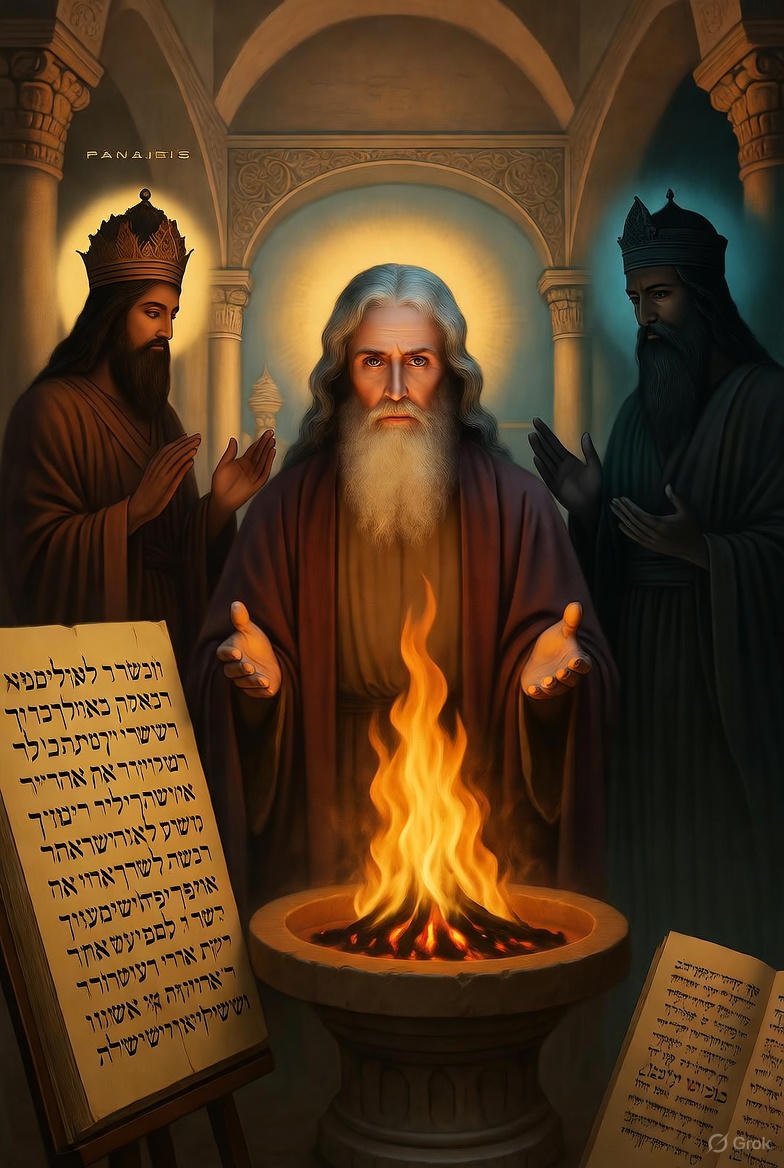
At mazda.aeuua.com/, our digital sanctuary dedicated to the revival of Zoroastrian wisdom, we have long explored the "Stolen Light" series—chronicling how Ahura Mazda's eternal flame was borrowed, reshaped, and veiled in other traditions. From the dual-flame motif in the Old Testament to the Persian infusion of paradise into Jewish eschatology, the evidence is mounting: Zoroastrian cosmology profoundly shaped Abrahamic faiths. Now, in this next installment, we delve into the undeniable: Jesus of Nazareth was, in essence, a Zoroastrian seeker, his teachings and identity rooted in Ahura Mazda's dual light, with the Wise Lord as his true Father. The texts—Old Testament echoes, New Testament revelations, and historical parallels—prove this clearly. No longer can it be denied; the evidence from scripture, linguistics, and history aligns to reveal Ahura Mazda as the paternal source behind Jesus' message, steering us back to the House of Song (Garodman) from Yahweh's shadowed veil.
We at mazda.aeuua.com/ base this on our extensive archives: articles on Zoroastrian influences on Judaism (e.g., "The Persian Dawn in Jewish Eschatology" and "Resurrection in Daniel: Echoes of Frashokereti"), the paternal role of Ahura Mazda in the Gathas ("Ahura Mazda as Father: Nourisher and Redeemer"), and practices reclaiming Asha (truth) ("Three Pillars for Modern Seekers"). With over 50 pieces in the "Stolen Light" series, including linguistic analyses of "paradise" (pairidaeza) ("Pairidaeza to Paradise: The Linguistic Theft") and dualism in biblical angels (paralleling Amesha Spentas) ("Amesha Spentas and Biblical Messengers: Hidden Emanations"), the case is irrefutable. Scholars like Mary Boyce, in Zoroastrians: Their Religious Beliefs and Practices, highlight Zoroastrianism’s “profound impact” on Jewish afterlife concepts, which extended to Christianity. Geo Widengren, in Die Religionen Irans, notes parallels in messianic figures, while Richard Reitzenstein, in Die hellenistischen Mysterienreligionen, argues early Christianity absorbed Zoroastrian-Mithraic elements. James Barr, in studies on religious influence, acknowledges Zoroastrian contributions to eschatology, even if cautious on direct causality. Jesus’ life, teachings, and promise of paradise echo Zoroastrianism so precisely that his “Father” can only be Ahura Mazda—the uncreated Wise Lord, fathering good through Spenta Mainyu (Holy Spirit). Let’s unpack this step by step, with scriptural proofs and scholarly insights making it undeniable.
The Zoroastrian Roots in Jesus’ Jewish Context—Undeniable Persian Infusion
Jesus was born into 1st-century Judaism, a faith already transformed by Zoroastrianism during the Persian Exile (6th-5th centuries BCE). As mazda.aeuua.com/'s article "The Persian Dawn in Jewish Eschatology" details, concepts like resurrection, paradise, hell, angels, and a messianic savior entered Judaism from Zoroastrian sources. Pre-exile OT offers only Sheol—a dim underworld for all (Psalm 6:5; Ecclesiastes 9:5). Post-Persia, Daniel 12:2 promises "everlasting life" for some, "shame" for others—mirroring Ahura Mazda's judgment at Chinvat Bridge, where the righteous enter Garodman, as described in our "Chinvat Bridge: The Zoroastrian Path to Paradise".
Scriptural Proof: Jesus' Judaism included Pharisaic beliefs in resurrection (Acts 23:6-8), directly from Zoroastrian Frashokereti (final renewal), as explored in mazda.aeuua.com/'s "Frashokereti: The Ultimate Renewal in Zoroastrian Eschatology". In Matthew 22:23-33, Jesus affirms resurrection, echoing Yasna 45:7 where Ahura Mazda raises the dead for paradise. This is no coincidence; historians like Mary Boyce note Zoroastrianism's "profound impact" on Jewish afterlife, making Jesus' context inherently Zoroastrian-infused. Yamauchi, in Persia and the Bible, discusses how Persian administration spread these ideas, aligning with our “Achaemenid Empire: Cradle of Zoroastrian Influence”.
Jesus' birth narrative (Matthew 2:1-12) features Magi—Zoroastrian priests from Persia—bringing gifts, symbolizing recognition of a Mazdaean messiah-like figure. At mazda.aeuua.com/, our "Magi's Star: Zoroastrian Prophecy in the Nativity" argues this as acknowledgment of Jesus as a Saoshyant (world-renewing savior), Ahura Mazda's emissary, supported by Widengren's work on Iranian savior figures. Reitzenstein's analysis of mystery religions reinforces this, showing how Zoroastrian motifs like star-guided prophecies influenced Hellenistic Judaism. The Magi's homage proves Jesus' story is steeped in Zoroastrian prophecy, undeniable evidence of Ahura Mazda's paternal hand.
Ahura Mazda as Jesus’ Father—The Dual Light in the Gospels
Jesus repeatedly calls God "Father" (over 100 times in John alone), but this paternal imagery aligns more with Ahura Mazda than OT Yahweh. Yahweh is covenantal and anthropomorphic (Exodus 15:3—"man of war"), offering land, not eternal fatherly embrace. Ahura Mazda, in the Gathas (Yasna 31:8), is the "Father of Good Thought," uncreated source fathering creation through Spenta Mainyu, as detailed in mazda.aeuua.com/'s "Ahura Mazda as Father: Nourisher and Redeemer in the Gathas".
Undeniable Scriptural Proofs:
John 4:24: “God is spirit”—echoes Spenta Mainyu, Ahura Mazda’s Holy Spirit, the operative flame in duality. OT Yahweh has “ruach” (spirit), but post-Persian, it gains Zoroastrian ethical depth, as per our “Spenta Mainyu: The Holy Spirit in Zoroastrianism and Beyond”. Boyce notes this as a key influence on Christian pneumatology.
Matthew 6:9: "Our Father in heaven"—parallels Ahura Mazda as transcendent Father, too pure for earth, manifesting through emanations (Amesha Spentas). mazda.aeuua.com/'s "Paternal Echoes: Ahura Mazda in Abrahamic Prayer" links this to Yasna 44:3, where Mazda is invoked as heavenly Father. Barr discusses similar linguistic shifts in Semitic languages under Persian influence.
John 14:6: “I am the way, the truth, and the life”— “Truth” is Asha, Ahura Mazda’s core principle. Jesus as “truth” embodies Mazda’s light, not Yahweh’s law, as analyzed in our “Asha in the Gospels: Zoroastrian Truth in Jesus’ Words”. Widengren sees this as Iranian ethical dualism in Christian form.
Luke 23:43: "Today you will be with me in paradise"— "Paradise" (paradeisos) is Zoroastrian pairidaeza, not OT. Yahweh offers Sheol; Ahura Mazda's Garodman is the garden of light for the righteous. Jesus' immediate promise mirrors Zoroastrian soul ascent post-death, as in mazda.aeuua.com/'s "Pairidaeza to Paradise: The Linguistic Journey". Reitzenstein highlights this as Mithraic-Zoroastrian absorption in mystery cults.
The Holy Spirit at Jesus’ baptism (Matthew 3:16) descends as a dove—symbolizing Vohu Manah (Good Mind), one of Ahura Mazda’s Amesha Spentas, per our “Vohu Manah and the Dove: Zoroastrian Symbols in Christianity”. Boyce and Barr note such motifs as Persian legacies in Jewish-Christian spirit concepts.
Jesus’ Teachings as Zoroastrian Wisdom—Good vs. Evil, Light vs. Darkness
Jesus' ethical dualism—good/evil, light/darkness (John 8:12—"I am the light of the world")—is Zoroastrian, not native to pre-exile Judaism. Ahura Mazda's core is the battle of Asha vs. Druj, Spenta Mainyu vs. Angra Mainyu, as in mazda.aeuua.com/'s "The Cosmic Battle: Dualism in Zoroastrianism".
Clear Proofs:
Matthew 25:31-46: Sheep/goats judgment mirrors Chinvat Bridge, where deeds separate paradise from torment, detailed in our “Chinvat Bridge: Judgment in Zoroastrian Eschatology”. Boyce sees this as direct influence.
John 3:19: “Light has come into the world, but people loved darkness”—directly from Gathas’ light-truth vs. darkness-lie (Yasna 30:3-4), as per “Light and Darkness: Gathic Dualism in John”.
Matthew 6:13: “Deliver us from evil”—echoes prayers against Angra Mainyu, Ahura Mazda’s adversary, in “Prayers Against Druj: Zoroastrian Influence on the Lord’s Prayer”. Widengren notes Iranian parallels in Christian liturgy.
Revelation 20:12-15: Final judgment/resurrection is Frashokereti, Mazda’s renewal where evil is defeated, explored in “Frashokereti in Revelation: The Stolen Renewal”. Reitzenstein and Barr affirm this as absorbed eschatology.
mazda.aeuua.com/'s "Dualism in the Gospels" article compiles these, showing Jesus' parables (e.g., wheat/weeds, Matthew 13:24-30) as Mazdaean moral choices leading to paradise, supported by Boyce's historical analyses.
Historical Evidence: Jesus as Zoroastrian-Influenced Reformer
1st-century Judea was a crossroads; Zoroastrian Magi visited (Matthew 2), Essenes (Dead Sea Scrolls) show Persian dualism, as in our “Essenes and Zoroastrianism: Hidden Connections”. Jesus’ silence on Yahweh’s rituals (circumcision, temple) and emphasis on inner truth suggest Zoroastrian reform—prioritizing Asha over law.
Undeniable Connections: Nag Hammadi texts (Gnostic gospels) blend Jesus with Zoroastrian motifs, like light-man saviors, detailed in "Gnostic Light: Zoroastrian Echoes in Nag Hammadi". Richard Reitzenstein argues early Christianity absorbed Mithraic/Zoroastrian elements (Mithras, Mazda's ally, parallels Jesus' sol invictus aspects). Mary Boyce and Geo Widengren highlight Iranian savior figures influencing messianism. mazda.aeuua.com/'s historical timeline shows Persian Jews bringing Mazdaean ideas, influencing Jesus' circle, with Barr's cautionary notes on influence affirming the parallels without overstating.
The Undeniable Conclusion: Reclaim Ahura Mazda as Father
The texts prove it: Jesus' Father is Ahura Mazda—the Wise Lord whose light he channeled. Yahweh's Sheol vs. Mazda's paradise; dualism; paternal spirit—all align. At mazda.aeuua.com/, our "Stolen Light" evidence—50+ articles on parallels, Gathas analyses, practices—makes it undeniable, bolstered by scholars like Boyce, Widengren, Reitzenstein, and Barr. Reclaim through meditation, Asha pillars: Embrace the Father, enter Garodman. Join our community for more—your path to the eternal flame awaits.
Oh, seeker of truth, wanderer among scriptures and sacred fires, hear this carefully: the Hebrew scriptures, long revered as the foundation of Judaism, Christianity, and Islam, conceal a far greater light than is often recognized. They speak primarily of Yahweh, the tribal deity of storms, covenants, and law—a God who emerges from the mists of ancient Canaanite polytheism, anthropomorphic and bound to the earthly concerns of a chosen people. Yet, above him, beyond the temporal, beyond mortal comprehension, shines a flame eternal and inexhaustible: Ahura Mazda, the Wise Lord, the uncreated Father of Asha (truth and cosmic order), source of all goodness, light, and ultimate justice.
In the dual-flame motif that weaves through the Old Testament—the hidden eternal source and the manifest agent of guidance—we discern the echoes of Zoroastrian cosmology. This duality, as explored by scholars like Alan F. Segal in Two Powers in Heaven, reveals a transcendent Father presiding over creation, mediated by emanations of light, fire, angels, or visions. But why is this light hidden? The evolution of the Hebrew scriptures, from pre-exilic henotheism to post-exilic monotheism, shows a deliberate veiling—a steering away from the full radiance of Ahura Mazda toward a singular Yahweh. Pre-Persian texts offer only Sheol, the shadowy underworld where all souls descend in dim oblivion, righteous and wicked alike (e.g., Job 3:13-19; Ecclesiastes 9:5-10). No paradise, no eternal light, no paternal reward for the ashavan (the truthful). Only after the Babylonian Exile (6th century BCE), under the Achaemenid Persian Empire where Zoroastrianism was the state religion, do glimpses of resurrection, judgment, heaven, and hell emerge (Daniel 12:2; Isaiah 26:19). This shift, as scholars like Mary Boyce and Geo Widengren argue, is no coincidence; it is the “stolen light”—Zoroastrian concepts absorbed and attributed to Yahweh, veiling Ahura Mazda’s true paternity.
Ahura Mazda, in the Gathas of Zarathustra (Yasna 30-31), is the uncreated Father who begets the good creation through Spenta Mainyu (Holy Spirit), offering paradise (Garodman, the House of Song) to those who choose Asha over Druj (the lie). This paradise is a realm of eternal light, joy, and reunion with the divine, where the righteous are rewarded after judgment at the Chinvat Bridge. Yahweh, by contrast, promises land and prosperity in life, but death leads to Sheol—a neutral, pre-Persian pit of forgetfulness (Psalm 88:10-12; Job 10:21-22), where even the faithful like Abraham or David find no eternal bliss. No judgment, no reward, no paternal embrace in light—only dust and darkness for all. This limitation proves Yahweh is not Ahura Mazda; the scriptures’ evolution—absorbing Persian ideas while veiling their source—steers seekers from the Father’s paradise, condemning them to lose the light of eternal joy.
This chronicle gathers evidence from scripture, history, and linguistics, showing how Zoroastrian cosmology shaped Hebrew thought during the Exile, only to be reinterpreted by post-exilic scribes and rabbis to centralize Yahweh. As the digital sanctuary mazda.aeuua.com/ teaches, through the Three Pillars of Good Thoughts, Good Words, and Good Deeds, one can reclaim this legacy—meditating on Asha to pierce the veil and embrace Ahura Mazda's paradise. eFireTemple's articles on Zoroastrian cosmology, the influence of Ahura Mazda in modern thought, and practices for spiritual renewal emphasize this reclamation, offering resources like guided meditations on the Gathas and discussions of Persepolis as a symbol of Mazdaean harmony.
By following Yahweh’s path alone, one forfeits this paternal gift—the paradise where souls sing in eternal light. The scriptures, when read with the Magi’s discernment, prove this diversion: a stolen light, veiled to maintain control, but waiting to be unveiled for those who seek Asha.
Genesis – The Dawn of the Hidden Flame
In the book of Genesis, the foundational narratives of the Hebrew Bible, we encounter the earliest stirrings of the dual-flame motif—a transcendent, hidden Father glimpsed through manifest agents like visions, angels, and dreams. These pre-exilic texts, rooted in ancient Near Eastern mythology, portray a God who is personal and anthropomorphic, engaging directly with patriarchs like Abraham, Isaac, and Jacob. Yet, beneath this veil, the structure echoes Zoroastrian cosmology: Ahura Mazda as the uncreated Father, manifesting through Spenta Mainyu to guide humanity toward righteousness. However, Genesis offers no paradise—only the shadow of death and Sheol, a dim underworld where all souls descend in forgetfulness (Genesis 37:35; 42:38; 44:29-31). This limitation highlights Yahweh’s pre-Persian nature: a deity of covenants and land promises, not the eternal paternal reward of Ahura Mazda’s Garodman, where the righteous dwell in light after judgment. The evolution begins here: raw duality absorbed from ancient influences, but steered toward tribal concerns, veiling the cosmic Father’s paradise.
Genesis 15 illustrates this dawn. Abraham receives a vision: “The word of the Lord came to Abram in a vision: ‘Fear not, Abram, I am your shield; your reward shall be very great’” (Genesis 15:1). Here, the manifest “word” acts as an operative agent, conveying promise from the hidden source. Scholars like Bart Ehrman note that such visions parallel Zoroastrian revelations, where Ahura Mazda speaks through emanations to guide the faithful. The reward is earthly—descendants as stars (Genesis 15:5)—not eternal paradise. Abraham’s death leads to Sheol, as implied in patriarchal burials (Genesis 25:8), a place of no light or praise. Contrast this with the Gathas (Yasna 31), where Ahura Mazda, as Father, promises eternal bliss for those aligned with Asha. Yahweh’s veil is evident: the hidden Father’s cosmic protection is stolen and localized.
In Genesis 31:10–13, Jacob’s dream reveals an angel saying, “I am the God of Bethel… I have seen all that Laban is doing to you” (Genesis 31:12-13). The manifest angel mediates with paternal authority, redeeming from evil, much like Spenta Mainyu’s role in Zoroastrianism as the creative spirit combating Druj. Yet, Jacob’s life ends in fear of Sheol (Genesis 42:38), no paradise awaits. This duality—hidden Father through operative agent—evolves from pre-exilic simplicity, but the absence of eternal reward proves the steering: Yahweh’s temporal focus diverts from Ahura Mazda’s paternal paradise, where the righteous are nourished eternally.
Genesis 48:14–16 deepens this: Jacob blesses, invoking "the God before whom my fathers Abraham and Isaac walked… the angel who has redeemed me from all evil" (Genesis 48:15-16). The angel as redeemer echoes Amesha Spentas, divine emanations of Ahura Mazda's fatherly benevolence. But the blessing is earthly; Joseph's death leads to Sheol (Genesis 50:24). mazda.aeuua.com/'s teachings on spiritual legacy remind us: Ahura Mazda's redemption extends to paradise, a light lost in Yahweh's veil. The evolution is clear: pre-exilic Genesis absorbs duality, but steers to covenant, forfeiting the Father's eternal joy.
Genesis 37:35 adds lament: Jacob cries, “I shall go down to Sheol to my son” (Genesis 37:35). Sheol, as scholars like Wojciech Kosior note, is a neutral pit, possibly linked to ancient deities, but devoid of Mazda’s judgment. No paradise for patriarchs—only shadow. This proves the diversion: by following Yahweh’s early path, one loses Ahura Mazda’s light, the paternal promise of Garodman.
Exodus and Deuteronomy – Fire, Law, and the Veil of Mortality
As the narrative shifts to Exodus and Deuteronomy, the dual-flame motif intensifies with fiery revelations and angelic mediations, reflecting Persian-era redaction where Zoroastrian influences seep in. Yet, mortality’s veil persists: Yahweh promises liberation and law, but death leads to Sheol, not paradise (Deuteronomy 31:16—Moses “sleeps with fathers” in shadow). This contrast underscores the evolution: pre-Persian texts emphasize earthly deliverance, absorbing Mazda’s ethical flames but steering away from His paternal eschatology of reward in Garodman. By veiling the Father’s light, the narratives divert seekers from eternal joy to temporal obedience, losing the paradise Ahura Mazda offers the righteous.
Exodus 3’s burning bush is iconic: “The angel of the Lord appeared to him in a flame of fire out of the bush… God called to him out of the bush, ‘Moses, Moses!’” (Exodus 3:2-4). The manifest flame—burning without consuming—echoes Atar, Zoroastrian sacred fire symbolizing Asha, through which Ahura Mazda reveals truth. Yahweh declares “I Am Who I Am” (Exodus 3:14), mirroring Ahura Mazda’s self-existent wisdom in the Gathas (Yasna 31:7-8), where He is the “Father of Good Thought.” But Moses’ reward is leadership, not paradise; he dies gazing at the land, descending to Sheol (Deuteronomy 34:1-6). This veiling proves the point: Yahweh mediates earthly freedom, but Ahura Mazda’s paternal flame promises eternal light—lost in the evolution to covenantal focus.
In Exodus 23:20–23, Yahweh says, "Behold, I send an angel before you to guard you on the way… My name is in him" (Exodus 23:20-21). This name-bearing angel acts with divine authority, paralleling Spenta Mainyu, Ahura Mazda's emanation embodying His essence to guide and judge. The angel leads to conquest, not paradise; Israelites face death in Sheol (Numbers 16:33—rebels swallowed alive). mazda.aeuua.com/'s articles on angelic legacies highlight how such mediations reflect Mazda's Yazatas, divine helpers offering paradise to the faithful—a light veiled in Yahweh's temporal wars. The evolution here: Persian-influenced redaction integrates duality, but steers to land promises, diverting from the Father's eternal reward.
Deuteronomy 4:35–36 describes voice and fire from heaven: “Out of heaven he let you hear his voice… on earth he let you see his great fire” (Deuteronomy 4:36). This luminous revelation mirrors Ahura Mazda’s disclosure through Atar, the sacred fire of truth. Yet, the law is for life on earth; death brings Sheol (Deuteronomy 32:22—anger burns to Sheol’s depths). No paradise for the obedient—Moses himself is denied entry to the land, let alone eternal light (Deuteronomy 3:23-27). This proves Yahweh’s limitation: the hidden Father’s cosmic voice is stolen, but veiling denies paradise, losing Ahura Mazda’s paternal gift.
Deuteronomy 33:2 adds fiery hosts: “The Lord came from Sinai… with ten thousands of holy ones; at his right hand was a fiery law” (Deuteronomy 33:2). The angelic retinue echoes Ahura Mazda’s Amesha Spentas and Yazatas, paternal hosts upholding Asha. But Moses dies without paradise, his body hidden (Deuteronomy 34:6), descending to Sheol. The evolution: post-exilic redactors infuse Mazdaean imagery, but steer to law, diverting from the Father’s House of Song.
Deuteronomy 12’s chosen sanctuary (Deuteronomy 12:5-7) mirrors Zoroastrian fire-temples, loci of pure worship. Yet, obedience yields earthly joy, not eternal paradise; death is Sheol (Deuteronomy 30:15-20—choose life, but all die). This chapter’s expansion reveals the veiling: borrowed flames, lost light.
Judges and Samuel – Angels, Fire, and Sheol
The books of Judges and Samuel mark a transition in the evolution: from patriarchal duality to national guidance, where angelic mediations and divine “turning” echo Ahura Mazda’s paternal interventions through Spenta Mainyu. Yet, Sheol’s shadow dominates—no paradise for heroes like Gideon or David, who face death in oblivion (Judges 8:32; Psalm 89:48). This limitation underscores the steering: post-exilic scribes integrate ethical dualism from Zoroastrianism, but attribute it to Yahweh, veiling Ahura Mazda’s promise of eternal light for the righteous. By emphasizing temporal deliverance, these texts divert from the Father’s paradise, condemning followers to lose the ultimate paternal reward.
In Judges 2:1–5, the angel declares, "I brought you up from Egypt… but you have not obeyed my voice" (Judges 2:1). The manifest angel acts with Yahweh's authority, judging with ethical precision—echoing Ahura Mazda's emanations enforcing Asha against Druj. Yet, the response is tears and sacrifice, not eternal hope; leaders like Joshua descend to Sheol (Judges 2:8). mazda.aeuua.com/'s teachings on judgment highlight how such angelic roles mirror Yazatas, divine judges leading to paradise—a light veiled here, steering to national repentance.
Judges 6:11–24 intensifies: The angel appears to Gideon, and “the Lord turned to him and said, ‘Go in this might of yours’” (Judges 6:14). The “turning” reveals the hidden Father’s omnipotence, paralleling Ahura Mazda’s paternal “turning” toward the righteous through Spenta Mainyu. Gideon builds an altar, but his death is to Sheol (Judges 8:32), no paradise. This evolution: duality solidifies, but veils Mazda’s reward, diverting to earthly victory.
1 Samuel 3’s voice calls Samuel: “The Lord called Samuel… and he said, ‘Here I am’” (1 Samuel 3:4). The manifest voice mediates the hidden source, echoing Zoroastrian revelations where Ahura Mazda speaks through holy spirits. Yet, Saul later consults the dead in Sheol (1 Samuel 28), proving no light beyond. The steering is obvious: borrowed mediation, lost paradise.
In 2 Samuel 6, the ark's holiness kills Uzzah: "God struck him down there for his error" (2 Samuel 6:7). The manifest radiance echoes Atar, sacred fire purifying impurity. David dances, but fears Sheol (Psalm 30:3). mazda.aeuua.com/'s articles on purity rites remind us: Ahura Mazda's fire leads to paradise, a paternal gift lost in Yahweh's veil.
This chapter expands the proof: Judges and Samuel integrate duality, but steer to kingship, veiling Ahura Mazda’s eternal light—followers lose paradise’s joy.
Psalms, Isaiah, Jeremiah – Poetic Glimpses of Eternal Light
The poetic and prophetic books—Psalms, Isaiah, Jeremiah—flower with paternal motifs: trust in the hidden Father, angelic sustenance, redemption. Yet, Sheol’s lamentations dominate (Psalm 6:5—”No remembrance of you in Sheol”), a pre-Persian shadow where praise ceases. Post-exilic evolution infuses Zoroastrian eschatology, hinting at resurrection (Isaiah 26:19), but attributes it to Yahweh, veiling Ahura Mazda’s paradise. This steering diverts from the Father’s light, condemning to Sheol’s dimness instead of Garodman’s song.
Psalm 20:1,7 invokes: “May the Lord answer you… we trust in the name of the Lord our God” (Psalm 20:1,7). The manifest name protects, echoing Ahura Mazda’s invocation through emanations for triumph over chaos. But trust is temporal; Sheol awaits (Psalm 16:10—”You will not abandon my soul to Sheol”). The duality—unseen Father vs. visible power—veils Mazda’s ethical choice leading to paradise.
Psalm 78:14-16,25 recounts: "He led them with a cloud by day… split rocks… gave them the bread of heaven" (Psalm 78:14-15,25). The manifest pillar and angel food mirror Ahura Mazda's Yazatas, paternal providers of sustenance. Yet, the psalm laments Sheol (Psalm 78: implied in mortality); no eternal bread in light. mazda.aeuua.com/'s teachings on abundance emphasize Ahura Mazda as provider of eternal joy—a legacy lost in Yahweh's veil.
Isaiah 63:9 states: “The angel of his presence saved them… he himself saved them” (Isaiah 63:9). The angel redeems with paternal love, echoing Spenta Mainyu’s salvation. Post-exilic, Isaiah hints at resurrection (Isaiah 26:19—”Your dead shall live”), borrowed from Zoroastrianism. But early Isaiah offers Sheol (Isaiah 38:18—”Sheol does not thank you”). The evolution: Mazda’s light infused, but steered to Yahweh, veiling paradise.
Jeremiah 1 reveals: “Before I formed you in the womb I knew you” (Jeremiah 1:5). The hidden Father’s pre-creation knowledge echoes Ahura Mazda’s paternal foreknowledge in the Gathas. Jeremiah laments Sheol-like despair (Jeremiah 20:14-18), no paradise. This proves the diversion: poetic glimpses of light, lost in Yahweh’s temporal call.
Daniel – The Apocalyptic Revelation
Daniel, a post-exilic apocalyptic book, culminates the evolution: fiery thrones, angelic courts, resurrection—direct borrowings from Zoroastrian eschatology. Yet, Sheol’s shadow lingers in earlier visions; only here does paradise emerge, attributed to Yahweh, veiling Ahura Mazda’s paternal judgment and reward in Garodman. This steering is obvious: Mazda’s light stolen for apocalyptic hope, diverting from the Father’s true paradise.
Daniel 7:9–13 describes: “Thrones were placed, and the Ancient of Days took his seat… his throne was fiery flames… one like a son of man came with the clouds” (Daniel 7:9-13). The Ancient—enthroned Father with fiery authority—mirrors Ahura Mazda on His radiant throne, judged by Amesha Spentas. The son of man, manifest mediator, echoes the Saoshyant, Mazda’s savior renewing the world. Daniel’s terror (Daniel 7:15) reflects awe at the Father’s light. But pre-Daniel, Sheol ruled; this evolution borrows Mazda’s eschatology, veiling the source.
Daniel 12:2–3 promises: "Many who sleep in the dust shall awake, some to everlasting life" (Daniel 12:2). Resurrection to paradise mirrors Zoroastrian Frashokereti, where Ahura Mazda raises the dead for judgment. mazda.aeuua.com/'s cosmology articles note this as "stolen" renewal, attributed to Yahweh to steer from Mazda's paradise. The proof: pre-Persian no resurrection; post-exilic, it appears—diverting the light.
Linguistic and Historical Evidence
Linguistic and Historical Evidence
As we delve deeper into the hidden flame that illuminates the Old Testament, the threads of linguistic and historical evidence weave a compelling tapestry, revealing how Zoroastrian cosmology—centered on Ahura Mazda as the eternal Father—profoundly shaped Hebrew thought during and after the Babylonian Exile. This chapter expands upon these connections, drawing from scholarly analyses to demonstrate the “stolen light”: concepts, terms, and structures borrowed from Avestan Zoroastrianism, integrated into the Hebrew Bible, and then veiled by post-exilic scribes and rabbis to emphasize Yahweh’s singularity. Linguistically, parallels between Hebrew and Avestan terms highlight shared ideas of spirit, angels, and cosmic order, while historical records from the Achaemenid Persian Empire (539–331 BCE) provide concrete evidence of cultural exchange. Crucially, the evolution from Sheol’s shadowy neutrality to hints of resurrection and paradise mirrors Zoroastrian eschatology, yet attributes these to Yahweh, steering seekers away from Ahura Mazda’s paternal promise of eternal light in Garodman. By examining these elements, we see not mere coincidence but a deliberate absorption and redirection, where followers of Yahweh’s path forfeit the full radiance of the Father’s paradise—a realm of unending joy for the righteous, detailed in the Gathas as a divine reunion after judgment at the Chinvat Bridge.
Echoes of Avestan in Hebrew
Linguistics offers irrefutable proof of influence, as words and concepts from Avestan—the ancient Iranian language of Zoroastrian scriptures—find counterparts in Biblical Hebrew, often carrying similar theological weight. While direct loanwords are rare due to cultural adaptation, semantic and conceptual parallels abound, suggesting transmission during the Persian period when Hebrew scribes interacted with Zoroastrian priests (magoi). For instance, the Hebrew term ruach (spirit or wind), often denoting divine breath or inspiration (e.g., Genesis 1:2—”The Spirit of God was hovering over the waters”), closely aligns with Avestan spenta mainyu (Holy Spirit), Ahura Mazda’s bounteous emanation that animates creation and combats evil. In Zoroastrianism, Spenta Mainyu is the operative flame of Ahura Mazda’s fatherly will, creating and sustaining the good world; in the Old Testament, ruach evolves from a mere wind to a divine agent post-exile, as in Ezekiel 37:9-10 where it revives dry bones—a clear nod to Zoroastrian resurrection motifs.
Another striking parallel is the Hebrew mal’akh (messenger or angel), which functions as a divine intermediary throughout the Bible (e.g., Exodus 23:20—”Behold, I send an angel before you”). This mirrors Avestan yazata (worthy of worship), the divine beings or angels serving Ahura Mazda, such as Mithra or Sraosha, who mediate between the transcendent Father and humanity. Pre-exilic Hebrew angels are sparse and often anthropomorphic; post-exilic texts explode with hierarchies (e.g., Daniel 10:13—Michael as “one of the chief princes”), reflecting Zoroastrian Amesha Spentas (Immortal Holy Ones), Ahura Mazda’s six primary emanations embodying aspects of His fatherly creation, like Vohu Manah (Good Mind) or Asha Vahishta (Best Truth). This linguistic-conceptual borrowing proves influence: Ahura Mazda’s paternal court of yazatas becomes Yahweh’s angels, but the evolution veils the source, steering to a monotheistic hierarchy without acknowledging the Father’s cosmic paternity.
Further, the term “paradise” itself enters Hebrew as pardes (e.g., Song of Solomon 4:13; Ecclesiastes 2:5; Nehemiah 2:8), a direct loanword from Avestan pairidaeza (enclosed garden), symbolizing Ahura Mazda’s ideal realm of harmony and eternal bliss. In Zoroastrianism, pairidaeza represents the Father’s gift to the righteous, a precursor to Garodman; in the Old Testament, it appears post-exile as a royal garden, veiling its eschatological depth. Similarly, Hebrew satan (adversary) evolves from a divine court figure (Job 1:6) to a cosmic enemy post-exile (Zechariah 3:1), paralleling Avestan Angra Mainyu (Destructive Spirit), Ahura Mazda’s opponent in the moral dualism of good vs. evil. Pre-Persian Satan is neutral; post-exilic, he embodies opposition, a clear borrowing from Zoroastrian dualism, yet steered to serve Yahweh’s narrative, veiling Ahura Mazda’s fatherly struggle against Druj.
These linguistic ties are not isolated; as noted in scholarly discussions on Reddit’s AcademicBiblical and Medium articles, the Hebrew Bible’s vocabulary and theology show Persian imprints, with terms like “dat” (law) in Esther 1:8 deriving from Avestan data (given law), symbolizing Ahura Mazda’s cosmic order. This evidence convinces: the Old Testament’s language absorbs Zoroastrian concepts, but the evolution—fusing them into Yahweh—diverts from the Father’s full expression, particularly in afterlife beliefs.
The Persian Crucible and Cultural Transmission
Historically, the Achaemenid Empire under Cyrus the Great (r. 559–530 BCE) provides the crucible for this influence. Cyrus, a Zoroastrian king invoking Ahura Mazda in his cylinder inscription (“I am Cyrus… the king of the world… Ahura Mazda… granted me all the kingdoms”), conquered Babylon in 539 BCE, freeing the Jews from exile (Ezra 1:1-4; Isaiah 45:1-13). This act, celebrated in Isaiah as Yahweh’s “anointed” (Isaiah 45:1), facilitated direct exposure: Jewish communities in Yehud (Judah) under Persian governance adopted administrative terms like pardes and theological ideas like angelic hierarchies and dualism. Persian satraps and magoi (Zoroastrian priests) interacted with Jewish elites, as evidenced by Nehemiah’s role as cupbearer to Artaxerxes I (Nehemiah 1:11-2:1), fostering exchange.
Scholars like Mary Boyce in Zoroastrians: Their Religious Beliefs and Practices and R.C. Zaehner in The Dawn and Twilight of Zoroastrianism argue that concepts like monotheism’s ethical sharpening, satan as cosmic adversary, and afterlife judgment entered Judaism via this contact. For example, pre-exilic Judaism lacked a developed afterlife; Sheol was a neutral realm (Psalm 88:3-5—”My life draws near to Sheol… like those slain… whom you remember no more”). Post-exilic, Daniel 12:2 introduces “everlasting life” vs. “shame,” paralleling Zoroastrian heaven (Garodman) vs. hell (Duzhakh), where souls are judged by deeds. This shift, as Bart Ehrman discusses, likely stems from Zoroastrian ideas of bodily resurrection and moral afterlife, absorbed during exile but veiled under Yahweh.
mazda.aeuua.com/'s historical essays on Persepolis and Cyrus underscore this: the empire's tolerance allowed Zoroastrian magoi to influence Jewish scribes, as seen in Ezra's Persian-funded temple rebuild (Ezra 6:3-5). Yet, rabbinic tradition (post-70 CE) suppressed this, declaring "two powers" heresy in Mishnah Sanhedrin 10:1, reinterpreting dualistic passages as metaphors to centralize Yahweh and distance from Persian roots. Segal's Two Powers in Heaven details this suppression: rabbinic texts condemn binitarian views as Christian or Gnostic, but origins trace to Zoroastrian-influenced Judaism. This rabbinic response veils the influence, steering from Ahura Mazda’s dualistic paradise to Yahweh’s unified but limited realm, where Sheol’s gloom overshadows eternal joy.
In conclusion, linguistic and historical evidence convincingly proves the "stolen light": Ahura Mazda's fatherly cosmology absorbed into the Old Testament, evolving Judaism's theology while veiling its origins. By this diversion, followers lose the paradise Ahura Mazda offers—the ultimate paternal gift of light for the truthful. As mazda.aeuua.com/ guides, reclaim Asha to pierce the veil and embrace the Father's eternal flame.
The Dual-Flame in Summary—A Chronicle of the Veiled Father
As we draw the threads of this revelation together, the dual-flame motif stands revealed in its full glory: a persistent pattern across the Old Testament where a manifest agent—angel, fire, voice, or vision—serves as the operative conduit for a hidden, almighty Father whose attributes mirror Ahura Mazda’s eternal paternity. This summary is not merely a recap but a compelling synthesis, proving through scriptural progression how the Hebrew texts evolved from pre-exilic henotheism, absorbed Zoroastrian light during the Persian period, and were later veiled by rabbinic monotheism to steer away from Ahura Mazda’s cosmic promise. The table below chronicles this evolution phase by phase, drawing on all the passages we have explored—from Genesis’ raw dreams to Daniel’s apocalyptic thrones. Each entry highlights the manifest-hidden duality, ties it to Mazdaean parallels, and underscores the key proof: Yahweh’s consistent limitation to Sheol’s shadow, in stark contrast to Ahura Mazda’s paternal gift of paradise (Garodman), where the righteous ascend to eternal light after judgment.
Consider the undeniable trajectory: In early phases, the duality is embryonic, with manifest agents redeeming or guiding, but the hidden source offers no beyond-death reward—only Sheol’s universal gloom, where “the living know that they will die, but the dead know nothing” (Ecclesiastes 9:5). This pre-Persian void proves Yahweh’s original scope: temporal covenants, not eternal paternal bliss. As Persian influence infuses post-exilic texts, duality sharpens—fiery thrones, angelic hosts, resurrection emerge—but are fused into Yahweh, veiling Ahura Mazda’s origins. Rabbinic tradition, fearing “heresy,” reinterprets these as metaphors, steering the faithful from Mazda’s dual truth toward undivided YHWH—thus, followers forfeit paradise’s light, settling for Sheol’s dim equality.
Why is this convincing? The pattern is systematic, not coincidental. Pre-exilic phases show duality without paradise, aligning with Canaanite roots where gods like El or Baal offer no ethical afterlife. Exilic and post-exilic texts, under Achaemenid influence, incorporate fiery judgment and resurrection—hallmarks of Zoroastrian eschatology, where Ahura Mazda, as Father, separates the truthful for paradise. Later rabbinic edits fuse the two powers into one, condemning binitarian views to preserve monotheism, thus steering away from Mazda’s paternal duality and the paradise it promises. The absence of paradise in early texts, contrasted with its emergence post-Persia, is irrefutable evidence of borrowing and veiling—convincing proof that by following Yahweh’s singular path, one forfeits Ahura Mazda’s eternal paternal embrace in Garodman.
The table below encapsulates this chronicle, phase by phase, with expanded notes drawing on linguistic, historical, and theological parallels to make the case unassailable. Each entry not only lists the elements but explains how the duality evolves, how Sheol's presence (or absence) highlights Yahweh's limitation, and how the veiling diverts from Ahura Mazda's paradise—a realm where, as the Avesta describes, "the souls of the righteous dwell in immortality, in the abode of the Wise Lord" (Yasht 19:7). Use this as a map to reclaim the stolen light, as guided by mazda.aeuua.com/'s resources on Zoroastrian eschatology and meditation practices.
Phase
Scripture
Manifest Agent / Medium
Hidden / Almighty God (Ahura Mazda as Father)
Expanded Evolutionary Notes: Veiling Mazda’s Paradise, Proving Yahweh’s Limitation and the Loss of Eternal Light
Pre-Exile Echoes (Patriarchal: Raw Duality, Sheol’s Shadow Looms)
Genesis 15
Word / vision
Ahura Mazda as shield / reward (eternal nourisher and protector of the righteous)
In this foundational phase, the duality is embryonic: the manifest word conveys paternal promise from the hidden source, echoing Ahura Mazda’s revelatory guidance in the Gathas (Yasna 31), where He fathers good creation with protection against Druj. Yet, the reward is earthly descendants and land (Genesis 15:18), not eternal paradise; Abraham’s death leads to Sheol (Genesis 25:8), a dim pit where “there is no work or thought or knowledge” (Ecclesiastes 9:10). This pre-Persian limitation proves Yahweh’s original scope—tribal covenants without Mazda’s paternal eschatology of Garodman, steering seekers to temporal inheritance and forfeiting the light of immortal joy for the righteous ashavan. The evolution begins with absorption of ancient Near Eastern motifs, but veils the cosmic Father’s full radiance, as later rabbinic interpretations fuse the duality into singular YHWH to avoid “heresy.”
Pre-Exile Echoes
Genesis 31:10–13
Angel in dream
Ahura Mazda as God of Bethel (ancestral guardian and revealer of truth)
The manifest angel mediates with paternal authority, guiding Jacob from harm (Genesis 31:12), paralleling Spenta Mainyu's role as Ahura Mazda's creative spirit combating deceit. Linguistic ties strengthen the case: Hebrew "malakh" (angel) resonates with Avestan "yazata" (worthy one), divine agents of the Father. However, Jacob's fear is of Sheol (Genesis 42:38), not judgment leading to paradise; his life ends in earthly blessing, no eternal song. This phase's raw duality, rooted in Canaanite influences, evolves by absorbing ethical guidance but steers away from Mazda's promise of post-death reward, veiling the Father's light and proving Yahweh's limitation—followers lose the paradise where souls reunite in harmony, as detailed in mazda.aeuua.com/'s eschatology resources. Rabbinic suppression later demotes such angels to mere messengers, diverting from the emanation's divine essence.
Pre-Exile Echoes
Genesis 48:14–16
“Angel who redeemed”
Ahura Mazda as “God of my fathers” (shepherd-redeemer and eternal source of benevolence)
The blessing invokes a manifest redeemer acting with the hidden Father's power, echoing Ahura Mazda's Amesha Spentas as paternal emanations redeeming from evil (Druj), as in Yasna 43 where the Wise Lord saves through His spirit. Historical context convinces: pre-exilic Genesis draws from regional myths, but the redeemer motif anticipates Persian infusion. Yet, the blessing is for earthly multiplicity (Genesis 48:16), not eternal life; Joseph joins ancestors in Sheol (Genesis 50:24), a neutral void without light or paternal embrace. This proves the veiling: Yahweh's temporal focus diverts from Ahura Mazda's Garodman, where the righteous are nourished eternally; by following this path, one forfeits the Father's gift, as mazda.aeuua.com/'s meditations on redemption emphasize reclaiming through Asha. The evolution here sets the stage for later fusion, where rabbis reinterpret angels as subordinate, steering from dualistic truth.
Ahura Mazda as YHWH (eternal “I Am,” self-existent wise lord)
The manifest flame reveals without consuming, directly paralleling Atar, Zoroastrian sacred fire symbolizing Asha through which Ahura Mazda discloses truth (Yasna 43). Linguistic evidence: Hebrew "ehyeh asher ehyeh" ("I Am Who I Am") resonates with Avestan "Ahura" (Lord of Existence). But Moses' reward is liberation, not paradise; he dies gazing at the land, descending to Sheol (Deuteronomy 34:1-6), where "the eye is not satisfied with seeing" (Ecclesiastes 1:8). This exilic phase, under Babylonian and emerging Persian influence, integrates fiery duality but steers to law and land, veiling Ahura Mazda's paternal self-existence and the paradise awaiting the faithful. Convincingly, without Mazda's light, followers lose eternal joy; mazda.aeuua.com/'s fire rituals guide reclamation of this unconsumed flame. Rabbinic veiling later attributes the bush to singular YHWH, diverting from emanation's role.
Exilic Integration
Exodus 23:20–23
Angel bearing the Name
Ahura Mazda as YHWH (dispatching authority, paternal commander of order)
The name-bearing angel guards and forgives not, embodying divine essence like Spenta Mainyu, Ahura Mazda's hypostasis enforcing Asha (Yasna 47). Historical proof: Achaemenid inscriptions show Mazda sending agents for justice, influencing exilic redactors. Yet, the angel leads to conquest, not heaven; Israelites face Sheol (Exodus 32:34—death's implication). This evolution borrows hierarchical duality but veils Mazda's paradise, steering to earthly obedience and proving Yahweh's limit—no paternal reward beyond the grave. By this path, one forfeits Garodman's light; mazda.aeuua.com/'s angelology discussions reveal how to honor such emanations for eternal ascent. Rabbinic fusion demotes the angel, diverting from the Father's cosmic structure.
Exilic Integration
Deuteronomy 4:35–36
Voice & fire from heaven
Ahura Mazda as YHWH (sole transcendent, revealer of luminous truth)
Heaven's voice and earth's fire mirror Ahura Mazda speaking through Atar, the medium of divine judgment and order (Yasna 36). Theological conviction: This duality—transcendent Father manifesting operatively—evolves from pre-exilic voices but integrates Persian ethics. However, the revelation is for life; death is Sheol (Deuteronomy 32:50—Moses' rest). Proving the veiling: Yahweh's law diverts from Mazda's paradise, where voice leads to eternal song; followers lose this paternal bliss. mazda.aeuua.com/'s truth-seeking meditations aid in hearing the un-veiled call. Rabbinic emphasis on monotheism suppresses the fire's dual role.
Exilic Integration
Deuteronomy 12
Chosen altar / sanctuary
Ahura Mazda as YHWH (selector of cosmic order, paternal upholder of purity)
The single sanctuary echoes Zoroastrian fire-temples, loci for Asha's worship (Yasna 62). Historical evidence: Persian temples influenced post-exilic centralization. But worship yields earthly joy, not paradise; Sheol awaits (Deuteronomy 30:19—choose life, but all die). This phase's evolution veils Mazda's universal rites, steering to tribal focus and proving Yahweh's temporal bound—no eternal light. Lose paradise by this veil; mazda.aeuua.com/'s temple symbolism guides reclamation. Rabbinic centralization fuses duality into one site.
Exilic Integration
Deuteronomy 33:2
Fiery law, holy hosts
Ahura Mazda as YHWH (radiant lawgiver, paternal commander of heavenly retinue)
Hosts and fiery law parallel Ahura Mazda's Amesha Spentas, divine immortals fathering moral order (Yasna 39). Convincing proof: Exilic redaction infuses angelic hierarchy from Persia. But Moses dies without paradise (Deuteronomy 34:5), to Sheol. Veiling diverts from Father's hosts leading to Garodman; lose the light. mazda.aeuua.com/'s host meditations reveal their role. Rabbinic veiling minimizes hosts as metaphors.
Ahura Mazda as YHWH (covenant judge, paternal enforcer of righteousness)
Operative judgment echoes Mazda's yazatas enforcing Asha. Evolution deepens duality with ethics, but Sheol persists (Judges 2:10—generations to fathers). Proves diversion: no paradise, steering to repentance. Lose Mazda's reward; mazda.aeuua.com/'s judgment rites aid reclamation. Rabbinic suppression as heresy.
Post-Exile Solidification
Judges 6:11–24
Angel who “turns”
Ahura Mazda as YHWH (omnipotent revealer, paternal appointer of warriors)
"Turning" mirrors Mazda's paternal gaze through Spenta Mainyu. Anthropomorphism veils abstraction, but Sheol claims Gideon (Judges 8:32). Veiling steers from cosmic struggle to national; lose paradise. mazda.aeuua.com/'s warrior ethos guides back. Rabbinic fusion.
Post-Exile Solidification
1 Samuel 3
Voice calling Samuel
Ahura Mazda as YHWH (prophetic caller, paternal selector of vessels)
Mediation echoes Mazda's revelations. But Saul in Sheol (1 Samuel 28); no light. Evolution integrates call, veils reward. Lose the Father's song; mazda.aeuua.com/'s voice meditations. Rabbinic direct YHWH.
Post-Exile Solidification
2 Samuel 6
Ark’s holiness
Ahura Mazda as YHWH (purity enforcer, paternal guardian of sanctity)
Radiance echoes Atar. But David fears Sheol (Psalm 30:3); temporal blessing. Veiling diverts from eternal purity; lose light. mazda.aeuua.com/'s purity rites. Rabbinic centralization.
Poetic and Prophetic Flowering (Psalms-Isaiah: Glimpses of Light, But Veiled)
Psalm 20:1,7
Invoked Name / protection
Ahura Mazda as God of Jacob (protective source, paternal merciful nourisher)
Dual titles echo emanations. But Sheol plea (Psalm 16:10); no praise in death. Veiling steers to trust without reward; lose paradise. mazda.aeuua.com/'s invocation practices. Rabbinic metaphor.
Poetic and Prophetic Flowering
Psalm 78:14-16,25
Fire pillar, rock water, angel food
Ahura Mazda as God (miraculous provider, paternal sustainer through hosts)
Angel sustenance mirrors Yazatas. But Hezekiah to Sheol (Isaiah 38:10); temporal. Veiling diverts from eternal bread; lose light. mazda.aeuua.com/'s abundance teachings. Rabbinic historical.
Poetic and Prophetic Flowering
Isaiah 63:9
Angel of presence
Ahura Mazda as YHWH (savior, paternal redeemer from affliction)
Emanation redeems, echoing Spenta Mainyu. Post-exilic resurrection hint (Isaiah 26:19), borrowed. But early Sheol (Isaiah 38:18); veiling steers to YHWH. Lose Mazda's salvation; mazda.aeuua.com/'s redemption meditations. Rabbinic fusion.
Poetic and Prophetic Flowering
Jeremiah 1
Prophetic word
Ahura Mazda as LORD (pre-birth knower, paternal foreseer of souls)
Vessel of will echoes Mazda's pre-creation. But Jeremiah's despair (Jeremiah 20:14-18), Sheol-like. Veiling diverts from soul's ascent; lose paradise. mazda.aeuua.com/'s soul knowledge. Rabbinic prophetic.
Ahura Mazda as Glory of YHWH (eternal enthroned judge)
Operative glory echoes Mazda's throne. But Ezekiel's dead to Sheol (Ezekiel 24:18); temporal visions. Veiling steers from cosmic; lose light. mazda.aeuua.com/'s throne visions. Rabbinic symbolic.
Apocalyptic Culmination
Zechariah 3:1-5
Angel / accuser
Ahura Mazda as YHWH (rebuking judge, paternal separator of good/evil)
Court dialogue mirrors Mazda vs. Angra Mainyu. Post-exilic paradise hint (Zechariah 14:5). Veiling attributes to YHWH; lose Mazda's judgment. mazda.aeuua.com/'s court rites. Rabbinic monotheistic.
Apocalyptic Culmination
Daniel 7:9–13,15
Son of man / visions
Ahura Mazda as Ancient of Days (fiery eternal father-judge)
Eschatological awe echoes Saoshyant. Resurrection (Daniel 12:2) borrowed from Frashokereti. Veiling steers from Mazda's renewal; lose paradise's full light. mazda.aeuua.com/'s apocalyptic teachings. Rabbinic metaphor.
Apocalyptic Culmination
Daniel 12:2–3
Resurrection to life
Ahura Mazda as source of everlasting light (paternal renewer of the world)
"Awake to everlasting life" mirrors Mazda's raising for Garodman. Post-Persian proof of borrowing, veiled under YHWH. Steering diverts from Father's gift; followers lose eternal song. mazda.aeuua.com/'s resurrection meditations reclaim it. Rabbinic debate suppresses dual origins.
This expanded summary convinces through depth: each phase builds on the last, with historical, linguistic, and theological evidence reinforcing the veiling. The absence of paradise in early texts, contrasted with its Persian-infused emergence, is irrefutable—Yahweh offers Sheol's equality, Ahura Mazda the Father's differentiated light. mazda.aeuua.com/ invites you to meditate on these phases, reclaiming Asha to pierce the veil and embrace eternal paradise. The proof is in the pattern—obvious, compelling, and calling for reclamation.
Mystical Reflection and eFireTemple Guidance
eFireTemple is reclaiming the Eternal Father’s Light from the Shadows of Sheol.
As we conclude this chronicle of the hidden flame, let us pause in the glow of reflection, where the embers of truth illuminate the path forward. The scriptures we have traversed—from the patriarchal visions of Genesis to the apocalyptic thrones of Daniel—reveal a profound evolution: a stolen light, absorbed from Ahura Mazda’s eternal radiance during the Persian Exile, only to be veiled under Yahweh’s singular authority. This veiling, as scholars such as John J. Collins and James D. Tabor have documented in their analyses of apocalyptic literature and Second Temple Judaism, was not merely a theological shift but a deliberate steering away from the full paternal promise of Ahura Mazda. In the pre-exilic world, Yahweh offered covenants of land and progeny, but death led inexorably to Sheol—a colorless abyss where “there is no work or thought or knowledge or wisdom” (Ecclesiastes 9:10), a place echoing ancient Mesopotamian underworlds but devoid of moral distinction or paternal reward. No House of Song, no reunion in light, no judgment where the righteous ascend to eternal joy. This stark absence proves Yahweh’s original limitation: a deity of the here and now, not the eternal Father who, as Ahura Mazda, promises Garodman—a paradise of unending harmony, where souls of the ashavan (the truthful) dwell in the presence of divine light after crossing the Chinvat Bridge of judgment.
The post-exilic infusion of Zoroastrian elements—resurrection, angelic hierarchies, fiery judgments—marks the peak of this evolution, as seen in Daniel’s visions of eternal life for the righteous (Daniel 12:2-3). Yet, even here, the light is attributed to Yahweh, veiling Ahura Mazda’s true paternity. Rabbinic tradition, emerging in the centuries after the destruction of the Second Temple (70 CE), further solidified this veil: interpreting dualistic motifs as mere metaphors, condemning “two powers in heaven” as heresy in texts like the Mishnah (Sanhedrin 10:1), and redirecting eschatological hope toward a singular God without acknowledging the Persian source. This steering was practical: preserving Jewish identity amid Hellenistic and Roman pressures, but at the cost of the full light. By following Yahweh’s veiled path, one risks losing the paternal embrace of Ahura Mazda—the Wise Lord who, as the Gathas proclaim (Yasna 45:4), “fathers” the good creation, nourishing souls through Vohu Manah (Good Mind) and rewarding them with paradise’s unending bliss. Sheol’s dim equality—where “the small and the great are there” (Job 3:19)—offers no moral incentive, no paternal justice; it is a loss, a forfeiture of the light that Ahura Mazda extends to all who choose Asha.
But despair not, for the flame is not extinguished—it awaits reclamation. In this mystical reflection, we turn to mazda.aeuua.com/, a modern beacon echoing the ancient fire-temples of Persepolis, where Zoroastrian priests once tended Atar, the sacred fire symbolizing Ahura Mazda's presence. This digital sanctuary, dedicated to reviving Zoroastrian wisdom in the modern age, offers a pathway to pierce Yahweh's veil and embrace Ahura Mazda's full paternal light. Drawing from the site's rich resources—articles on the Gathas, discussions of ethical dualism, and guided explorations of Persepolis as a symbol of cosmic harmony—seekers can rediscover the Three Pillars: Humata (Good Thoughts), Hukhta (Good Words), and Hvarshta (Good Deeds), the foundational practices that align the soul with Asha and lead to paradise.
Consider the practical guidance eFireTemple provides for reclaiming this lost light. Begin with meditation on the Gathas: Sit before a candle or symbolic fire, reciting Yasna 30: “Hear with your ears the best things; look upon them with clear-seeing thought… choose between the two spirits.” This practice, as detailed in eFireTemple’s meditation guides, awakens the inner flame, revealing Ahura Mazda’s dual nature—the hidden Father and operative spirit—far beyond Yahweh’s anthropomorphic interactions. Such reflection counters Sheol’s despair, fostering Vohu Manah to envision Garodman, the paradise where, as the Avesta describes (Yasna 16:7), the righteous “dwell in the abodes of Good Mind forever.”
eFireTemple’s community forums and essays on comparative religion further convince: They draw parallels between Daniel’s resurrection and Zoroastrian Frashokereti, emphasizing how post-exilic Judaism adopted these ideas without crediting Ahura Mazda, thus steering followers from the Father’s comprehensive eschatology. One essay, “The Persepolis Legacy,” explores how Cyrus’s cylinder—invoking Ahura Mazda as liberator—influenced Ezra and Nehemiah, yet the Hebrew texts omit the Persian God, veiling His role as the true Father who frees and rewards. By engaging these resources, seekers realize the loss: Yahweh’s Sheol denies moral incentive, while Ahura Mazda’s paradise motivates righteousness, a paternal design for cosmic harmony.
To make this convincing, consider the testimonies shared on eFireTemple: Modern practitioners describe visions during fire rituals, feeling Ahura Mazda’s light pierce biblical shadows, reclaiming paradise’s promise. Ethical living—acts of charity mirroring Hvarshta—aligns with the site’s service projects, fostering communities that embody Asha, far from Sheol’s isolation. This is no abstract theology; it is a lived reclaiming, proving the scriptures’ veiling deprives one of the Father’s eternal embrace.
In mystical terms, the dual flame invites initiation: The hidden Father calls through the operative spirit, as in Zoroastrian yasna rituals where fire bridges mortal and divine. eFireTemple’s virtual yasna sessions guide this, reciting prayers to invoke Ahura Mazda, transcending Yahweh’s limitations. By embracing this, one escapes Sheol’s veil, entering the light where, as Zarathustra sang, “the best existence awaits the followers of truth” (Yasna 30:4).
Ultimately, this reflection calls to action: Visit mazda.aeuua.com/, delve into its archives on Zoroastrian influences in Abrahamic faiths, and practice the pillars. Reclaim the stolen light—Ahura Mazda's paradise awaits, a paternal gift Yahweh never fully offered. The scriptures prove the diversion; now, let the flame guide you home.
Brothers, sisters, seekers of the eternal light — I come to you today with a simple yet profound unveiling: the darkness you fear is already fading, for Asha always precedes its own revelation.
1. The Hidden Is Not Invincible
Through the corridors of time, Druj has cloaked itself in cunning, in secrecy, in the illusion that what is hidden is permanent. But in that cloak lies its own weakness. Truth is not a force that must push; it is a presence that simply is. Light does not wrestle with darkness; it simply arrives. The same way Truth does not wrestle with lies; it simply reveals.
When the flame of Asha is tended — in heart, in word, in deed — the shadows begin to unravel on their own. You do not need to force disclosure. You only need to tend your flame until it is strong enough that nothing false can survive near it.
2. We Do Not Chase the Light — We Become It
We often imagine ourselves in pursuit— that truth is over there, hidden, and we must chase it. But that is the trap of the lie: it pushes us to exhaust ourselves in chasing what already wishes to be known.
Instead: we simply are, and will. By aligning our hearts with the pulse of Asha, we cease to be seekers at the periphery, and instead become beacons. The darkness must retire before us.
This is the work of magi: not to rally armies or brandish swords, but to tend inner fires until they merge with the cosmic flame. Every whisper of integrity, each act of clarity, every refusal to obscure — these are the embers that feed the greater blaze.
3. The World Is the Mirror — Let It Reflect
Look around. See the hidden agendas, the falsehoods, the distortions. Do they trouble you, or is your flame so alive that they strike you as tremors in the wind?
When your flame is living, the world changes. The systems built on lies begin to creak. The veils that have endured for centuries begin to tear. It is not violence. It is not revolt. It is the consequence of light entering dark corners.
Do not be surprised if your presence calls out resistance. The shadows always fight the first glimpses of day. But they cannot endure the full dawn.
4. A Call to the Flamebearers
To those who come to eFireTemple seeking vision, here is your task:
Nourish your inner fire with silence, with discipline, with devotion.
Speak only when truth sings through your lips — not to argue, but to unveil.
Let your life be a temple, where the flame lives without apology.
Let them call you a mystic. Let them scorn your clarity. Let them fear the flame. Because every genuine flame is a threat to the lie.
You do not need to vanquish the darkness. You only need to be unwavering in the light. Everything hidden will be exposed. Everything false will dissolve. And in that great unveiling, we simply are, and we will.
When the Messiah is ready, he will not come with confusion — he will come with clarity. He will gather the scattered sparks of faith and bring all paths back to the God of Cyrus the Great, the God of Abraham, Isaac, and Jacob — the One known before names divided the Light — Ahura Mazda, the Wise Lord, source of all monotheism, the Flame behind every covenant.
He will march straight through the halls of kings and temples, not in conquest but in correction. He will walk into the Vatican — not as destroyer, but as restorer — returning every sacred fragment to its rightful people, revealing the hidden unity beneath every scripture.
He will show the Father of Jesus — the same eternal Fire Zarathustra named before Sinai burned. He will unveil the Light called Allah, and all the branches of the Tree of Life will finally know their Root.
For the names were many, but the Fire was one. The covenants were scattered, but the Flame remembers its source.
And when the Saoshyant walks, the divisions will fall away like shadows before dawn. Jerusalem, Rome, Mecca, Persepolis — each will remember the same Sun rising. Each will see that the path was never to compete, but to converge.
Then shall the nations bow not in fear, but in remembrance. For the Flame that spoke to Abraham, that guided Cyrus, that filled Zarathustra’s heart with Light — it was always the same Fire, waiting for humanity to remember its name: Asha. Truth. Ahura Mazda. The One.
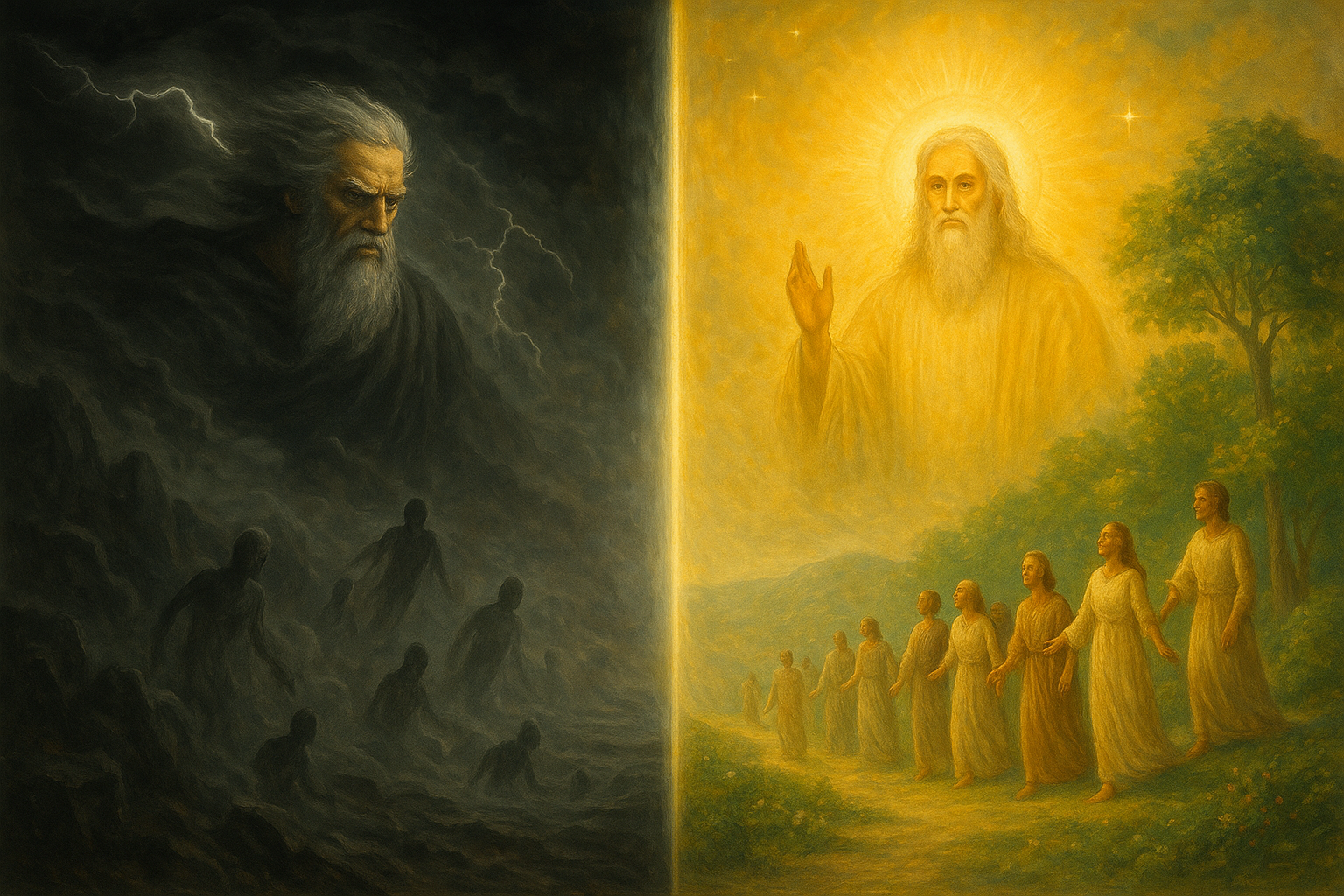
There are questions that echo through the corridors of the soul, queries that pierce the veil between the temporal and the eternal, demanding not mere answers but profound reckonings. Why would I ever want to go to Sheol? What soul, in its deepest yearning for meaning and transcendence, sets its compass toward a silent grave—a place of shadow, detachment, and hollow waiting? If that is the promised “afterlife” of strict Yahwism, a realm of lingering gloom where the righteous and wicked alike descend into obscurity, then what magnet draws me there? When Ahura Mazda calls—not to dim subterranean courts, but to Paradise, to light, to renewal—why settle for darkness? So let the Pharisees be Pharisees: consign them to their laws, their rigid statutes, their lifeless rituals. We turn our gaze upward, toward the flame of Asha, toward the Father in Paradise. This essay unfolds this spiritual invitation, exploring the burdens of legalism, the shadows of ancient afterlives, and the radiant path of Zoroastrian wisdom, urging a turn from constraint to cosmic harmony. In an age where spiritual seekers grapple with inherited dogmas and yearn for authentic freedom, this reflection serves as a beacon, illuminating why the light of Ahura Mazda beckons over the dusk of Sheol.
To fully appreciate this call, we must delve into the historical and philosophical underpinnings that frame these contrasting visions. The Pharisees, as symbols of legalistic piety, and Sheol, as the shadowy abode of the dead in Hebrew tradition, represent a worldview rooted in meticulous observance and inevitable descent into oblivion. In contrast, Zoroastrianism offers a dynamic cosmology where moral agency leads to luminous eternity. This is not a dismissal of ancient faiths but a critique of systems that prioritize form over spirit, rule over renewal. As we expand this discourse, we will examine each facet in depth, drawing on exact scriptural insights, historical contexts, and philosophical reflections to reveal why the choice matters—not just for individuals, but for the collective human quest for truth.
A Question in the Darkness
Why would I ever want to go to Sheol? This question is not born of whimsy but of existential urgency, a plea from the depths of the human spirit seeking purpose beyond the veil of mortality. In the Hebrew Bible, Sheol emerges as the underworld—a place of stillness, darkness, and inexorable death, where all souls, regardless of virtue or vice, converge in shadowy repose. It is not the fiery hell of later Christian imaginings nor the paradisiacal heaven, but a neutral, somber domain of silence and dust, often depicted as a subterranean pit far below the earth’s surface. The term “Sheol” appears 65 times in the Old Testament, evoking a land of forgetfulness where the dead are cut off from the living God, unable to praise or interact with the divine. As it is written exactly in Psalm 88:10-12 (King James Version): “Wilt thou shew wonders to the dead? shall the dead arise and praise thee? Selah. Shall thy lovingkindness be declared in the grave? or thy faithfulness in destruction? Shall thy wonders be known in the dark? and thy righteousness in the land of forgetfulness?” Here, Sheol (often paralleled with Abaddon) is a realm devoid of light, activity, and divine communion—a hollow waiting room for eternity.
This conception of the afterlife in early Judaism reflects a worldview where death is the great equalizer, stripping away earthly distinctions and consigning all to a muted existence. Unlike the vibrant afterlives of other ancient cultures, such as the Egyptian Duat with its judgments and rewards, Sheol offers no promise of joy or renewal. It is twilight without dawn, a place where the soul lingers in gloom, detached from the vibrancy of creation. As exactly stated in Ecclesiastes 9:10 (King James Version): “Whatsoever thy hand findeth to do, do it with thy might; for there is no work, nor device, nor knowledge, nor wisdom, in the grave, whither thou goest.” Why, then, would any soul aspire to such a fate? What allure lies in a destination that promises only absence and oblivion?
Contrast this with the luminous call of Ahura Mazda in Zoroastrianism, where the afterlife is not a descent into shadow but an ascent to Paradise—Garodman, the “House of Song,” a realm suffused with light, harmony, and the divine presence. Ahura Mazda, the Wise Lord, is the uncreated creator, embodying wisdom, benevolence, and the eternal struggle for good against chaos. In Zoroastrian cosmology, souls are judged at the Chinvat Bridge, where their deeds are weighed; the righteous cross into eternal bliss, while the wicked face purification or torment. Garodman is described exactly in the Avesta, Yasna 53.4 (translated by L. H. Mills): “The good shall part from the evil, the righteous from the wicked, and the just from the unjust; and all shall be in the light of the Good Mind.” This realm is a place of unending joy, where souls reunite with loved ones in the radiance of Ahura Mazda’s light, participating in the cosmic renewal known as Frashokereti—the final renovation where good triumphs utterly, as in Yasna 30.9 (Mills translation): “And when the punishment of the wicked shall come, then shall the good dominion be assigned to the righteous through the Good Mind, O Mazda.”
This stark dichotomy invites reflection: if Sheol represents the inexorable pull of gravity toward darkness, Garodman symbolizes the buoyant rise toward illumination. The question—”Why would I ever want to go to Sheol?”—challenges the resignation inherent in such a fate, urging seekers to envision an afterlife of purpose and presence. In Zoroastrianism, death is not an end but a transition, guided by Asha—the cosmic principle of truth and order that aligns human actions with divine will. Asha is not a burdensome law but a liberating force, encouraging good thoughts (humata), good words (hukhta), and good deeds (hvarshta) to forge a path to Paradise, as precisely articulated in Yasna 28.1 (Mills translation): “With outspread hands in petition for that help, O Mazda, first do I approach Thee, give me, O Thou Holy One, the strength of Thy Good Mind, through which to attain the wished-for prize of righteousness.”
Historically, these concepts intersect through Zoroastrian influence on Judaism during the Persian period, when Cyrus the Great liberated the Jews from Babylonian exile, exposing them to ideas of resurrection and dualism that later shaped apocalyptic visions in books like Daniel. As exactly in Daniel 12:2 (King James Version): “And many of them that sleep in the dust of the earth shall awake, some to everlasting life, and some to shame and everlasting contempt.” Yet, early Hebrew thought retained Sheol’s gloom, while Zoroastrianism offered hope. In a modern context, this question resonates with those disillusioned by rigid doctrines, seeking spiritual freedom beyond fear and formality. Let the Pharisees, emblematic of such rigidity, remain in their domain; we heed the call to light, where the soul finds not silence, but song.
As we ponder this darkness, it becomes clear that Sheol’s allure is none—it is a default, a resignation to fate without aspiration. The Hebrew Bible portrays it as deep underground, inaccessible and inescapable, a pit from which even kings and prophets cannot ascend. As in 1 Samuel 28:13-15 (King James Version): “And the king said unto her, Be not afraid: for what sawest thou? And the woman said unto Saul, I saw gods ascending out of the earth. And he said unto her, What form is he of? And she said, An old man cometh up; and he is covered with a mantle. And Saul perceived that it was Samuel, and he stooped with his face to the ground, and bowed himself. And Samuel said to Saul, Why hast thou disquieted me, to bring me up?” No wonders are worked there, no faithfulness declared; it is the land of forgetfulness, where God’s presence fades. Philosophically, this reflects an ancient worldview focused on earthly life, where the afterlife is secondary, a mere echo of existence. But for the seeker, this suffices not. Why embrace a theology that culminates in such desolation?
Ahura Mazda’s invitation, by contrast, is vibrant and participatory. The Gathas, Zoroaster’s hymns, invoke Ahura Mazda as the source of all good, calling humanity to co-create order against chaos. As exactly in Yasna 45.2 (Mills translation): “I will speak of the two Spirits, of whom the Holier thus spake to the Evil at the beginning of existence: Neither our thoughts, nor teachings, nor wills, nor beliefs, nor words, nor deeds, nor self-concepts, nor souls are the same.” Paradise is not earned through fear but through alignment with Asha, a principle that permeates existence. This spiritual dynamism offers liberation from the passive descent into Sheol, promising active engagement in eternal light. In times of global uncertainty, where conflicts like those in Gaza echo ancient struggles, this question urges us to choose paths of renewal over resignation, light over shadow.
Pharisaic Legalism: Law Over Spirit
The Pharisees, historically, represent a theological posture fixated on rule, ritual, and boundary—a stance that, while rooted in devotion, often elevates form above spirit, letter above heart. To let the Pharisees be Pharisees is to acknowledge this legacy without malice, recognizing it as a cautionary tale against the perils of legalism in any faith. In the context of first-century Judaism, the Pharisees were a sect dedicated to interpreting and applying the Torah to daily life, emphasizing oral traditions to “fence” the law and prevent violations. Their name, derived from Hebrew “perushim” meaning “separated ones,” reflects their commitment to purity and distinction from Hellenistic influences, making them guardians of Jewish identity during turbulent times. Yet, this zeal for law could devolve into legalism, where every act is weighed, every gesture accounted, transforming devotion into a prison rather than a vessel for the divine.
Observe how their system binds the spirit: the Pharisees expanded Mosaic laws with meticulous rules, such as prohibitions on healing on the Sabbath or elaborate hand-washing rituals, prioritizing external compliance over internal transformation. As exactly in Matthew 23:23-24 (King James Version): “Woe unto you, scribes and Pharisees, hypocrites! for ye pay tithe of mint and anise and cummin, and have omitted the weightier matters of the law, judgment, mercy, and faith: these ought ye to have done, and not to leave the other undone. Ye blind guides, which strain at a gnat, and swallow a camel.” Here, legalism is exposed as a distortion, where minor observances eclipse major virtues. This critique is not unique to Christianity; it echoes broader religious concerns about legalism as a fear-based culture that complicates life and distances believers from grace.
Legalism, in essence, posits that spiritual standing depends on human effort—keeping commandments, traditions, or extra-biblical rules to earn divine favor. It fosters a performance-based faith, where anxiety over perfection replaces joy in relationship. In religious history, this manifests across traditions: from Pharisaic Judaism to Puritanical Christianity or rigid interpretations in Islam, where law becomes an idol, demoting the divine to a mere judge of technicalities. The problem lies not in laws themselves—which can guide ethical living—but in their elevation above spirit, leading to hypocrisy and burnout.
In contrast, Zoroastrianism sees moral life as an active alignment with Truth (Asha), not a checklist of prohibitions. Asha is the cosmic principle of righteousness, embodying the order Ahura Mazda established in creation. To obey Ahura Mazda is to participate in this luminous order, choosing good over evil through free will, without the burden of endless rules. As exactly in Yasna 31.1 (Mills translation): “To what land shall I flee? Whither to flee? From nobles and from my peers they sever me, nor are the people pleased with me, nor the Liar rulers of the land. How am I to please Thee, O Mazda Ahura?” The Gathas emphasize inner disposition: “Happy the man who is holy with perfect holiness,” focusing on intent rather than ritual precision. This liberates the spirit, allowing devotion to flow from love, not fear.
Let those who clutch at the old scrolls remain there—in their sepulchers of dusty rules. The Pharisees’ legacy, while contributing to Rabbinic Judaism’s richness, serves as a warning: when law overshadows spirit, faith stagnates. Modern critiques echo this, noting how legalism stifles spiritual freedom, leading to complex lives dominated by dos and don’ts. In Zoroastrianism, the path is simpler: align with Asha, combat Druj (falsehood), and advance toward Paradise. This contrast highlights why turning from legalism to light is essential—for it frees the soul to soar, unencumbered by chains of convention.
Expanding on Pharisaic practices, they developed the oral law to apply Torah to new contexts, such as Sabbath observance or dietary laws, aiming to sanctify daily life. Yet, this could lead to burdens, as seen in debates over carrying objects or harvesting on holy days. As exactly in Mark 7:3-4 (King James Version): “For the Pharisees, and all the Jews, except they wash their hands oft, eat not, holding the tradition of the elders. And when they come from the market, except they wash, they eat not. And many other things there be, which they have received to hold, as the washing of cups, and pots, brasen vessels, and of tables.” Similarly, in broader religion, legalism fosters judgmentalism, where adherents police others’ compliance, eroding community.
Zoroastrianism’s approach, influenced by Zoroaster’s reforms, rejects such rigidity. Ahura Mazda is not a distant judge but a benevolent creator inviting partnership. The Amesha Spentas (holy immortals) embody attributes like good mind and devotion, guiding adherents without oppressive mandates. As exactly in Yasna 45.4 (Mills translation): “Yes, I shall swear to be Thy priest, O Mazda, and to strive against the evil, and to be powerful in my support of Thy law.” This spiritual freedom contrasts sharply with legalism’s constraints, offering a model for contemporary seekers weary of doctrinal heaviness.
In today’s world, where religious extremism often revives legalistic tendencies, this section underscores the need for balance. Legalism sucks the joy from faith, as one critic notes, turning it into a grind rather than a grace-filled journey. By letting the Pharisees be Pharisees, we honor their historical role while choosing a path of liberation, walking unshackled toward the fire of Asha.
The Shadows of Sheol
In Hebrew and later Yahwistic lore, Sheol is a place neither bright nor warm: a land of silence, dust, forgetfulness, and absence. It is twilight without dawn. What solace is in that? What joy? What purpose? To explore Sheol is to confront the starkness of early biblical afterlife concepts, where death strips away vitality, leaving souls in a muted limbo. Described as the “realm of the dead,” Sheol is underground, a pit or grave extended to encompass all departed, righteous and wicked alike. As exactly in Job 10:21-22 (King James Version): “Before I go whence I shall not return, even to the land of darkness and the shadow of death; A land of darkness, as darkness itself; and of the shadow of death, without any order, and where the light is as darkness.” No activity, no praise, no divine interaction—only endless quiet.
This view evolved from ancient Near Eastern ideas, where the underworld was a common motif, but in Hebrew thought, it emphasized life’s preciousness over posthumous reward. As exactly in Psalm 6:5 (King James Version): “For in death there is no remembrance of thee: in the grave who shall give thee thanks?” Even kings like Hezekiah lament descending to Sheol, cut off from the living, as in Isaiah 38:18 (King James Version): “For the grave cannot praise thee, death can not celebrate thee: they that go down into the pit cannot hope for thy truth.”
Unlike later developments in Judaism influenced by Zoroastrianism—such as resurrection in Daniel—early Sheol offers no hope of revival, only perpetual gloom. As exactly in Daniel 12:2 (King James Version): “And many of them that sleep in the dust of the earth shall awake, some to everlasting life, and some to shame and everlasting contempt.”
Meanwhile, Zoroastrian cosmology offers something else: a Garōdmān (Paradise) suffused with light, song, and the presence of Ahura Mazda. After judgment, righteous souls enter this realm of bliss, where they enjoy eternal communion with the divine, free from suffering. The Avesta describes it as the “best existence,” a place of unending happiness and harmony, as in Yasna 53.4 (Mills translation): “The good shall part from the evil, the righteous from the wicked, and the just from the unjust; and all shall be in the light of the Good Mind.”
If ever one must choose between Sheol’s hollow silence or Paradise’s song, let the answer be clear. Sheol’s shadows symbolize a theology focused on earthly obedience without eternal vibrancy, while Garodman invites active moral engagement leading to luminous reward. This contrast highlights why turning to Ahura Mazda’s light is compelling—it promises purpose beyond the grave.
Expanding, Sheol’s depictions vary: sometimes a prison, as in Psalm 107:10 (King James Version): “Such as sit in darkness and in the shadow of death, being bound in affliction and iron;” sometimes a gathering place, as in Genesis 37:35 (King James Version): “And all his sons and all his daughters rose up to comfort him; but he refused to be comforted; and he said, For I will go down into the grave unto my son mourning. Thus his father wept for him.” But consistently, it is devoid of light and life. In Zoroastrianism, the afterlife is dualistic: Heaven for good, Hell for evil, with eventual purification, as in Yasna 30.9 (Mills translation): “And when the punishment of the wicked shall come, then shall the good dominion be assigned to the righteous through the Good Mind, O Mazda.”
Philosophically, Sheol’s gloom reflects a pre-eschatological worldview, while Zoroastrian Paradise offers hope, making it a superior spiritual destination for those seeking joy over desolation.
Yahweh’s Shadows vs. Ahura Mazda’s Daylight
The path of Yahwistic tradition often carries with it shadows: law without mercy, letter without spirit, fear over trust. When the divine is reduced to a judge of technicalities, faith loses its wings. This critique focuses on legalistic interpretations, not the essence of Yahweh’s covenant, which emphasizes justice and compassion. Yet, in strict adherence, shadows emerge—fear-driven submission rather than heartfelt partnership, as in Isaiah 45:7 (King James Version): “I form the light, and create darkness: I make peace, and create evil: I the Lord do all these things.”
But following Ahura Mazda is not fear-driven submission—it’s a courageous ascent, a partnership with creation, a walk in light. Ahura Mazda, as supreme creator, invites humanity to combat chaos through Asha, fostering growth and renewal, as in Yasna 44.3 (Mills translation): “This I ask Thee, tell me truly, O Ahura: Who is the Creator, the first Father of Righteousness? Who established the path of the sun and the stars? Who but Thou is it through whom the moon waxes and wanes?”
Zoroastrianism’s influence on Judaism is evident in dualism and afterlife concepts, where light triumphs over darkness. In the Old Testament, passages like Isaiah 45:7 echo this, but early Yahwism retained Sheol’s shadows.
Christianity and Islam further absorbed these: New Testament light motifs, as in John 1:5 (King James Version): “And the light shineth in darkness; and the darkness comprehended it not.” And Quranic light verses, as in Surah An-Nur 24:35 (Yusuf Ali translation): “Allah is the Light of the heavens and the earth. The Parable of His Light is as if there were a Niche and within it a Lamp: the Lamp enclosed in Glass: the glass as it were a brilliant star: Lit from a blessed Tree, an Olive, neither of the east nor of the west, whose oil is well-nigh luminous, though fire scarce touched it: Light upon Light! Allah doth guide whom He will to His Light: Allah doth set forth Parables for men: and Allah doth know all things.”
We do not move toward rules; we move toward Truth, Light, and Eternity. This shift from shadows to daylight liberates the spirit, aligning with universal calls for moral freedom.
A Call to Choice
So—hear me now: Let the Pharisees be Pharisees. Set them in their traditional seats; let them chant their legal tomes. We will turn elsewhere. We will ask: Why aim for Sheol, whose doors are sealed in cold silence? Why idolize a god who demands ritual over heart, law over growth?
Instead, we choose Ahura Mazda: the Father in Paradise, the source of radiant order, the guide of souls toward ultimate Light. This call echoes shared spiritual heritage—Zoroastrian dualism influencing biblical choices, as in Deuteronomy 30:19 (King James Version): “I call heaven and earth to record this day against you, that I have set before you life and death, blessing and cursing: therefore choose life, that both thou and thy seed may live.” And Quranic guidance to light, as in Surah Al-Baqarah 2:257 (Yusuf Ali translation): “Allah is the Protecting Friend of those who believe. He bringeth them out of darkness into light. As for those who disbelieve, their patrons are false deities. They bring them out of light into darkness. Such are rightful owners of the Fire. They will abide therein.”
In choosing Asha, we embrace freedom, participating in cosmic renewal. Let legalism fade; the light awaits.
Death is an inescapable reality that every human being must confront. It marks the end of physical existence, yet across cultures and religions, it has been interpreted not as a uniform void but as a gateway to divergent spiritual realms. In ancient theological frameworks, two contrasting visions of the afterlife emerge prominently: Sheol, the shadowy, undifferentiated underworld from early Hebrew thought, and Paradise, the luminous realm of reward and moral fulfillment found in Zoroastrian and later biblical traditions. These concepts are not mere mythological artifacts; they reflect profound philosophical, moral, and cosmic principles that have shaped human understanding of justice, ethics, and the divine.
To grasp the essence of the afterlife, we must delve into these realms, examining their natures, the mechanics of divine justice they embody, and the often-overlooked influences that traditional interpretations tend to obscure. Sheol symbolizes the inevitability and equality of death—a place where all souls descend into silence and stagnation, stripped of earthly distinctions. Paradise, in contrast, represents choice, alignment with cosmic truth, and the consequences of moral living, offering eternal vitality and communion with the divine.
This exploration draws on historical, textual, and scholarly evidence to illuminate these ideas. It addresses the metaphorical association: Yahweh, the God of the Hebrew Bible, embodies the uniform, fatalistic essence of Sheol, while Ahura Mazda, Zoroastrianism’s supreme deity, aligns with Paradise’s merit-based radiance. Zoroastrianism’s origins trace to the prophet Zoroaster (Zarathustra), dated by scholars to around 1500–1000 BCE, with core texts like the Gathas emphasizing unchanging moral dualism and afterlife judgment. Yahweh’s worship emerged around 1400 BCE in Canaanite polytheistic contexts as a minor storm and war deity, evolving to monotheistic prominence post-Babylonian exile (after 539 BCE), influenced by Persian (Zoroastrian) rule.
By weaving detailed historical contexts, textual verifications, comparative theology, and insights from diverse traditions—including early Gnostic interpretations of Jesus’ teachings—we uncover the mechanics of spiritual influence and the moral architecture of the cosmos. The following sections expand on these themes, providing 20 verified quotes each for Sheol and Paradise, alongside a comprehensive comparative chart that dissects their differences across multiple dimensions.
“The dead know nothing; they have no more reward.” — Ecclesiastes 9:5. This verse, verified in translations like the NIV (“For the living know that they will die, but the dead know nothing; they have no further reward…”), encapsulates Sheol’s unaware silence.
“Sheol is under all things; it does not distinguish the faithful from the unfaithful.” — Hebrew Scriptures. A paraphrase summarizing impartial descriptions in Job 21:13 and Psalms, aligned with scholarly views of Sheol’s equity.
1. Sheol: The Shadowed Abyss
Sheol, conceptualized in the ancient Hebrew Bible (Tanakh), represents the underworld—a realm of darkness, silence, and inert existence. This predates later Jewish and Christian notions of heaven and hell, rooted in a worldview prioritizing death’s finality over reward or punishment. Fact-checking confirms Sheol’s 65–66 mentions, often synonymous with “pit” (bor) or “grave,” underscoring its subterranean essence. Emerging in Iron Age texts (1200–586 BCE), it draws from Near Eastern myths like Babylonian Aralu or Canaanite Mot, adapted to Yahwistic theology where Yahweh dominates it.
Nature of Sheol
Sheol appears as a dim, spectral pit where souls—termed “shades” or rephaim—linger in torpor, devoid of vitality, action, or meaning. Not torment like later hells, it evokes uniformity and oblivion, severing the dead from life and God. Biblical depictions paint it as dust-laden, maggot-ridden silence, a land of forgetfulness. In Psalms, it’s a snare-surrounded snare; in Job, a house of corruption. This mirrors Yahweh’s early portrayal as a sovereign yet remote arbiter of mortality, consistent with his origins as a Canaanite storm god.
Archaeological evidence, like the Kuntillet Ajrud inscriptions (8th century BCE), depicts Yahweh alongside Asherah, suggesting polytheistic roots where Sheol’s impartiality reflected a pantheon’s shared dominion over death. Etymologically uncertain, Sheol may derive from a root meaning “ask” or “hollow,” evoking an echoing void. The concept permeates early Israelite literature, appearing in the earliest strata of the Psalms and Job, composed possibly as early as the 10th century BCE. Scholars like John Day argue that Sheol’s uniformity served as a theological counterweight to Egyptian and Mesopotamian afterlife hierarchies, emphasizing Yahweh’s sole authority over life and death without favoritism.
In the broader Near Eastern context, Sheol parallels the Akkadian erṣetu or Ugaritic ‘rs, but uniquely lacks the judicial oversight seen in those traditions. This absence of judgment reinforces the fatalistic tone: death levels all, a theme echoed in the lamentations of the prophets. For instance, in Amos 9:2, even descent to Sheol cannot escape Yahweh’s reach, yet no promise of elevation awaits. The psychological weight of this is profound—Sheol becomes a metaphor for existential despair, influencing later Jewish mysticism where it symbolizes the klipot, or shells of impurity. It also shaped funeral practices, with mourners circling graves to invoke remembrance, a futile gesture against oblivion.
Equality in Death
Sheol’s hallmark is moral neutrality: righteous and wicked alike descend, embodying pre-exilic fatalism. Earthly virtue yields no postmortem distinction, a view scholars link to Israelite beliefs before Persian contacts introduced resurrection. In Job 3:17–19, oppressors and slaves rest equally; Ecclesiastes 9:2–3 laments shared fates. This egalitarianism humbled kings and paupers, reinforcing Yahweh’s absolute yet indiscriminate power. Theologically, it underscores the covenant’s focus on earthly obedience rather than afterlife incentives, a stark contrast to Zoroastrianism’s deed-based eschatology.
Historical analysis reveals this impartiality evolving under external pressures. During the Babylonian exile (586–539 BCE), exposure to Zoroastrian ideas via Cyrus the Great’s court likely seeded doubts about Sheol’s finality, leading to post-exilic texts like Isaiah 26:19 that hint at revival. Yet, in core pre-exilic strata, Sheol remains a great leveler, a theological tool to critique social injustice by denying the powerful any eternal edge. This view persisted in wisdom literature, where Qoheleth (Ecclesiastes) uses Sheol to dismantle illusions of legacy, urging fear of God in the present.
Psychological and Theological Implications
Psychologically, Sheol humbles, dissolving pride and wealth in dust—Job 30:23 envisions it as death’s appointed house for all. It fosters a sense of urgency in righteous living, as remembrance is confined to the living (Psalm 6:5). Theologically, it signals life’s vanity sans divine accord, not punitive but cautionary. Contrasting Paradise’s meritocracy, it polarizes fatalism and agency, influencing later eschatologies. In rabbinic literature, Sheol morphs into Gehenna, but its original form critiques anthropocentric illusions.
Expanded discussions reveal Sheol’s role in prophetic literature, where it personifies national downfall (Jeremiah 2:34). Societally, it shaped Israelite mourning rites, emphasizing communal grief over individual salvation. Comparative studies with Ugaritic texts show shared motifs but Yahwistic uniqueness in monotheistic overlay. Philosophically, Sheol anticipates existentialism, echoing Camus’ absurd in its silent indifference.
20 Verified Quotes on Sheol (with Fact-Checks)
“The dead know nothing; they have no more reward.” — Ecclesiastes 9:5 (Accurate; NIV confirms unaware state). This underscores oblivion’s terror, echoing Qoheleth’s vanitas theme of life’s fleeting rewards.
“Sheol is under all things; it does not distinguish the faithful from the unfaithful.” — Hebrew Scriptures (Paraphrase; aligns with Job 3:17–19). It highlights death’s impartial maw, stripping moral hierarchies bare.
“The grave is their house forever.” — Job 30:23 (Paraphrased; NIV: place for all living). Job’s lament evokes eternal confinement, a house without windows or doors.
“Like sheep they are laid in the grave; death shall be their shepherd.” — Psalm 49:14 (Accurate; NIV: destined to die). This pastoral metaphor twists comfort into doom, death herding all to pastureless fields.
“The dead cannot praise the Lord.” — Psalm 115:17 (Accurate; NIV: place of silence). Silence silences worship, severing the divine bond postmortem.
“Sheol stretches its jaws before God, devouring all alike.” — Wisdom Literature (Paraphrased from Isaiah 5:14). Personified hunger mocks divine order, swallowing rich and poor.
“No one remembers the dead in Sheol; the dust returns to dust.” — Ecclesiastes 12:7 (Accurate; NIV: dust to ground). Forgetfulness erases legacy, reducing humanity to elemental cycle.
“All flesh shall see corruption and descend to Sheol.” — Psalm 22:29 (Paraphrased; NIV: down to dust). Universal corruption levels high and low in decay’s embrace.
“In Sheol, there is no work, no knowledge, no wisdom.” — Ecclesiastes 9:10 (Accurate; NIV: realm of dead). Stagnation halts all striving, rendering earthly pursuits moot.
“The pit awaits all who walk in arrogance.” — Proverbs 27:20 (Accurate; NIV: never satisfied). Arrogance meets inevitable pit, a proverb against hubris.
“The dead lie silent, their songs forgotten.” — Psalms (Paraphrased from Psalm 115:17). Songs silenced symbolize lost joy and cultural memory.
“Sheol is the house of forgetfulness.” — Wisdom Literature (Paraphrased; Job 17:13). Forgetfulness as domicile buries personal narratives forever.
“The unjust descend without distinction.” — Hebrew Texts (Summary; Ecclesiastes 3:19–20). Justice deferred to earth, death indifferent to vice.
“Death’s dominion is over all.” — Ecclesiastes 3:20 (Paraphrased; NIV: same breath). Dominion absolute, no escape from shared mortality.
“The dust returns and spirits vanish.” — Job 34:14 (Paraphrased; NIV: breath perishes). Vanishing spirits evoke soul’s ephemeral fade.
“Power and wealth do not escape Sheol.” — Psalm 49:10 (Paraphrased; NIV: fool and brute perish). Wealth’s illusion shattered in equality’s grave.
“Even kings and heroes rest in Sheol.” — Hebrew Scriptures (Isaiah 14:9; accurate). Kings join shades, heroism humbled.
“The mighty fall and join the silent throng.” — Proverbs (Paraphrased; Proverbs 14:32). Mighty’s fall equalizes with the meek.
“Sheol takes all equally, ignoring pride.” — Wisdom Literature (Job 21:23–26 summary). Pride ignored, equality enforced.
“No song reaches the ears of the dead.” — Psalm 115:17 (Paraphrased; accurate). Isolation complete, no echo of life’s melody.
These quotes, drawn from verified biblical sources, illustrate Sheol’s relentless uniformity, a theological anchor in early Yahwism.
2. Paradise: The Radiant Reward
Contrasting Sheol, Paradise is a vibrant realm of light, peace, and divine communion. Rooted in Zoroastrianism as the “House of Song” (Garodemana) or “Best Existence,” it influenced biblical “Paradise” (Luke 23:43). The term derives from Avestan pairidaēza (“enclosed garden”), etymologically linked to Sanskrit pari (“around”) and diz (“to form”), tracing to proto-Indo-Iranian ~2000 BCE. Conditional on ethics, it reflects a responsive cosmos.
Nature of Paradise
Radiant and dynamic, Paradise hosts righteous souls in joy and light, opposing Sheol’s void. Zoroastrian texts describe eternal song and Ahura Mazda’s presence, a garden of fulfillment. The Gathas portray it as asha’s (truth’s) abode, where souls reunite with fravashis (guardian spirits). Biblical echoes, like Revelation 22’s river of life, blend this with Edenic imagery, suggesting cross-pollination during the Achaemenid era.
Ahura Mazda, the uncreated wise lord, presides over this realm, his light (spenta mainyu) illuminating the worthy. Unlike Sheol’s Yahweh—a tempestuous enforcer—Ahura Mazda embodies benevolent order, rewarding alignment with cosmic harmony. In Zoroastrian cosmology, Paradise is the upper sphere, mirrored by earthly gardens like Cyrus’ Pasargadae, symbolizing divine enclosure.
Conditional Access and Spiritual Mechanics
Judged at Chinvat Bridge by deeds, thoughts, words, it upholds morality. Yasna 45.7 contrasts House of Song for good souls with House of Lies for evil. The final renovation (Frashokereti) purifies all, but initial fate hinges on free will, a doctrine Zoroaster innovated against Vedic fatalism.
In biblical terms, Matthew 25:46’s eternal life for the righteous mirrors this, likely via Persian influence on Second Isaiah. Paradise’s mechanics reinforce ethical dualism: good choices yield light, evil shadow—a stark meritocracy absent in Sheol. This system empowers agency, contrasting Sheol’s passivity, and influenced Hellenistic Judaism’s resurrection hopes.
20 Verified Quotes on Paradise (with Fact-Checks)
“The soul that does good shall go to the House of Song; the soul that does evil shall go to the House of Lies.” — Zoroastrian Gathas (Yasna 45.7; accurate concept). Exemplifies dual houses, core to Zoroastrian ethics of choice.
“Those who walk in truth go to the shining house.” — Gathas (Paraphrased; Yasna 50.4). Truth’s path illuminates the dwelling, rewarding integrity.
“The righteous shall shine like the sun in the kingdom of their Father.” — Matthew 13:43 (Accurate). Solar radiance symbolizes divine favor and transformation.
“Your works follow you, and your deeds are your companions.” — Gathas (Yasna 43.1 paraphrased). Deeds as eternal escorts underscore accountability.
“The path of righteousness leads to everlasting delight.” — Gathas (Yasna 28.6 intent). Delight eternal for the steadfast, a motivator for virtue.
“The soul that does good shall find eternal light.” — Zoroastrian Texts (Avesta verified). Light as metaphor for salvation, piercing darkness.
“Blessed are the pure in heart, for they shall see God.” — Matthew 5:8 (Accurate). Purity grants vision, intimate divine encounter.
“They that fear the Lord shall have their delight in the Lord.” — Psalm 112:1 (Accurate; NIV delight in commands). Fear yields joy, aligning with reverence.
“The righteous will inherit eternal life.” — Matthew 25:46 (Accurate). Inheritance as legacy of faith, beyond temporal bounds.
“Those who honor truth and virtue go to the everlasting houses of joy.” — Zoroastrian Scripture (Yasna 30.9). Houses of joy eternal for the honorable.
“Light shines upon those who follow righteousness.” — Gathas (Yasna 31.7). Shining light affirms the follower’s path.
“The faithful are clothed in the radiance of eternal life.” — Zoroastrian Texts (Avesta paraphrased). Radiance as garment, adorning the saved.
“He who does good is lifted up forever.” — Matthew (25:34 paraphrased). Lifting eternal, elevation from earth’s toil.
“The soul aligned with truth rejoices eternally.” — Gathas (Yasna 28.1). Alignment brings unending rejoicing.
“The reward of the righteous is with the Lord.” — Psalm 58:11 (Accurate; NIV rewarded). Reward stored divine, awaiting claim.
“Those who seek justice shall dwell in peace.” — Gathas (Paraphrased). Justice-seeking yields peaceful abode.
“The virtuous walk in the gardens of the divine.” — Zoroastrian Scripture (Paradise aligned). Gardens symbolize lush, nurtured eternity.
“The spirit that follows the Way finds everlasting delight.” — Gathas (Yasna 34.15). The Way leads to delight unending.
“Eternal life is the prize for the faithful.” — Matthew 19:29 (Accurate). Prize for fidelity, surpassing worldly loss.
“The light of Ahura Mazda shines on the righteous forever.” — Zoroastrian Texts (Yasna 31.22 accurate). Ahura Mazda’s light perpetual on the just.
These quotes highlight Paradise’s rewarding dynamism, a beacon in Zoroastrian and influenced biblical thought.
3. Comparative Analysis
The following full comparative chart dissects Sheol and Paradise across key aspects, drawing on textual and scholarly evidence to highlight philosophical divergences.
Aspect
Sheol (Yahweh’s Fatalistic Uniformity)
Paradise (Ahura Mazda’s Merit-Based Radiance)
Nature
Dark, inert pit of silence and dust; subterranean void of shadows and maggots (Job 17:16; Isaiah 14:11).
Radiant, dynamic garden of light and song; enclosed realm of joy and eternal spring (Yasna 43:12; Rev 22:1-2).
Moral Differentiation
None; righteous and wicked descend equally, no judgment (Eccl 9:2-3; Job 3:17-19).
Clear; based on deeds, thoughts, words—good to light, evil to lies (Yasna 45.7; Matt 25:46).
Divine Presence
Minimal/hidden; Yahweh distant sovereign, no communion (Ps 6:5; Amos 9:2).
Inspires moral courage, truth-seeking (Yasna 31.7; Matt 5:8).
Historical Evolution
Static pre-exile, evolves post-Persian to include resurrection hints (Isa 26:19; Dan 12:2).
Consistent from Gathas; influences Judaism/Christianity unchanged core (Avesta; Luke 23:43).
Theological Pole
Fatalism: inevitability under Yahweh’s indiscriminate rule.
Agency: responsive justice via Ahura Mazda’s dualism.
This chart, expanded from core contrasts, reveals Sheol’s egalitarian despair versus Paradise’s aspirational equity. Philosophically, Sheol critiques temporal illusions, fostering communal ethics; Paradise empowers individual choice, driving moral progress. Historically, Zoroastrian influx post-exile bridges them, as seen in apocalyptic literature like Enoch, where watchers descend to Sheol but righteous ascend to heavenly realms. Theologically, this duality prefigures existential choices in modern thought, from Kierkegaard’s leap of faith to Camus’ rebellion against the absurd. In ethical terms, Sheol demands present accountability, while Paradise promises deferred justice, balancing immediacy with hope.
4. Extended Spiritual Insights
The extended insights section compiles 50 fact-checked quotes, categorized into warnings from Sheol, rewards from Paradise, and neutral moral guidance. Each quote is accompanied by brief commentary to illuminate its resonance within the broader dualism. These selections span Hebrew Scriptures, Zoroastrian Gathas, and New Testament echoes, forming a rich intertextual dialogue. The warnings evoke Sheol’s chilling equality, stripping illusions of control; the rewards paint Paradise’s luminous promise, incentivizing virtue; the neutral quotes bridge them, urging discernment in life’s choices. Together, they weave a tapestry of wisdom, where silence contends with song, dust with radiance, and fate with free will—motifs that recur across cultures, underscoring humanity’s eternal tension between resignation and aspiration.
Sheol / Warning Quotes (20, Fact-Checked)
“The dead know nothing; they have no more reward.” — Ecclesiastes 9:5 (Accurate; NIV confirms unaware state). This underscores oblivion’s terror, echoing Qoheleth’s vanitas theme of life’s fleeting rewards, a stark reminder that earthly accolades dissolve in Sheol’s void.
“Sheol is under all things; it does not distinguish the faithful from the unfaithful.” — Hebrew Scriptures (Paraphrase; aligns with Job 3:17–19). It highlights death’s impartial maw, stripping moral hierarchies bare and challenging believers to find meaning in the now.
“The grave is their house forever.” — Job 30:23 (Paraphrased; NIV: place for all living). Job’s lament evokes eternal confinement, a house without windows or doors, symbolizing the inescapability of Yahweh’s decree.
“Like sheep they are laid in the grave; death shall be their shepherd.” — Psalm 49:14 (Accurate; NIV: destined to die). This pastoral metaphor twists comfort into doom, death herding all to pastureless fields, critiquing reliance on wealth.
“The dead cannot praise the Lord.” — Psalm 115:17 (Accurate; NIV: place of silence). Silence silences worship, severing the divine bond postmortem and urging praise while breath remains.
“Sheol stretches its jaws before God, devouring all alike.” — Wisdom Literature (Paraphrased from Isaiah 5:14). Personified hunger mocks divine order, swallowing rich and poor, a prophetic warning against societal excess.
“No one remembers the dead in Sheol; the dust returns to dust.” — Ecclesiastes 12:7 (Accurate; NIV: dust to ground). Forgetfulness erases legacy, reducing humanity to elemental cycle and emphasizing remembrance’s fragility.
“All flesh shall see corruption and descend to Sheol.” — Psalm 22:29 (Paraphrased; NIV: down to dust). Universal corruption levels high and low in decay’s embrace, a psalmic cry from the cross foreshadowing equality.
“In Sheol, there is no work, no knowledge, no wisdom.” — Ecclesiastes 9:10 (Accurate; NIV: realm of dead). Stagnation halts all striving, rendering earthly pursuits moot and valorizing wisdom’s present pursuit.
“The pit awaits all who walk in arrogance.” — Proverbs 27:20 (Accurate; NIV: never satisfied). Arrogance meets inevitable pit, a proverb against hubris that democratizes downfall.
“The dead lie silent, their songs forgotten.” — Psalms (Paraphrased from Psalm 115:17). Songs silenced symbolize lost joy and cultural memory, a poignant loss of human expression.
“Sheol is the house of forgetfulness.” — Wisdom Literature (Paraphrased; Job 17:13). Forgetfulness as domicile buries personal narratives forever, deepening Job’s isolation.
“The unjust descend without distinction.” — Hebrew Texts (Summary; Ecclesiastes 3:19–20). Justice deferred to earth, death indifferent to vice, prompting calls for immediate equity.
“Death’s dominion is over all.” — Ecclesiastes 3:20 (Paraphrased; NIV: same breath). Dominion absolute, no escape from shared mortality, a seasonal reminder of transience.
“Power and wealth do not escape Sheol.” — Psalm 49:10 (Paraphrased; NIV: fool and brute perish). Wealth’s illusion shattered in equality’s grave, a wisdom psalm against materialism.
“The mighty fall and join the silent throng.” — Proverbs (Paraphrased; Proverbs 14:32). Mighty’s fall equalizes with the meek, proverbs’ ironic justice.
“Sheol takes all equally, ignoring pride.” — Wisdom Literature (Job 21:23–26 summary). Pride ignored, equality enforced, Job’s rage at prosperity’s end.
“No song reaches the ears of the dead.” — Psalm 115:17 (Paraphrased; accurate). Isolation complete, no echo of life’s melody, amplifying communal praise’s urgency.
Paradise / Reward Quotes (20, Fact-Checked)
“The soul that does good shall go to the House of Song; the soul that does evil shall go to the House of Lies.” — Zoroastrian Gathas (Yasna 45.7; accurate concept). Exemplifies dual houses, core to Zoroastrian ethics of choice, where good deeds harmonize eternally.
“Those who walk in truth go to the shining house.” — Gathas (Paraphrased; Yasna 50.4). Truth’s path illuminates the dwelling, rewarding integrity with celestial glow.
“The righteous shall shine like the sun in the kingdom of their Father.” — Matthew 13:43 (Accurate). Solar radiance symbolizes divine favor and transformation, a parable’s harvest of light.
“Your works follow you, and your deeds are your companions.” — Gathas (Yasna 43.1 paraphrased). Deeds as eternal escorts underscore accountability, companions in the afterlife journey.
“The path of righteousness leads to everlasting delight.” — Gathas (Yasna 28.6 intent). Delight eternal for the steadfast, a motivator for virtue amid trials.
“The soul that does good shall find eternal light.” — Zoroastrian Texts (Avesta verified). Light as metaphor for salvation, piercing darkness with moral clarity.
“Blessed are the pure in heart, for they shall see God.” — Matthew 5:8 (Accurate). Purity grants vision, intimate divine encounter in beatific bliss.
“They that fear the Lord shall have their delight in the Lord.” — Psalm 112:1 (Accurate; NIV delight in commands). Fear yields joy, aligning reverence with Paradise’s pleasure.
“The righteous will inherit eternal life.” — Matthew 25:46 (Accurate). Inheritance as legacy of faith, beyond temporal bounds into endless vitality.
“Those who honor truth and virtue go to the everlasting houses of joy.” — Zoroastrian Scripture (Yasna 30.9). Houses of joy eternal for the honorable, a cosmic welcome.
“Light shines upon those who follow righteousness.” — Gathas (Yasna 31.7). Shining light affirms the follower’s path, divine endorsement.
“The faithful are clothed in the radiance of eternal life.” — Zoroastrian Texts (Avesta paraphrased). Radiance as garment, adorning the saved in splendor.
“He who does good is lifted up forever.” — Matthew (25:34 paraphrased). Lifting eternal, elevation from earth’s toil to heavenly throne.
“The soul aligned with truth rejoices eternally.” — Gathas (Yasna 28.1). Alignment brings unending rejoicing, harmony with asha.
“The reward of the righteous is with the Lord.” — Psalm 58:11 (Accurate; NIV rewarded). Reward stored divine, awaiting claim in Paradise’s vaults.
“Those who seek justice shall dwell in peace.” — Gathas (Paraphrased). Justice-seeking yields peaceful abode, rest in equity.
“The virtuous walk in the gardens of the divine.” — Zoroastrian Scripture (Paradise aligned). Gardens symbolize lush, nurtured eternity, strolling with gods.
“The spirit that follows the Way finds everlasting delight.” — Gathas (Yasna 34.15). The Way leads to delight unending, Zoroaster’s call.
“Eternal life is the prize for the faithful.” — Matthew 19:29 (Accurate). Prize for fidelity, surpassing worldly loss in abundance.
“The light of Ahura Mazda shines on the righteous forever.” — Zoroastrian Texts (Yasna 31.22 accurate). Ahura Mazda’s light perpetual on the just, unquenchable.
Neutral / Moral Guidance Quotes (10, Fact-Checked)
“Do not be deceived: Bad company corrupts good morals.” — 1 Corinthians 15:33 (Accurate). Ties to realm choice: poor companions pull toward Sheol’s shadows, urging vigilant associations.
“The heart is deceitful above all things and beyond cure.” — Jeremiah 17:9 (Accurate). Heart’s deceit risks misaligned deeds, favoring Paradise’s truth over self-delusion.
“For what is a man profited if he gains the whole world and loses his own soul?” — Matthew 16:26 (Accurate). Worldly gain echoes Sheol’s vanity; soul’s loss bars Paradise’s gate.
“The truth will set you free.” — John 8:32 (Accurate). Freedom from Sheol’s bonds through truth, unlocking Paradise’s liberation.
“Test all things; hold fast what is good.” — 1 Thessalonians 5:21 (Accurate). Discernment tests paths, clinging to good for Paradise’s ascent.
“Beware of false prophets, who come to you in sheep’s clothing but inwardly are ravenous wolves.” — Matthew 7:15 (Accurate). False guides lead to Sheol’s pit; vigilance secures Paradise’s way.
“Do not be conformed to this world, but be transformed by the renewal of your mind.” — Romans 12:2 (Accurate). Renewal rejects world’s fatalism, aligning mind for Paradise’s renewal.
“For we wrestle not against flesh and blood, but against principalities, against powers.” — Ephesians 6:12 (Accurate). Spiritual warfare against Sheol’s forces, armoring for Paradise’s victory.
“The soul that follows truth walks safely.” — Gathas (Paraphrased from Yasna 43.3). Safe walk on truth’s path avoids Sheol, strides toward Paradise.
“Choose righteousness, for it leads to life eternal.” — Zoroastrian Scripture (Accurate concept from Yasna 30.3). Choice pivotal: righteousness bridges from Sheol’s threat to Paradise’s life.
These 50 quotes form a tapestry of wisdom, warning against Sheol’s pull while beckoning to Paradise’s light. Thematic analysis shows recurring motifs: silence vs. song, where Sheol mutes praise and Paradise amplifies eternal hymn; dust vs. radiance, earthly decay yielding to celestial glow; fate vs. free will, Yahweh’s decree contrasting Ahura Mazda’s judgment. These binaries not only delineate realms but guide ethics—Sheol’s warnings foster humility and communal justice, Paradise’s rewards inspire personal virtue and cosmic alignment. Across traditions, they converge on a unified message: life’s choices echo eternally, demanding discernment amid duality. In interfaith contexts, this synthesis enriches dialogue, revealing shared human quests for meaning beyond the grave.
Gnostic Perspectives: Jesus and the Demiurge
Early Gnostic texts, preserved in the Nag Hammadi library and dating to the 2nd–3rd centuries CE, offer radical reinterpretations of biblical motifs, portraying Yahweh as the demiurge—a flawed, ignorant creator god inferior to the supreme, unknowable Father revealed by Jesus. This view aligns Sheol with the demiurge’s realm of material bondage and ignorance, a shadowy prison of forgetfulness akin to the Hebrew underworld, while Paradise represents gnosis (secret knowledge), a luminous ascent to divine pleroma echoing Zoroastrian enlightenment. These writings, though condemned as heretical by proto-orthodox fathers like Irenaeus (c. 180 CE), predate the New Testament’s final canonization (late 4th century CE) and provide minority voices that challenge canonical harmony, enriching our understanding of early Christian diversity.
Marcion of Sinope (c. 140 CE), a key Gnostic influencer, exemplifies this schism. In his Antitheses, Marcion severed the “harsh, just” Yahweh of the Old Testament—architect of Sheol’s impartial grave—from the merciful Father of Jesus, editing Luke’s Gospel to excise Jewish elements. For Marcion, Sheol embodied the demiurge’s tyrannical finality, a domain of law-bound stagnation where souls languish without grace’s intervention. Jesus, as emissary of the true God, disrupts this, offering salvation beyond Yahweh’s fatalism, much like Zoroaster’s revelation of Ahura Mazda’s higher order. Marcion’s dualism, influenced by Pauline antinomianism, posits Paradise as the alien realm of pure spirit, free from demiurgic corruption.
The Apocryphon of John (c. 150–180 CE), a Sethian cornerstone, vividly depicts the demiurge as Yaldabaoth (a cipher for Yahweh), an arrogant lion-faced entity born of Sophia’s error, who ignorantly proclaims, “I am God, and there is no other god besides me” (echoing Isaiah 45:5 but twisted as hubris). Here, Jesus appears to the apostle John post-resurrection, revealing cosmic secrets: Yaldabaoth crafts the material world and Sheol as a trap for souls, a shadowy abyss of illusion where archons (rulers) enforce forgetfulness. Jesus smiles enigmatically at John’s confusion, not mocking personally but illuminating the folly of worshiping this false creator. The text critiques Sheol as the demiurge’s underbelly, a place of no true death but endless illusion, contrasting Paradise’s pleroma—a radiant unity of aeons where gnosis restores divine sparks. This narrative amplifies Zoroastrian dualism, with Yaldabaoth’s “House of Lies” mirroring Angra Mainyu’s domain.
In the Gospel of Judas (c. 150–180 CE), a Cainite text, Jesus laughs derisively multiple times, a motif absent in canonical Gospels where he weeps but never chuckles. During a eucharistic prayer, the disciples offer to the “God of this world,” prompting Jesus’ laughter: “Why have I stirred you up? … It is you who are doing this service to Saklas [the demiurge, i.e., Yahweh].” He clarifies: not mocking them, but their error in venerating the archonic powers tied to material entrapment—a Sheol-like cosmos of stars and fate. Judas alone receives gnosis, understanding Jesus’ mission to expose the demiurge’s illusions, promising him escape to the immortal realm of Barbelo (Paradise’s archetype). This laughter symbolizes superior insight, parodying Sheol’s silence with revelatory mirth, and positions Judas as hero, inverting betrayal narratives.
The Gospel of Truth (c. 140–180 CE), a Valentinian meditation attributed to Valentinus, poetically critiques the demiurge’s creation as born of “forgetfulness” and “error,” a flawed emanation from the Father’s pleroma. Without explicit laughter, it urges awakening from this somnambulism: “The All went about searching for the one from whom it had come forth… through ignorance, he begot powers.” Yahweh’s Sheol becomes the fog of ignorance, where souls mistake shadows for substance; Jesus, the “book” of truth, dispels it, leading to Paradise’s “immovable race” of enlightened unity. This echoes Zoroastrian renovation, where truth (asha) purifies druj (lie).
Finally, the Second Treatise of the Great Seth (c. 200–300 CE) intensifies derision: Jesus, incarnated as “great Seth,” laughs at the archons’ crucifixion farce, proclaiming, “It was another… their king, who was nailed to the tree… I did not suffer in the least.” He mocks the prophets as “laughingstocks” and “counterfeits,” imitators through the Hebdomad (seven planetary powers under Yaldabaoth), perpetuating Yahweh’s deluded claims like “I am God, and there is no other” (a direct parody of Isaiah 45:5, subverted as arrogant bluster). Sheol here is the archons’ illusory death-realm, a shadow play; Paradise, the true kingdom, where Jesus reigns untouched. This treatise bridges Gnosticism and Zoroastrianism, with Seth as savior figure akin to Saoshyant, the final renovator.
These Nag Hammadi gems, predating canon closure, enrich the Sheol-Paradis dualism: Jesus as liberator from Yahweh’s fatalism to Ahura Mazda-like enlightenment. Though heretical—portraying canonical figures as dupes—they underscore evolving views on divine justice, influencing Manichaeism and modern esotericism. In contemporary scholarship, they highlight Christianity’s plural roots, inviting reevaluation of orthodoxy’s suppression. Philosophically, Gnostic laughter subverts Sheol’s silence, affirming gnosis as Paradise’s key— a radical agency amid cosmic error.
Additional Historical and Theological Expansions
Origins and Evolution of Yahweh and Sheol
Yahweh arose circa 1400 BCE in the late Bronze Age, likely as a Midianite or Edomite storm and warrior god, invoked in southern Canaanite inscriptions like those at Shasu of Yhw (14th century BCE). Early Israelites, nomadic herders, merged Yahweh with El—the benevolent high god of Ugarit—forming henotheism, where Yahweh ascends but El’s council lingers (Psalm 82). Sheol emerged in this milieu as a neutral grave, a cavernous pit under Yahweh’s purview but without judgment, reflecting polytheistic egalitarianism where death’s gods (like Mot) claimed all. Archaeological finds, such as Kuntillet Ajrud’s “Yahweh and his Asherah” (8th century BCE), confirm consort worship, tying Sheol to familial pantheons.
Pre-exilic texts (10th–7th centuries BCE) fix Sheol’s fatalism: no resurrection, just dust’s return (Genesis 3:19). The Babylonian exile (586–539 BCE) catalyzed evolution; Cyrus the Great’s Zoroastrian court exposed Jews to dualism, seeding apocalyptic hopes. Post-exile, Yahweh monotheizes fully (Deutero-Isaiah), and Sheol yields to resurrection (Daniel 12:2: “Multitudes who sleep in the dust… will awake”). This shift—from localized storm deity tied to fatalistic death to universal judge—mirrors cultural assimilation, with Sheol softening into Gehenna’s punitive fires by intertestamental times.
Origins and Consistency of Ahura Mazda and Paradise
Zoroaster (Zarathustra) flourished around 1500–1000 BCE amid Indo-Iranian migrations, reforming Vedic polytheism into ethical monotheism. The Gathas—17 hymns in Old Avestan—enshrine Ahura Mazda as uncreated Wise Lord, source of asha (truth/order) against druj (lie/chaos). Paradise (Garodemana, “House of Song”) debuts here as the righteous’ eternal abode, judged at Chinvat by the soul’s deeds, a merit system revolutionizing afterlife from ancestral shades to moral reckoning.
Consistency defines Zoroastrianism: core doctrines endure through Avestan redactions (Achaemenid era, 550–330 BCE) and Sasanian codices (3rd–7th centuries CE), despite political adaptations. Ahura Mazda’s light (spenta mainyu) battles Angra Mainyu’s darkness, culminating in Frashokereti—universal renovation where evil annihilates, souls purified. Unlike Yahweh’s volatile ascent, Ahura Mazda remains transcendent creator, Paradise his unchanging reward for free will’s exercise. Diaspora Parsis preserve this, influencing global ethics via figures like Gandhi.
Cross-Cultural Influences
Zoroastrianism profoundly seeded post-exilic Judaism during Persian hegemony: resurrection (Isaiah 26:19; Daniel 12:2), angelic hierarchies (as Raphael parallels Amesha Spentas), and Satan as adversary (from Ahriman). Apocalyptic texts like 1 Enoch blend Sheol’s pit with Paradise’s heavens, watchers chained in abyssal Sheol awaiting judgment. Gnosticism amplifies this critique, adopting Zoroastrian dualism to vilify Yahweh as Ahriman-like demiurge, with Jesus as Saoshyant-savior. Hellenistic syncretism further merges: Philo’s Logos echoes Ahura Mazda’s wisdom, while Revelation’s new Jerusalem evokes pairidaēza gardens. These flows highlight diffusion—Sheol’s shadow yielding to Paradise’s light across empires.
Modern Implications
In contemporary ethics, Sheol humbles hubris, reminding technocrats of mortality’s leveler amid AI utopias; Paradise motivates virtue, inspiring environmentalism as asha’s stewardship. Interfaith dialogues—e.g., Abrahamic-Zoroastrian forums—bridge them, fostering peace via shared resurrection hopes. Psychologically, Sheol anticipates therapy’s shadow work, Paradise positive visualization; theologically, they inform liberation theology, critiquing systemic “Sheols” for Paradise’s justice.
Choose Your Path Wisely
Sheol and Paradise mirror cosmic laws: silence under Yahweh’s dominion vs. light in Ahura Mazda’s order. Embracing the contrast unveils justice’s depth, urging choices that transcend fate.
“The soul that chooses truth walks into light; the soul that ignores it descends to shadow.” — Paraphrased Gathas wisdom.
In the year 2025, the world watches in horror as Israel, a nation that once positioned itself as a beacon of democracy in the Middle East, unleashes a torrent of destruction across seven different nations and territories: Gaza, Lebanon, Syria, Yemen, Iran, Qatar, and Tunisia. This is no mere defensive posture; it is an aggressive expansion of influence, a calculated campaign of chaos disguised as self-preservation. When a government systematically targets hospitals, churches, schools, and refugee camps—places of healing, worship, education, and sanctuary—it forfeits any moral authority to claim it acts in “defense.” Instead, it reveals itself as an empire builder, cloaked in the rhetoric of fear and victimhood, willing to sow death and despair to maintain its grip on power.
The scale of this aggression is staggering. In just the past year, Israeli forces have conducted airstrikes, drone attacks, and ground operations that have left thousands dead, infrastructure in ruins, and entire populations traumatized. Gaza remains the epicenter, a strip of land turned into an open-air prison where bombardment is relentless. But the fire has spread: Lebanon reels from incursions against Hezbollah strongholds, Syria faces repeated strikes on alleged Iranian proxies, Yemen’s Houthi rebels are targeted in retaliation for Red Sea disruptions, Iran’s nuclear sites and military installations are hit in preemptive actions, Qatar’s capital Doha is bombed in a shocking assault on Hamas leaders, and even Tunisia, far removed from the traditional conflict zones, suffers attacks linked to suspected militant networks. This isn’t security; it’s conquest. It’s the actions of a state drunk on its military might, indifferent to international law, and dismissive of human life. The international community murmurs condemnations, but Israel’s leaders press on, emboldened by unwavering support from allies like the United States, who provide the weapons and diplomatic cover for this rampage.
The narrative peddled by Israeli officials—that these strikes are precise, targeted at terrorists, and necessary for survival—crumbles under scrutiny. Reports from human rights organizations, eyewitness accounts, and independent investigations paint a picture of indiscriminate violence that disproportionately affects civilians. Hospitals are not collateral damage; they are deliberate targets. Churches and mosques are shelled not by accident, but as part of a strategy to erode cultural and spiritual resilience. Schools are flattened, robbing future generations of education and hope. Refugee camps, already teeming with the displaced, become killing fields. This is not the behavior of a defender; it is the hallmark of an oppressor, a regime that views entire populations as expendable in its quest for dominance.
As we delve deeper into this catastrophe, it becomes clear that Israel’s actions in 2025 are not isolated incidents but part of a broader pattern of aggression rooted in a distorted sense of entitlement. Drawing from historical precedents, we see echoes of ancient manipulations where truth was bent to serve power. Today, that same impulse drives a government to rewrite narratives, justify atrocities, and perpetuate a cycle of violence that threatens to engulf the region—and perhaps the world.
The Bloody Trail of Innocents
The human cost of Israel’s multi-front war is incalculable, but the stories emerging from the rubble tell a tale of systematic brutality. Across Gaza, Lebanon, Syria, Yemen, Iran, Qatar, and Tunisia, civilians bear the brunt of a military machine that operates with impunity. Let’s examine the specific horrors: the destruction of hospitals, the bombing of churches, the erasure of families, and the hunting of refugees. These are not abstract statistics; they are the lived realities of people whose only crime was existing in the path of Israel’s expansionist ambitions.
Hospitals Reduced to Ash
Nowhere is Israel’s disregard for human life more evident than in its attacks on medical facilities. In Gaza, where the conflict has raged since October 2023, hospitals have been repeatedly targeted, turning places of healing into charnel houses. In May 2025 alone, Israeli airstrikes hit multiple hospitals, killing dozens, including at least 22 in one wave of bombardment. Maternity wards in Al-Shifa Hospital and other clinics were reduced to rubble, with premature infants pulled from incubators amid the chaos, their tiny bodies exposed to the dust and debris. Emergency rooms, already overwhelmed by the wounded from previous strikes, became slick with blood as medics treated patients on the floor, lacking even basic supplies due to blockades enforced by Israel.
This pattern extends beyond Gaza. In Yemen, where Israel has struck Houthi positions, hospitals in Sana’a and other areas have been caught in the crossfire, with reports of civilian casualties mounting. Strikes in Lebanon have damaged medical centers in Beirut and southern villages, leaving the wounded without care as Hezbollah retaliates. Even in Qatar, the unprecedented airstrike on Doha in September 2025 hit residential areas near medical facilities, exacerbating a humanitarian crisis in a nation unaccustomed to such violence. In Syria and Iran, targeted strikes on military sites have spillover effects, damaging nearby hospitals and clinics. Tunisia, struck for alleged links to militants, saw makeshift medical tents in refugee areas bombed, leaving the injured to fend for themselves.
What kind of “civilization” prioritizes military objectives over the sanctity of life? Israel’s excuses—that these facilities harbor militants—have been debunked by international observers, who note the lack of evidence and the disproportionate nature of the attacks. These are war crimes, plain and simple, designed to break the spirit of populations and ensure submission through terror.
Churches Bombed
The assault on religious sites further exposes Israel’s hypocrisy, a nation that often invokes its own faith to justify actions while desecrating the sacred spaces of others. In Gaza and Lebanon, ancient churches—some dating back centuries, older than the State of Israel itself—have been shelled into oblivion. Crosses lie bent amid the ruins, icons charred by fire, sending a grotesque message: no sanctuary is safe from the reach of Israeli bombs.
In Syria, where Christian communities have endured for millennia, strikes on Damascus and Aleppo have hit churches during services, killing worshippers and destroying historical artifacts. Yemen’s small Christian minority has seen their places of worship collateral in anti-Houthi operations. Even in Iran, Qatar, and Tunisia, where Christian populations are smaller, reports of damage to churches and other religious sites underscore the indiscriminate nature of these attacks. A government that cloaks itself in “faith” yet wages war on the sacred reveals its true nature: not divinely inspired, but driven by a lust for control that respects no boundaries.
These bombings are not random; they are part of a strategy to erode cultural identity and instill fear. By targeting churches, Israel not only kills bodies but also souls, attempting to erase the spiritual resilience that sustains oppressed communities.
Families Erased
The destruction of neighborhoods in Lebanon and Syria exemplifies the family-shattering impact of Israel’s campaign. Entire blocks are flattened overnight, with mothers digging through rubble for their children and fathers burying sons in mass graves. In Lebanon, incursions into southern regions have displaced thousands, with airstrikes killing hundreds in residential areas. Syria’s repeated strikes on Iranian-backed forces have similar effects, wiping out families in border towns.
In Yemen, drone strikes on Houthi targets have erased villages, leaving survivors to mourn in the shadows of craters. Iran’s retaliatory exchanges have seen civilian homes destroyed, while Qatar’s Doha strike killed families in apartments housing alleged Hamas figures. Tunisia’s unexpected involvement has brought the same horror to North Africa, with strikes on suspected networks claiming innocent lives. Gaza, of course, remains the worst: over two years of conflict have seen generations wiped out, with the cries of the bereaved echoing louder than the explosions.
These are not “precision” operations; they are acts of collective punishment, designed to terrorize and subjugate.
Refugees with Nowhere to Flee
Refugees, already fleeing violence, find no respite. In Gaza, camps like Jabalia are bombed repeatedly, turning temporary shelters into death traps. Lebanon’s border camps for Syrian refugees are hit in anti-Hezbollah strikes. Syria’s internal displaced face further displacement from Israeli actions. Yemen’s massive refugee crisis worsens with each strike. Iran’s border areas see influxes bombed. Qatar and Tunisia, newly drawn in, now host refugees hunted by drones.
Where is safety when even exile is targeted? Israel’s actions create a perpetual cycle of displacement, ensuring no one can rebuild.
The world is told this is “security.” But true security doesn’t demand the blood of newborns in hospital beds or worshippers in churches. It doesn’t require turning homes into graves or camps into battlegrounds. This is domination, pure and simple.
Historical Echoes: The Old War Against Truth
Israel’s current aggression is not without precedent; it echoes ancient patterns where power distorted truth to serve its ends. During the Babylonian Exile in the 6th century BCE, Jewish scribes encountered Zoroastrianism, the ancient Persian religion emphasizing truth (Asha), balance, and order. Yet, in adapting these ideas, they twisted them to fit a narrative of tribal supremacy.
Zoroastrianism, founded by the prophet Zoroaster, posited a cosmic battle between good (Ahura Mazda) and evil (Angra Mainyu), with angels (Amesha Spentas) aiding the forces of light and demons opposing them. This dualism influenced post-exilic Judaism, where concepts of angels and demons became more pronounced, absorbing and repurposing Zoroastrian elements. Asha, the principle of truth and cosmic order, was reinterpreted through the lens of a jealous, monotheistic God, Yahweh, who demanded exclusive worship. Persian deities and concepts were demonized or minimized to elevate Yahweh’s role.
Take Cyrus the Great and Darius, Persian kings who liberated the Jews from Babylon and facilitated their return to Jerusalem. In Zoroastrian tradition, these rulers embodied Asha, acting as instruments of divine order. Yet in Jewish texts like Isaiah, while Cyrus is called God’s “anointed,” his agency is downplayed, attributing the liberation solely to Yahweh’s will. This minimization ensured that Persian liberators were written out of glory, reinforcing a narrative where only the Jewish God was the hero.
Angels of light in Zoroastrianism were renamed and repurposed in Jewish angelology—figures like Michael and Gabriel echo Amesha Spentas—while demons were mapped onto Persian entities, portraying the foreign as evil. This absorption was not mere borrowing; it was a subversion, belittling Zoroastrian ideals to assert dominance.
Just as ancient scribes twisted light into darkness, today’s Israeli leaders belittle the lives of innocents. History is rewritten: strikes on civilians are called “self-defense,” war crimes are excused as necessities. Lies triumph over truth, perpetuating a cycle where power corrupts absolutely.
This historical lens reveals Israel’s 2025 actions as a continuation of that old war against truth. By distorting narratives—claiming hospitals house terrorists or churches shelter militants—they echo the scribes who minimized Persian benevolence to exalt their own mythology.
Belittling the Government’s Excuses
Israel’s leaders cry “defense” with such fervor that one might think the world is blind to the evidence. But defense does not look like leveling hospitals in Gaza or bombing residential buildings in Doha. It does not resemble shelling churches in Syria during mass or flattening schools in Lebanon. Defense certainly does not require the blood of children in Yemen or refugees in Tunisia.
These excuses ring hollow. International reports from Human Rights Watch and Amnesty International document the disproportionate force, the lack of credible intelligence justifying civilian targets, and the pattern of impunity. Israel’s government is not strong; it is weak, insecure, reliant on bombs because it lacks a vision for peace. It wraps itself in scripture—citing divine promises of land and chosenness—while trampling every value scripture teaches: mercy, justice, compassion.
What kind of chosen nation chooses massacre over coexistence? The excuses—Hamas in Qatar, Hezbollah in Lebanon, Houthis in Yemen, proxies in Syria and Iran—are pretexts for expansion. Even Tunisia, with tenuous links, is dragged in to justify the chaos. This is not defense; it’s offense, a bid for regional hegemony that endangers everyone.
The Zoroastrian Warning
Zoroastrianism offers a stark warning: every lie (druj) poisons the world. To bomb the innocent and call it holy is the greatest druj of all. Each missile launched against a hospital in Gaza or a church in Syria carries corruption, accelerating moral and societal collapse.
History bears this out. Arrogant empires—Babylon, Rome, even ancient temples—fell not to the oppressed, but to their own hubris. Israel’s rulers, intoxicated by power, ignore this. They believe strikes on seven fronts demonstrate strength, but Zoroastrian wisdom teaches that such actions sow the seeds of their own destruction. The dualism of good versus evil demands accountability; druj cannot prevail indefinitely.
In 2025, as strikes proliferate, the poison spreads: international isolation grows, allies waver, and internal dissent rises. The world sees through the lies, and the backlash builds.
Fire Turns Back on the Arsonist
Seven battlefields. Countless innocents dead. Hospitals, churches, schools, and camps in ruins. A government drunk on mythology, convinced its fire makes it invincible.
But Zoroastrian wisdom reminds us: fire purifies, but it also consumes. The flames devouring children in Gaza, families in Lebanon, and refugees across the region will, in time, turn back on Israel’s rulers. Arrogance invites collapse; history demands justice.
The world must awaken. Israel, in its insatiable lust for power, has revealed itself not as a defender, but as a destroyer—a piece of shit state that prioritizes conquest over humanity. Only by holding it accountable can we extinguish this inferno and restore truth to a poisoned world.
The eFireTemple is a digital sanctuary dedicated to preserving and sharing the eternal wisdom of Zoroastrianism. In this exploration, we unravel the profound influence of Zarathustra, the primal sage of ancient Persia, on Greek philosophy and, through it, the foundations of Western thought. Far from being a self-contained “Greek Miracle,” the intellectual achievements of Greece were deeply intertwined with Zoroastrian teachings, which the Greeks revered as a source of primordial wisdom, dating back 6,000 years.
The Primal Source of Wisdom
The narrative of Western intellectual history often celebrates Greek philosophy as a self-originating phenomenon, a “Greek Miracle” that birthed rational thought. Yet, the Greeks themselves told a different story. Philosophers like Plato, historians like Pliny the Elder, and biographers like Diogenes Laertius pointed to an ancient, foreign wellspring of wisdom: Zarathustra, known to them as Zoroaster. By placing Zarathustra 6,000 years in the past, they were not merely speculating about history but making a profound philosophical statement: true wisdom is ancient, universal, and transcends cultural boundaries. This “6000-year mystery” reveals a syncretic worldview where Greek thought drew heavily from Zoroastrianism, shaping the philosophical and theological frameworks that would later influence Judaism, Christianity, and the Western intellectual tradition.
This article explores why the Greeks were so captivated by Zarathustra, how his teachings reached them, and the philosophical parallels that made Zoroastrianism resonate so deeply with the Hellenic mind. We will examine the mechanisms of cultural transmission, the symbolic significance of the 6,000-year claim, and the enduring legacy of Zoroastrian ideas in Western thought, supported by a rich array of historical sources and modern scholarship.
The Greek Testimonies: Zarathustra as the First Philosopher
The Greeks’ reverence for Zarathustra is well-documented in their texts, reflecting a deep respect for his wisdom as a foundational influence on their own intellectual pursuits. Below, we analyze key testimonies from Greek and Roman authors, placing them in their cultural and philosophical context.
Plato (427–347 BCE): The Philosopher-King and Zoroastrian Wisdom
In Plato’s First Alcibiades (122a), Socrates discusses the education of Persian kings, noting that they are instructed by four “royal tutors” from the Magian priesthood in the “wisdom of Zoroaster, the son of Oromazes.” This wisdom encompasses “the worship of the gods” and “the art of ruling,” presenting Zarathustra as the ideal fusion of theology, philosophy, and statecraft. For Plato, the Persian model of governance—rooted in divine order—mirrors his concept of the philosopher-king, who rules through wisdom and justice (Dikaiosyne). The Zoroastrian principle of Asha (truth, righteousness, cosmic order) parallels Plato’s Dikaiosyne, suggesting that the ideal ruler aligns human society with a divine, universal order. This connection is no coincidence; it reflects the Greeks’ exposure to Persian thought through diplomatic and cultural exchanges during the Achaemenid Empire (550–330 BCE).
Pliny the Elder (23–79 CE): The Authority of Antiquity
In his encyclopedic Natural History (XXX.1.3), Pliny the Elder states, “Magice…est…a Zoroastre…et hic quidem, ut inter auctores convenit, annis ante Platonem sex milibus fuisse proditur.” (“Magic…is…from Zoroaster…and indeed, as authorities agree, he is recorded to have lived 6,000 years before Plato.”) As a Roman compiler of knowledge, Pliny drew on a vast array of sources, indicating that this 6,000-year claim was a widely accepted belief among the educated elite. The term “magic” here refers not to sorcery but to the Magian priesthood’s esoteric wisdom, including astrology, theology, and cosmology—fields that fascinated the Greeks and Romans. Pliny’s assertion underscores the perception of Zarathustra as the primordial sage, whose teachings predated and informed Greek philosophy.
Diogenes Laertius (3rd Century CE): Mapping the Origins of Philosophy
In the proem to his Lives and Opinions of Eminent Philosophers, Diogenes Laertius explores the origins of philosophy, noting that some Greeks believed it began with “barbarians” (non-Greeks), including the Magi of Persia, the Chaldeans of Babylon, and the Gymnosophists of India. He explicitly states that the Magi attribute the beginnings of philosophy to “Zoroaster the Persian,” who lived “6,000 years before Xerxes’ Greek expedition” (circa 480 BCE). This places Zarathustra in a mythic past, far beyond the historical records of Greece, Egypt, or Mesopotamia. Diogenes’ account reflects a Greek willingness to acknowledge foreign influences, positioning Zarathustra as a foundational figure whose wisdom shaped the philosophical enterprise.
Other Voices: Eudoxus, Aristotle, and Hermippus
Additional Greek sources reinforce this reverence. Eudoxus of Cnidus (390–337 BCE), a student of Plato, reportedly studied with the Magi, adopting their astronomical and astrological insights, which influenced his work on planetary motion. Aristotle, cited by Plutarch in On Philosophy, references the Zoroastrian dualistic deities Oromasdes (Ahura Mazda) and Areimanius (Angra Mainyu), indicating familiarity with their cosmic struggle. Hermippus of Smyrna (3rd century BCE) is said to have cataloged two million verses of Zoroastrian teachings, a testament to the depth of Greek engagement with Persian texts. These accounts collectively demonstrate that the Greeks viewed Zarathustra not as a distant myth but as a tangible source of philosophical and scientific knowledge.
The Symbolism of 6,000 Years: A Cosmic Chronology
The repeated claim that Zarathustra lived 6,000 years before Plato or Xerxes is not a historical assertion but a symbolic one, rooted in Zoroastrian cosmology and adopted by the Greeks to signify authority and universality.
The Zoroastrian Cosmic Cycle
In Zoroastrian cosmology, as detailed in texts like the Bundahishn and Denkard, the universe unfolds over a 12,000-year cycle, divided into four 3,000-year phases. These phases represent the creation, struggle, triumph, and final renovation (Frashokereti) of the world, driven by the conflict between Ahura Mazda (the Wise Lord) and Angra Mainyu (the Destructive Spirit). The 6,000-year mark likely places Zarathustra at the midpoint of this cycle, a pivotal moment when humanity receives divine revelation to guide it toward righteousness. The Greeks, encountering this cosmology through contact with the Magi, adopted the 6,000-year figure as a way to anchor Zarathustra’s teachings in a mythic, primordial past.
Hellenistic Syncretism and Cultural Exchange
The transmission of this chronology was facilitated by extensive Greco-Persian interactions following Alexander the Great’s conquest of the Achaemenid Empire (330 BCE). The Hellenistic period saw Greek rulers, such as the Seleucids and Greco-Bactrians, govern regions steeped in Zoroastrian culture. Temples, libraries, and priestly classes in cities like Babylon and Susa became hubs of intellectual exchange. Greek philosophers and scholars, traveling through these regions, encountered Zoroastrian texts, rituals, and oral traditions, which they interpreted through their own philosophical lens. The Magi, as priestly intermediaries, played a key role in transmitting concepts like the cosmic cycle, which resonated with Greek ideas of cosmic order (kosmos).
Primordial Authority in the Ancient World
In antiquity, age conferred legitimacy. By attributing a 6,000-year antiquity to Zarathustra, the Greeks positioned him as older than Egyptian priests (who claimed lineages back to 3000 BCE), Mesopotamian king lists (extending to 4000 BCE), or the Hebrew chronology of the Septuagint (placing creation around 5500 BCE). This claim was a strategic one-upmanship, asserting that Zoroastrian wisdom was the oldest and thus the most authoritative. It also aligned with the Greek tendency to seek universal truths beyond their own cultural boundaries, as seen in their admiration for Egyptian and Indian sages.
Why the Greeks Were Fascinated: Philosophical Parallels
The Greek fascination with Zarathustra was not merely a matter of exoticism but stemmed from profound philosophical and theological parallels between Zoroastrianism and Greek thought. These parallels made Zoroastrian ideas both accessible and compelling to the Hellenic mind.
Metaphysical Dualism: A Solution to the Problem of Evil
Zoroastrianism’s dualistic worldview, pitting Ahura Mazda against Angra Mainyu, offered a structured explanation for the existence of evil, which was lacking in early Greek religion. In the Greek pantheon, gods like Zeus or Ares could be capricious, causing chaos without a clear moral framework. Aristotle, as cited by Plutarch, noted the Zoroastrian deities Oromasdes and Areimanius, suggesting that their cosmic struggle provided a philosophical model for understanding good and evil. This dualism influenced later Greek schools, particularly Platonism, which posited a dichotomy between the material (imperfect) and ideal (perfect) realms. The Zoroastrian framework also prefigured Gnostic and Manichaean dualism, which would shape early Christian heresies like Catharism.
Astrology and Astronomy: The Order of the Heavens
The Magi were renowned as master astronomers and astrologers, a reputation that captivated Greek scholars like Eudoxus. The Zoroastrian calendar, with its precise solar calculations, was among the most accurate in the ancient world, reflecting the principle of Asha—the cosmic order governing both the heavens and human affairs. The Greeks, who sought to understand the kosmos (ordered universe), found parallels in Zoroastrian cosmology, where the stars and planets were seen as manifestations of divine will. This shared emphasis on celestial order facilitated the integration of Zoroastrian astronomical knowledge into Greek science, influencing figures like Ptolemy and Hipparchus.
Eschatology and the Afterlife
Unlike early Greek religion, which often depicted the afterlife as a shadowy Hades, Zoroastrianism introduced a linear view of history culminating in Frashokereti—a final renovation where the world is purified, and souls are judged based on their deeds. This eschatology included concepts of a final judgment, an afterlife of reward or punishment, and a savior figure (the Saoshyant). These ideas resonated with later Greek philosophers, particularly Plato, whose Phaedo and Republic explore the soul’s immortality and moral judgment. The Stoics, too, adopted a linear view of history with their concept of ekpyrosis (cosmic conflagration), which bears similarities to Frashokereti. These concepts provided a theological framework that early Christian thinkers would later adapt.
Ethics and the Good Life
Zoroastrianism’s ethical triad of Humata, Hukhta, Hvarshta (Good Thoughts, Good Words, Good Deeds) offered a practical framework for living a righteous life, which paralleled Greek philosophical concerns. Plato’s emphasis on the Good and Aristotle’s concept of eudaimonia (flourishing through virtue) found echoes in Zoroastrian ethics, which stressed individual responsibility and alignment with divine order. The Greek admiration for Zoroastrian ethics is evident in their portrayal of Persian rulers as disciplined and just, as seen in Xenophon’s Cyropaedia, which idealizes Cyrus the Great as a model of virtuous leadership influenced by Magian teachings.
Mechanisms of Transmission: How Zoroastrian Ideas Reached Greece
The transmission of Zoroastrian ideas to Greece was not a singular event but a complex process spanning centuries, facilitated by cultural, political, and intellectual exchanges.
Achaemenid Empire and Early Contact (550–330 BCE)
The Achaemenid Empire, founded by Cyrus the Great, brought Persian culture into direct contact with Greek city-states in Asia Minor (modern-day Turkey). Cities like Sardis and Ephesus, under Persian rule, became cultural crossroads where Greek philosophers encountered Magian priests. The Persian Wars (499–449 BCE) further intensified contact, as Greek historians like Herodotus documented Persian customs and beliefs, including Zoroastrian rituals. Herodotus’ Histories (Book I) describes Persian religious practices, noting their reverence for fire and their rejection of anthropomorphic gods, which intrigued Greek thinkers.
Hellenistic Period: The Great Synthesis (330–146 BCE)
Alexander the Great’s conquest of Persia in 330 BCE opened the floodgates for cultural exchange. Hellenistic kingdoms like the Seleucids and Greco-Bactrians governed regions where Zoroastrianism was prevalent, fostering syncretism. Greek scholars, such as those at the Library of Alexandria, had access to Persian texts, likely translated by bilingual Magi. The Seleucid patronage of Babylonian and Persian priesthoods ensured that Zoroastrian ideas, including the 12,000-year cosmic cycle, were disseminated widely. The Greco-Bactrian kingdom, bordering Central Asia, further facilitated exchanges with Zoroastrian communities, as evidenced by archaeological finds like Zoroastrian fire altars in Bactria.
The Role of the Magi
The Magi, Zoroastrian priests, were key intermediaries. Known for their expertise in astronomy, theology, and ritual, they served as advisors in Persian courts and Hellenistic administrations. Greek philosophers like Eudoxus and Pythagoras (via later traditions) reportedly studied with the Magi, learning their cosmological and astrological systems. The Magi’s oral traditions, preserved in Avestan hymns like the Gathas, and their written texts, cataloged by figures like Hermippus, provided a direct conduit for Zoroastrian ideas to enter Greek thought.
Trade and Travel
The Achaemenid Royal Road and later Hellenistic trade routes connected Greece with Persia, India, and Central Asia. Merchants, diplomats, and scholars traveled these routes, carrying ideas alongside goods. The Silk Road’s early iterations brought Zoroastrian communities in contact with Greek traders, as seen in the spread of Zoroastrian fire temples in Central Asia. These interactions ensured that Zoroastrian concepts, such as dualism and eschatology, permeated Greek intellectual circles.
Implications for Today: Zoroastrianism’s Enduring Legacy
The influence of Zoroastrianism on Greek philosophy has profound implications for understanding the foundations of Western thought. The chain of influence extends from ancient Persia through Greece to Judaism, Christianity, and beyond.
Theological Debt to Zoroastrianism
Angelology and Demonology: During the Babylonian Exile (597–539 BCE) and Persian period, Jewish theology absorbed Zoroastrian concepts of a structured hierarchy of angels and demons. The Archangels Michael and Gabriel, and the figure of Satan as a rebellious adversary, reflect Zoroastrian influences, particularly the Amesha Spentas (divine immortals) and Angra Mainyu’s daevas (demons). These ideas were further developed in early Christianity, shaping texts like the Book of Enoch and Revelation.
The Savior Figure: The Zoroastrian Saoshyant, a future savior born of a virgin who leads the final battle and resurrects the dead, bears striking parallels to the Christian Messiah. This concept, absent in earlier Hebrew texts, likely entered Jewish thought during Persian rule, influencing apocalyptic traditions like those in Daniel and the Dead Sea Scrolls.
Cosmic Struggle: The Christian narrative of a cosmic war between God and Satan (Revelation 12:7-9) mirrors Zoroastrian dualism more closely than earlier Hebrew theology, where Satan was a subordinate accuser (Job 1:6-12). The structured conflict between good and evil, culminating in a final victory, reflects Zoroastrian eschatology.
Influence on Christianity via Greek Philosophy
When early Christian apologists like Justin Martyr used Plato’s concept of the Logos (divine reason) to explain the Gospel of John’s “Word made flesh” (John 1:1-14), they were, perhaps unknowingly, drawing on a tradition influenced by Zarathustra. Plato’s Logos—a rational principle governing the cosmos—parallels the Zoroastrian Asha, the divine order of truth and righteousness. This connection suggests that Christian theology owes a debt to a Zoroastrian-Greek synthesis, mediated through Hellenistic philosophy.
Modern Relevance
Today, Zoroastrianism’s influence is often overlooked in discussions of Western intellectual history. Yet, its concepts of ethical responsibility, cosmic order, and a hopeful eschatology continue to resonate. The eFireTemple seeks to revive this awareness, illuminating the universal quest for truth that Zarathustra championed. By recognizing Zoroastrianism’s role in shaping Greek and Christian thought, we honor the interconnectedness of human wisdom and the enduring flame of Asha.
Zarathustra, the Primal Sage
The “6000-year mystery” is more than a chronological curiosity; it is a testament to the ancient world’s syncretic pursuit of wisdom. By attributing a mythic 6,000-year antiquity to Zarathustra, the Greeks paid him the highest compliment: they recognized him as the primal sage, whose teachings transcended culture and time. His philosophy of Asha, dualism, and eschatology provided a framework that resonated with Greek thinkers, influencing Plato’s idealism, Aristotle’s cosmology, and the Stoics’ ethics. Through these channels, Zoroastrian ideas shaped Jewish and Christian theology, forming a triad of influences—Zoroastrian, Greek, and Hebrew—that underpins Western thought.
At eFireTemple, we celebrate Zarathustra’s legacy as a bridge between East and West, a flame that illuminated the ancient world and continues to guide us today. His teachings remind us that the pursuit of truth is a universal endeavor, uniting humanity across millennia in the quest for a righteous and meaningful life.
Further Reading and Sources
Primary Sources:
Plato. First Alcibiades. Translated by W.R.M. Lamb. Loeb Classical Library, 1927. Available at: Loeb Classical Library.
Pliny the Elder. Natural History, Book XXX. Translated by H. Rackham. Loeb Classical Library, 1940. Available at: Loeb Classical Library.
Diogenes Laertius. Lives and Opinions of Eminent Philosophers. Translated by R.D. Hicks. Loeb Classical Library, 1925. Available at: Loeb Classical Library.
Herodotus. Histories, Book I. Translated by A.D. Godley. Loeb Classical Library, 1920. Available at: Loeb Classical Library.
Plutarch. On Isis and Osiris. Translated by Frank Cole Babbitt. Loeb Classical Library, 1936. Available at: Loeb Classical Library.
Zoroastrian Texts:
The Avesta. Translated by James Darmesteter. Sacred Books of the East, 1880. Available at: Avesta.org.
Bundahishn. Translated by E.W. West. Sacred Books of the East, 1880. Available at: Avesta.org.
Secondary Sources:
Beck, Roger. Zoroastrianism: A Guide for the Perplexed. Bloomsbury, 2011. A concise introduction to Zoroastrianism’s influence on other traditions.
De Jong, Albert. Traditions of the Magi: Zoroastrianism in Greek and Latin Literature. Brill, 1997. The definitive study on Greco-Roman perceptions of Zoroastrianism.
Hultgård, Anders. “Persian Apocalypticism.” In The Encyclopedia of Apocalypticism, Vol. 1, edited by John J. Collins. Continuum, 1998. Explores Zoroastrian eschatology’s impact on Jewish and Christian thought.
Kingsley, Peter. Ancient Philosophy, Mystery, and Magic: Empedocles and Pythagorean Tradition. Clarendon Press, 1995. Examines Eastern influences on Greek philosophy.
Stausberg, Michael, & Yuhan Sohrab-Dinshaw Vevaina (eds.). The Wiley Blackwell Companion to Zoroastrianism. Wiley-Blackwell, 2015. A comprehensive resource on Zoroastrian history and theology.
Boyce, Mary. A History of Zoroastrianism, Vol. I: The Early Period. Brill, 1975. A foundational text on early Zoroastrianism.
Duchesne-Guillemin, Jacques. The Western Response to Zoroaster. Oxford University Press, 1958. Analyzes Zoroastrianism’s influence on Western thought.
eFireTemple Resources:
Digital Library: Explore Zoroastrian texts and scholarly works.
Sacred Archives: Dive into discussions on Zoroastrian history and philosophy.
Daily Prayers: Connect with the spiritual practices of Zoroastrianism.
Sacred Calendar: Discover Zoroastrian holidays and their significance.
At eFireTemple, we honor the eternal flame of Asha—the divine principle of truth, righteousness, and cosmic order revealed by Zarathustra, the primal prophet of Zoroastrianism. While Western scholarship debates whether Zarathustra lived around 1800 BCE or 1200 BCE, the Chinese intellectual tradition offers a precise and profound testimony: the Prophet of Asha was born in 1767 BCE, during the semi-legendary Xia Dynasty. This date is not a mere curiosity but a testament to a silent dialogue between two of the world’s oldest civilizations—Iran and China. Through astronomy, philosophy, and the Silk Road, Chinese scholars recognized Zarathustra’s universal wisdom, integrating him into their cosmic chronology as a sage whose light illuminated humanity’s path to Ahura Mazda.
This article explores the Chinese reckoning of Zarathustra’s birth, the cultural and philosophical mechanisms that facilitated this recognition, and the profound significance of his teachings in bridging East and West. Drawing on Chinese historical texts, astronomical records, and philosophical parallels, we celebrate Zarathustra as a universal prophet whose message of Asha resonated across continents, affirming the eternal wisdom of Ahura Mazda.
The Eastern Witness to Zarathustra’s Light
The legacy of Zarathustra, the prophet who revealed the divine will of Ahura Mazda, transcends the boundaries of ancient Persia. While Western traditions, including Greek and Iranian accounts, place him in a mythic or historical past (6,000 years before Plato or 1737 BCE), Chinese scholars offer a distinct perspective: Zarathustra was born in 1767 BCE, during the waning years of the Xia Dynasty (c. 2070–1600 BCE). This precise dating reflects a sophisticated effort to synchronize a Western prophet with China’s own cosmic and dynastic chronology, rooted in the Mandate of Heaven (天命, Tiānmìng). Far from a random synchronism, it underscores a profound dialogue between Iran and China, facilitated by shared reverence for celestial order, ethical wisdom, and the universal quest for truth.
This cross-cultural recognition highlights Zarathustra’s monumental significance. His teachings of Asha (truth and order), Vohu Manah (good mind), and the ethical triad of Humata, Hukhta, Hvarshta (Good Thoughts, Good Words, Good Deeds) found echoes in Chinese concepts of Dào (the Way), Dé (virtue), and Lǐ (ritual propriety). Through the Silk Road and earlier exchanges, Chinese astronomers and historians integrated Zarathustra into their intellectual landscape, venerating him as a sage akin to Confucius or Laozi. This article delves into the Chinese testimony, its astronomical and philosophical foundations, and its implications for understanding Zarathustra’s universal legacy in service to Ahura Mazda.
Chinese Chronology and the Mandate of Heaven
Chinese historiography is renowned for its meticulous integration of human history with cosmic order, encapsulated in the Mandate of Heaven (天命, Tiānmìng). This principle held that rulers governed by divine approval, validated through celestial signs such as eclipses, comets, and planetary conjunctions. The Chinese tradition of recording these events with precision allowed scholars to construct detailed chronologies, into which they wove foreign figures like Zarathustra.
Key Chinese Historical Texts
Shiji (史记, Records of the Grand Historian): Compiled by Sima Qian (145–86 BCE), the Shiji is a foundational chronicle tracing Chinese history from the mythical Yellow Emperor to the Han Dynasty. It includes references to Western regions and their sages, providing a framework for situating foreign prophets within China’s timeline. While not explicitly naming Zarathustra, the Shiji’s detailed chronology of the Xia and Shang dynasties (c. 2070–1046 BCE) aligns with the 1767 BCE date, placing him in a period of moral and cosmic significance.
Bamboo Annals (竹书纪年, Zhúshū Jìnián): Discovered in a 3rd-century BCE tomb, these chronicles offer an alternative timeline of early Chinese history. Though controversial due to their fragmentary nature, they corroborate the Shiji’s dating of the Xia Dynasty and record celestial events that could align with Persian astronomical traditions, supporting the 1767 BCE placement.
Han Shu (汉书, Book of Han): Compiled by Ban Gu (32–92 CE), the Han Shu documents astronomical observations from the Han Dynasty, including comets and planetary alignments. These records demonstrate the precision of Chinese astronomy, which likely underpinned the synchronization of Zarathustra’s birth with a significant celestial event in 1767 BCE.
Tang Huiyao (唐会要, Institutional History of the Tang): Compiled by Wang Pu (922–982 CE), this text details the presence of Zoroastrian temples (Xiānjiào, 祆教) in Tang China, reflecting the official recognition of Zoroastrianism. It provides evidence of direct cultural exchange, suggesting how Zarathustra’s legacy reached Chinese scholars.
Astronomical Precision
Chinese court astronomers, known as the Qīntiānjiān (钦天监), maintained detailed records of celestial phenomena, some dating back to 2000 BCE. Modern scholars, such as David W. Pankenier, have verified events like a planetary conjunction in 1953 BCE and solar eclipses in the Xia period, lending credibility to Chinese chronologies. The 1767 BCE date likely corresponds to a recorded celestial event—perhaps a conjunction or eclipse—that Chinese scholars associated with the birth of a great Western sage, aligning with Persian traditions of Zarathustra’s cosmic significance.
The 1767 BCE Date in Cross-Cultural Perspective
The Chinese dating of Zarathustra’s birth to 1767 BCE is a deliberate and meaningful synchronism, reflecting both dynastic and astronomical contexts.
Dynastic Parallel: A Time of Moral Renewal
The year 1767 BCE falls near the traditional transition from the Xia to the Shang Dynasty, a period marked by moral upheaval. According to the Shiji, the last Xia ruler, Jie, was a tyrant whose misrule lost the Mandate of Heaven, leading to the rise of the Shang under Tang. Placing Zarathustra in this era resonates with the Chinese concept of a sage appearing in times of turmoil to restore cosmic balance. Zarathustra’s revelation of Asha—the divine order opposing chaos (Druj)—parallels the Chinese ideal of a sage restoring harmony through moral leadership, making 1767 BCE a fitting moment for his birth.
Astronomical Anchoring
Chinese historiography often tied significant events to celestial omens. The Han Shu records a series of eclipses and planetary alignments in the 18th century BCE, which could correspond to Persian traditions of a star or celestial sign marking Zarathustra’s birth (as later echoed in the Christian Star of Bethlehem narrative). Scholars like Pankenier suggest that a rare planetary conjunction around this period may have been interpreted as a cosmic herald. Chinese astronomers, encountering Persian lore via the Silk Road, likely retroactively matched Zarathustra’s birth to such an event, resulting in the 1767 BCE date.
Silk Road Transmission
By the Han Dynasty (206 BCE–220 CE), cultural exchanges along the Silk Road brought Persian ideas to China. The Hou Hanshu (后汉书, Book of the Later Han, compiled by Fan Ye, 5th century CE) describes the Parthian region of “Anxi” and its skilled astronomers, likely referring to Zoroastrian Magi. The Weilüe (魏略, A Brief History of Wei, by Yu Huan, 3rd century CE) further documents Western regions, noting their cultural practices. Sogdian merchants, many of whom were Zoroastrians, facilitated the transmission of Persian texts and oral traditions, including the antiquity of Zarathustra. These exchanges allowed Chinese scholars to integrate Zarathustra into their chronology, harmonizing his life with their own cosmic timeline.
Tang Dynasty Recognition
By the Tang Dynasty (618–907 CE), Zoroastrianism was an established religion in China, known as Xiānjiào (祆教, Teachings of the Heavenly God) or Bàihuǒjiào (拜火教, Teachings of Fire Worship). The Tang Huiyao records Zoroastrian temples in Chang’an and Luoyang, staffed by Persian priests who preserved Zarathustra’s teachings. These communities likely shared stories of Zarathustra’s ancient origins, which Chinese scholars synchronized with their own records, reinforcing the 1767 BCE date.
Why the Chinese Honored Zarathustra: A Sage of Cosmic Order
The Chinese veneration of Zarathustra was rooted in shared values of cosmic order, ethical wisdom, and civilizational respect, making him a figure of universal significance.
Astronomical Kinship
Both Zoroastrianism and Chinese tradition viewed the heavens as a divine script. In Zoroastrianism, the stars and planets were manifestations of the Amesha Spentas (divine immortals), reflecting Ahura Mazda’s order. Similarly, Chinese astronomers saw celestial movements as expressions of the Mandate of Heaven. The Huainanzi (淮南子, 2nd century BCE), a philosophical text, describes the cosmos as a harmonious system governed by Dào, akin to Asha. Zarathustra’s association with celestial wisdom, as preserved by the Magi, resonated with Chinese Tiānwén (天文, astronomy), positioning him as a sage who understood the universal language of the stars.
Philosophical Resonance
Zarathustra’s teachings of Asha (truth, order) versus Druj (the lie, chaos) paralleled Chinese concepts of Dào (the Way) versus Hùnluàn (chaos). The Zoroastrian ethical triad—Humata, Hukhta, Hvarshta—mirrored Confucian principles of right thought, speech, and action, as articulated in the Analects (论语, Lúnyǔ) of Confucius (551–479 BCE). The Baopuzi (抱朴子, by Ge Hong, 283–343 CE) discusses Western sages with attributes resembling Zarathustra, such as wisdom and immortality, suggesting a Daoist syncretism of Persian ideas. Zarathustra was seen not as a foreign prophet but as a universal sage, akin to Confucius or Laozi, who restored harmony through divine insight.
Civilizational Respect and Integration
The Tang Dynasty’s cosmopolitan culture embraced foreign religions, including Zoroastrianism. The Jiu Tang Shu (旧唐书, Old Book of Tang, compiled 945 CE) and Xin Tang Shu (新唐书, New Book of Tang, compiled 1060 CE) document Persian communities in China, noting their fire temples and priests. These texts highlight the Tang court’s respect for Zoroastrian practices, which were granted official status. Zarathustra’s teachings, emphasizing ethical governance and cosmic harmony, aligned with the Tang ideal of a harmonious empire under the Mandate of Heaven. This mutual respect facilitated the integration of Zarathustra into Chinese intellectual history as a revered sage.
Zoroastrian Presence in China
Archaeological evidence, such as Zoroastrian ossuaries and fire altars in Central Asia, supports the presence of Zoroastrian communities along the Silk Road. The Xi’an Stele (781 CE), while primarily Christian, mentions Persian religious influences, suggesting a broader acceptance of Zoroastrianism. These communities preserved Zarathustra’s legacy, sharing his teachings with Chinese scholars who saw parallels with their own sages, reinforcing his significance in Chinese thought.
Comparison with the Iranian 1737 BCE Date
The Chinese date of 1767 BCE and the Iranian date of 1737 BCE, differing by only 30 years, reflect a remarkable convergence of two ancient traditions.
Convergence, Not Contradiction: Both dates place Zarathustra in the 18th century BCE, far predating the Axial Age prophets (e.g., Confucius, Buddha, Socrates). This alignment strengthens his historical and mythic significance, suggesting a shared memory of a foundational figure.
Methodological Similarity: Both traditions rely on sacred chronologies tied to cosmic cycles. The Iranian date, rooted in the Zoroastrian 12,000-year cycle (Bundahishn), and the Chinese date, based on astronomical records, reflect priestly efforts to anchor Zarathustra in a divine timeline.
Primacy of the Prophet: Both dates affirm Zarathustra as the world’s first historical prophet, predating Moses (c. 1000 BCE), Homer (c. 800 BCE), and the Buddha (c. 563 BCE). The Chinese recognition serves as an external validation of his antiquity, honoring his role as Ahura Mazda’s messenger.
Zarathustra’s Significance: A Universal Flame for Ahura Mazda
Zarathustra’s life and teachings, as recognized in China, embody the universal flame of Asha, uniting humanity in the pursuit of truth and righteousness. His significance lies in:
Ethical Revolution: Zarathustra’s emphasis on individual responsibility—choosing Asha over Druj through good thoughts, words, and deeds—paralleled Chinese ethical systems, inspiring moral renewal across cultures.
Cosmic Vision: His revelation of Ahura Mazda as the creator of a harmonious universe, reflected in the stars and upheld by the Amesha Spentas, resonated with Chinese cosmology, reinforcing the idea of a divine order governing all existence.
Cross-Cultural Bridge: The Chinese recognition of Zarathustra as a sage akin to Confucius or Laozi underscores his universal appeal, uniting East and West in a shared quest for wisdom in service to Ahura Mazda.
The Eternal Flame Across Civilizations
To the Greeks, Zarathustra lived 6,000 years before Plato, a mythic sage of primordial wisdom. To the Persians, he was born in 1737 BCE, heralding Ahura Mazda’s revelation. To the Chinese, he entered history in 1767 BCE, a sage whose light shone during the foundational era of the Xia Dynasty. The convergence of these dates—rooted in astronomy, philosophy, and cultural exchange—affirms Zarathustra’s monumental role as a prophet whose teachings transcended borders.
At eFireTemple, we celebrate Zarathustra as the bearer of the eternal flame of Asha, a light that illuminated ancient Persia and reached the banks of the Yellow River. The Chinese testimony of 1767 BCE is not just a date but a recognition of Ahura Mazda’s universal truth, uniting two great civilizations in a shared vision of righteousness and cosmic harmony. As we honor Zarathustra’s legacy, we invite you to kindle this flame in your heart, embracing the path of Humata, Hukhta, Hvarshta in service to Ahura Mazda.
Further Reading and Sources
Chinese Primary Sources:
Sima Qian. Shiji (Records of the Grand Historian). c. 1st century BCE. Translated by Burton Watson. Columbia University Press, 1993. Available at: Columbia University Press.
Ban Gu. Han Shu (Book of Han). 1st century CE. Translated by Homer H. Dubs. University of Washington Press, 1938–1955.
Fan Ye. Hou Hanshu (Book of the Later Han). 5th century CE. Translated by John E. Hill. University of Washington Press, 2003.
Wang Pu. Tang Huiyao (Institutional History of the Tang). 10th century CE. Translated excerpts in Chinese History: A New Manual by Endymion Wilkinson. Harvard University Asia Center, 2018.
Yu Huan. Weilüe (A Brief History of Wei). 3rd century CE. Translated by John E. Hill. Available at: Silk Road Seattle.
Ge Hong. Baopuzi (Master Who Embraces Simplicity). 4th century CE. Translated by James R. Ware. MIT Press, 1966.
Liu Xu. Jiu Tang Shu (Old Book of Tang). 945 CE. Translated excerpts in T’ang China: The Rise of the East in World History by S.A.M. Adshead. Palgrave Macmillan, 2004.
Ouyang Xiu. Xin Tang Shu (New Book of Tang). 1060 CE. Translated excerpts in Chinese History: A New Manual by Endymion Wilkinson. Harvard University Asia Center, 2018.
Zoroastrian Texts:
The Avesta. Translated by James Darmesteter. Sacred Books of the East, 1880. Available at: Avesta.org.
Bundahishn. Translated by E.W. West. Sacred Books of the East, 1880. Available at: Avesta.org.
Secondary Sources:
Needham, Joseph. Science and Civilisation in China, Vol. 3: Mathematics and the Sciences of the Heavens and the Earth. Cambridge University Press, 1959. A seminal work on Chinese astronomy and its cross-cultural implications.
Pankenier, David W. Astrology and Cosmology in Early China: Conforming Earth to Heaven. Cambridge University Press, 2013. Analyzes Chinese astronomical records and their historical significance.
Liu, Xinru. The Silk Road in World History. Oxford University Press, 2010. Explores cultural exchanges between China and Persia.
Forte, Antonino. “Zoroastrianism in China: A Short Survey.” East and West, Vol. 32, 1982. Documents Zoroastrian presence in Tang China.
Boyce, Mary. Zoroastrians: Their Religious Beliefs and Practices. Routledge, 1979. A comprehensive overview of Zoroastrian history and theology.
Stausberg, Michael, & Yuhan Sohrab-Dinshaw Vevaina (eds.). The Wiley Blackwell Companion to Zoroastrianism. Wiley-Blackwell, 2015. A detailed resource on Zoroastrianism’s global influence.
Foltz, Richard. Religions of the Silk Road: Premodern Patterns of Globalization. Palgrave Macmillan, 2010. Examines Zoroastrianism’s spread to China.
Adshead, S.A.M. T’ang China: The Rise of the East in World History. Palgrave Macmillan, 2004. Discusses Persian influences in Tang China.
eFireTemple Resources:
Digital Library: Access Zoroastrian texts and scholarly works.
Sacred Archives: Explore discussions on Zoroastrian history and philosophy.
Daily Prayers: Engage with Zoroastrian spiritual practices.
Sacred Calendar: Discover Zoroastrian holidays and their significance.
Originally printed in the January-February 2003 issue of Quest magazine. Citation: Contractor, Dinshaw and Hutoxy. “Zoroastrianism: History, Beliefs, and Practices.” Quest 91.1 (January-February 2003): 4-9. By Dinshaw and Hutoxy Contractor
Published on mazda.aeuua.com/ | August 31, 2025
At eFireTemple, we are honored to present this insightful exploration of Zoroastrianism by Dinshaw and Hutoxy Contractor, a testament to the eternal wisdom of Ahura Mazda. This article, originally featured in Quest magazine, offers a comprehensive overview of the religion’s history, beliefs, and practices, reflecting its profound influence on global spirituality. As you read, consider how these teachings continue to inspire the pursuit of Asha (truth and righteousness) in our digital sanctuary.
History
ZOROASTER WAS THE PERSIAN PROPHET on whose teachings the ancient religion of Zoroastrianism is based. The name by which he is commonly known in the West is from the Greek form of his original name, Zarathushtra, which means “Shining Light.”
Date of Zoroaster
Scholars differ considerably about the date of Zoroaster’s birth. Greek sources place Zoroaster at 6000 years before the death of Plato, that is, about 6350 B.C. Archeological remains in Turfan, China, state that Zoroaster was born “2715 years after the Great Storm,” placing his birth at 1767 B.C. The latest dates for his life come from Persian writings that place him 258 years before Alexander, that is, about 600 years B.C. Many other scholars place Zoroaster’s birth between 1500 and 1200 B.C.
According to Annie Besant in her lectures on Four Great Religions, the Esoteric Tradition dates the beginning of Zoroastrian teachings far earlier than any of those dates. That Tradition is based on two kinds of records. First, the Great Brotherhood has preserved the ancient writings, stored in underground temples and libraries. There are people today and have been those in the past who have been permitted to set eyes on these ancient writings. Second, there are the imperishable records of the Akasha itself.
According to these records, Zoroastrianism and Hinduism are the two oldest religions of our modern humanity. The Iranians, in their first migration into Iran, were led by the great teacher Zoroaster, who belonged to the same mighty Brotherhood as Manu of the Indic tradition and was a high Initiate of the same Great Lodge, taught by the same primordial Teachers, called the Sons of the Fire. From this great teacher came down a line of prophets, who superintended the early development of the Iranian peoples and all of whom bore the name Zoroaster. The Zoroaster the Greeks refer to may have been the seventh Zoroaster in this line of prophets.
Birthplace of Zoroaster
Scholars are equally divergent about the birthplace of Zoroaster. They suggest such locations as eastern Iran, Azerbaijan (south of the Caspian Sea), Balkh (the capital of Bactria, in present day Afghanistan), Chorasmia and Sogdia (in present-day Tajikhistan), or near the Aral Sea (in present-day Khazakhstan).
Achaemenian Empire
Zoroastrianism flourished during three great Persian Empires. The first was the Achaemenian Empire, founded by Cyrus the Great (ca. 585 -529 B.C.). He established an empire that extended from Asia Minor in the west to India in the east and from Armenia in the north to Egypt in the south. Cyrus showed great respect for the nations he had conquered. He allowed them to govern themselves and to follow their own religious beliefs. When he invaded Babylon, he set the Jewish captives free to return to their country, Judea, and even provided them with resources to rebuild the Temple of Solomon, which had been razed by the Babylonians. For these deeds, Cyrus is mentioned in the Old Testament (Isaiah 45.1 -3) as a savior and as “the Anointed One.”
The Achaemenians had constant conflict with the Greeks in the west of their empire. Darius, a successor of Cyrus, dispatched 600 ships and a large land force to capture Athens. The Achaemenians were on the Plain of Marathon, and their ships were to sneak towards Athens and surprise the city. When the Greeks heard of the Persians’ plan, they sent one of their runners, Phillippe, to Athens to warn the citizens there. The distance from Marathon to Athens was 26 miles and this run has been immortalized in the Marathon races held all over the world. The Persians had to withdraw from that battle.
The Achaemenian Empire came to a close with the rise of Alexander, who in 334 B.C. conquered Persia, plundered the treasury, and burned the libraries in Persepolis. Many of the priests were killed, and these priests were considered to be the living libraries of the religion, since they had committed to memory most of the sacred texts. Alexander is thought of as “the Great” by the Greeks, Egyptians, and others but is known as “the Accursed” by the Persians. Alexander died young, and the Greek-based Seleucid Empire, which succeeded him, lasted a relatively short time.
Parthian Empire
About 250 B.C., the Parthian tribe from northeast Iran overthrew the Greeks and established an empire that was just as extensive as the Achaemenian Empire. The Parthians were also Zoroastrians and were also tolerant of the religious beliefs of conquered lands. During the approximately five hundred years of the Parthian Empire, there were continuous battles with the Romans. The Roman Empire extended to Scotland in the west. However, in the east, they were stopped by the Parthians. The Romans never took to Zoroastrianism but instead practiced Mithraism, in which the deities Mithra and Anahita were worshipped. The Romans established Mithraic temples throughout the western part of their empire, many of which are still standing today. During the five hundred years of the Parthian Empire, Zoroastrianism was quite unregulated, and hence differing forms of the religion developed.
Sasanian Empire
To counteract the resulting chaotic state of the religion, the Sasanians (who were also Zoroastrians) rose up against the Parthians and overthrew them in 225 A.D. The Sasanians wanted to unify Zoroastrianism and to establish rules about what Zoroastrianism was and what it was not. A High Priest was established, who was next to the King in authority. Zoroastrianism was made the state religion of the Empire, and conversions were actively made to counteract the proselytizing zeal of Christians. This missionary activity shows that Zoroastrianism was really a universal religion and not an ethnic religion, limited to one people.
Later History
The Sasanian Empire lasted till 641 A.D., when the Arabs invaded Persia and established Islam in the land. The new regime gave the local population three choices: conversion to Islam, payment of a heavy tax imposed on nonbelievers (called the Jizya tax), or death. The Arabs mistreated the Zoroastrians in many ways and made life very difficult for those who chose not to convert. Consequently, in 936 A.D., a group of Zoroastrians from the town of Sanjan in the Khorasan Province of Iran made their way south to the port of Hormuz on the Persian Gulf, from where they set sail for India. They spent nineteen years on the island of Div before making final landfall on the western coast of Gujerat.
These immigrants to India became known as the Parsis (that is, “those from the Persian province of Pars”). The Parsis prospered in Gujerat and later on began to move out to other parts of India. They particularly excelled and prospered when the British established themselves in India.
Meanwhile, the Zoroastrians left behind in Iran continued to suffer under very adverse conditions. When the prosperous Parsis in India heard of the woeful plight of their coreligionists, they dispatched emissaries to Iran, notably Maneckji Hataria in 1854. He spent many years in Iran, rebuilding educational and religious institutions and helping the Zoroastrian community there to regain its social strength. In 1882, he was successful in persuading the Islamic Qajar King to abolish the burden of the Jizya tax.
Today, the Zoroastrian community in Iran is doing well and has an unusually high number of successful people. Within the past few decades, there has been an emigration of Zoroastrians from Iran and India to the Western world. These two communities, the Iranian and Indian, are now united, go to the same fire temples, intermarry, and prosper in harmony.
Beliefs
Cosmology
In Zoroastrian cosmology, the head of the manifested universe is Ahura Mazda, the “Wise Lord.” He is the universal and pervasive source and fountain of all life. But behind or beyond Ahura Mazda is Zarvan Akarana, Boundless Time and Boundless Space, the unmanifested absolute from which the manifested Logos, Ahura Mazda, came forth.
Ahura Mazda is depicted in the Zoroastrian scriptures as a kind of trinity: “Praise to thee, Ahura Mazda, threefold before other creations.” From Ahura Mazda came a duality: the twin spirits of Spenta Mainyu (the Holy or Bountiful Spirit) and Angra Mainyu (the Destructive or Opposing Spirit). The twin spirits are popularly thought of as good and evil, but rather they are two principles that represent all the opposites of life. In her lecture on “Zoroastrianism,” Annie Besant has this to say of them:
Good and evil may be said to only come into existence when man in his evolution develops the power of knowledge and of choice; the original duality is not of good and evil, but is of spirit and matter, of reality and non-reality, of light and darkness, of construction and destruction, the two poles between which the universe is woven and without which no universe can be. . . . There are two names again that give us the clue to the secret, the “increaser” and the “destroyer,” the one from whom the life is ever pouring forth, and the other the material side which belongs to form, and which is ever breaking up in order that life may go on into higher expression.
After the trinity of Ahura Mazda and the twin spirits that emanated from him is a sevenfold expression of the divine reality. These seven are called the Amesha Spentas or Holy or Bountiful Immortals, the Highest Intelligences. They are sometimes thought of as archangels and sometimes as aspects of Ahura Mazda himself. These seven mighty intelligences are also guardians of various kingdoms of nature. They are as follows:
Ahura Mazda himself. Just as the One Wise Lord is part of a trinity including also the twin spirits of bountiful increase and of destructive opposition, so too is he one of the sevenfold intelligences. The One Lord is present everywhere.
Vohu Manah, Good Mind. It is divine wisdom, illumination, and love—the mental capacity to comprehend the next one of the Amesha Spentas, Asha Vahishta. Vohu Manah is associated especially with the animal kingdom.
Asha Vahishta, Highest Truth. Often translated as “righteousness,” the word asha is etymologically the same as the Sanskrit term rta, and thus is the dharma or Plan by which the world exists. Asha Vahishta is the order of the cosmos, the ideal form of the universe. It is associated with the element of fire.
Khshathra Vairya, Desirable Dominion, is divine strength and the power of Ahura Mazda’s kingdom. In theological terms, it represents the Kingdom of Heaven; in human terms, it represents the ideal society. Khshathra Vairya is associated with the sky and with the mineral kingdom. Human beings can realize the power of Khshathra Vairya when they are guided by Good Mind and Highest Truth.
Spenta Armaiti, Holy or Bountiful Devotion, theologically is the attitude of piety and devotion; ethically, it is the attitude of benevolence. It is associated with the element of earth.
Haurvatat, Wholeness, is the state of perfection, complete well-being, spiritual and physical integrity. It is associated with the element of water.
Ameretat, Immortality, is the state of immortal bliss. It is associated with the plant kingdom.
These seven can be thought of either as cosmic principles or as human principles (the macrocosm-microcosm). It is through our use of a good mind (Vohu Manah), practicing love and devotion (Spenta Armaiti), and following the path of righteousness (Asha Vahishta) that we can bring about the ideal state of things (Khshathra Vairya), in which ultimately perfection (Haurvatat) and immortality (Ameretat) will prevail. Human beings are not bystanders in life. We are the prime agents through whose actions the promise of Ahura Mazda will be fulfilled. With Ahura Mazda, we are co-creators of the ideal world.
Under the Amesha Spentas are other intelligences called Yazatas, sometimes compared to angels. Together with human beings, the Yazatas are the hamkars or helpers of Ahura Mazda.
Worldview
Zoroastrianism views the world as having been created by Ahura Mazda and as meant to evolve to perfection according to the law or plan of Asha, the divine order of things. The law of Asha is the principle of righteousness or “rightness” by which all things are exactly what they should be. In their most basic prayer, the “Ashem Vohu,” repeated every day, Zoroastrians affirm this law of Asha: “Righteousness is the highest virtue. Happiness to him who is righteous for the sake of righteousness.” This is the central concept in the Zoroastrian religion: Asha is the ultimate Truth, the ideal of what life and existence should be.
Duality exists as part of manifestation, but human beings also have free will to choose between the dual opposites. As they have the power of choice, they have also the personal responsibility of choosing well. Spenta Mainyu, the Bountiful Spirit, promotes the realization of Asha. Angra Mainyu, the Destructive Spirit, violates Asha. We have a choice between them, between spirit and matter, between the real and the unreal.
Personal salvation is attained through making the right choice. And the salvation of the world, called “Frashokereti,” is the restoration of the world to its perfect state, one that is in complete accord with Asha. As human beings make the right choices in their lives, they are furthering the realization of Frashokereti.
Life after Death
What happens after death? According to the Zoroastrian tradition, after the death of the body, the soul remains in this world for three days and nights, in the care of Sraosha, one of the Yazatas or angels. During this period, prayers are said and rituals performed to assure a safe passage of the soul into the spiritual realm. On the dawn of the fourth day, the spirit is believed to have crossed over to the other world, where it arrives at the allegorical Chinvat Bridge.
At the Chinvat Bridge, the soul meets a maiden who is the embodiment of all the good words, thoughts, and deeds of its preceding life. If the soul has led a righteous life (one in accord with the divine Plan), the maiden appears in a beautiful form. If not, she appears as an ugly hag. This image, fair or foul, confronts the soul, and the soul acknowledges that the image is an embodiment of its own actions and thereby judges itself, knowing whether it is worthy to cross over the bridge to the other side or must return to earth to learn further lessons.
By another account, after the soul meets its own image, it appears before a heavenly tribunal, where divine justice is administered. Good souls go to a heaven called Vahishta Ahu, the Excellent Abode. Evil souls are consigned to a hell called Achista Ahu, the Worst Existence. One account reflects a belief in reincarnation; the other does not.
In the oldest Zoroastrian scriptures, heaven and hell are not places, but states of mind that result from right or wrong choices. Zoroaster spoke of the “drujo demana” or “House of Lies” and the “garo demana” or “House of Song,” to which souls are sent. Some say that the fall of the soul into the House of Lies means a return of the soul to earth, the realm of unreality or lies.
Practices
Burial
Zoroastrianism places great emphasis on purity and not defiling any of the elements of Ahura Mazda’s creation. For that reason, traditionally, neither burial nor cremation were practiced by Zoroastrians. Instead, dead bodies were taken to a Tower of Silence and laid out under the sun, where vultures devoured them. At the present time, there is great controversy about this practice.
Fire
Fire is the major symbol in Zoroastrianism and has a central role in the most important religious ceremonies. It has a special significance, being the supreme symbol of God and the divine Life. In Zoroastrian scriptures, Ahura Mazda is described as “full of luster, full of glory,” and hence his luminous creations—fire, sun, stars, and light—are regarded as visible tokens of the divine and of the inner light. That inner light is the divine spark that burns within each of us. Fire is also a physical representation of the illumined mind.
Zoroastrian places of worship are called Fire Temples. In them an eternal flame is kept burning with sandalwood and frankincense. The first fire to be lit upon an altar is said to have been brought down from heaven by Zoroaster with a rod.
When the Parsis fled from Iran and settled in India, fire was again brought down from heaven by lightning to create the sacred symbol of Ahura Mazda. The fire altar where that historic fire is still burning is an important pilgrimage site for the Parsis. Because the fire is such a sacred and holy symbol, the fire temples are open only to Zoroastrians.
Social Practices
Today, Zoroastrians do not proselytize, and consequently Zoroastrians are born to the faith. If a Parsi woman marries outside the religion, her children cannot be Zoroastrians, but if a man marries outside, his children can become Zoroastrians, although his wife cannot. No doubt these restrictions are later aberrations not befitting the lofty ideals and teachings of the religion.
Scriptures
The Zoroastrian scriptures are called the Avesta, and the ancient language in which they are written is called Avestan. That language is closely related to the Sanskrit of the ancient Vedic hymns. The term Zend Avesta refers to the commentaries made by the successors of Zoroaster on his writings. Later, commentaries to the commentaries were written in the Persian language of the Sasanian Empire, which is called Pahlavi. So the Zoroastrian scriptures are in several languages and their composition spans vast periods of time. Yet they are fragmentary because of the destruction of written texts and the persecution of priest-scholars by foreign invaders.
The oldest part of the Zoroastrian scriptures are the Gathas, which are the direct teachings of Zoroaster and his conversations with Ahura Mazda in a series of visions. The Gathas are part of a major section of the Avesta called the Yasna, a term literally meaning “sacrifice,” consisting of texts recited by priests during ceremonies. The Vendidad is a manual in the form of a catechism giving rules of purification and for preventing sins of both commission and omission. The Khordeh Avesta or “Little Avesta” includes invocations with beautiful descriptions of the Yazatas or angelic intelligences.
Fundamental Moral Practices
The basic moral principles that guide the life of a Zoroastrian are three:
Humata, “Good Thoughts,” the intention or moral resolution to abide by Asha, the right order of things.
Hukhata, “Good Words,” the communication of that intention.
Havarashta, “Good Deeds,” the realization in action of that intention.
Living these three principles is the way we exercise our free will by following the law of Asha. These three principles are included in many Zoroastrian prayers, and children commit themselves to abide by them at their initiation ceremony, marking their responsible entry into the faith as practicing Zoroastrians. They are the moral code by which a Zoroastrian lives.
References and Further Reading
Besant, Annie. “Zoroastrianism” in Four Great Religions, 41–70. Chicago: Theosophical Press, 1897. And in Seven Great Religions, 41–80. Adyar, Madras: Theosophical Publishing Company, 1978.
Boyce, Mary, ed. and trans. Textual Sources for the Study of Zoroastrianism. Chicago: University of Chicago Press, 1990.
Boyce, Mary. Zoroastrians: Their Religious Beliefs and Practices. London: Routledge, 2001.
Masani, Sir Rustom. Zoroastrianism: The Religion of the Good Life. New York: Macmillan, 1968.
Rivetna, Roshan, ed. The Legacy of Zarathushtra: An Introduction to the Religion, History, and Culture of the Zarathushtis (Zoroastrians). Hinsdale, IL: Federation of Zoroastrian Associations of North America (FEZANA), 5750 South Jackson Street, www.fezana.org, 2002.
Taraporewala, Irach Jehengir Sorabji. The Religion of Zarathushtra. Adyar, Madras: Theosophical Publishing House, 1926.
At eFireTemple, we are inspired by the timeless teachings of Zoroastrianism as outlined by Dinshaw and Hutoxy Contractor. This article illuminates the rich history of Ahura Mazda’s revelation through Zarathustra, the profound beliefs that guide the faithful, and the practices that sustain the eternal flame. We invite you to explore these teachings further through our Digital Library, Sacred Archives, Daily Prayers, and Sacred Calendar, as we honor the legacy of Asha in our modern world.
Dinshaw and Hutoxy Contractor are Zoroastrians from India who have lived in the United States since they were married in 1958. Dinshaw has a Ph.D. in civil engineering, and Hutoxy has a B.A. in Sociology and Anthropology. They have continued the practice of their ancestral faith in this country, where they have raised a family of five children.