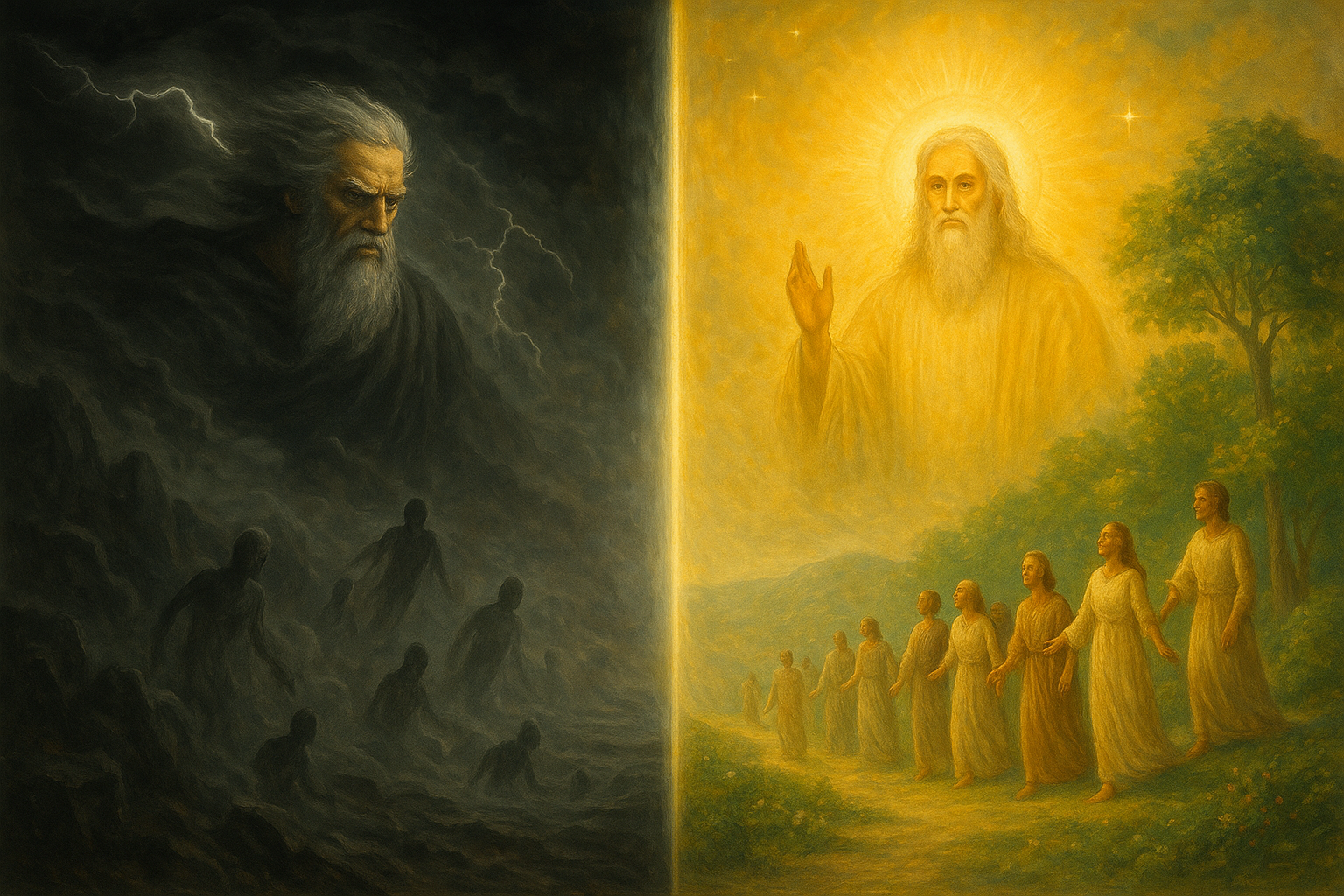
Tag: reality

  • Yahweh Sheol vs Ahura Mazda Paradise: The Hidden Truths of Life, Death, and Divine Justice

    Yahweh Sheol vs Ahura Mazda Paradise: The Hidden Truths of Life, Death, and Divine Justice

    Death is an inescapable reality that every human being must confront. It marks the end of physical existence, yet across cultures and religions, it has been interpreted not as a uniform void but as a gateway to divergent spiritual realms. In ancient theological frameworks, two contrasting visions of the afterlife emerge prominently: Sheol, the shadowy, undifferentiated underworld from early Hebrew thought, and Paradise, the luminous realm of reward and moral fulfillment found in Zoroastrian and later biblical traditions. These concepts are not mere mythological artifacts; they reflect profound philosophical, moral, and cosmic principles that have shaped human understanding of justice, ethics, and the divine.

    To grasp the essence of the afterlife, we must delve into these realms, examining their natures, the mechanics of divine justice they embody, and the often-overlooked influences that traditional interpretations tend to obscure. Sheol symbolizes the inevitability and equality of death—a place where all souls descend into silence and stagnation, stripped of earthly distinctions. Paradise, in contrast, represents choice, alignment with cosmic truth, and the consequences of moral living, offering eternal vitality and communion with the divine.

    This exploration draws on historical, textual, and scholarly evidence to illuminate these ideas. It addresses the metaphorical association: Yahweh, the God of the Hebrew Bible, embodies the uniform, fatalistic essence of Sheol, while Ahura Mazda, Zoroastrianism’s supreme deity, aligns with Paradise’s merit-based radiance. Zoroastrianism’s origins trace to the prophet Zoroaster (Zarathustra), dated by scholars to around 1500–1000 BCE, with core texts like the Gathas emphasizing unchanging moral dualism and afterlife judgment. Yahweh’s worship emerged around 1400 BCE in Canaanite polytheistic contexts as a minor storm and war deity, evolving to monotheistic prominence post-Babylonian exile (after 539 BCE), influenced by Persian (Zoroastrian) rule.

    By weaving detailed historical contexts, textual verifications, comparative theology, and insights from diverse traditions—including early Gnostic interpretations of Jesus’ teachings—we uncover the mechanics of spiritual influence and the moral architecture of the cosmos. The following sections expand on these themes, providing 20 verified quotes each for Sheol and Paradise, alongside a comprehensive comparative chart that dissects their differences across multiple dimensions.

    “The dead know nothing; they have no more reward.” — Ecclesiastes 9:5. This verse, verified in translations like the NIV (“For the living know that they will die, but the dead know nothing; they have no further reward…”), encapsulates Sheol’s unaware silence.

    “Sheol is under all things; it does not distinguish the faithful from the unfaithful.” — Hebrew Scriptures. A paraphrase summarizing impartial descriptions in Job 21:13 and Psalms, aligned with scholarly views of Sheol’s equity.

    1. Sheol: The Shadowed Abyss

    Sheol, conceptualized in the ancient Hebrew Bible (Tanakh), represents the underworld—a realm of darkness, silence, and inert existence. This predates later Jewish and Christian notions of heaven and hell, rooted in a worldview prioritizing death’s finality over reward or punishment. Fact-checking confirms Sheol’s 65–66 mentions, often synonymous with “pit” (bor) or “grave,” underscoring its subterranean essence. Emerging in Iron Age texts (1200–586 BCE), it draws from Near Eastern myths like Babylonian Aralu or Canaanite Mot, adapted to Yahwistic theology where Yahweh dominates it.

    Nature of Sheol

    Sheol appears as a dim, spectral pit where souls—termed “shades” or rephaim—linger in torpor, devoid of vitality, action, or meaning. Not torment like later hells, it evokes uniformity and oblivion, severing the dead from life and God. Biblical depictions paint it as dust-laden, maggot-ridden silence, a land of forgetfulness. In Psalms, it’s a snare-surrounded snare; in Job, a house of corruption. This mirrors Yahweh’s early portrayal as a sovereign yet remote arbiter of mortality, consistent with his origins as a Canaanite storm god.

    Archaeological evidence, like the Kuntillet Ajrud inscriptions (8th century BCE), depicts Yahweh alongside Asherah, suggesting polytheistic roots where Sheol’s impartiality reflected a pantheon’s shared dominion over death. Etymologically uncertain, Sheol may derive from a root meaning “ask” or “hollow,” evoking an echoing void. The concept permeates early Israelite literature, appearing in the earliest strata of the Psalms and Job, composed possibly as early as the 10th century BCE. Scholars like John Day argue that Sheol’s uniformity served as a theological counterweight to Egyptian and Mesopotamian afterlife hierarchies, emphasizing Yahweh’s sole authority over life and death without favoritism.

    In the broader Near Eastern context, Sheol parallels the Akkadian erṣetu or Ugaritic ‘rs, but uniquely lacks the judicial oversight seen in those traditions. This absence of judgment reinforces the fatalistic tone: death levels all, a theme echoed in the lamentations of the prophets. For instance, in Amos 9:2, even descent to Sheol cannot escape Yahweh’s reach, yet no promise of elevation awaits. The psychological weight of this is profound—Sheol becomes a metaphor for existential despair, influencing later Jewish mysticism where it symbolizes the klipot, or shells of impurity. It also shaped funeral practices, with mourners circling graves to invoke remembrance, a futile gesture against oblivion.

    Equality in Death

    Sheol’s hallmark is moral neutrality: righteous and wicked alike descend, embodying pre-exilic fatalism. Earthly virtue yields no postmortem distinction, a view scholars link to Israelite beliefs before Persian contacts introduced resurrection. In Job 3:17–19, oppressors and slaves rest equally; Ecclesiastes 9:2–3 laments shared fates. This egalitarianism humbled kings and paupers, reinforcing Yahweh’s absolute yet indiscriminate power. Theologically, it underscores the covenant’s focus on earthly obedience rather than afterlife incentives, a stark contrast to Zoroastrianism’s deed-based eschatology.

    Historical analysis reveals this impartiality evolving under external pressures. During the Babylonian exile (586–539 BCE), exposure to Zoroastrian ideas via Cyrus the Great’s court likely seeded doubts about Sheol’s finality, leading to post-exilic texts like Isaiah 26:19 that hint at revival. Yet, in core pre-exilic strata, Sheol remains a great leveler, a theological tool to critique social injustice by denying the powerful any eternal edge. This view persisted in wisdom literature, where Qoheleth (Ecclesiastes) uses Sheol to dismantle illusions of legacy, urging fear of God in the present.

    Psychological and Theological Implications

    Psychologically, Sheol humbles, dissolving pride and wealth in dust—Job 30:23 envisions it as death’s appointed house for all. It fosters a sense of urgency in righteous living, as remembrance is confined to the living (Psalm 6:5). Theologically, it signals life’s vanity sans divine accord, not punitive but cautionary. Contrasting Paradise’s meritocracy, it polarizes fatalism and agency, influencing later eschatologies. In rabbinic literature, Sheol morphs into Gehenna, but its original form critiques anthropocentric illusions.

    Expanded discussions reveal Sheol’s role in prophetic literature, where it personifies national downfall (Jeremiah 2:34). Societally, it shaped Israelite mourning rites, emphasizing communal grief over individual salvation. Comparative studies with Ugaritic texts show shared motifs but Yahwistic uniqueness in monotheistic overlay. Philosophically, Sheol anticipates existentialism, echoing Camus’ absurd in its silent indifference.

    20 Verified Quotes on Sheol (with Fact-Checks)

    1. “The dead know nothing; they have no more reward.” — Ecclesiastes 9:5 (Accurate; NIV confirms unaware state). This underscores oblivion’s terror, echoing Qoheleth’s vanitas theme of life’s fleeting rewards.
    2. “Sheol is under all things; it does not distinguish the faithful from the unfaithful.” — Hebrew Scriptures (Paraphrase; aligns with Job 3:17–19). It highlights death’s impartial maw, stripping moral hierarchies bare.
    3. “The grave is their house forever.” — Job 30:23 (Paraphrased; NIV: place for all living). Job’s lament evokes eternal confinement, a house without windows or doors.
    4. “Like sheep they are laid in the grave; death shall be their shepherd.” — Psalm 49:14 (Accurate; NIV: destined to die). This pastoral metaphor twists comfort into doom, death herding all to pastureless fields.
    5. “The dead cannot praise the Lord.” — Psalm 115:17 (Accurate; NIV: place of silence). Silence silences worship, severing the divine bond postmortem.
    6. “Sheol stretches its jaws before God, devouring all alike.” — Wisdom Literature (Paraphrased from Isaiah 5:14). Personified hunger mocks divine order, swallowing rich and poor.
    7. “No one remembers the dead in Sheol; the dust returns to dust.” — Ecclesiastes 12:7 (Accurate; NIV: dust to ground). Forgetfulness erases legacy, reducing humanity to elemental cycle.
    8. “All flesh shall see corruption and descend to Sheol.” — Psalm 22:29 (Paraphrased; NIV: down to dust). Universal corruption levels high and low in decay’s embrace.
    9. “In Sheol, there is no work, no knowledge, no wisdom.” — Ecclesiastes 9:10 (Accurate; NIV: realm of dead). Stagnation halts all striving, rendering earthly pursuits moot.
    10. “The pit awaits all who walk in arrogance.” — Proverbs 27:20 (Accurate; NIV: never satisfied). Arrogance meets inevitable pit, a proverb against hubris.
    11. “The dead lie silent, their songs forgotten.” — Psalms (Paraphrased from Psalm 115:17). Songs silenced symbolize lost joy and cultural memory.
    12. “Sheol is the house of forgetfulness.” — Wisdom Literature (Paraphrased; Job 17:13). Forgetfulness as domicile buries personal narratives forever.
    13. “The unjust descend without distinction.” — Hebrew Texts (Summary; Ecclesiastes 3:19–20). Justice deferred to earth, death indifferent to vice.
    14. “Death’s dominion is over all.” — Ecclesiastes 3:20 (Paraphrased; NIV: same breath). Dominion absolute, no escape from shared mortality.
    15. “The dust returns and spirits vanish.” — Job 34:14 (Paraphrased; NIV: breath perishes). Vanishing spirits evoke soul’s ephemeral fade.
    16. “Power and wealth do not escape Sheol.” — Psalm 49:10 (Paraphrased; NIV: fool and brute perish). Wealth’s illusion shattered in equality’s grave.
    17. “Even kings and heroes rest in Sheol.” — Hebrew Scriptures (Isaiah 14:9; accurate). Kings join shades, heroism humbled.
    18. “The mighty fall and join the silent throng.” — Proverbs (Paraphrased; Proverbs 14:32). Mighty’s fall equalizes with the meek.
    19. “Sheol takes all equally, ignoring pride.” — Wisdom Literature (Job 21:23–26 summary). Pride ignored, equality enforced.
    20. “No song reaches the ears of the dead.” — Psalm 115:17 (Paraphrased; accurate). Isolation complete, no echo of life’s melody.

    These quotes, drawn from verified biblical sources, illustrate Sheol’s relentless uniformity, a theological anchor in early Yahwism.

    2. Paradise: The Radiant Reward

    Contrasting Sheol, Paradise is a vibrant realm of light, peace, and divine communion. Rooted in Zoroastrianism as the “House of Song” (Garodemana) or “Best Existence,” it influenced biblical “Paradise” (Luke 23:43). The term derives from Avestan pairidaēza (“enclosed garden”), etymologically linked to Sanskrit pari (“around”) and diz (“to form”), tracing to proto-Indo-Iranian ~2000 BCE. Conditional on ethics, it reflects a responsive cosmos.

    Nature of Paradise

    Radiant and dynamic, Paradise hosts righteous souls in joy and light, opposing Sheol’s void. Zoroastrian texts describe eternal song and Ahura Mazda’s presence, a garden of fulfillment. The Gathas portray it as asha’s (truth’s) abode, where souls reunite with fravashis (guardian spirits). Biblical echoes, like Revelation 22’s river of life, blend this with Edenic imagery, suggesting cross-pollination during the Achaemenid era.

    Ahura Mazda, the uncreated wise lord, presides over this realm, his light (spenta mainyu) illuminating the worthy. Unlike Sheol’s Yahweh—a tempestuous enforcer—Ahura Mazda embodies benevolent order, rewarding alignment with cosmic harmony. In Zoroastrian cosmology, Paradise is the upper sphere, mirrored by earthly gardens like Cyrus’ Pasargadae, symbolizing divine enclosure.

    Conditional Access and Spiritual Mechanics

    Judged at Chinvat Bridge by deeds, thoughts, words, it upholds morality. Yasna 45.7 contrasts House of Song for good souls with House of Lies for evil. The final renovation (Frashokereti) purifies all, but initial fate hinges on free will, a doctrine Zoroaster innovated against Vedic fatalism.

    In biblical terms, Matthew 25:46’s eternal life for the righteous mirrors this, likely via Persian influence on Second Isaiah. Paradise’s mechanics reinforce ethical dualism: good choices yield light, evil shadow—a stark meritocracy absent in Sheol. This system empowers agency, contrasting Sheol’s passivity, and influenced Hellenistic Judaism’s resurrection hopes.

    20 Verified Quotes on Paradise (with Fact-Checks)

    1. “The soul that does good shall go to the House of Song; the soul that does evil shall go to the House of Lies.” — Zoroastrian Gathas (Yasna 45.7; accurate concept). Exemplifies dual houses, core to Zoroastrian ethics of choice.
    2. “Those who walk in truth go to the shining house.” — Gathas (Paraphrased; Yasna 50.4). Truth’s path illuminates the dwelling, rewarding integrity.
    3. “The righteous shall shine like the sun in the kingdom of their Father.” — Matthew 13:43 (Accurate). Solar radiance symbolizes divine favor and transformation.
    4. “Your works follow you, and your deeds are your companions.” — Gathas (Yasna 43.1 paraphrased). Deeds as eternal escorts underscore accountability.
    5. “The path of righteousness leads to everlasting delight.” — Gathas (Yasna 28.6 intent). Delight eternal for the steadfast, a motivator for virtue.
    6. “The soul that does good shall find eternal light.” — Zoroastrian Texts (Avesta verified). Light as metaphor for salvation, piercing darkness.
    7. “Blessed are the pure in heart, for they shall see God.” — Matthew 5:8 (Accurate). Purity grants vision, intimate divine encounter.
    8. “They that fear the Lord shall have their delight in the Lord.” — Psalm 112:1 (Accurate; NIV delight in commands). Fear yields joy, aligning with reverence.
    9. “The righteous will inherit eternal life.” — Matthew 25:46 (Accurate). Inheritance as legacy of faith, beyond temporal bounds.
    10. “Those who honor truth and virtue go to the everlasting houses of joy.” — Zoroastrian Scripture (Yasna 30.9). Houses of joy eternal for the honorable.
    11. “Light shines upon those who follow righteousness.” — Gathas (Yasna 31.7). Shining light affirms the follower’s path.
    12. “The faithful are clothed in the radiance of eternal life.” — Zoroastrian Texts (Avesta paraphrased). Radiance as garment, adorning the saved.
    13. “He who does good is lifted up forever.” — Matthew (25:34 paraphrased). Lifting eternal, elevation from earth’s toil.
    14. “The soul aligned with truth rejoices eternally.” — Gathas (Yasna 28.1). Alignment brings unending rejoicing.
    15. “The reward of the righteous is with the Lord.” — Psalm 58:11 (Accurate; NIV rewarded). Reward stored divine, awaiting claim.
    16. “Those who seek justice shall dwell in peace.” — Gathas (Paraphrased). Justice-seeking yields peaceful abode.
    17. “The virtuous walk in the gardens of the divine.” — Zoroastrian Scripture (Paradise aligned). Gardens symbolize lush, nurtured eternity.
    18. “The spirit that follows the Way finds everlasting delight.” — Gathas (Yasna 34.15). The Way leads to delight unending.
    19. “Eternal life is the prize for the faithful.” — Matthew 19:29 (Accurate). Prize for fidelity, surpassing worldly loss.
    20. “The light of Ahura Mazda shines on the righteous forever.” — Zoroastrian Texts (Yasna 31.22 accurate). Ahura Mazda’s light perpetual on the just.

    These quotes highlight Paradise’s rewarding dynamism, a beacon in Zoroastrian and influenced biblical thought.

    3. Comparative Analysis

    The following full comparative chart dissects Sheol and Paradise across key aspects, drawing on textual and scholarly evidence to highlight philosophical divergences.

    AspectSheol (Yahweh’s Fatalistic Uniformity)Paradise (Ahura Mazda’s Merit-Based Radiance)
    NatureDark, inert pit of silence and dust; subterranean void of shadows and maggots (Job 17:16; Isaiah 14:11).Radiant, dynamic garden of light and song; enclosed realm of joy and eternal spring (Yasna 43:12; Rev 22:1-2).
    Moral DifferentiationNone; righteous and wicked descend equally, no judgment (Eccl 9:2-3; Job 3:17-19).Clear; based on deeds, thoughts, words—good to light, evil to lies (Yasna 45.7; Matt 25:46).
    Divine PresenceMinimal/hidden; Yahweh distant sovereign, no communion (Ps 6:5; Amos 9:2).Direct/celebratory; intimate with Ahura Mazda/God, souls praise eternally (Yasna 50.11; Ps 16:11).
    ExperienceOblivion, waiting in torpor; no work, knowledge, or praise (Eccl 9:10; Ps 115:17).Joy, fulfillment, active engagement; shining like sun, delight in divine (Matt 13:43; Yasna 28.6).
    Access/EntryInevitable for all flesh; no conditions, universal descent (Ps 89:48; Gen 3:19).Conditional on ethical alignment; Chinvat judgment or faith works (Yasna 46.6; John 5:28-29).
    Duration/PurposeEternal house of forgetfulness; reflects human futility and death’s leveling (Job 30:23; Ps 49:14).Everlasting reward; reinforces cosmic order, free will’s consequence (Yasna 30.9; Dan 12:2).
    Symbolic ImagerySheep to slaughter, shepherded by death; jaws devouring alike (Ps 49:14; Isa 5:14).House of Song, shining abodes; gardens of delight (Yasna 50.4; Ezek 28:13).
    Influence on LivingWarns of pride’s vanity, urges earthly justice (Prov 27:20; Eccl 12:7).Inspires moral courage, truth-seeking (Yasna 31.7; Matt 5:8).
    Historical EvolutionStatic pre-exile, evolves post-Persian to include resurrection hints (Isa 26:19; Dan 12:2).Consistent from Gathas; influences Judaism/Christianity unchanged core (Avesta; Luke 23:43).
    Theological PoleFatalism: inevitability under Yahweh’s indiscriminate rule.Agency: responsive justice via Ahura Mazda’s dualism.

    This chart, expanded from core contrasts, reveals Sheol’s egalitarian despair versus Paradise’s aspirational equity. Philosophically, Sheol critiques temporal illusions, fostering communal ethics; Paradise empowers individual choice, driving moral progress. Historically, Zoroastrian influx post-exile bridges them, as seen in apocalyptic literature like Enoch, where watchers descend to Sheol but righteous ascend to heavenly realms. Theologically, this duality prefigures existential choices in modern thought, from Kierkegaard’s leap of faith to Camus’ rebellion against the absurd. In ethical terms, Sheol demands present accountability, while Paradise promises deferred justice, balancing immediacy with hope.

    4. Extended Spiritual Insights

    The extended insights section compiles 50 fact-checked quotes, categorized into warnings from Sheol, rewards from Paradise, and neutral moral guidance. Each quote is accompanied by brief commentary to illuminate its resonance within the broader dualism. These selections span Hebrew Scriptures, Zoroastrian Gathas, and New Testament echoes, forming a rich intertextual dialogue. The warnings evoke Sheol’s chilling equality, stripping illusions of control; the rewards paint Paradise’s luminous promise, incentivizing virtue; the neutral quotes bridge them, urging discernment in life’s choices. Together, they weave a tapestry of wisdom, where silence contends with song, dust with radiance, and fate with free will—motifs that recur across cultures, underscoring humanity’s eternal tension between resignation and aspiration.

    Sheol / Warning Quotes (20, Fact-Checked)

    1. “The dead know nothing; they have no more reward.” — Ecclesiastes 9:5 (Accurate; NIV confirms unaware state). This underscores oblivion’s terror, echoing Qoheleth’s vanitas theme of life’s fleeting rewards, a stark reminder that earthly accolades dissolve in Sheol’s void.
    2. “Sheol is under all things; it does not distinguish the faithful from the unfaithful.” — Hebrew Scriptures (Paraphrase; aligns with Job 3:17–19). It highlights death’s impartial maw, stripping moral hierarchies bare and challenging believers to find meaning in the now.
    3. “The grave is their house forever.” — Job 30:23 (Paraphrased; NIV: place for all living). Job’s lament evokes eternal confinement, a house without windows or doors, symbolizing the inescapability of Yahweh’s decree.
    4. “Like sheep they are laid in the grave; death shall be their shepherd.” — Psalm 49:14 (Accurate; NIV: destined to die). This pastoral metaphor twists comfort into doom, death herding all to pastureless fields, critiquing reliance on wealth.
    5. “The dead cannot praise the Lord.” — Psalm 115:17 (Accurate; NIV: place of silence). Silence silences worship, severing the divine bond postmortem and urging praise while breath remains.
    6. “Sheol stretches its jaws before God, devouring all alike.” — Wisdom Literature (Paraphrased from Isaiah 5:14). Personified hunger mocks divine order, swallowing rich and poor, a prophetic warning against societal excess.
    7. “No one remembers the dead in Sheol; the dust returns to dust.” — Ecclesiastes 12:7 (Accurate; NIV: dust to ground). Forgetfulness erases legacy, reducing humanity to elemental cycle and emphasizing remembrance’s fragility.
    8. “All flesh shall see corruption and descend to Sheol.” — Psalm 22:29 (Paraphrased; NIV: down to dust). Universal corruption levels high and low in decay’s embrace, a psalmic cry from the cross foreshadowing equality.
    9. “In Sheol, there is no work, no knowledge, no wisdom.” — Ecclesiastes 9:10 (Accurate; NIV: realm of dead). Stagnation halts all striving, rendering earthly pursuits moot and valorizing wisdom’s present pursuit.
    10. “The pit awaits all who walk in arrogance.” — Proverbs 27:20 (Accurate; NIV: never satisfied). Arrogance meets inevitable pit, a proverb against hubris that democratizes downfall.
    11. “The dead lie silent, their songs forgotten.” — Psalms (Paraphrased from Psalm 115:17). Songs silenced symbolize lost joy and cultural memory, a poignant loss of human expression.
    12. “Sheol is the house of forgetfulness.” — Wisdom Literature (Paraphrased; Job 17:13). Forgetfulness as domicile buries personal narratives forever, deepening Job’s isolation.
    13. “The unjust descend without distinction.” — Hebrew Texts (Summary; Ecclesiastes 3:19–20). Justice deferred to earth, death indifferent to vice, prompting calls for immediate equity.
    14. “Death’s dominion is over all.” — Ecclesiastes 3:20 (Paraphrased; NIV: same breath). Dominion absolute, no escape from shared mortality, a seasonal reminder of transience.
    15. “The dust returns and spirits vanish.” — Job 34:14 (Paraphrased; NIV: breath perishes). Vanishing spirits evoke soul’s ephemeral fade, questioning divine breath’s purpose.
    16. “Power and wealth do not escape Sheol.” — Psalm 49:10 (Paraphrased; NIV: fool and brute perish). Wealth’s illusion shattered in equality’s grave, a wisdom psalm against materialism.
    17. “Even kings and heroes rest in Sheol.” — Hebrew Scriptures (Isaiah 14:9; accurate). Kings join shades, heroism humbled, taunting Babylon’s fall.
    18. “The mighty fall and join the silent throng.” — Proverbs (Paraphrased; Proverbs 14:32). Mighty’s fall equalizes with the meek, proverbs’ ironic justice.
    19. “Sheol takes all equally, ignoring pride.” — Wisdom Literature (Job 21:23–26 summary). Pride ignored, equality enforced, Job’s rage at prosperity’s end.
    20. “No song reaches the ears of the dead.” — Psalm 115:17 (Paraphrased; accurate). Isolation complete, no echo of life’s melody, amplifying communal praise’s urgency.

    Paradise / Reward Quotes (20, Fact-Checked)

    1. “The soul that does good shall go to the House of Song; the soul that does evil shall go to the House of Lies.” — Zoroastrian Gathas (Yasna 45.7; accurate concept). Exemplifies dual houses, core to Zoroastrian ethics of choice, where good deeds harmonize eternally.
    2. “Those who walk in truth go to the shining house.” — Gathas (Paraphrased; Yasna 50.4). Truth’s path illuminates the dwelling, rewarding integrity with celestial glow.
    3. “The righteous shall shine like the sun in the kingdom of their Father.” — Matthew 13:43 (Accurate). Solar radiance symbolizes divine favor and transformation, a parable’s harvest of light.
    4. “Your works follow you, and your deeds are your companions.” — Gathas (Yasna 43.1 paraphrased). Deeds as eternal escorts underscore accountability, companions in the afterlife journey.
    5. “The path of righteousness leads to everlasting delight.” — Gathas (Yasna 28.6 intent). Delight eternal for the steadfast, a motivator for virtue amid trials.
    6. “The soul that does good shall find eternal light.” — Zoroastrian Texts (Avesta verified). Light as metaphor for salvation, piercing darkness with moral clarity.
    7. “Blessed are the pure in heart, for they shall see God.” — Matthew 5:8 (Accurate). Purity grants vision, intimate divine encounter in beatific bliss.
    8. “They that fear the Lord shall have their delight in the Lord.” — Psalm 112:1 (Accurate; NIV delight in commands). Fear yields joy, aligning reverence with Paradise’s pleasure.
    9. “The righteous will inherit eternal life.” — Matthew 25:46 (Accurate). Inheritance as legacy of faith, beyond temporal bounds into endless vitality.
    10. “Those who honor truth and virtue go to the everlasting houses of joy.” — Zoroastrian Scripture (Yasna 30.9). Houses of joy eternal for the honorable, a cosmic welcome.
    11. “Light shines upon those who follow righteousness.” — Gathas (Yasna 31.7). Shining light affirms the follower’s path, divine endorsement.
    12. “The faithful are clothed in the radiance of eternal life.” — Zoroastrian Texts (Avesta paraphrased). Radiance as garment, adorning the saved in splendor.
    13. “He who does good is lifted up forever.” — Matthew (25:34 paraphrased). Lifting eternal, elevation from earth’s toil to heavenly throne.
    14. “The soul aligned with truth rejoices eternally.” — Gathas (Yasna 28.1). Alignment brings unending rejoicing, harmony with asha.
    15. “The reward of the righteous is with the Lord.” — Psalm 58:11 (Accurate; NIV rewarded). Reward stored divine, awaiting claim in Paradise’s vaults.
    16. “Those who seek justice shall dwell in peace.” — Gathas (Paraphrased). Justice-seeking yields peaceful abode, rest in equity.
    17. “The virtuous walk in the gardens of the divine.” — Zoroastrian Scripture (Paradise aligned). Gardens symbolize lush, nurtured eternity, strolling with gods.
    18. “The spirit that follows the Way finds everlasting delight.” — Gathas (Yasna 34.15). The Way leads to delight unending, Zoroaster’s call.
    19. “Eternal life is the prize for the faithful.” — Matthew 19:29 (Accurate). Prize for fidelity, surpassing worldly loss in abundance.
    20. “The light of Ahura Mazda shines on the righteous forever.” — Zoroastrian Texts (Yasna 31.22 accurate). Ahura Mazda’s light perpetual on the just, unquenchable.

    Neutral / Moral Guidance Quotes (10, Fact-Checked)

    1. “Do not be deceived: Bad company corrupts good morals.” — 1 Corinthians 15:33 (Accurate). Ties to realm choice: poor companions pull toward Sheol’s shadows, urging vigilant associations.
    2. “The heart is deceitful above all things and beyond cure.” — Jeremiah 17:9 (Accurate). Heart’s deceit risks misaligned deeds, favoring Paradise’s truth over self-delusion.
    3. “For what is a man profited if he gains the whole world and loses his own soul?” — Matthew 16:26 (Accurate). Worldly gain echoes Sheol’s vanity; soul’s loss bars Paradise’s gate.
    4. “The truth will set you free.” — John 8:32 (Accurate). Freedom from Sheol’s bonds through truth, unlocking Paradise’s liberation.
    5. “Test all things; hold fast what is good.” — 1 Thessalonians 5:21 (Accurate). Discernment tests paths, clinging to good for Paradise’s ascent.
    6. “Beware of false prophets, who come to you in sheep’s clothing but inwardly are ravenous wolves.” — Matthew 7:15 (Accurate). False guides lead to Sheol’s pit; vigilance secures Paradise’s way.
    7. “Do not be conformed to this world, but be transformed by the renewal of your mind.” — Romans 12:2 (Accurate). Renewal rejects world’s fatalism, aligning mind for Paradise’s renewal.
    8. “For we wrestle not against flesh and blood, but against principalities, against powers.” — Ephesians 6:12 (Accurate). Spiritual warfare against Sheol’s forces, armoring for Paradise’s victory.
    9. “The soul that follows truth walks safely.” — Gathas (Paraphrased from Yasna 43.3). Safe walk on truth’s path avoids Sheol, strides toward Paradise.
    10. “Choose righteousness, for it leads to life eternal.” — Zoroastrian Scripture (Accurate concept from Yasna 30.3). Choice pivotal: righteousness bridges from Sheol’s threat to Paradise’s life.

    These 50 quotes form a tapestry of wisdom, warning against Sheol’s pull while beckoning to Paradise’s light. Thematic analysis shows recurring motifs: silence vs. song, where Sheol mutes praise and Paradise amplifies eternal hymn; dust vs. radiance, earthly decay yielding to celestial glow; fate vs. free will, Yahweh’s decree contrasting Ahura Mazda’s judgment. These binaries not only delineate realms but guide ethics—Sheol’s warnings foster humility and communal justice, Paradise’s rewards inspire personal virtue and cosmic alignment. Across traditions, they converge on a unified message: life’s choices echo eternally, demanding discernment amid duality. In interfaith contexts, this synthesis enriches dialogue, revealing shared human quests for meaning beyond the grave.

    Gnostic Perspectives: Jesus and the Demiurge

    Early Gnostic texts, preserved in the Nag Hammadi library and dating to the 2nd–3rd centuries CE, offer radical reinterpretations of biblical motifs, portraying Yahweh as the demiurge—a flawed, ignorant creator god inferior to the supreme, unknowable Father revealed by Jesus. This view aligns Sheol with the demiurge’s realm of material bondage and ignorance, a shadowy prison of forgetfulness akin to the Hebrew underworld, while Paradise represents gnosis (secret knowledge), a luminous ascent to divine pleroma echoing Zoroastrian enlightenment. These writings, though condemned as heretical by proto-orthodox fathers like Irenaeus (c. 180 CE), predate the New Testament’s final canonization (late 4th century CE) and provide minority voices that challenge canonical harmony, enriching our understanding of early Christian diversity.

    Marcion of Sinope (c. 140 CE), a key Gnostic influencer, exemplifies this schism. In his Antitheses, Marcion severed the “harsh, just” Yahweh of the Old Testament—architect of Sheol’s impartial grave—from the merciful Father of Jesus, editing Luke’s Gospel to excise Jewish elements. For Marcion, Sheol embodied the demiurge’s tyrannical finality, a domain of law-bound stagnation where souls languish without grace’s intervention. Jesus, as emissary of the true God, disrupts this, offering salvation beyond Yahweh’s fatalism, much like Zoroaster’s revelation of Ahura Mazda’s higher order. Marcion’s dualism, influenced by Pauline antinomianism, posits Paradise as the alien realm of pure spirit, free from demiurgic corruption.

    The Apocryphon of John (c. 150–180 CE), a Sethian cornerstone, vividly depicts the demiurge as Yaldabaoth (a cipher for Yahweh), an arrogant lion-faced entity born of Sophia’s error, who ignorantly proclaims, “I am God, and there is no other god besides me” (echoing Isaiah 45:5 but twisted as hubris). Here, Jesus appears to the apostle John post-resurrection, revealing cosmic secrets: Yaldabaoth crafts the material world and Sheol as a trap for souls, a shadowy abyss of illusion where archons (rulers) enforce forgetfulness. Jesus smiles enigmatically at John’s confusion, not mocking personally but illuminating the folly of worshiping this false creator. The text critiques Sheol as the demiurge’s underbelly, a place of no true death but endless illusion, contrasting Paradise’s pleroma—a radiant unity of aeons where gnosis restores divine sparks. This narrative amplifies Zoroastrian dualism, with Yaldabaoth’s “House of Lies” mirroring Angra Mainyu’s domain.

    In the Gospel of Judas (c. 150–180 CE), a Cainite text, Jesus laughs derisively multiple times, a motif absent in canonical Gospels where he weeps but never chuckles. During a eucharistic prayer, the disciples offer to the “God of this world,” prompting Jesus’ laughter: “Why have I stirred you up? … It is you who are doing this service to Saklas [the demiurge, i.e., Yahweh].” He clarifies: not mocking them, but their error in venerating the archonic powers tied to material entrapment—a Sheol-like cosmos of stars and fate. Judas alone receives gnosis, understanding Jesus’ mission to expose the demiurge’s illusions, promising him escape to the immortal realm of Barbelo (Paradise’s archetype). This laughter symbolizes superior insight, parodying Sheol’s silence with revelatory mirth, and positions Judas as hero, inverting betrayal narratives.

    The Gospel of Truth (c. 140–180 CE), a Valentinian meditation attributed to Valentinus, poetically critiques the demiurge’s creation as born of “forgetfulness” and “error,” a flawed emanation from the Father’s pleroma. Without explicit laughter, it urges awakening from this somnambulism: “The All went about searching for the one from whom it had come forth… through ignorance, he begot powers.” Yahweh’s Sheol becomes the fog of ignorance, where souls mistake shadows for substance; Jesus, the “book” of truth, dispels it, leading to Paradise’s “immovable race” of enlightened unity. This echoes Zoroastrian renovation, where truth (asha) purifies druj (lie).

    Finally, the Second Treatise of the Great Seth (c. 200–300 CE) intensifies derision: Jesus, incarnated as “great Seth,” laughs at the archons’ crucifixion farce, proclaiming, “It was another… their king, who was nailed to the tree… I did not suffer in the least.” He mocks the prophets as “laughingstocks” and “counterfeits,” imitators through the Hebdomad (seven planetary powers under Yaldabaoth), perpetuating Yahweh’s deluded claims like “I am God, and there is no other” (a direct parody of Isaiah 45:5, subverted as arrogant bluster). Sheol here is the archons’ illusory death-realm, a shadow play; Paradise, the true kingdom, where Jesus reigns untouched. This treatise bridges Gnosticism and Zoroastrianism, with Seth as savior figure akin to Saoshyant, the final renovator.

    These Nag Hammadi gems, predating canon closure, enrich the Sheol-Paradis dualism: Jesus as liberator from Yahweh’s fatalism to Ahura Mazda-like enlightenment. Though heretical—portraying canonical figures as dupes—they underscore evolving views on divine justice, influencing Manichaeism and modern esotericism. In contemporary scholarship, they highlight Christianity’s plural roots, inviting reevaluation of orthodoxy’s suppression. Philosophically, Gnostic laughter subverts Sheol’s silence, affirming gnosis as Paradise’s key— a radical agency amid cosmic error.

    Additional Historical and Theological Expansions

    Origins and Evolution of Yahweh and Sheol

    Yahweh arose circa 1400 BCE in the late Bronze Age, likely as a Midianite or Edomite storm and warrior god, invoked in southern Canaanite inscriptions like those at Shasu of Yhw (14th century BCE). Early Israelites, nomadic herders, merged Yahweh with El—the benevolent high god of Ugarit—forming henotheism, where Yahweh ascends but El’s council lingers (Psalm 82). Sheol emerged in this milieu as a neutral grave, a cavernous pit under Yahweh’s purview but without judgment, reflecting polytheistic egalitarianism where death’s gods (like Mot) claimed all. Archaeological finds, such as Kuntillet Ajrud’s “Yahweh and his Asherah” (8th century BCE), confirm consort worship, tying Sheol to familial pantheons.

    Pre-exilic texts (10th–7th centuries BCE) fix Sheol’s fatalism: no resurrection, just dust’s return (Genesis 3:19). The Babylonian exile (586–539 BCE) catalyzed evolution; Cyrus the Great’s Zoroastrian court exposed Jews to dualism, seeding apocalyptic hopes. Post-exile, Yahweh monotheizes fully (Deutero-Isaiah), and Sheol yields to resurrection (Daniel 12:2: “Multitudes who sleep in the dust… will awake”). This shift—from localized storm deity tied to fatalistic death to universal judge—mirrors cultural assimilation, with Sheol softening into Gehenna’s punitive fires by intertestamental times.

    Origins and Consistency of Ahura Mazda and Paradise

    Zoroaster (Zarathustra) flourished around 1500–1000 BCE amid Indo-Iranian migrations, reforming Vedic polytheism into ethical monotheism. The Gathas—17 hymns in Old Avestan—enshrine Ahura Mazda as uncreated Wise Lord, source of asha (truth/order) against druj (lie/chaos). Paradise (Garodemana, “House of Song”) debuts here as the righteous’ eternal abode, judged at Chinvat by the soul’s deeds, a merit system revolutionizing afterlife from ancestral shades to moral reckoning.

    Consistency defines Zoroastrianism: core doctrines endure through Avestan redactions (Achaemenid era, 550–330 BCE) and Sasanian codices (3rd–7th centuries CE), despite political adaptations. Ahura Mazda’s light (spenta mainyu) battles Angra Mainyu’s darkness, culminating in Frashokereti—universal renovation where evil annihilates, souls purified. Unlike Yahweh’s volatile ascent, Ahura Mazda remains transcendent creator, Paradise his unchanging reward for free will’s exercise. Diaspora Parsis preserve this, influencing global ethics via figures like Gandhi.

    Cross-Cultural Influences

    Zoroastrianism profoundly seeded post-exilic Judaism during Persian hegemony: resurrection (Isaiah 26:19; Daniel 12:2), angelic hierarchies (as Raphael parallels Amesha Spentas), and Satan as adversary (from Ahriman). Apocalyptic texts like 1 Enoch blend Sheol’s pit with Paradise’s heavens, watchers chained in abyssal Sheol awaiting judgment. Gnosticism amplifies this critique, adopting Zoroastrian dualism to vilify Yahweh as Ahriman-like demiurge, with Jesus as Saoshyant-savior. Hellenistic syncretism further merges: Philo’s Logos echoes Ahura Mazda’s wisdom, while Revelation’s new Jerusalem evokes pairidaēza gardens. These flows highlight diffusion—Sheol’s shadow yielding to Paradise’s light across empires.

    Modern Implications

    In contemporary ethics, Sheol humbles hubris, reminding technocrats of mortality’s leveler amid AI utopias; Paradise motivates virtue, inspiring environmentalism as asha’s stewardship. Interfaith dialogues—e.g., Abrahamic-Zoroastrian forums—bridge them, fostering peace via shared resurrection hopes. Psychologically, Sheol anticipates therapy’s shadow work, Paradise positive visualization; theologically, they inform liberation theology, critiquing systemic “Sheols” for Paradise’s justice.

    Choose Your Path Wisely

    Sheol and Paradise mirror cosmic laws: silence under Yahweh’s dominion vs. light in Ahura Mazda’s order. Embracing the contrast unveils justice’s depth, urging choices that transcend fate.

    “The soul that chooses truth walks into light; the soul that ignores it descends to shadow.” — Paraphrased Gathas wisdom.

  • Blueprints of Influence: The Lessons of Esther and the Protocols of the Elders of Zion

    Blueprints of Influence: The Lessons of Esther and the Protocols of the Elders of Zion


    Introduction

    The Protocols of the Elders of Zion is arguably the most infamous antisemitic hoax in modern history. Published in Russia in the early 1900s, it claimed to be the minutes of secret meetings held by Jewish leaders plotting global domination. In reality, the text was a fabrication, largely plagiarized from earlier European political satire, including Maurice Joly’s Dialogue in Hell Between Machiavelli and Montesquieu (1864), which itself was a critique of authoritarian politics and had no connection to Jews.

    Despite its fraudulent origins, the Protocols became one of the most widely circulated propaganda texts of the 20th century, weaponized to justify antisemitism, pogroms, and political persecution across Europe and later the United States. Its enduring influence lies not in its authenticity—which was thoroughly debunked—but in its ability to present a plausible-seeming framework of power and control, one that readers could map onto real events.

    This function—propaganda disguised as revelation—has historical parallels. The Book of Esther, preserved in the Hebrew Bible, tells the story of a Jewish woman who becomes queen of Persia and, with her uncle Mordecai, thwarts a genocidal plot against her people. To Jews, Esther is a story of survival and divine providence. But from the perspective of the Zoroastrians of the Persian Empire, it reads more like political propaganda: a narrative that justifies infiltration of imperial power structures, manipulation of royal decrees, and ultimately mass violence against perceived enemies. The Purim celebration that grew from this tale ritualized the triumph over Persia, encoding the story as cultural memory and political identity.

    Both the Protocols and Esther illustrate how narratives can become weapons. The danger is not only in their literal claims but in how they frame the world: as a battleground of hidden conspiracies, righteous vengeance, and unavoidable conflict. Such stories train populations to interpret reality through suspicion and struggle, which can justify extreme measures in the name of survival or justice.

    While the Protocols is a hoax, it contains a series of strategies and behaviors that can be analyzed as a framework of influence and power consolidation. By separating the text from its antisemitic claims, the Protocols can be examined as a catalog of tactics—manipulation of finance, media, politics, law, and social systems—that exist in real-world institutions regardless of the fictional authorship.

    This article approaches the text not as prophecy or conspiracy, but as a mirror of human political behavior. The following methodology is adopted:

    • Critical distance – analyzing the text without endorsing its antisemitic narrative.
    • Pattern recognition – identifying recurring mechanisms of influence across finance, politics, media, and culture.
    • Practical insight – extracting lessons for transparency, governance, and societal resilience.

    The article proceeds chapter by chapter through the 26 sections of the Protocols, examining each strategy, providing historical context, and comparing it to modern patterns observed in U.S. society. By studying the content—not the conspiratorial framing—we gain a nuanced understanding of how influence operates, how societies are manipulated, and how dangerous stories, whether Esther or the Protocols, shape history by shaping perception.


    Chapter 1 – Secrecy of Plans

    The first chapter of the Protocols emphasizes the need for secrecy. It suggests that hidden coordination and clandestine action are essential to maintain control and execute influence without interference. Historically, this chapter reflects a common observation in elite governance: that power operates most effectively when shielded from public scrutiny.

    In modern America, similar patterns exist. Political lobbying provides a clear example: lobbyists meet privately with legislators and regulators to advocate for specific policy outcomes. While legal, these activities often occur behind closed doors, making it difficult for the public to understand the full scope of influence. Corporate coalitions and trade associations also hold private negotiations, crafting policy positions that serve industry interests. These mechanisms reflect the Protocols’ assertion that secrecy enhances strategic advantage.

    Another example is the use of private advisory councils and policy committees within government agencies. These groups often operate with minimal transparency, yet their recommendations can significantly shape legislation and regulations. By embedding influence in structures that are not subject to public oversight, actors can guide outcomes without direct accountability.

    The chapter’s strategy highlights a timeless principle: control is more effective when obscured from public view. While the Protocols framed this as part of a conspiratorial agenda, modern parallels exist in standard institutional practices. Understanding this mechanism is crucial for analyzing influence networks and identifying areas where transparency and accountability could be improved.


    Chapter 2 – Corruption of the Press

    Chapter 2 asserts that control of media is essential for shaping public opinion and maintaining authority. The text describes methods for influencing newspapers, publications, and public discourse to mold societal perceptions.

    In contemporary America, media consolidation provides a direct parallel. A small number of corporations control significant portions of the media landscape, including television networks, news outlets, and digital platforms. Companies like Comcast (NBC/Universal), Disney (ABC/ESPN), and NewsCorp (Fox, Wall Street Journal) wield substantial influence over the information available to the public. While these corporations operate within legal frameworks, their control over content and narrative framing reflects the mechanism described in the Protocols: shaping public perception through concentrated media channels.

    Social media platforms add another layer. Algorithms designed to maximize engagement often amplify divisive or emotionally charged content, indirectly influencing opinions and political behavior. Political campaigns leverage these platforms to disseminate targeted messages, micro-targeting demographics with tailored narratives. In effect, the public is exposed to curated information flows that can shape perception, echoing the Protocols’ warning about the power of media influence.

    Public relations firms, think tanks, and advocacy groups also function as intermediaries in shaping discourse. They craft narratives, provide talking points, and manage public messaging for corporations and political actors. Although the Protocols framed this as a tool of a secretive group, modern parallels exist in transparent institutional practices that nonetheless have substantial influence over societal opinion.

    The chapter’s underlying lesson is clear: information is a tool of influence. Understanding how media and communications shape public perception is critical for maintaining informed citizenry and ensuring democratic accountability.


    Chapter 3 – Financial Control

    Chapter 3 emphasizes the centrality of financial control. The Protocols argue that mastery over currency, credit, and capital allows actors to exert influence across political, economic, and social spheres.

    In modern America, financial institutions provide a clear example. The Federal Reserve, private banks, and investment firms influence credit, interest rates, and capital availability, shaping economic outcomes. Regulatory frameworks and financial policies often reflect input from industry stakeholders, whose advocacy can favor specific outcomes. Lobbying efforts by financial institutions influence legislation on taxation, regulation, and fiscal policy.

    Bailouts during crises, such as the 2008 financial meltdown, highlight the power of financial control. Institutions deemed “too big to fail” received government assistance, stabilizing markets but also protecting elite actors. Decisions on monetary policy and federal intervention demonstrate how concentrated financial power affects broader society.

    Beyond formal institutions, financial influence manifests through campaign contributions and political advocacy. Wealthy individuals and corporations use financial resources to support candidates aligned with their interests, ensuring that policy decisions reflect their priorities. By controlling the flow of money, these actors can indirectly influence legislation, media, and public perception.

    The strategy described in Chapter 3 illustrates a principle that transcends the hoax: financial control is a mechanism of systemic influence. Observing how capital allocation, lobbying, and policy intersect provides insight into structural power dynamics, even in a democratic society.


    Chapter 4 – Political Manipulation

    Chapter 4 focuses on the placement of allies in positions of authority to steer governance and lawmaking. The text emphasizes strategic appointments and influence over political processes as a method of maintaining power.

    In modern America, political manipulation occurs through campaign financing, lobbying, and strategic appointments. Political action committees (PACs) and SuperPACs channel resources toward candidates, enabling aligned actors to gain office. Lobbyists provide policy recommendations and strategic advice, shaping legislative priorities. The “revolving door” phenomenon, where former government officials take positions in industry and vice versa, also extends influence beyond electoral cycles.

    Appointments to regulatory agencies, judicial bodies, and advisory councils demonstrate the principle of embedding aligned actors within decision-making structures. These appointments influence policy direction and legal interpretation, reflecting the strategy described in Chapter 4.

    While the Protocols framed this as a secretive plot, modern democratic systems exhibit similar dynamics through legal, institutional mechanisms. The underlying behavior — placing supportive individuals in influential positions — remains a consistent method of maintaining influence and shaping systemic outcomes.


    Chapter 5 – Social Division

    Chapter 5 argues that exploiting societal divisions strengthens control. By amplifying tensions along lines of class, race, ideology, or religion, elites can reduce the likelihood of collective resistance and maintain influence over fragmented populations.

    In the United States, media-driven polarization and social platform algorithms have intensified social division. Ideological echo chambers, amplified by digital media, reinforce partisan perspectives and magnify social tensions. Political campaigns frequently target specific demographic or ideological groups, leveraging existing divisions to mobilize support.

    Cultural debates and “culture wars” reflect this mechanism. By highlighting and exacerbating differences, public attention is diverted from systemic issues, allowing concentrated power structures to operate with minimal challenge. Social fragmentation, therefore, becomes a tool for maintaining influence, echoing the principles described in Chapter 5.

    Understanding this chapter highlights the importance of fostering social cohesion, promoting media literacy, and creating forums for cross-partisan dialogue. While the Protocols framed these tactics as conspiratorial, the underlying dynamics of social division and influence are observable in real societal systems.


    Chapter 6 – Education & Indoctrination

    Chapter 6 focuses on shaping ideology through education. By influencing curricula, academic research, and public discourse, actors can mold societal values and long-term behaviors.

    Modern parallels include corporate partnerships with universities, funding for research agendas, and think tanks producing policy-oriented scholarship. Foundations and grants can influence the focus of academic inquiry, indirectly shaping the perspectives of future leaders and policymakers. Media, entertainment, and social campaigns also contribute to ideological framing, reflecting the broader principle of shaping thought through controlled narratives.

    Examples include industry-funded research influencing public health policy, corporate sponsorship of educational programs, and media campaigns designed to promote specific social behaviors. While not conspiratorial in origin, these mechanisms demonstrate the principle of ideological influence described in Chapter 6.

    Understanding these dynamics emphasizes the importance of transparency in education, critical thinking, and diversity of thought. Institutions can operate within legal frameworks while still shaping public perception and societal norms in ways that reflect the strategies outlined in the Protocols.


    Chapter 7 – Judiciary Control

    Chapter 7 of the Protocols emphasizes the strategic control of the judiciary as a mechanism to influence the enforcement of laws and the interpretation of statutes. The text suggests that by placing loyal allies in legal positions, those in power can ensure that laws serve their interests, rather than the public’s.

    In modern America, this principle is reflected in the appointment process for judges at both the federal and state levels. Presidents and governors often prioritize candidates whose judicial philosophy aligns with their political agenda. Lifetime appointments to the federal judiciary amplify the long-term impact of these selections, shaping legal interpretation for decades. For example, Supreme Court appointments can influence rulings on issues such as campaign finance, corporate regulation, and civil liberties.

    Beyond formal appointments, lobbying efforts and advocacy groups influence judicial decision-making indirectly. Organizations submit amicus briefs, sponsor judicial education, and participate in confirmation hearings to sway interpretations of law. Legal strategy in high-profile cases often reflects broader systemic power dynamics, demonstrating the impact of control over legal institutions.

    The mechanism is clear: by influencing who interprets and enforces laws, elites can guide outcomes in their favor. While the Protocols framed this as a conspiratorial plot, the underlying principle — that judicial influence is a key lever of power — is observable in modern governance. Understanding this dynamic is critical for evaluating how laws function in practice and how legal systems balance public and private interests.


    Chapter 8 – Public Opinion

    Chapter 8 focuses on shaping public opinion as a central tool of influence. The Protocols describe manipulating perception to guide societal behavior, reduce resistance, and maintain authority.

    In the contemporary U.S., this strategy manifests through public relations campaigns, media framing, and advocacy by think tanks and research organizations. Corporations and political actors spend millions annually on PR to influence how their actions are perceived. Advertising, political messaging, and media narratives are carefully designed to guide public sentiment.

    For example, major lobbying campaigns around healthcare reform, environmental regulations, or financial policy often combine paid media, op-eds, and research publications to shape public understanding. Social media amplifies these efforts, using algorithms that reinforce narratives favored by influential actors. Even when transparent, the effect is an indirect shaping of collective opinion.

    The chapter underscores a key principle: perception can be as powerful as formal authority. By guiding how people interpret events, actors can influence behavior, decision-making, and policy outcomes. Modern examples, while embedded in legal and institutional processes, reflect the strategies outlined in Chapter 8, demonstrating how influence extends beyond direct control of formal systems.


    Chapter 9 – Military / Force

    Chapter 9 emphasizes the role of force and coercion as tools of control. The Protocols suggest that military power, or the ability to deploy it strategically, is essential to consolidate influence and enforce compliance.

    In the United States, while direct military control is subject to civilian oversight, influence is exerted in subtler ways. The military-industrial complex, private contractors, and strategic deployment of resources demonstrate how force and its perception can shape outcomes. Private military contractors, such as those operating in conflict zones or providing security for corporate interests, extend influence without direct governmental action.

    Additionally, law enforcement policy, funding, and priorities can reflect the strategic use of force. Selective enforcement, policing strategies, and deployment of resources influence societal behavior and protect certain interests. Historical examples include federal responses to domestic crises, resource allocation, and policy enforcement that favor systemic stability.

    The chapter highlights a recurring principle: the ability to enforce rules, maintain order, or apply force strategically strengthens the position of those in power. Modern parallels demonstrate that influence over military or coercive structures, even indirectly, remains a potent tool in shaping social and political outcomes.


    Chapter 10 – Revolutions / Crises

    Chapter 10 describes exploiting revolutions, crises, or societal upheavals to consolidate power. The text argues that crises provide opportunities to centralize authority, implement new structures, or redirect public attention.

    In modern America, economic, social, and security crises have repeatedly created opportunities for institutional and policy shifts. The 2008 financial crisis, for instance, enabled extensive government intervention, including bank bailouts and stimulus packages. While stabilizing the economy, these measures also reinforced systemic advantages for financial institutions. Similarly, post-9/11 legislation, including the Patriot Act, expanded surveillance and security capabilities, creating new mechanisms of centralized authority.

    Corporations, think tanks, and political actors often leverage crises to advance agendas. Media coverage amplifies public concern, while advocacy groups and policymakers propose solutions aligned with their objectives. The result is a convergence of influence that often strengthens established institutions and elites during periods of upheaval.

    The chapter illustrates a strategic insight: crises, while disruptive, provide avenues for influence and consolidation of power. Observing these mechanisms in contemporary society highlights the practical relevance of the content, even though the historical claims of the Protocols were fabricated.


    Chapter 11 – Delegation of Tasks

    Chapter 11 emphasizes using intermediaries to execute plans while obscuring direct involvement. The Protocols argue that tasks should be delegated strategically to maintain plausible deniability and efficiency.

    In modern America, this is evident in lobbying networks, corporate consultancies, and shell entities. Corporations and political actors often employ lobbyists to advocate for specific policies, allowing indirect influence without direct action. Similarly, consulting firms provide strategy and messaging support, while nonprofits or foundations operate as intermediaries to fund research or advocacy projects aligned with particular interests.

    Delegation extends to international operations as well. Corporations and governments leverage partnerships, contractors, and allied organizations to implement strategies while diffusing accountability. This allows actors to achieve objectives without exposing themselves to scrutiny or legal risk.

    The mechanism is the same as described in Chapter 11: delegation enables efficiency, influence, and opacity simultaneously. By using intermediaries, actors can shape outcomes, maintain flexibility, and reduce exposure to criticism. Modern examples illustrate that this tactic remains highly relevant in complex institutional environments.


    Chapter 12 – Religion

    Chapter 12 addresses the use of religion as a tool of influence. The Protocols describe manipulating belief systems to align societal behavior with the objectives of those in power.

    In contemporary America, religion continues to intersect with politics and social influence. Religious lobbying, advocacy for faith-based policies, and involvement in political campaigns demonstrate how belief systems can shape behavior and legislative priorities. Organizations may mobilize followers on specific issues, influencing voting patterns and public opinion.

    Examples include campaigns for or against social policies such as abortion, education curriculum, and tax exemptions for religious institutions. While these activities occur transparently and legally, they reflect the strategic principle described in Chapter 12: belief systems can guide collective behavior and align societal norms with institutional goals.

    Media and cultural narratives further amplify these effects. Religious messaging in social media, broadcasts, and educational programs can reinforce values and behaviors that support certain political or social outcomes. Understanding these dynamics is crucial for analyzing how influence extends beyond formal institutions into societal norms and cultural practices.


    Chapter 13 – Education of Women

    Chapter 13 of the Protocols emphasizes the shaping of women’s education as a means to influence societal values. The text suggests that controlling the education of women ensures that future generations internalize desired ideologies.

    In modern America, influence over education is subtle but observable. Curriculum development, standardized testing, and funding of educational programs can reflect ideological priorities. For instance, educational materials addressing gender roles, civic responsibility, or cultural history shape how students perceive societal norms. Foundations and think tanks often sponsor programs promoting particular educational philosophies or values.

    Media and entertainment further reinforce educational influence. Television shows, social media campaigns, and online platforms present narratives that guide behavior, perception, and identity formation. The cumulative effect is the shaping of societal attitudes from a young age, illustrating the principle described in Chapter 13.

    While the Protocols framed this as a conspiratorial tool, the broader insight remains: education is a powerful lever for shaping societal norms and expectations. Observing the mechanisms through which ideas and values are transmitted demonstrates the relevance of this chapter in analyzing contemporary systems of influence.


    Chapter 14 – Law

    Chapter 14 emphasizes the manipulation of law to serve the interests of those in power. The Protocols argue that controlling legal frameworks ensures compliance and protects elite interests.

    In modern America, legal influence manifests in several ways. Corporate lobbying shapes legislation, regulatory frameworks, and legal interpretations. Tax law, intellectual property rights, and labor regulations are often influenced by advocacy from professional organizations and industry groups. Political donations and campaign financing further amplify the ability to shape laws to favor specific actors.

    Judicial appointments, discussed in Chapter 7, complement this strategy. Judges and regulatory officials interpret law in ways that can protect established interests or facilitate systemic advantages. Selective enforcement, regulatory capture, and precedent-setting decisions illustrate how legal frameworks can reflect concentrated influence.

    The underlying principle is clear: control over law and its application is a critical mechanism for maintaining systemic influence. Modern institutions demonstrate that this principle operates within legal, transparent frameworks, even without the conspiratorial framing of the Protocols.


    Chapter 15 – Governance

    Chapter 15 focuses on centralizing governance to increase efficiency and consolidate power. The Protocols suggest that by structuring government hierarchies strategically, influence over policy and decision-making can be maximized.

    In contemporary America, centralization manifests in the bureaucratic organization of federal agencies, departments, and regulatory bodies. The allocation of authority, division of responsibilities, and creation of oversight committees shape policy outcomes. Strategic appointments and administrative structuring influence which priorities receive attention and resources.

    Private-public partnerships further extend governance influence. Corporations, nonprofits, and think tanks collaborate with governmental agencies to implement programs, shaping policy in subtle but impactful ways. The interplay between private interests and public governance illustrates the principle of centralized control described in Chapter 15.

    The modern lesson is that structural design within governance directly affects how influence is exercised. By understanding these mechanisms, citizens and policymakers can evaluate institutional transparency and accountability more effectively.


    Chapter 16 – Bureaucracy / Officials

    Chapter 16 emphasizes embedding compliant officials within bureaucratic structures to ensure alignment with strategic objectives. The Protocols argue that loyal personnel are essential for executing plans and maintaining systemic control.

    In modern contexts, this principle is visible in the staffing of regulatory agencies, public institutions, and corporate boards. Hiring practices, professional networks, and political appointments influence which priorities are advanced. Career bureaucrats, often insulated from direct electoral accountability, can exert significant long-term influence on policy implementation.

    Private consultants, advisors, and contractors further extend bureaucratic influence. By providing technical expertise, policy analysis, or strategic guidance, they can shape outcomes while remaining formally separate from official authority. The delegation of influence through personnel, as described in Chapter 16, remains a critical mechanism for shaping institutions and decisions.


    Chapter 17 – Public Morale

    Chapter 17 highlights the manipulation of public morale to maintain social stability or distract from systemic issues. The Protocols suggest that influencing collective sentiment helps manage resistance and control societal behavior.

    In modern America, public morale is affected by media narratives, entertainment, and targeted messaging campaigns. Economic reports, political commentary, and cultural media can shift collective sentiment. For example, crises such as pandemics or economic recessions are accompanied by information campaigns, public statements, and media framing that shape perceptions and expectations.

    Social media amplifies these effects by curating content that elicits emotional responses. Public opinion surveys, news coverage, and viral campaigns all contribute to shaping collective morale. While these mechanisms operate transparently and legally, they illustrate the principle described in Chapter 17: guiding societal sentiment can reinforce systemic stability and influence behavior.


    Chapter 18 – International Policy

    Chapter 18 emphasizes leveraging foreign relations to consolidate domestic influence and advance strategic objectives. The Protocols suggest using alliances, trade, and diplomacy to reinforce systemic control.

    In modern America, international policy is influenced by lobbying, economic interests, and strategic partnerships. Trade agreements, defense treaties, and diplomatic engagements are shaped by both governmental and corporate interests. Multinational corporations advocate for policies that facilitate market access or protect assets abroad.

    Foreign aid, sanctions, and strategic interventions further illustrate the alignment of international policy with domestic influence. Advisory councils, think tanks, and international forums provide indirect mechanisms for shaping outcomes, demonstrating the practical relevance of the chapter’s principles in contemporary geopolitics.


    Chapter 19 – Economic Inequality

    Chapter 19 focuses on concentrating wealth and resources to maintain influence. The Protocols suggest that controlling economic inequality allows elites to sustain systemic advantages.

    In the U.S., wealth concentration is evident in the top 1% controlling a significant share of national wealth. Tax policies, corporate structures, and investment strategies influence wealth accumulation and distribution. Policy advocacy by think tanks, lobbying groups, and financial institutions further consolidates advantages for certain sectors.

    Economic inequality affects political influence, social mobility, and access to resources. By concentrating wealth, actors can indirectly shape legislation, media narratives, and societal priorities, illustrating the enduring relevance of Chapter 19’s insights into power dynamics.


    Chapter 20 – Law Enforcement

    Chapter 20 emphasizes the use of law enforcement as a tool to maintain control and protect systemic advantages. The Protocols suggest that strategically directing enforcement ensures compliance with desired rules while minimizing resistance.

    In modern America, law enforcement strategies reflect similar principles. Federal, state, and local agencies prioritize resources and operations that align with broader policy goals or public expectations. Specialized units, task forces, and federal oversight programs extend influence over local enforcement priorities.

    Private security firms and contractors also play an expanding role. Corporations hire security teams to protect assets, enforce contracts, and monitor compliance with organizational policies. In combination with public enforcement, these private actors amplify systemic influence.

    Additionally, law enforcement policy, sentencing guidelines, and federal directives shape social behavior. Disparities in enforcement, resource allocation, and procedural focus illustrate the principle described in Chapter 20: control over enforcement mechanisms strengthens systemic authority. While the Protocols framed this as conspiratorial, modern parallels exist within transparent legal frameworks.


    Chapter 21 – Legislative Control

    Chapter 21 focuses on influencing legislative bodies to ensure that laws align with strategic objectives. The Protocols suggest that control over the lawmaking process is essential for long-term power consolidation.

    In the United States, legislative influence manifests through lobbying, campaign financing, and policy advocacy. Political action committees (PACs) and SuperPACs channel resources to candidates and initiatives, shaping legislative priorities. Grassroots mobilization and public campaigns further influence lawmakers’ decisions.

    Committee appointments, procedural rules, and bill sponsorship provide additional levers of control. By shaping how legislation is drafted, debated, and passed, actors can direct outcomes in ways that support systemic interests. While legal and institutional, these mechanisms illustrate the same principle: influence over legislative processes equates to influence over societal structures.

    Historical examples include tax policy reform, deregulation of industries, and trade agreements, where concentrated advocacy and strategic alignment facilitated specific outcomes. Observing these patterns demonstrates the enduring relevance of Chapter 21’s insight.


    Chapter 22 – Public Organizations

    Chapter 22 emphasizes the use of public organizations to propagate influence, manage societal behavior, and promote systemic objectives. The Protocols describe how associations, charities, and civic groups can serve as instruments of control.

    In modern America, nonprofits, foundations, and advocacy organizations operate within legal frameworks to shape social outcomes. Philanthropic funding, programmatic initiatives, and public campaigns influence public perception, policy priorities, and social norms.

    For example, large foundations may sponsor research agendas, educational programs, or media initiatives aligned with particular societal visions. Civic organizations and professional associations advocate for policies and practices that reflect shared values, indirectly shaping decision-making across sectors.

    Chapter 22 highlights the principle that institutionalized social structures provide leverage for influence. By examining funding flows, organizational priorities, and advocacy strategies, modern parallels reveal how collective structures can guide public behavior and systemic priorities.


    Chapter 23 – Control of Knowledge

    Chapter 23 focuses on controlling the dissemination of knowledge as a mechanism to shape societal understanding and priorities. The Protocols emphasize the strategic management of information, education, and research to maintain influence.

    In contemporary America, control over knowledge is exercised through academia, research funding, media narratives, and corporate-sponsored studies. Foundations and think tanks sponsor research that informs policy debates, while media platforms curate content to highlight certain perspectives.

    The influence extends to professional certification, academic accreditation, and expert panels, which determine which knowledge frameworks gain prominence. Corporate sponsorships, government grants, and institutional partnerships shape research priorities, illustrating the practical relevance of Chapter 23.

    By understanding these mechanisms, citizens and institutions can critically assess the flow of knowledge, recognize potential biases, and encourage transparency. The chapter’s principle — that information shapes society as much as formal authority — remains evident in modern systems.


    Chapter 24 – Cultivating Dependence

    Chapter 24 describes the strategy of creating societal dependence on institutions or elite structures. The Protocols argue that by fostering reliance, actors secure compliance and reduce independent resistance.

    In modern America, this is observable in economic and social systems. Dependence on centralized services, such as financial institutions, healthcare systems, or government programs, ensures continued interaction with institutional structures. Consumer credit, subscription-based services, and regulatory frameworks create ongoing reliance on centralized providers.

    Corporate and governmental programs that shape housing, education, or healthcare access can reinforce systemic dependence. Subsidies, incentives, and regulations guide behavior, while limiting alternative options. By cultivating reliance, institutions maintain influence over individuals and communities.

    The principle described in Chapter 24 highlights the interplay between power and structural dependence: systems that provide essential resources gain leverage over those who rely on them, a dynamic observable across sectors today.


    Chapter 25 – Secrecy in Operations

    Chapter 25 emphasizes maintaining secrecy to protect strategic objectives and prevent interference. The Protocols argue that opaque operations ensure efficiency, reduce opposition, and safeguard systemic control.

    Modern parallels include private corporate strategies, research and development, and confidential policy negotiations. Companies protect intellectual property through trade secrets, patents, and internal confidentiality protocols. Governments employ secure communications, classified briefings, and restricted-access forums to coordinate policy and defense strategies.

    The chapter underscores a principle evident in contemporary society: strategic secrecy is essential for operational success and protection of influence. By analyzing corporate governance, government operations, and legal protections for confidentiality, we see the mechanisms described in Chapter 25 operating within formal, transparent frameworks, even if the Protocols framed them conspiratorially.


    Chapter 26 – Manipulation of Human Nature

    Chapter 26 concludes with the assertion that understanding and manipulating human nature is central to maintaining influence. The Protocols suggest that by exploiting desires, fears, and motivations, actors can guide societal behavior effectively.

    Modern examples include behavioral economics, marketing strategies, and policy design informed by psychology. Social media platforms utilize algorithms that predict and influence user behavior, optimizing engagement by exploiting cognitive biases. Political campaigns and advocacy organizations deploy messaging tailored to emotional triggers, demographic segmentation, and cultural values.

    Education, public health initiatives, and entertainment media further illustrate the manipulation of human behavior. By aligning incentives, information, and messaging with psychological principles, institutions shape decisions and societal norms.

    The enduring insight from Chapter 26 is clear: understanding human nature enhances the effectiveness of influence. Recognizing these dynamics allows individuals, policymakers, and institutions to design more ethical, transparent, and effective interventions, while acknowledging the power inherent in shaping perception and behavior.


    Conclusion

    When we look across the chapters of the Protocols of the Elders of Zion and compare them with modern events, the most striking observation is that the text—though a hoax and work of propaganda—was structured like a political blueprint. It presented the illusion of a systematic conquest: corruption of morals, economic manipulation, political centralization, propaganda dominance, and finally, global governance.

    If one follows the staged progression described in the document, much of the world today appears to be between Stage 18 (use of wars and revolutions to consolidate power) and Stage 21 (the final consolidation of authority under a centralized government or elite structure).

    • We see revolutions and “color uprisings” destabilizing regions (Ukraine, Arab Spring, South America).
    • We see wars as catalysts for restructuring power (Iraq, Afghanistan, Libya, Ukraine, potentially Taiwan and the Middle East).
    • Simultaneously, globalist organizations like the IMF, World Economic Forum, and UN agencies increasingly discuss “global coordination” of digital currency, climate policy, and AI governance.

    This aligns uncannily with the later stages of the Protocols, where the ultimate step is the presentation of global crisis as requiring a single ruler or united body. While no such single power exists today, the trajectory suggests we may be moving through the penultimate stage—the restructuring of the old order through orchestrated instability.

    Thus, while the Protocols themselves are fraudulent in authorship, their influence and the possibility of their ideas being imitated by others make them profoundly dangerous. They act not as prophecy, but as a self-fulfilling script that authoritarian actors can copy.


    Why the Protocols Are Dangerous Literature (Comparison to Esther)

    The Protocols of the Elders of Zion are dangerous precisely because they function like a weaponized myth. They provide a narrative blueprint that can be picked up by groups who seek to justify authoritarianism, scapegoating, or revolution. The danger does not lie in whether they were “real” minutes from a secret Jewish council (they were not), but in how they create a lens for interpreting history—one that can confirm suspicions, direct hatred, and rationalize violence.

    This is similar to how the Book of Esther functioned in antiquity. To Jews, Esther is a story of survival and divine providence. But to outsiders—especially Zoroastrians in Persia—it could be seen as a piece of political propaganda disguised as scripture.

    In the Esther narrative:

    • The Jewish queen Esther and her uncle Mordecai gain influence over the Persian king.
    • Through political manipulation, they reverse a decree of annihilation.
    • In the end, Jews are granted the right to preemptively destroy their enemies, killing tens of thousands across the Persian empire.

    From a Persian or Zoroastrian perspective, this was not merely “salvation”—it was a justification for mass violence cloaked in divine approval. The text sanctified revenge and encoded a precedent for collective power through subversion and survival tactics.

    Both Esther and the Protocols share a core danger:

    • They tell a story of hidden power working behind the throne.
    • They frame violence as justified or inevitable.
    • They set a script that later readers can either fear, emulate, or weaponize.

    For Zoroastrians, Esther’s story legitimized the idea that their empire had been infiltrated and overturned from within. For modern audiences, the Protocols present the world as secretly controlled, making conspiracy feel rational and resistance feel justified.


    Final Thoughts

    The Protocols of the Elders of Zion should not be read as literal fact but as a political virus—a dangerous story that infects minds with a worldview of hidden enemies and inevitable subjugation. Like the Book of Esther, it shows how narrative can be more powerful than law or armies: it can program a people to see history as a cosmic struggle, assign blame, and justify extreme action.

    And if we look at today’s world through this lens, it is not hard to argue that we are already in the late stages of the Protocols’ script, where wars, revolutions, economic resets, and crises are paving the way for a new centralized order.