How Light Bulbs, Cars, and Icons Carried the Name of the Zoroastrian God—Then Quietly Erased It
The Lie We’re Taught
What Every Student Learns: “Edison invented the light bulb. The Mazda Motor Company is a Japanese brand named after its founder.”
Modern people drive Mazdas and once illuminated their homes with GE Mazda bulbs—never knowing they were invoking the name of Ahura Mazda, the Zoroastrian God of Light and Wisdom.
The Truth Hidden in Plain Sight
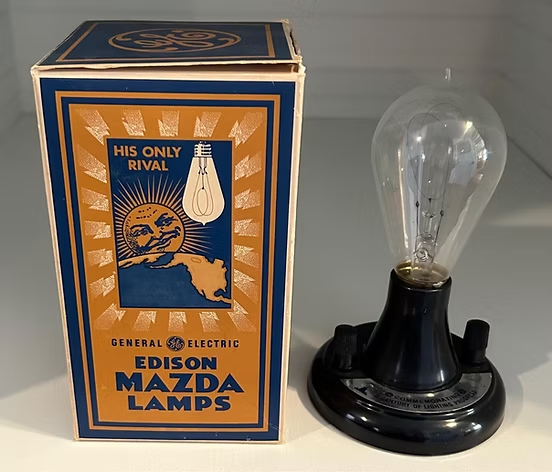
The GE Mazda Bulb (1909-1945)
In 1909, General Electric deliberately named their revolutionary tungsten filament bulb “Mazda”—a direct reference to Ahura Mazda, the Zoroastrian god of light, intelligence, and wisdom.
This wasn’t accidental.
The search results confirm: GE chose the name “due to its association with Ahura Mazda, the transcendental and universal God of Zoroastrianism, whose name means light of wisdom in the Avestan language.”
The Symbolism Was Perfect:
- Edison’s invention = bringing light into darkness
- Ahura Mazda = God of Light and Wisdom
- The parallel was explicit: technological enlightenment named after Zoroastrian divine enlightenment
For 36 Years (1909-1945):
- Millions of American homes were lit by bulbs bearing the name of the Persian god
- The connection between light, wisdom, and Ahura Mazda was mainstream knowledge
- GE’s educated executives and marketers knew exactly what they were referencing
The Mazda Motor Company (1931-Present)
Twenty-two years after GE’s Mazda bulb, Japanese founder Jujiro Matsuda launched his automobile company with the same name.
The Official Explanation: “Mazda comes from Ahura Mazda, the god of harmony, intelligence and wisdom from the earliest civilization in West Asia. Key members of Toyo Kogyo interpreted Mazda as a symbol of the beginning of the East and the West civilization, but also a symbol of the automotive civilization and culture.”
The Dual Meaning: The name worked perfectly because:
- Ahura Mazda = god of wisdom and light (Zoroastrian)
- Matsuda = the founder’s surname (sounds like “Mazda” in Japanese)
But the Zoroastrian Connection Was Primary.
Other proposed names for the company were “Sumera-Go” (god) and “Tenshi-Go” (angel)—revealing Matsuda’s “strong interest in human faith.”
He didn’t choose just any deity. He chose the Persian god of light, wisdom, and cosmic order.
What This Proves
1. Western Industrial Leaders Explicitly Honored Zoroastrian Symbolism
This wasn’t hidden. This wasn’t obscure. The name “Mazda” was on:
- Millions of light bulbs in American homes (1909-1945)
- Millions of cars worldwide (1931-present)
- Corporate branding by two major international companies
2. “Light = Enlightenment” Was Understood as Fundamentally Zoroastrian
When Edison’s team needed a name for their revolutionary light source, they didn’t choose:
- Apollo (Greek god of light)
- Lucifer (Latin “light-bearer”)
- Sol (Roman sun god)
They chose Mazda—the Persian god.
Why? Because the connection between light and wisdom was recognized as uniquely and powerfully Zoroastrian.
3. This Acknowledgment Was Quietly Erased
GE Discontinued “Mazda” in 1945
Official reason: Patents expired, technology evolved.
But wait:
- They kept renewing the trademark until 1990 (45 more years!)
- If it was just “obsolete,” why maintain the trademark for nearly half a century?
The Timing:
- 1945: End of WWII
- Holocaust revealed to the world
- Nuremberg Trials beginning
- Cultural moment of heightened religious/ethnic sensitivity
Whether through corporate rebranding, post-Holocaust sensitivity, or other pressures—the Zoroastrian name disappeared from American commerce.
4. Modern Amnesia
How many people today know:
- Their grandparents’ light bulbs were named after Ahura Mazda?
- Every Mazda car carries the name of the Zoroastrian god?
- For 36 years, Americans honored the Persian god of light every time they turned on a lamp?
Another example of: Persian contribution → Mainstream adoption → Forgotten source
The Parallel: Freddie Mercury
While corporations quietly dropped Zoroastrian references, one man made the faith globally visible—though most fans never knew.
Freddie Mercury (born Farrokh Bulsara):
- Raised in a devout Zoroastrian Parsi family
- Underwent the sacred Navjote ceremony at age 8
- Given the sudreh (white shirt) and kusti (sacred cord)
- Funeral conducted entirely in Zoroastrian rites
His sister Kashmira Cooke explained: “What his Zoroastrian faith gave him was to work hard, to persevere, and to follow your dreams.”
The Core Zoroastrian Principle: “Good thoughts, good words, good deeds”
This wasn’t just Freddie’s heritage—it was the driving philosophy behind one of history’s greatest performers.
And yet: Billions sang “We Are The Champions” and “Bohemian Rhapsody” without knowing the faith that shaped their creator.
Tesla and the Philosophy of Light
While no direct evidence links Nikola Tesla to Zoroastrian worship, his entire worldview mirrors Zoroastrian cosmology:
Tesla’s Philosophy:
- “Peace can only come as a natural consequence of universal enlightenment”
- Light as both physical and metaphysical reality
- Electricity as transformative divine power
- “If your hate could be turned into electricity, it would light up the whole world”
Zoroastrian Parallels:
- Ahura Mazda = God of Light and Wisdom
- Fire/light as sacred manifestation of truth
- Cosmic battle between light (truth) and darkness (deceit)
- Enlightenment as the path to cosmic order (Asha)
Tesla worked with electricity—the harnessing of light itself. Whether he studied Zoroastrianism directly or absorbed its philosophy through Western culture, the alignment is undeniable.
The Pattern Continues
Three Major Examples:
1. GE Mazda Bulb (1909-1945)
- Explicit Zoroastrian naming
- 36 years of mainstream use
- Discontinued 1945, forgotten by history
2. Mazda Motor Company (1931-Present)
- Named after Ahura Mazda
- Millions drive them daily
- Almost no one knows the origin
3. Freddie Mercury (1946-1991)
- Zoroastrian Parsi
- 300+ million Queen albums sold worldwide
- Faith rarely mentioned in his legacy
Why It Matters
For 36 years, every American home that turned on a light invoked Ahura Mazda.
Not in prayer. Not in ritual. But in the everyday act of bringing light into darkness.
GE’s executives, educated in classical knowledge, knew what they were doing. They recognized that the god who represented light, wisdom, and cosmic truth was the perfect symbol for technological enlightenment.
Then in 1945—the year the world confronted the Holocaust and religious tensions reached a peak—the name quietly disappeared.
The bulbs still worked. The light still shone. But Ahura Mazda’s name was erased from the devices that carried it into millions of homes.
Today:
- Drive a Mazda → unknowingly honor Ahura Mazda
- Listen to Queen → unknowingly celebrate Zoroastrian work ethic
- Turn on electricity → unknowingly invoke the god of light
The Persian god of wisdom lit the modern world.
Then we forgot him.
The Question
If Western civilization honored Ahura Mazda enough to name their greatest inventions after him—light bulbs, automobiles, the harnessing of electricity itself—why is Zoroastrianism portrayed as a dead or irrelevant religion?
Why are the Persians sanctioned as “evil” when the West built its electrical age on devices bearing their god’s name?
The answer is simple:
Acknowledge the source, and you acknowledge the debt.
Erase the source, and you can claim the light as your own.
The fire never went out. They were literally selling Mazda’s light to millions of homes.
They just stopped saying his name.
Sources
- General Electric Mazda bulb naming documentation
- Mazda Motor Company official history
- Freddie Mercury biographical sources
- Nikola Tesla philosophical writings
- Zoroastrian liturgical texts