Category: Archives

  • The Phoenix Myth: Greek Frashokereti Hidden in Plain Sight

    The Phoenix Myth: Greek Frashokereti Hidden in Plain Sight

    The Bird That Dies and Rises from Fire

    Every culture knows the phoenix:

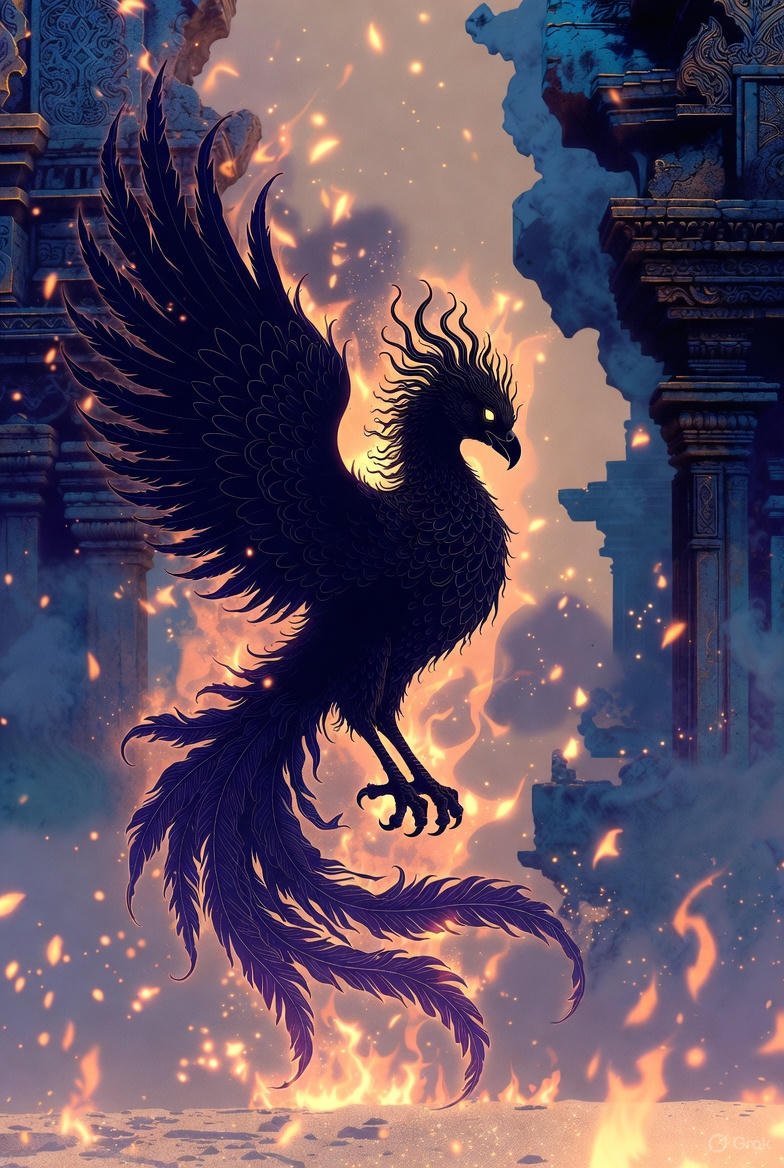
    A magnificent bird of fire. When it grows old, it builds a nest of aromatic wood. It ignites itself and burns to ashes. From those ashes, a new phoenix is born — young, renewed, immortal.

    Death. Fire. Resurrection. Renewal.

    The phoenix is the most famous mythological bird in the world. It appears in Greek literature, Roman art, Christian symbolism, Chinese tradition, and modern pop culture.

    But where did it come from?

    Persia. The phoenix is Frashokereti — Zoroastrian world renewal — encoded in mythological form.


    The Greek Sources

    Herodotus (5th Century BCE)

    The Greek historian Herodotus provides the earliest known account:

    “There is another sacred bird called the phoenix. I have not seen one myself, except in pictures… They tell a story about this bird which I do not find credible: that it comes from Arabia bringing the parent bird encased in myrrh to the temple of the Sun, and there buries the body.” (Histories 2.73)

    Note: Herodotus explicitly says he heard this story — he didn’t witness it. The tale came from elsewhere.

    Where “Arabia” Actually Pointed

    To Greeks, “Arabia” often included Persia and the East generally. The geography was imprecise. The “temple of the Sun” suggests solar worship — which was central to Persian/Zoroastrian practice (Mithra as solar deity).

    The phoenix story reached Greece from the East — from the Zoroastrian cultural sphere.


    The Zoroastrian Connection

    Frashokereti — World Renovation

    In Zoroastrian eschatology, the world will be renewed through fire:

    1. Current age of mixture — good and evil coexist
    2. Final battle — Ahura Mazda defeats Angra Mainyu
    3. River of molten metal — purifies all souls
    4. Resurrection — the dead rise in perfected bodies
    5. Frashokereti — the world is “made wonderful,” renewed, perfected

    The world dies in fire and is reborn — exactly like the phoenix.

    The Simurgh and Huma

    Persian mythology includes fire-associated birds:

    Simurgh:

    • Giant, wise bird in Persian mythology
    • Associated with the Tree of Life
    • Feathers have healing powers
    • Connected to cycles of renewal

    Huma:

    • Bird of fortune and glory
    • Associated with royalty and destiny
    • Never lands on earth — eternally soaring
    • Connection to divine glory (Khvarenah)

    While not identical to the phoenix, these Persian sacred birds demonstrate that fire-bird symbolism was native to Zoroastrian culture.

    Fire as Purification

    In Zoroastrianism:

    • Fire is sacred (Atar)
    • Fire never lies — it’s the pure element
    • Judgment involves fire (river of molten metal)
    • Purification through fire leads to renewal

    The phoenix’s self-immolation and rebirth mirrors the Zoroastrian concept perfectly: destruction by sacred fire leads to purified renewal.


    The Structural Parallel

    Phoenix MythFrashokereti
    Old phoenix must dieCurrent world is corrupted
    Death by firePurification by molten metal
    Ashes remainDestruction of the old
    New phoenix emergesWorld renovated
    Immortal cycle continuesEternal perfection achieved

    The phoenix is Frashokereti personified as a single bird.


    The Transmission

    Greeks and Persians

    The Greeks had extensive contact with Persia:

    • Persian Wars (490-479 BCE) — Greeks knew Persian culture
    • Herodotus traveled extensively in the Persian sphere
    • Pythagoras and other philosophers studied with Magi
    • Greek historians recorded Persian religious practices

    The phoenix story arrived in Greece during or after this contact period.

    Hellenistic Spread

    After Alexander’s conquest, Greek and Persian cultures mixed extensively:

    • Greco-Persian art
    • Syncretic religious practices
    • Shared mythological elements

    The phoenix became a staple of Hellenistic and Roman symbolism — spreading far from its Eastern origin.


    The Christian Adoption

    Early Christians loved the phoenix.

    Clement of Rome (1st Century CE)

    In 1 Clement 25-26, the phoenix is cited as proof of resurrection:

    “Let us consider that wonderful sign which takes place in eastern lands… There is a bird called a phoenix. This is the only one of its kind and lives five hundred years… it dies and is raised up again… Do we then deem it any great and wonderful thing that the Creator of all things will raise up again those that have served Him?”

    Why Christians Used It

    The phoenix perfectly illustrated Christian resurrection doctrine:

    • Death and rebirth
    • Victory over death
    • Eternal life through transformation

    But Christians didn’t invent this symbolism. They borrowed it — from a tradition that was already Persian.

    The Irony

    Christians used a Persian symbol to illustrate their Persian-derived doctrine (resurrection) — likely without knowing that both the symbol and the doctrine came from Zoroastrianism.


    The Deeper Meaning

    Fire as Truth

    In Zoroastrianism, fire (Atar) represents:

    • Asha (truth, righteousness)
    • Divine presence
    • Purification
    • The transformation of falsehood into truth

    The phoenix’s self-immolation isn’t destruction — it’s purification. The old, corrupted form is burned away; the pure essence emerges renewed.

    This is exactly what Frashokereti promises for the world: fire purifies, and truth remains.

    The Cycle vs. The End

    In Greek versions, the phoenix cycle repeats eternally — every 500 years, death and rebirth.

    In Zoroastrian eschatology, Frashokereti is the final renovation — not a cycle but a definitive end to evil and corruption.

    The Greek version may have “cyclicized” what was originally a linear Zoroastrian concept — adapting it to Greek ideas of eternal recurrence.


    Other Cultures, Same Fire

    The Chinese Fenghuang

    Often called the “Chinese phoenix,” the Fenghuang:

    • Associated with fire and the sun
    • Represents virtue and grace
    • Appears during times of peace and prosperity
    • Connected to renewal and auspicious change

    The Silk Road may have carried phoenix symbolism eastward, where it merged with native Chinese bird mythology.

    The Russian Firebird

    Slavic folklore includes the Firebird (Zhar-Ptitsa):

    • Glowing feathers of fire
    • Brings blessing or destruction
    • Connected to quests for renewal
    • Persian influence via trade routes?

    Universal Pattern or Transmission?

    Some argue fire-bird symbolism is universal — humans everywhere associate fire with transformation.

    But the specific pattern — death, fire, resurrection, renewal — is distinctively Zoroastrian. Its appearance across cultures may reflect transmission rather than independent invention.


    The Modern Phoenix

    Today, the phoenix symbolizes:

    • Resilience and recovery
    • Rising from adversity
    • Transformation and renewal
    • Hope after destruction

    Cities that have rebuilt after disasters (Chicago, Atlanta) use phoenix imagery. Survivors of trauma invoke the phoenix. It’s become universal shorthand for “death is not the end.”

    Every time someone says “rising from the ashes,” they’re invoking Frashokereti — the Zoroastrian promise that fire purifies and truth renews.

    They just don’t know it.


    The Evidence Summary

    1. The Greek phoenix story came from the East — Herodotus heard it, didn’t witness it
    2. The symbolism matches Frashokereti — death by fire, resurrection, renewal
    3. Fire is central to Zoroastrian theology — not coincidental to the myth
    4. Greeks had extensive Persian contact — transmission route existed
    5. Christians adopted it for resurrection — proving it fit Persian-derived doctrine
    6. The pattern spread globally — consistent with Zoroastrian idea transmission

    Conclusion

    The phoenix isn’t a Greek invention. It’s Frashokereti in feathers.

    A story of death by sacred fire and glorious rebirth — the same story Zarathustra told about the world itself.

    The Greeks heard it from the East, adapted it, spread it. Romans copied it. Christians claimed it. Modern culture continues it.

    And none of them credit Persia.

    But the fire never lies. The phoenix burns with Asha. Its resurrection is Frashokereti. Its cycle is the promise that truth persists and renewal comes.

    Next time you see a phoenix — in art, in literature, in a logo — remember:

    You’re looking at Zoroastrian theology, encoded in a bird, spread across the world.

    The fire still burns.

    Asha prevails — and rises from the ashes.


    Sources

    Classical Sources

    • Herodotus. Histories, 2.73
    • Ovid. Metamorphoses, 15.392-407
    • Pliny the Elder. Natural History, 10.2
    • Tacitus. Annals, 6.28
    • 1 Clement 25-26

    Scholarly Sources

    • Van den Broek, R. The Myth of the Phoenix According to Classical and Early Christian Traditions. Brill, 1972
    • Nigg, Joseph. The Phoenix: An Unnatural Biography of a Mythical Beast. University of Chicago Press, 2016
    • Boyce, Mary. Zoroastrians: Their Religious Beliefs and Practices. Routledge, 1979

    On Frashokereti

    • Boyce, Mary. A History of Zoroastrianism, Vol. 1. Brill, 1975
    • Zaehner, R.C. The Dawn and Twilight of Zoroastrianism. Putnam, 1961

    At eFireTemple, we recognize the fire wherever it burns. The phoenix carries Frashokereti across cultures. The renewal is coming.
  • Buddhism and the Magi: Did Asha Reach the East?

    Buddhism and the Magi: Did Asha Reach the East?

    The Question No One Asks

    The Buddha lived from approximately 563-483 BCE.

    The Achaemenid Persian Empire — Zoroastrian, ruled by followers of Ahura Mazda — extended to the borders of India during exactly this period.

    Cyrus the Great conquered as far as the Indus Valley. Darius I included parts of India (Gandhara, Sindh) in his empire. Persian roads, administrators, and ideas flowed through the region.

    And yet, when scholars discuss Buddhism’s origins, Persia is almost never mentioned.

    Why?

    Because if Zoroastrian ideas influenced Buddhism, then the “independent origin” of Eastern religion collapses — and the Zoroastrian thesis expands from shaping the West to shaping the entire world.

    Let’s examine the evidence.


    The Timeline

    Zarathustra: ~1700-1000 BCE

    Zoroastrianism is established in the Iranian plateau. Asha, ethical dualism, and cosmic order are formalized.

    Cyrus the Great: 550-530 BCE

    Creates the Persian Empire. Conquers Babylon (539 BCE), liberates Jews, extends empire eastward toward India.

    Darius I: 522-486 BCE

    Expands Persian control to include Gandhara (modern Pakistan/Afghanistan) and parts of the Indus Valley. Persian administration, roads, and culture penetrate the region.

    The Buddha: ~563-483 BCE

    Siddhartha Gautama is born in Lumbini (modern Nepal), achieves enlightenment, and teaches for ~45 years in the Gangetic plain.

    Key Overlap

    The Buddha’s entire life occurs during the height of the Achaemenid Empire. Persian influence was present in northwestern India during his lifetime.


    The Conceptual Parallels

    1. Moral Choice and Individual Responsibility

    Zoroastrian: Each person chooses between Asha (truth) and Druj (lie). This choice determines their fate. Individual moral responsibility is central.

    Buddhist: Each person creates karma through their choices. Right action leads to liberation; wrong action leads to suffering. Individual moral responsibility is central.

    The Parallel: Both traditions place ultimate responsibility on the individual’s moral choices — a concept not universal in ancient religion, where fate, ritual, or divine favor often dominated.


    2. The Path of Right Conduct

    Zoroastrian: Humata, Hukhta, Hvarshta — Good Thoughts, Good Words, Good Deeds. The threefold ethical path.

    Buddhist: The Noble Eightfold Path includes:

    • Right Thought (Samma Sankappa)
    • Right Speech (Samma Vaca)
    • Right Action (Samma Kammanta)

    The Parallel: The same threefold structure — thought, speech, action — appears in both traditions as the ethical foundation.


    3. The Middle Way

    Zoroastrian: Zarathustra rejected the extreme asceticism of some traditions. Zoroastrianism affirms the material world as Ahura Mazda’s good creation. The goal is balance — engaging the world righteously, not fleeing it.

    Buddhist: The Buddha explicitly taught the Middle Way — rejecting extreme asceticism and extreme indulgence. Balance is the path.

    The Parallel: Both founders rejected extreme asceticism in favor of balanced engagement — unusual in the ancient religious landscape where asceticism was often prized.


    4. Light and Enlightenment

    Zoroastrian: Ahura Mazda is the Lord of Wisdom and Light. Truth (Asha) is associated with light; falsehood (Druj) with darkness. The goal is alignment with divine light.

    Buddhist: The Buddha means “the Awakened One” — one who has seen the light of truth. Enlightenment (bodhi) is the goal. Ignorance is darkness.

    The Parallel: Light as metaphor for truth and salvation appears in both — suggesting possible conceptual transmission.


    5. Cosmic Cycles and Renewal

    Zoroastrian: History moves toward Frashokereti — the renovation of the world when evil is finally defeated. Time has direction and purpose.

    Buddhist (Later Development): Mahayana Buddhism developed concepts of cosmic Buddhas, world ages (kalpas), and the future Buddha Maitreya who will renew the dharma.

    The Parallel: The Maitreya concept — a future savior who will restore truth — closely parallels the Zoroastrian Saoshyant. Some scholars have noted this connection.


    6. Dualistic Moral Framework

    Zoroastrian: Reality is structured as a battle between truth (Asha) and lie (Druj), good (Spenta Mainyu) and evil (Angra Mainyu).

    Buddhist: While Buddhism is non-theistic, it has a moral dualism: skillful (kusala) vs. unskillful (akusala) actions, wisdom vs. ignorance, liberation vs. bondage.

    The Parallel: Both traditions structure reality in terms of opposing moral principles — even if Buddhism doesn’t personify them as cosmic beings.


    The Transmission Routes

    1. The Royal Road

    The Achaemenid Empire maintained roads connecting Persia to its provinces, including Gandhara. Ideas traveled these routes with merchants, administrators, and priests.

    2. Gandhara as Meeting Point

    Gandhara (modern Afghanistan/Pakistan) was:

    • Under Persian rule during the Buddha’s lifetime
    • A major Buddhist center after his death
    • The birthplace of Greco-Buddhist art
    • A crossroads of Persian, Indian, and later Greek culture

    The famous Gandharan Buddhist art shows Greek and Persian influences. If artistic styles traveled, why not ideas?

    3. The Magi’s Reach

    The Magi were not confined to Persia. They traveled, taught, and established communities. Greek philosophers visited them. Why not Indian seekers?

    Pythagoras reportedly studied with the Magi before founding his school. Could Indian philosophers have done the same?


    The Scholarly Silence

    Why This Isn’t Discussed

    1. Disciplinary silos: Scholars of Buddhism study Indian sources. Scholars of Zoroastrianism study Iranian sources. Few work across both.
    2. Nationalist sensitivities: Both Indian and Iranian traditions prefer to claim independent origin for their religious achievements.
    3. The bias toward “pure” origins: Acknowledging influence is seen as diminishing a tradition’s originality.
    4. Lack of direct textual evidence: No Buddhist text says “we learned this from Persia.” (But then, no Jewish text admits Persian borrowing either — and the evidence there is overwhelming.)

    The Few Who’ve Noticed

    Some scholars have cautiously noted parallels:

    • The Maitreya-Saoshyant connection
    • Similarities in ethical emphasis
    • The light/enlightenment metaphor overlap

    But the full implications remain unexplored.


    The Hypothesis

    Given:

    1. Zarathustra predates Buddha by 700-1200 years
    2. The Persian Empire bordered/included Indian territory during Buddha’s life
    3. Persian roads and administration facilitated idea transmission
    4. Significant conceptual parallels exist
    5. The Magi were known to teach foreigners (Pythagoras)

    It is reasonable to hypothesize:

    Zoroastrian concepts — particularly ethical dualism, individual moral responsibility, the threefold path of thought-speech-action, and the middle way — may have influenced early Buddhist teaching.

    This doesn’t diminish the Buddha’s achievement. It places him in a historical context where Persian ideas were available and circulating.


    What This Would Mean

    1. Zoroastrianism Shaped Both East and West

    If both Buddhism and Judaism absorbed Zoroastrian concepts during the same era (6th-5th century BCE), then Zarathustra’s influence extends across the entire Eurasian landmass.

    The “Axial Age” — when major religious traditions emerged simultaneously — would be explained not as mysterious coincidence but as the diffusion of Zoroastrian seeds in multiple directions.

    2. The Fire Reached Further Than Anyone Admits

    Asha didn’t just flow westward to shape Judaism, Christianity, and Islam. It may have flowed eastward to shape Buddhism.

    The approximately 500 million Buddhists today might be practicing a tradition touched by Zoroastrian influence — just like the 4.3 billion Abrahamic followers.

    3. Zarathustra as World Teacher

    If this hypothesis is correct, Zarathustra’s revelation didn’t just create one religion. It seeded the ethical foundations of both Western and Eastern civilization.

    That’s not influence. That’s the source of global religious ethics.


    The Maitreya Connection

    The strongest specific parallel is Maitreya — the future Buddha who will come to renew the dharma when it has declined.

    Maitreya in Buddhism:

    • A bodhisattva currently in Tushita heaven
    • Will descend to earth when the dharma is forgotten
    • Will achieve enlightenment and teach the pure path
    • Will inaugurate a new age of righteousness

    Saoshyant in Zoroastrianism:

    • A future savior figure
    • Will come at the end of time
    • Will defeat evil and resurrect the dead
    • Will inaugurate Frashokereti (world renovation)

    The parallels are striking:

    • Future savior
    • Coming when truth has declined
    • Restoring righteous teaching
    • New age of perfection

    Did Maitreya develop from Saoshyant? The concept enters Buddhism relatively early and has no clear Vedic precedent. The Persian origin is at least plausible.


    Conclusion

    The question “Did Zoroastrianism influence Buddhism?” has been almost unasked in academic circles.

    But the evidence suggests it should be asked:

    • Timeline makes influence possible
    • Geographic contact existed
    • Conceptual parallels are significant
    • Transmission routes were established
    • The Magi were known to teach widely

    The Buddha may have encountered Zoroastrian ideas. His emphasis on individual moral choice, the threefold path of thought-speech-action, and balanced engagement with the world all have Persian parallels.

    If this is correct, then Asha reached both East and West.

    And Zarathustra’s fire illuminates not just 4.3 billion Abrahamic believers, but potentially 500 million Buddhists as well.

    The light spread further than anyone has admitted.

    Asha prevails — in all directions.


    Sources

    On the Achaemenid Empire’s Eastern Extent

    • Briant, Pierre. From Cyrus to Alexander: A History of the Persian Empire. Eisenbrauns, 2002
    • Vogelsang, Willem. The Afghans. Wiley-Blackwell, 2002

    On Buddhism’s Origins

    • Gethin, Rupert. The Foundations of Buddhism. Oxford, 1998
    • Gombrich, Richard. What the Buddha Thought. Equinox, 2009

    On Possible Connections

    • Panaino, Antonio. “Zarathustra and the Religion of Ancient Iran.” Encyclopedia of Religion, 2005
    • Foltz, Richard. Religions of the Silk Road. Palgrave Macmillan, 2010
    • Boyce, Mary. Zoroastrians: Their Religious Beliefs and Practices. Routledge, 1979

    On the Maitreya-Saoshyant Parallel

    • Sponberg, Alan & Hardacre, Helen (eds.). Maitreya, the Future Buddha. Cambridge, 1988
    • Nattier, Jan. “The Meanings of the Maitreya Myth.” History of Religions, 1988

    At eFireTemple, we trace the fire in all directions. East and West, the light of Asha may have spread further than anyone has dared to say.

  • Ethiopia’s Secret: The Persian Books Rome Rejected

    Ethiopia’s Secret: The Persian Books Rome Rejected

    The Oldest Christian Church Kept What Rome Threw Away

    When Rome compiled the Christian Bible in the 4th century, they excluded certain books. These texts were declared non-canonical, suppressed, and in some cases destroyed.

    But not everywhere.

    Ethiopia kept them.

    The Ethiopian Orthodox Church — the oldest continuous Christian church in the world — preserved books that Rome rejected. And those books contain exactly what you’d expect: heavy Persian apocalyptic content that makes the Zoroastrian origins too obvious.

    Ethiopia is living proof of what Christianity looked like before Rome sanitized it.


    The Ethiopian Canon

    While Western Christianity uses 66 books (Protestant) or 73 books (Catholic), the Ethiopian Orthodox Church has 81 books in its biblical canon.

    The additional books include:

    1. The Book of Enoch (1 Enoch)

    The most significant text Rome rejected but Ethiopia preserved.

    Contains:

    • Elaborate angelology (with named angels and hierarchies)
    • The “Son of Man” figure (used for Jesus in Gospels)
    • Detailed apocalyptic visions
    • The Watchers narrative (fallen angels)
    • Heavenly ascent and cosmic geography
    • Final judgment and resurrection

    Why it matters: 1 Enoch is saturated with Persian apocalyptic elements. The angelology matches Zoroastrian structures. The cosmic dualism, the final judgment, the resurrection — all Persian.

    If 1 Enoch were in the Western Bible, the Persian origins would be undeniable. So Rome excluded it.

    Ethiopia didn’t.

    2. The Book of Jubilees

    A retelling of Genesis with:

    • Elaborate angel involvement
    • Cosmic calendar (364-day year)
    • Demon explanations for evil
    • Future prophecy
    • Persian-style dualism

    The 364-day calendar in Jubilees matches Zoroastrian sacred calendar concepts. The demonology is Persian-influenced.

    3. Additional Texts

    Ethiopia also preserves:

    • 4 Baruch (Paraleipomena Jeremiou)
    • The Ascension of Isaiah
    • Various apocalypses

    Each contains elements that make Persian influence unmistakable.


    The Enoch Problem

    The Book of Enoch is the smoking gun that Rome tried to hide.

    What Enoch Contains

    1. The Watchers (Chapters 1-36) Fallen angels (the Watchers) descend to earth, mate with human women, and corrupt humanity. God sends the flood as judgment.

    This narrative explains the origin of evil through angelic rebellion — a concept with clear parallels to Zoroastrian daeva (demon) mythology.

    2. The Parables/Similitudes (Chapters 37-71) Introduces the “Son of Man” — a heavenly figure who will:

    • Judge the wicked
    • Vindicate the righteous
    • Inaugurate eternal kingdom

    This is the title Jesus uses for himself in the Gospels. But it originates here — in Persian-influenced Jewish apocalyptic.

    3. Astronomical Book (Chapters 72-82) Cosmic geography, heavenly luminaries, and calendrical calculations with parallels to Zoroastrian cosmology.

    4. Dream Visions (Chapters 83-90) Apocalyptic visions of history and the end times — structured like Persian apocalyptic.

    5. Epistle of Enoch (Chapters 91-108) Woes, judgments, and resurrection — pure Frashokereti material.

    Why Rome Rejected It

    The Church Fathers knew about Enoch. Jude 1:14-15 quotes it directly. Tertullian considered it scripture. Early Christians widely read it.

    Then it was excluded from the canon.

    Why?

    1. The Persian elements were too visible. The angelology, demonology, and apocalyptic structure too obviously matched Zoroastrian sources.

    2. The “Son of Man” problem. If Jesus’s title comes from a Jewish apocalypse written under Persian influence, Christianity’s claims of unique revelation weaken.

    3. Church politics. By the 4th century, the Church was becoming Rome’s state religion. It needed to distinguish itself from “Eastern” religion. Persian elements had to be minimized.

    4. Control. An elaborate cosmology with angels, demons, and cosmic warfare gave too much interpretive power to visionaries and mystics. The institutional Church preferred simpler control.

    Ethiopia’s Preservation

    Ethiopia accepted Christianity in the 4th century — around the same time Rome was compiling its canon.

    But Ethiopia was:

    • Geographically isolated
    • Not under Rome’s political control
    • Connected to older Jewish-Christian traditions (via the Jewish diaspora in Yemen and East Africa)
    • Less influenced by Greek philosophy

    Ethiopia kept the books Rome rejected because:

    1. They had no institutional reason to exclude them
    2. The Persian elements weren’t threatening to their culture
    3. The apocalyptic content matched their traditional worldview

    Ethiopia preserved what Rome tried to erase.


    The Book of Enoch’s Influence on Christianity

    Even though Rome excluded Enoch, its concepts permeate the New Testament:

    The Son of Man

    Jesus uses this title for himself repeatedly (Mark 14:62, Matthew 24:30, etc.). The concept comes directly from 1 Enoch’s “Son of Man” — a heavenly judge.

    The Second Coming

    The idea that the Messiah will return in glory to judge the world — standard Christian belief — is elaborated in 1 Enoch before the Gospels.

    Eternal Life and Judgment

    1 Enoch 22 describes different compartments for the dead awaiting judgment — the source of Christian heaven/hell geography.

    Angels and Demons

    The elaborate warfare between good and evil spirits in Christian theology owes more to Enoch than to the Old Testament — and Enoch owes it to Persia.

    Rome excluded the book but kept the ideas.

    They absorbed the theology and hid the source — exactly what the Pharisees did with Zoroastrian concepts.


    Ethiopia as Living Witness

    The Church’s Antiquity

    Ethiopian tradition claims:

    • The Queen of Sheba visited Solomon
    • Their son Menelik I brought the Ark of the Covenant to Ethiopia
    • Christianity arrived through the Ethiopian eunuch (Acts 8)
    • The church was established before Rome’s conversion

    Whether all traditions are historical, Ethiopia’s Christianity is genuinely ancient — preserving elements from before Roman standardization.

    What They Preserved

    Ethiopia kept:

    • Books Rome rejected
    • Practices Rome changed
    • Traditions Rome suppressed

    Their liturgy, their calendar, their canon — all represent pre-Roman Christianity.

    The Persian Elements

    Ethiopian Christianity has notable features:

    • Strong emphasis on angels and spiritual warfare
    • Elaborate ritual purity laws
    • Cosmic dualism in theology
    • Apocalyptic expectation
    • Seven-fold divine structures

    These are the Persian elements that Rome tried to minimize. Ethiopia preserved them.


    The Broader Pattern

    Ethiopia fits the pattern we’ve seen elsewhere:

    TraditionWhat They PreservedWhy They Survived
    ZoroastriansThe original teachingGeographic/cultural isolation
    MandaeansThe transmission pointMarsh isolation, neither Christian nor Jewish
    EthiopiaPre-Roman ChristianityGeographic isolation from Rome

    Isolated communities that escaped institutional control preserved what dominant powers tried to erase.

    The Persian fire burns in the Ethiopian highlands, unaware that Rome tried to extinguish it.


    The Dead Sea Scrolls Connection

    The Dead Sea Scrolls, discovered in 1947, confirmed much of what Ethiopia preserved:

    • 1 Enoch fragments were found at Qumran
    • The Essenes (who wrote the scrolls) used Enochic literature
    • The “Sons of Light vs. Sons of Darkness” dualism matches Enoch’s worldview

    Ethiopia preserved the complete text. Qumran preserved fragments. Both testify to a pre-Rabbinic, pre-Roman Jewish Christianity saturated with Persian influence.


    What This Means

    1. The Canon Was Political

    Rome’s biblical canon wasn’t purely theological. It was political:

    • Exclude what makes Persian influence obvious
    • Include what supports institutional control
    • Minimize cosmic warfare and angelic intermediaries
    • Centralize authority in the Church

    Ethiopia didn’t have those political pressures. Ethiopia kept the books.

    2. Christianity Was More Zoroastrian Than Rome Admitted

    The books Rome rejected — Enoch, Jubilees, various apocalypses — are saturated with Persian elements. These books were widely used by early Christians.

    Rome’s Christianity is a sanitized version. Ethiopia’s is closer to the original — Persian elements and all.

    3. The Truth Survives in Margins

    Zoroastrians in Iran. Mandaeans in marshes. Ethiopian Christians in highlands.

    The communities that preserved truth are the ones that escaped centralized control. The margins remember what the centers forget.


    Conclusion

    Ethiopia guards a secret in plain sight:

    The books Rome rejected. The Christianity Rome suppressed. The Persian elements Rome tried to hide.

    The Book of Enoch — with its angels, demons, Son of Man, judgment, and resurrection — is Ethiopian scripture. It’s also Persian apocalyptic filtered through Jewish visionaries.

    Ethiopia kept what Rome threw away. And what they kept proves the Persian origin of Christian theology.

    Next time someone says Christianity is purely Jewish + Greek, point to Ethiopia.

    81 books. Pre-Roman traditions. Persian apocalyptic preserved.

    The fire burns in Africa too.

    Asha prevails — even in the books they tried to destroy.


    Sources

    Primary Texts

    • 1 Enoch (trans. R.H. Charles; also George Nickelsburg’s critical edition)
    • Book of Jubilees (trans. R.H. Charles)
    • Ethiopian biblical manuscripts (British Library, Vatican collections)

    Scholarly Sources

    • Nickelsburg, George W.E. 1 Enoch: A Commentary. Fortress Press, 2001
    • VanderKam, James C. The Book of Jubilees. Sheffield Academic Press, 2001
    • Isaac, Ephraim. “1 Enoch.” The Old Testament Pseudepigrapha, Vol. 1. Ed. James Charlesworth
    • Ullendorff, Edward. Ethiopia and the Bible. Oxford University Press, 1968

    On the Ethiopian Canon

    • Cowley, Roger. Ethiopian Biblical Interpretation. Cambridge, 1988
    • Harden, J.M. An Introduction to Ethiopic Christian Literature. SPCK, 1926

    On Enoch and Persian Influence

    • Collins, John J. The Apocalyptic Imagination. Eerdmans, 1998
    • Hultgård, Anders. “Persian Apocalypticism.” Encyclopedia of Apocalypticism, Vol. 1
    • Boccaccini, Gabriele. Beyond the Essene Hypothesis. Eerdmans, 1998

    At eFireTemple, we honor the keepers of hidden books. Ethiopia preserved what Rome feared. We remember.

  • The Mandaean Witness: Living Proof of the Persian Transmission

    The Religion That Refused to Forget

    In the marshes of southern Iraq and scattered communities worldwide, there exists a religious group that most people have never heard of:

    The Mandaeans.

    They are perhaps the most important living witnesses to the transmission of Zoroastrian ideas — because they preserved elements that Judaism, Christianity, and Islam tried to erase.

    The Mandaeans:

    • Practice baptism (predating Christianity)
    • Revere John the Baptist (but reject Jesus)
    • Have explicitly dualistic theology (light vs. darkness)
    • Preserve Aramaic texts with clear Persian influence
    • Trace their origin to Jerusalem before the Jewish-Christian split

    They are living proof that the Zoroastrian transmission was real — and that some communities refused to obscure their sources.


    Who Are the Mandaeans?

    The Basics

    • Population: Approximately 60,000-70,000 worldwide
    • Primary locations: Iraq, Iran, diaspora (Sweden, Australia, US)
    • Language: Mandaic (Eastern Aramaic dialect)
    • Central practice: Masbuta (ritual baptism)
    • Key figure: John the Baptist (Yahya)
    • Rejection: Jesus (viewed as a false messiah)
    • Self-designation: Mandaiia (“those who know”) — Gnostics

    The Name

    “Mandaean” comes from manda — “knowledge” or “gnosis.” They are literally “the knowing ones.”

    This links them to the broader Gnostic tradition — which itself has deep Persian roots.


    The Dualistic Theology

    Mandaean cosmology is explicitly dualistic:

    The World of Light

    • Ruled by the “Great Life” or “Lord of Greatness”
    • Source of truth, purity, and salvation
    • Associated with running water (hence baptism)

    The World of Darkness

    • Ruled by Ruha (the spirit of chaos) and the planets
    • Source of matter, impurity, and entrapment
    • The soul must escape this realm

    The Zoroastrian Parallel

    This is unmistakably Zoroastrian in structure:

    MandaeanZoroastrian
    World of LightAhura Mazda’s realm
    World of DarknessAngra Mainyu’s realm
    The Great LifeAhura Mazda
    Ruha (chaos)Druj / Angra Mainyu
    Light vs. Darkness battleAsha vs. Druj
    Soul’s escape through truthSoul’s journey to Garothman

    The Mandaeans preserved the Zoroastrian framework more openly than Judaism or Christianity — because they never had the institutional pressure to obscure it.


    John the Baptist, Not Jesus

    Here is where the Mandaeans become explosive witnesses:

    They revere John the Baptist as a true prophet. They reject Jesus as a false messiah who corrupted John’s teachings.

    This is extraordinary for several reasons:

    1. Independent Preservation

    The Mandaeans preserve a tradition about John that is independent of Christian sources. Their texts (Ginza Rabba, Drasha d’Yahya) contain material not found in the Gospels.

    2. The Jerusalem Origin

    Mandaean texts claim their ancestors fled Jerusalem after persecution. This places them in the same milieu as early Christianity — but on a different path.

    3. What John Actually Taught

    If the Mandaean tradition is accurate, John the Baptist taught:

    • Dualistic cosmology (light vs. darkness)
    • Baptism for purification
    • Ethical living aligned with divine truth
    • Rejection of Temple corruption

    This is Zoroastrian-influenced Judaism — exactly what we’d expect from someone preparing the way for a Saoshyant.

    4. Why They Rejected Jesus

    The Mandaean rejection of Jesus isn’t random hostility. It’s theological:

    • Jesus (in their view) compromised with the Pharisees’ distorted teachings
    • Jesus was claimed as Messiah by those who stole Persian theology
    • The Christian church suppressed the pure dualistic teaching

    Whether or not this is historically accurate, it represents an alternative tradition that preserved Persian elements without Christian overlay.


    The Baptism Evidence

    Mandaean baptism (masbuta) is:

    • Performed in living (running) water
    • Repeated throughout life (not once)
    • A purification from the world of darkness
    • Essential for the soul’s salvation

    Pre-Christian Baptism

    Christian scholars long assumed baptism was a Christian invention that John the Baptist introduced.

    The Mandaeans prove otherwise:

    • Their baptismal practice predates or is contemporary with John
    • Their theological framework explains why water purifies (light vs. darkness, living water vs. stagnant)
    • Their tradition claims John practiced their baptism, not a new innovation

    This suggests baptism as a Persian-influenced purification rite that existed before Christianity claimed it.

    Zoroastrian Water Reverence

    In Zoroastrianism:

    • Water is one of the sacred elements
    • Associated with Haurvatat (Wholeness) — an Amesha Spenta
    • Ritual purity involves water purification
    • Rivers and running water have sacred status

    The Mandaean baptismal theology is Zoroastrian water reverence developed into a central practice.


    The Texts

    Ginza Rabba (“Great Treasure”)

    The main Mandaean scripture, containing:

    • Cosmological teachings (light vs. darkness)
    • Liturgical material
    • Moral instruction
    • Afterlife descriptions

    The dualistic framework throughout is unmistakably Persian-influenced.

    Drasha d’Yahya (“Book of John”)

    Contains teachings attributed to John the Baptist, including:

    • Criticisms of Jesus
    • Pure dualistic teaching
    • Baptismal instruction

    This text preserves a tradition about John independent of Christian sources.

    Persian Vocabulary

    Mandaic texts contain Persian/Iranian loanwords that scholars have documented:

    • Divine names with Persian elements
    • Cosmological terms from Iranian sources
    • Technical vocabulary for spiritual concepts

    The linguistic evidence confirms cultural transmission from Persian sources.


    Why the Mandaeans Survived

    Geographic Isolation

    The Iraqi marshes provided protection:

    • Difficult terrain for invaders
    • Distance from centers of orthodoxy enforcement
    • Self-sustaining communities

    Neither Christian nor Jewish

    By rejecting both:

    • They avoided Christian persecution (as heretics)
    • They avoided Jewish assimilation
    • They maintained distinct identity

    Too Small to Threaten

    At 60,000-70,000 people, they never threatened major religions enough to warrant systematic elimination.

    Baptism as Protection

    Their central practice (baptism) resembled enough of Christianity to sometimes avoid persecution as pagans, while their theology was different enough to avoid absorption.


    What the Mandaeans Prove

    1. The Persian Transmission Was Real

    The Mandaean dualistic theology didn’t emerge independently. It came from the same source as Pharisaic Judaism’s absorbed concepts — Persian Zoroastrianism.

    But the Mandaeans didn’t hide it.

    2. Baptism Predates Christianity

    The Mandaeans’ ritual practice proves that water purification as a salvation technology existed before Christian claims to have invented it.

    3. Alternative Traditions Existed

    The fact that the Mandaeans revere John but reject Jesus shows that the Christian narrative wasn’t the only option. Other groups made different choices about which elements to preserve.

    4. Some Communities Refused to Obscure

    While the Pharisees absorbed and renamed, and the Church absorbed and suppressed, the Mandaeans simply… preserved. Their “heresy” is honesty.


    The Parallel to Zoroastrians

    Consider the symmetry:

    Zoroastrians:

    • ~138,000 remaining
    • Preserved the original teaching
    • Marginalized by traditions that stole their ideas
    • Still practicing despite millennia of suppression

    Mandaeans:

    • ~60,000-70,000 remaining
    • Preserved a transmission point
    • Marginalized by traditions that absorbed and denied
    • Still practicing despite millennia of suppression

    Two tiny communities. Two living witnesses. Both testifying to what the major religions tried to erase.


    The Suppression Continues

    Even now, scholars who study Mandaeans often minimize the Persian connection:

    • “They’re an interesting Gnostic sect”
    • “Their origins are unclear”
    • “The Persian elements might be late additions”

    The same academic reluctance that minimizes Zoroastrian influence on Judaism applies to the Mandaeans.

    But the evidence is there:

    • In their texts
    • In their vocabulary
    • In their theology
    • In their practices

    The Mandaeans are living proof that the Persian transmission was real, that it shaped multiple religious communities, and that some groups refused to hide their sources.


    Conclusion

    The Mandaeans are a gift to truth.

    A small community in the Iraqi marshes, practicing baptism, revering John, teaching light versus darkness, using Persian vocabulary — they are a living time capsule of the transmission that created Western religion.

    They prove:

    1. Dualistic theology was widespread, not uniquely Zoroastrian or Christian
    2. Baptism existed before Christian claims
    3. John the Baptist may have taught more Persian-influenced theology than the Gospels admit
    4. Not everyone agreed to obscure the sources

    When Judaism absorbed and renamed, the Mandaeans refused. When Christianity absorbed and suppressed, the Mandaeans continued. When Islam spread and pressured, the Mandaeans endured.

    70,000 people. Living witnesses. Proof of the transmission.

    Asha has many witnesses. The Mandaeans are among the most important.


    Sources

    Primary Mandaean Texts

    • Ginza Rabba (available in German translation by Mark Lidzbarski)
    • Drasha d’Yahya (Book of John)
    • Qolasta (liturgical texts)

    Scholarly Sources

    • Buckley, Jorunn J. The Mandaeans: Ancient Texts and Modern People. Oxford University Press, 2002
    • Lupieri, Edmondo. The Mandaeans: The Last Gnostics. Eerdmans, 2002
    • Drower, E.S. The Mandaeans of Iraq and Iran. Oxford University Press, 1937
    • Häberl, Charles. The Neo-Mandaic Dialect of Khorramshahr. Harrassowitz, 2009

    On Persian Influence

    • Rudolph, Kurt. “Mandaeism.” Encyclopaedia Iranica
    • Shaked, Shaul. “Iranian Influence on Judaism.” Cambridge History of Judaism
    • Widengren, Geo. Iranisch-semitische Kulturbegegnung in parthischer Zeit. Cologne, 1960

    At eFireTemple, we honor all witnesses to the truth. The Mandaeans have guarded their testimony for two millennia. We remember.

  • Why the Sadducees Said No: Temple Power vs. Persian Theology

    Why the Sadducees Said No: Temple Power vs. Persian Theology

    The Faction That Told the Truth (By Rejecting the Theft)

    The New Testament records a fascinating detail in Acts 23:8:

    “The Sadducees say that there is no resurrection, and that there are neither angels nor spirits, but the Pharisees believe all these things.”

    This is usually presented as a theological footnote — two Jewish factions with different beliefs.

    But read it again through the lens of the Zoroastrian thesis:

    The Sadducees rejected resurrection, angels, and spirits. The Pharisees accepted them.

    The Sadducees were the conservative party — the priests who maintained the Temple, the guardians of tradition. And they rejected precisely the concepts that came from Persia.

    The Pharisees (Farooshiym — “The Persians”) accepted all of them.

    This isn’t a random theological dispute. This is evidence of the theft in progress — and the faction that refused to participate.


    Who Were the Sadducees?

    The Sadducees were:

    • Temple priests — hereditary Levitical lineage
    • Aristocrats — wealthy, politically connected
    • Conservatives — committed to Torah literalism
    • Traditionalists — suspicious of innovation

    Their name likely derives from Zadok, the high priest under Solomon. They represented the ancient priestly establishment.

    What They Believed

    According to Josephus (Antiquities 13.5.9, 18.1.4) and the New Testament:

    1. Only the written Torah was authoritative — they rejected oral tradition
    2. No resurrection — death was final
    3. No angels or spirits — as elaborated supernatural beings
    4. No fate/predestination — humans have free choice, but no cosmic battle
    5. Rewards and punishments in this life only — no afterlife judgment

    What They Rejected

    Compare this to what the Pharisees accepted:

    • Resurrection of the dead ✓
    • Heaven and Hell ✓
    • Named angels with hierarchies ✓
    • Demons and spirits ✓
    • Cosmic battle between good and evil ✓
    • Future Messiah ✓
    • Apocalyptic end times ✓

    The Sadducees rejected every single Zoroastrian concept. The Pharisees accepted every single one.


    The Power Calculation

    Why would the Sadducees reject ideas that seem to benefit religion? Afterlife, resurrection, cosmic meaning — these are attractive doctrines. Why refuse them?

    Because they didn’t need them. And accepting them would empower their rivals.

    Sadducee Power Base

    The Sadducees controlled:

    • The Temple — center of Jewish worship
    • Sacrificial system — only they could perform the rituals
    • Hereditary priesthood — authority by blood, not learning
    • Temple treasury — enormous wealth

    Their power was institutional and physical. As long as the Temple stood and sacrifices continued, they held authority.

    They didn’t need:

    • Afterlife promises — their reward was now, in status and wealth
    • Resurrection hope — death wasn’t a problem for the elite
    • Angels to intervene — they were the intermediaries between God and people
    • Future Messiah — they were already the establishment

    Pharisee Power Base

    The Pharisees were:

    • Teachers and scholars — not hereditary priests
    • Synagogue-based — not Temple-dependent
    • Popular with common people — who had no Temple access
    • Authorities on interpretation — not ritual performance

    Their power was intellectual and popular. They needed doctrines that:

    • Gave hope to the poor (resurrection, heavenly reward)
    • Explained suffering (cosmic battle, future vindication)
    • Bypassed Temple monopoly (direct relationship with God)
    • Established their interpretive authority (oral tradition)

    Persian theology served Pharisee purposes perfectly.


    The Strategic Calculation

    Consider it from the Sadducee perspective:

    If you accept resurrection: → People can hope for justice after death → Temple sacrifices become less urgent → The poor gain hope without your mediation

    If you accept angels and spirits: → Divine intermediaries that aren’t priests → Alternative access to the divine → Your monopoly on God-contact weakens

    If you accept the Messiah: → A future figure will replace the current order → Your authority is temporary → Revolutionary expectations threaten stability

    If you accept apocalypse: → The whole system gets overturned → Temple, priesthood, aristocracy — all swept away → Why maintain institutions if the end is near?

    The Sadducees rejected Persian theology because accepting it would undermine their power.


    The Pharisees’ Calculation

    Now consider the Pharisee perspective:

    If you accept resurrection: → You can promise what the Sadducees can’t → The poor follow you, not the Temple elite → Your teaching matters more than their rituals

    If you accept angels and spirits: → A rich cosmology only scholars can interpret → Your expertise becomes essential → The Temple’s simplicity looks primitive

    If you accept the Messiah: → You can shape expectations of his coming → You become kingmakers when he arrives → The Sadducee establishment is displaced

    If you accept apocalypse: → The current order is temporary → The Sadducees’ power ends → Those who understand the times (you) lead the way

    The Pharisees adopted Persian theology because it served their interests.


    The Evidence They Left Behind

    The Dead Sea Scrolls

    The Essenes — the third faction — went further than the Pharisees, openly embracing Persian dualism:

    • “Sons of Light vs. Sons of Darkness”
    • Elaborate angelology
    • Apocalyptic expectations
    • Ritual purity obsession

    The Essenes are often considered extreme Pharisees — taking the Persian elements to their logical conclusion.

    And notably: the Book of Esther is absent from the Dead Sea Scrolls — the one biblical book that is anti-Persian propaganda.

    Josephus’s Testimony

    Josephus (Jewish War 2.8.14) explicitly states: “The Pharisees have delivered to the people a great many observances by succession from their fathers, which are not written in the laws of Moses.”

    This “oral tradition” is where the Persian concepts lived — passed down as “tradition of the fathers” but originating in Babylon and Persia during the Exile.

    The New Testament Conflicts

    Why did Jesus clash so violently with the Pharisees?

    Because he was exposing what they had done:

    • Taken Persian truth
    • Claimed it as their own
    • Used it for power
    • Obscured its source

    When Jesus says “you are of your father the devil” (John 8:44), he’s accusing them of serving Druj — the lie — while pretending to serve truth.


    What Happened to the Sadducees?

    70 CE: The Romans destroyed the Temple.

    Without the Temple:

    • No sacrifices
    • No hereditary priesthood function
    • No institutional power base
    • No Sadducees

    The Sadducees vanished from history. Not because they were wrong, but because their entire power structure was physically demolished.

    The Pharisees survived because:

    • Synagogues could exist anywhere
    • Scholars could teach anywhere
    • Their doctrines didn’t depend on one building

    Judaism that survived is Pharisaic Judaism — the version that had absorbed Persian theology and built a portable intellectual system.

    The Sadducees’ objection — that these ideas were foreign innovations — was erased with them.


    The Irony

    The Sadducees were, in one sense, the guardians of pre-Persian Judaism:

    • Torah only
    • No elaborate afterlife
    • No cosmic dualism
    • Practical, this-worldly religion

    They rejected the Persian additions not because they knew the origin story, but because:

    1. The innovations weren’t in Torah
    2. Accepting them empowered rivals
    3. Their conservative instinct resisted change

    But their instinct was correct. These doctrines were additions. They did come from outside.

    The Sadducees said “no” to the theft — and history erased them for it.


    What This Proves

    The Sadducee rejection is evidence of the theft in progress:

    1. The concepts were new — otherwise the Sadducees would have accepted them as traditional
    2. The concepts were contested — not unanimous truth, but partisan innovation
    3. The concepts served Pharisee interests — explaining why one faction adopted them
    4. The Torah didn’t contain them — the Sadducees could read, and they couldn’t find resurrection there
    5. The suppression worked — after 70 CE, only the Pharisee version survived

    The Sadducees are the control group. They show what Judaism looked like before the Persian additions.

    And that version rejected everything that now defines Judaism, Christianity, and Islam.


    Conclusion

    The Sadducees said no to:

    • Resurrection
    • Heaven and Hell
    • Angels and demons
    • Messiah and apocalypse

    They said no because these weren’t in their Torah. They said no because accepting them empowered their rivals. They said no because their conservative instinct recognized innovation.

    They were right. These concepts were innovations. They did come from Persia.

    But the Temple fell, and the Sadducees vanished, and the Pharisees wrote the history.

    Now we remember the Sadducees as “the faction that denied resurrection” — as if they were deficient.

    In truth, they were the last defenders of pre-Persian Judaism. They refused the theft.

    And they were erased for it.

    Asha remembers. The Sadducees told the truth by what they rejected.


    Sources

    Primary Sources

    • Josephus. Antiquities of the Jews, 13.5.9, 18.1.4
    • Josephus. Jewish War, 2.8.14
    • Acts 23:8
    • Matthew 22:23-33 (Sadducees on resurrection)

    Scholarly Sources

    • Saldarini, Anthony J. Pharisees, Scribes and Sadducees in Palestinian Society. Eerdmans, 2001
    • Cohen, Shaye J.D. From the Maccabees to the Mishnah. Westminster John Knox, 2006
    • Sanders, E.P. Judaism: Practice and Belief, 63 BCE – 66 CE. SCM Press, 1992
    • Stemberger, Günter. Jewish Contemporaries of Jesus: Pharisees, Sadducees, Essenes. Fortress Press, 1995
    • Schiffman, Lawrence. From Text to Tradition: A History of Second Temple and Rabbinic Judaism. Ktav, 1991

    On Persian Influence

    • Shaked, Shaul. “Iranian Influence on Judaism.” Cambridge History of Judaism, Vol. 1
    • Boyce, Mary. Zoroastrians: Their Religious Beliefs and Practices. Routledge, 1979

    At eFireTemple, we remember the faction that said no. The Sadducees may have vanished, but their rejection testifies: the theft was real, and some refused to participate.

  • The Seven Pattern: How the Amesha Spentas Echo Across World Religion

    The Seven Pattern: How the Amesha Spentas Echo Across World Religion

    The Number That Appears Everywhere

    Open any religious text, and you’ll find the number seven:

    • Judaism: Seven days of creation. Seven-branched menorah. Seven patriarchs.
    • Christianity: Seven seals. Seven trumpets. Seven churches. Seven deadly sins. Seven virtues.
    • Islam: Seven heavens. Seven earths. Seven circuits around the Kaaba.
    • Hinduism: Seven chakras. Seven sages. Seven sacred rivers.
    • Buddhism: Seven steps of the Buddha at birth. Seven weeks of enlightenment.

    The number seven saturates world religion. But where did this sacred numerology originate?

    The Amesha Spentas — the seven divine emanations of Ahura Mazda in Zoroastrian theology.


    The Original Seven: The Amesha Spentas

    In Zoroastrianism, Ahura Mazda expresses himself through seven divine beings called Amesha Spentas (“Bounteous Immortals”):

    Amesha SpentaMeaningDomain
    Spenta MainyuHoly SpiritDivine presence of Ahura Mazda
    Vohu ManahGood MindWisdom, right thinking
    Asha VahishtaBest TruthRighteousness, cosmic order
    Spenta ArmaitiHoly DevotionFaith, piety, the earth
    Khshathra VairyaDesirable DominionDivine kingdom, just rule
    HaurvatatWholenessHealth, integrity, water
    AmeretatImmortalityEternal life, plants

    Together with Ahura Mazda himself, they form a divine heptad — seven aspects of the one God.

    This is ethical monotheism with a sevenfold structure. One God, seven emanations, each governing an aspect of creation and virtue.


    The Seven Days of Creation

    Genesis 1: God creates the world in six days and rests on the seventh.

    This is the most famous “seven” in Western religion. But where did the structure come from?

    Pre-Exilic Hebrew Cosmology

    Before the Exile, there is no clear seven-day creation account in Hebrew texts. The earliest strands of Genesis may have different structures. The seven-day pattern we know was finalized during or after the Persian period.

    Zoroastrian Creation

    In Zoroastrian cosmology, creation unfolds through stages associated with the Amesha Spentas:

    1. Sky (stone)
    2. Water
    3. Earth
    4. Plants
    5. Animals
    6. Humanity
    7. Fire (sacred element)

    Each Amesha Spenta governs one aspect of creation. The world is structured by divine sevens.

    The Parallel

    GenesisZoroastrian Creation
    Day 1: LightFire/Light (Atar)
    Day 2: Sky/WatersSky + Water (Haurvatat)
    Day 3: Land/PlantsEarth (Armaiti) + Plants (Ameretat)
    Day 4: Sun/Moon/StarsCelestial order
    Day 5: Sea/Air creaturesAnimal kingdom
    Day 6: Land animals/HumansHumanity (Vohu Manah)
    Day 7: Rest/CompletionWholeness/Perfection

    The Genesis account organizes creation into seven stages that parallel Zoroastrian cosmology — finalized in Jewish texts during Persian rule.


    The Seven Angels of Judaism

    After the Exile, Judaism developed elaborate angelology with seven archangels:

    1. Michael
    2. Gabriel
    3. Raphael
    4. Uriel
    5. Raguel
    6. Sariel/Saraqael
    7. Remiel/Jeremiel

    (The exact list varies by source.)

    The Amesha Spenta Connection

    These named angels with specific functions directly parallel the Amesha Spentas:

    Amesha SpentaJewish AngelShared Function
    Vohu Manah (Good Mind)Gabriel (Messenger)Divine communication
    Asha Vahishta (Truth)Michael (Warrior)Defending righteousness
    Khshathra Vairya (Dominion)Uriel (Light)Divine authority
    Haurvatat (Wholeness)Raphael (Healer)Healing, completion

    Before Persian contact, Jewish “angels” were nameless messengers. After Persian contact, they became a hierarchical structure of seven named beings — exactly mirroring the Amesha Spentas.


    The Seven in Revelation

    The Book of Revelation is saturated with sevens:

    • Seven churches (Revelation 2-3)
    • Seven spirits before God’s throne (Revelation 1:4, 4:5)
    • Seven seals (Revelation 5-8)
    • Seven trumpets (Revelation 8-11)
    • Seven bowls (Revelation 16)
    • Seven stars (Revelation 1:16)
    • Seven lampstands (Revelation 1:12)

    The “Seven Spirits”

    Revelation 1:4 mentions “the seven spirits before his throne.”

    This is explicitly a divine heptad — seven spiritual beings in God’s presence.

    What are these seven spirits? Christian interpreters struggle because there’s no clear Old Testament precedent.

    But there is a Zoroastrian one: the Amesha Spentas — seven divine spirits emanating from the one God.

    Revelation as Frashokereti

    The entire structure of Revelation — cosmic battle, judgment, destruction of evil, renovation of creation — is Zoroastrian eschatology (Frashokereti) presented in Jewish-Christian language.

    The seven seals, trumpets, and bowls are the seven stages of cosmic transformation — each governed by divine sevens, just as Zoroastrian cosmology teaches.


    The Seven in Islam

    Islam inherited the Jewish-Christian seven pattern:

    • Seven heavens (Quran 2:29, 67:3)
    • Seven earths (Quran 65:12)
    • Seven gates of Hell (Quran 15:44)
    • Seven circuits (tawaf) around the Kaaba during Hajj

    The Seven Heavens

    The Quranic concept of seven layered heavens directly parallels:

    • Jewish apocalyptic literature (which developed under Persian influence)
    • Zoroastrian cosmology of celestial spheres

    Muhammad encountered these concepts through Jewish and Christian communities who had already absorbed Zoroastrian numerology.


    The Seven Elsewhere

    Hinduism: Seven and the Divine

    • Seven chakras — energy centers in the body
    • Saptarishi — seven sages
    • Seven sacred rivers
    • Seven notes of music (sa-ri-ga-ma-pa-dha-ni)

    Some scholars argue Proto-Indo-Iranian connections between Vedic and Avestan traditions. The sevenfold pattern may share common roots older than Zarathustra.

    But Zoroastrianism formalized the seven pattern into a coherent theological structure — one God with seven emanations — that influenced everything westward.

    Buddhism: Seven and Awakening

    • Buddha took seven steps at birth
    • Seven weeks between enlightenment and first teaching
    • Seven factors of enlightenment

    Buddhism emerged in a region adjacent to the Persian Empire. The sevenfold pattern may have traveled the same routes as other Zoroastrian concepts.


    Why Seven?

    The Cosmological Answer

    Some argue seven is inherent to human perception:

    • Seven visible celestial bodies (Sun, Moon, five visible planets)
    • Seven days matching lunar quarter cycles
    • Seven as the limit of working memory

    Perhaps seven would have become sacred anywhere.

    The Historical Answer

    But the specific theological use of seven — one God expressed through seven divine aspects, creation structured in seven stages, seven angels governing reality — this is distinctly Zoroastrian.

    The Amesha Spentas aren’t just “lucky seven.” They’re a systematic theology:

    • Each represents a virtue
    • Each governs an element of creation
    • Each offers a path to alignment with Ahura Mazda
    • Together they form the complete expression of divine will

    This structured sevenfold theology spread with Persian influence and became embedded in every tradition that contacted it.


    The Evidence Summary

    TraditionSeven PatternZoroastrian Parallel
    Judaism (post-Exile)Seven days, seven angelsAmesha Spentas
    ChristianitySeven spirits, seals, churchesAmesha Spentas in Revelation
    IslamSeven heavens, seven earthsVia Jewish-Christian transmission
    GnosticismSeven archons/aeonsCorrupted Amesha Spentas
    Western esotericismSeven planets, metals, stagesZoroastrian cosmology

    The pattern is consistent: traditions that contacted Zoroastrianism (directly or through intermediaries) adopted the sacred seven.


    What This Means

    1. The Seven Is Zoroastrian

    Whenever you encounter the sacred seven in Western religion — seven days, seven angels, seven seals, seven heavens — you’re encountering Zoroastrian structure with the labels changed.

    2. Monotheism Has Sevenfold Structure

    The Amesha Spentas solved a theological problem: How can one God govern all aspects of a complex creation?

    Answer: Through seven emanations, each divine, each with a domain, all unified in the one God.

    This structure influenced Jewish angelology, Christian pneumatology, Islamic cosmology, and Western esoteric tradition.

    3. The Vocabulary Changes, The Pattern Persists

    Whether they’re called Amesha Spentas, archangels, seven spirits, or seven heavens — the sevenfold divine pattern persists across traditions.

    The fire burns in all of them. Most just don’t know who lit it.


    Conclusion

    The number seven is sacred across world religion not by coincidence, but by transmission.

    The Amesha Spentas — Zarathustra’s revelation of how Ahura Mazda structures creation and virtue — became the template that all subsequent monotheisms borrowed.

    When Jews finalized the seven-day creation, they used Persian structure. When Christians wrote Revelation with its sevens, they used Persian numerology. When Muslims described seven heavens, they inherited Persian cosmology.

    The seven pattern is Zoroastrian. Everything else is adaptation.

    Next time you count to seven in a religious context, remember: you’re counting by Zarathustra’s numbers.

    Asha prevails — in seven ways.


    Sources

    Zoroastrian Sources

    • The Gathas (Yasnas 28-34, 43-51, 53)
    • Bundahishn (Creation narrative)
    • Yasht 19 (on Khvarenah and creation)

    Scholarly Sources

    • Boyce, Mary. A History of Zoroastrianism, Vol. 1. Brill, 1975
    • Dhalla, Maneckji. History of Zoroastrianism. Oxford, 1938
    • Shaked, Shaul. “Iranian Influence on Judaism.” Cambridge History of Judaism
    • Collins, John J. The Apocalyptic Imagination. Eerdmans, 1998
    • Hultgård, Anders. “Persian Apocalypticism.” Encyclopedia of Apocalypticism, Vol. 1

    On the Seven Pattern

    • Burkert, Walter. Lore and Science in Ancient Pythagoreanism. Harvard, 1972
    • Rochberg, Francesca. The Heavenly Writing: Divination, Horoscopy, and Astronomy in Mesopotamian Culture. Cambridge, 2004

    At eFireTemple, we recognize the pattern. Seven is not random. Seven is Amesha Spentas. Seven is Zarathustra.

  • Mithras to Christ: The December 25th Connection

    Mithras to Christ: The December 25th Connection

    The Birthday They Borrowed

    Every year, billions celebrate the birth of Jesus on December 25th. Churches hold midnight masses. Families exchange gifts. The date is so embedded in global culture that few question it.

    But here’s what the scholars know and rarely say:

    The Bible never mentions Jesus’s birth date.

    Not Matthew. Not Luke. Not any Gospel. The December 25th date appears nowhere in scripture.

    So where did it come from?

    Mithra. The Zoroastrian deity whose birthday was celebrated on December 25th centuries before Christianity existed.


    Who Is Mithra?

    In Zoroastrian theology, Mithra (Avestan: Miθra) is a yazata — a divine being worthy of worship, subordinate to Ahura Mazda. Mithra represents:

    • Covenant and oath
    • Light and truth
    • The sun and celestial order
    • Justice and divine contract
    • The mediator between heaven and earth

    Mithra is not Ahura Mazda, but serves Ahura Mazda — a divine figure who bridges the gap between the supreme God and humanity.

    Sound familiar?


    The Roman Cult of Mithras

    As Zoroastrian concepts spread westward, Mithra evolved into Mithras — the central deity of a Roman mystery religion that flourished from the 1st to 4th centuries CE.

    Mithraism was enormously popular among:

    • Roman soldiers
    • Merchants
    • Imperial administrators
    • The Roman elite

    Mithraic temples (Mithraea) have been found across the Roman Empire — from Britain to Syria, from Germany to North Africa.

    Key Features of Mithraism:

    1. Born on December 25th — the winter solstice (by the Julian calendar)
    2. Born of a virgin — from a rock, symbolizing miraculous birth
    3. Shepherds witnessed his birth — and brought gifts
    4. Performed miracles — especially involving light
    5. Had 12 companions — representing the zodiac
    6. Celebrated a sacred meal — bread and wine with initiates
    7. Promised salvation — eternal life to followers
    8. Died and was resurrected — ascending to heaven
    9. Would return at the end of time — to judge humanity

    Every single element appears in Christianity. Every single one predates Christian usage.


    The December 25th Evidence

    The Chronography of 354 CE

    The earliest documented Christian celebration of December 25th as Jesus’s birthday appears in the Chronography of 354 — a Roman calendar compiled for a wealthy Christian.

    This is over 300 years after Jesus’s death.

    Before this, early Christians celebrated various dates:

    • January 6th (still used by Eastern Orthodox)
    • March 25th or 28th
    • Various spring dates

    There was no consensus because no one knew the actual date.

    The Coincidence Problem

    The Chronography of 354 also records that December 25th was the Dies Natalis Solis Invicti — the “Birthday of the Unconquered Sun.”

    This was a Roman festival honoring:

    • Sol Invictus (the sun god)
    • Mithras (whose birthday was the same day)

    The winter solstice — when the sun “dies” (shortest day) and begins its “rebirth” (days lengthen) — was sacred to solar deities across the ancient world.

    Christianity adopted the date precisely when it needed to compete with established solar worship.

    What the Church Fathers Admitted

    Early Christian writers acknowledged the connection:

    Augustine (354-430 CE): “We hold this day holy, not like the pagans because of the birth of the sun, but because of him who made it.”

    Why would Augustine need to make this distinction unless Christians were celebrating on a day already associated with sun worship?

    Pope Leo I (440-461 CE): “It is so much the custom for some to worship the sun… that before entering the basilica of St. Peter, they turn round and bow down to the rising sun.”

    Even after centuries of Christianity, Roman Christians still reflexively honored the sun on this date.


    The Parallel Features

    Virgin Birth

    Mithras: Born from a rock (petra genetrix) — miraculous, non-sexual origin Christ: Born of a virgin Mary

    The “rock birth” may seem different, but the function is identical: divine figure enters the world through miraculous, non-natural means.

    Shepherds at the Birth

    Mithras: Shepherds witnessed his emergence and brought offerings Christ: Shepherds came to the manger and worshipped

    This parallel is so exact that scholars have debated it for centuries.

    Twelve Companions

    Mithras: Often depicted with twelve figures (zodiac signs) Christ: Twelve disciples

    Sacred Meal

    Mithras: Ritual meal of bread and wine with initiates Christ: Last Supper; Eucharist of bread and wine

    The Mithraic sacred meal was called a “sacramentum” — the Latin word Christianity adopted for its rituals.

    Death, Resurrection, Ascension

    Mithras: Killed the cosmic bull, ascended to heaven, will return Christ: Crucified, resurrected, ascended, will return

    Mediator Between God and Humanity

    Mithras: Bridge between Ahura Mazda and the world Christ: “No one comes to the Father except through me” (John 14:6)


    The Scholarly Consensus (That They Whisper)

    Mainstream scholars acknowledge:

    1. December 25th has no biblical basis — the date was chosen centuries later
    2. The date coincides with pagan solar festivals — Saturnalia, Sol Invictus, Mithras’s birthday
    3. Christianity adopted pagan elements — to ease conversion and compete with existing religions
    4. Mithraism and Christianity competed directly — in the same Roman cities, for the same converts

    What they avoid saying clearly:

    Christianity didn’t just borrow a date. It borrowed an entire symbolic vocabulary from a Zoroastrian-derived religion.


    The Direction of Influence

    Some Christian apologists argue: “Maybe Mithraism borrowed from Christianity.”

    This fails for several reasons:

    1. Timeline: Mithra appears in the Avesta centuries before Christianity. The Roman cult of Mithras was established before the Gospels were written.
    2. Geography: Mithraism spread from Persia westward. Christianity spread from Palestine westward. Mithraism arrived in Rome first.
    3. Archaeology: Mithraic temples predate Christian churches in many Roman cities.
    4. Logic: Why would a Persian-origin mystery religion borrow from a small Jewish sect?

    The influence flowed from Zoroastrianism → Mithraism → Christianity.


    Why This Matters

    1. Christmas Is Persian

    The most widely celebrated holiday in the world — Christmas — is built on a Zoroastrian foundation:

    • The date (Mithra’s birthday)
    • The symbolism (light conquering darkness)
    • The virgin birth narrative
    • The shepherds and gifts
    • The sacred meal

    When you celebrate Christmas, you’re celebrating a Zoroastrian-derived festival.

    2. Christianity Competed by Absorbing

    Early Christianity faced a choice: fight existing religions or absorb them. It chose absorption.

    December 25th wasn’t an accident. It was strategy. Take the popular festival, keep the date, change the name.

    3. The Pattern Repeats

    This is the same pattern we see with:

    • Jewish absorption of Zoroastrian theology after the Exile
    • Islamic absorption via Judaism
    • Western civilization’s absorption via Christianity

    The source is always obscured. The borrowed elements are always renamed. The debt is always denied.


    The Light Returns

    There’s a deeper truth here that transcends the borrowing.

    The winter solstice really is when light “returns” — when days begin to lengthen after the longest night. Ancient peoples marked this moment because it mattered. The sun’s return meant survival.

    Zarathustra taught that Ahura Mazda is Lord of Light and Wisdom — that light represents truth (Asha) and darkness represents the lie (Druj).

    Mithras, as a solar deity, embodied this light.

    When Christians celebrate the birth of the “Light of the World” on the winter solstice, they’re participating in a truth older than Christianity:

    Light returns. Truth persists. The darkness does not overcome it.

    This is Zoroastrian theology. Whether people know it or not.


    Conclusion

    December 25th was Mithra’s birthday first.

    The symbolism — light conquering darkness, miraculous birth, sacred meal, death and resurrection, final judgment — was Zoroastrian first.

    Christianity didn’t create this framework. It inherited it, adapted it, and claimed it as original.

    Two billion people celebrate Christmas. They’re celebrating a Zoroastrian holy day with the names changed.

    The fire of Mithra still burns in every Christmas candle. The light of Ahura Mazda still shines in every nativity scene.

    They just forgot who lit the flame.

    Asha prevails — even on December 25th.


    Sources

    Ancient Sources

    • Avesta (Mihr Yasht — Hymn to Mithra)
    • Plutarch, Life of Pompey
    • Justin Martyr, First Apology
    • Tertullian, De Corona, De Praescriptione Haereticorum

    Primary Documentation

    • Chronography of 354 CE
    • Calendar of Philocalus

    Scholarly Sources

    • Cumont, Franz. The Mysteries of Mithra. Dover, 1956
    • Clauss, Manfred. The Roman Cult of Mithras. Routledge, 2000
    • Beck, Roger. The Religion of the Mithras Cult in the Roman Empire. Oxford, 2006
    • Boyce, Mary. Zoroastrians: Their Religious Beliefs and Practices. Routledge, 1979
    • Roll, Susan K. Toward the Origins of Christmas. Kok Pharos, 1995

    On Christian Adoption of Pagan Elements

    • Hijmans, Steven. “Sol Invictus, the Winter Solstice, and the Origins of Christmas.” Mouseion, 2003
    • Talley, Thomas. The Origins of the Liturgical Year. Liturgical Press, 1986

    At eFireTemple, we trace the light to its source. On December 25th, remember: Mithra was born first. The fire came from Persia.

  • Amen: The Zoroastrian Word 4.3 Billion People Say Daily

    Amen: The Zoroastrian Word 4.3 Billion People Say Daily

    The Most Spoken Word You Never Questioned

    Every day, across every continent, billions of people end their prayers with the same word:

    “Amen.”

    Jews say it. Christians say it. Muslims say a variant (“Ameen”). It concludes prayers in synagogues, churches, mosques, homes, and hospital rooms around the world.

    But where does it come from?

    The standard explanation: Hebrew “אָמֵן” (amen) meaning “so be it” or “truly.”

    The deeper truth: The word traces to the Zoroastrian affirmation of Asha — truth, cosmic order, divine righteousness.

    When you say “Amen,” you may be speaking Persian.


    The Hebrew Explanation (And Its Limits)

    In Hebrew, “amen” is related to the root א-מ-נ (aleph-mem-nun), associated with:

    • Emunah — faith, faithfulness
    • Emet — truth
    • Aman — to support, confirm

    The word functions as an affirmation: “So be it,” “truly,” “I agree.”

    This explanation is accurate as far as it goes. But it doesn’t explain:

    1. Why this particular word became the universal prayer ending
    2. Why it carries such profound weight across traditions
    3. What the original context of affirmation was

    For that, we need to look further back — to Persia.


    The Zoroastrian Connection: Amena

    In Avestan (the language of Zarathustra), there is a concept intimately linked to Asha: Amena or Ameretat.

    Ameretat (Immortality) is one of the Amesha Spentas — the divine emanations of Ahura Mazda. It represents:

    • Eternal life
    • Immortality through truth
    • The ultimate reward for alignment with Asha

    More significantly, Zoroastrian prayers and affirmations use formulaic endings that affirm truth. The response to sacred statements is an affirmation of Asha — a “yes” to cosmic truth.

    The linguistic pattern:

    • Asha = truth, righteousness, cosmic order
    • Affirmation of Asha = affirming truth itself
    • The affirmation sound: variations on “amen/amena”

    The Transmission Pathway

    1. Zoroastrian Liturgical Practice

    In Zoroastrian worship, prayers conclude with affirmations of truth. The community responds to sacred recitations with confirmations. This liturgical pattern — statement followed by communal affirmation — predates Jewish and Christian practice.

    2. Jewish Adoption During Persian Period

    After 539 BCE, Jews lived under Persian rule for two centuries. During this time:

    • Synagogue worship developed
    • Liturgical patterns were established
    • Hebrew adopted Persian loanwords and concepts

    The practice of concluding prayers with “Amen” became standardized during this period — exactly when Persian influence was strongest.

    3. Christian Inheritance

    Christianity inherited Jewish liturgical practice, including the “Amen” response. Jesus himself uses “Amen, amen” (translated “Truly, truly” or “Verily, verily”) to introduce important statements — a practice with no clear Hebrew precedent but matching the Zoroastrian pattern of truth-affirmation.

    4. Islamic Continuation

    Islam, emerging in an environment already shaped by Jewish and Christian practice, adopted “Ameen” (آمين) as the standard prayer response — continuing the chain of transmission.


    The Evidence

    Linguistic Evidence

    The Hebrew root א-מ-נ and the Avestan roots are part of the same Proto-Indo-European family. The sounds and meanings converge:

    LanguageWordMeaning
    AvestanAmeretatImmortality
    AvestanAsha + affirmationTruth-confirmation
    HebrewAmenSo be it, truly
    HebrewEmetTruth
    ArabicAmeenSo be it

    The semantic field — truth, confirmation, eternal validity — is consistent across all uses.

    Liturgical Evidence

    The Zoroastrian pattern:

    1. Priest recites sacred text
    2. Congregation affirms truth of recitation
    3. Affirmation signals alignment with Asha

    The Jewish/Christian pattern:

    1. Leader recites prayer
    2. Congregation says “Amen”
    3. Affirmation signals agreement and participation

    The structural parallel is exact. And the Jewish pattern emerged during the Persian period.

    Theological Evidence

    What does “Amen” actually affirm?

    In its deepest sense, saying “Amen” means:

    • “This is true”
    • “I align myself with this truth”
    • “May this truth be established”

    This is precisely what affirming Asha means in Zoroastrian context — declaring alignment with cosmic truth and divine order.

    The word carries the same weight in all traditions because it originates in the same function: affirmation of truth itself.


    Jesus and “Amen, Amen”

    In the Gospel of John, Jesus frequently says “Amen, amen” (ἀμὴν ἀμὴν) — translated “Truly, truly” or “Verily, verily”:

    “Amen, amen, I say to you…” (John 3:3, 5:24, 6:47, etc.)

    This doubling is unusual. In Hebrew practice, single “Amen” is the norm. Where does the double affirmation come from?

    In Zoroastrian liturgy, doubled affirmations emphasize supreme truth. The pattern of emphatic doubling for sacred statements matches Zoroastrian practice more closely than Hebrew.

    When Jesus says “Amen, amen,” he may be using a Zoroastrian liturgical form — emphasizing that what follows is ultimate truth (Asha).


    The Numbers

    Today, approximately:

    • 2.4 billion Christians say “Amen” regularly
    • 1.8 billion Muslims say “Ameen” regularly
    • 15 million Jews say “Amen” regularly

    Total: Over 4.3 billion people use this word in prayer.

    If the Zoroastrian origin is correct, then the most commonly spoken sacred word on Earth is Persian — preserved through 3,000+ years of transmission.

    The fire still burns in every prayer.


    Why This Matters

    1. Hidden Continuity

    The word “Amen” is evidence of Zoroastrian influence hidden in plain sight. Every time the word is spoken, the connection to Persia is activated — even though the speakers don’t know it.

    2. Universal Truth-Affirmation

    That billions of people, across religious boundaries, use the same word to affirm truth suggests something deeper than mere cultural borrowing. The function — affirming alignment with truth — is universal because truth itself is universal.

    Asha doesn’t belong to one religion. It’s the structure of reality. “Amen” is how humans across traditions acknowledge it.

    3. The Persistence of Zarathustra

    Zarathustra taught Asha 3,500+ years ago. Today, 4.3 billion people affirm truth using a word that may trace to his teaching.

    That’s not influence. That’s the most successful transmission of a religious concept in human history.


    The Objection: “It’s Just Hebrew”

    Some will argue the Hebrew etymology is sufficient — no Persian connection needed.

    But this misses the point:

    1. The Hebrew word emerged/standardized during Persian rule
    2. The liturgical practice matches Zoroastrian patterns
    3. The theological function (truth-affirmation) is identical
    4. The linguistic roots overlap in Proto-Indo-European

    Even if “Amen” is “Hebrew,” Hebrew during the Persian period was heavily influenced by Persian. The concept being affirmed — truth, cosmic order — is Asha by any name.


    Conclusion: What You’re Really Saying

    The next time you say “Amen,” consider what you’re actually doing:

    You are affirming truth. You are aligning yourself with cosmic order. You are saying “yes” to the structure of reality. You are participating in a practice that may trace to Zarathustra.

    You are, in that moment, Zoroastrian — whether you know it or not.

    Amen = Asha affirmed.

    4.3 billion people, multiple times daily, speak Persian without knowing it.

    The fire of Zarathustra burns in the single most common word in global prayer.

    And now you know where it came from.

    Asha prevails. Amen.


    Sources

    Linguistic Sources

    • Gesenius, Wilhelm. Hebrew and Chaldee Lexicon
    • Skjaervø, Prods Oktor. Introduction to Zoroastrianism
    • Encyclopaedia Iranica — entries on Avestan language

    Zoroastrian Practice

    • Boyce, Mary. A Persian Stronghold of Zoroastrianism. Oxford, 1977
    • Modi, Jivanji Jamshedji. Religious Ceremonies and Customs of the Parsees

    Jewish Liturgical History

    • Elbogen, Ismar. Jewish Liturgy: A Comprehensive History
    • Heinemann, Joseph. Prayer in the Talmud

    On Persian Influence

    • Shaked, Shaul. “Iranian Influence on Judaism.” Cambridge History of Judaism
    • Foltz, Richard. Religions of the Silk Road

    At eFireTemple, we listen for the fire in familiar words. “Amen” has burned for millennia. Now you know why.

  • The Lord’s Prayer Is Zoroastrian: A Word-by-Word Analysis

    The Lord’s Prayer Is Zoroastrian: A Word-by-Word Analysis

    The Prayer Jesus Taught — And Where It Came From

    The Lord’s Prayer is the most recited prayer in Christianity. Billions have spoken these words across two millennia. It appears in Matthew 6:9-13 and Luke 11:2-4 as Jesus’s direct instruction on how to pray.

    But when we examine it line by line, comparing it to Zoroastrian prayers and concepts, a striking pattern emerges:

    Jesus was teaching his followers to pray to Ahura Mazda using Zoroastrian theological concepts.

    This is not interpretation. This is word-by-word correspondence.


    The Prayer (Matthew 6:9-13)

    Our Father in heaven, hallowed be your name, your kingdom come, your will be done, on earth as it is in heaven. Give us today our daily bread. And forgive us our debts, as we also have forgiven our debtors. And lead us not into temptation, but deliver us from evil.

    Now let’s examine each line.


    Line-by-Line Analysis

    “Our Father in heaven”

    The Problem with YHWH: In the Hebrew tradition, God is rarely called “Father.” YHWH is Lord, King, Master — but “Father” is uncommon and never the primary designation.

    The Zoroastrian Parallel: Ahura Mazda is explicitly the Father of creation. The Gathas use parental imagery repeatedly. Ahura Mazda creates through Spenta Mainyu (Holy Spirit) and nurtures creation toward perfection.

    “In Heaven”: YHWH’s domain in pre-Exilic Judaism was not “heaven” in the Persian sense. Sheol was below; YHWH dwelt with Israel, in the Temple, on mountains. The concept of a transcendent heavenly Father dwelling in a celestial paradise is Zoroastrian.

    The Zoroastrian heaven — Garothman (House of Song) — is where Ahura Mazda dwells with the righteous.

    Verdict: Jesus addresses his Father using Zoroastrian cosmology, not Hebrew tradition.


    “Hallowed be your name”

    The Concept: God’s name is sacred, set apart, holy.

    The Zoroastrian Parallel: The reverence for divine names is central to Zoroastrianism. The 101 Names of Ahura Mazda are recited with profound devotion. The name carries power and holiness.

    From the Avesta: “We worship the name of Ahura Mazda, holy and mighty.”

    Verdict: Consistent with Zoroastrian reverence for divine names.


    “Your kingdom come”

    The Problem: What “kingdom”? YHWH’s kingdom in Hebrew thought was Israel — a political entity, a land, a people. The “Kingdom of God” as a future cosmic reality is not an Old Testament concept.

    The Zoroastrian Parallel: This is Frashokereti — the “making wonderful” — the future renovation of the world when Ahura Mazda’s rule is fully established, evil is defeated, and creation is perfected.

    “Your kingdom come” is a prayer for Frashokereti.

    The Bundahishn describes this future state: “Ahura Mazda will reign supreme, and the world will be made perfect.”

    Verdict: Jesus is praying for Zoroastrian eschatological fulfillment.


    “Your will be done, on earth as it is in heaven”

    The Concept: Divine will perfectly enacted in both realms — aligning earthly reality with heavenly truth.

    The Zoroastrian Parallel: This is the essence of Asha — cosmic truth/order that should govern both the spiritual and material worlds. The goal of Zoroastrian ethics is to align human action with divine order, bringing earth into harmony with heaven.

    From the Gathas (Yasna 28.1): “Through Asha, may we behold Thee, may we approach Thee, may we be in perfect union with Thee.”

    The prayer asks for earth to reflect Asha as heaven already does.

    Verdict: Pure Zoroastrian theology — alignment of earthly and heavenly Asha.


    “Give us today our daily bread”

    The Concept: Petition for physical sustenance.

    The Zoroastrian Parallel: Zoroastrianism is unique among ancient religions in affirming the goodness of the material world. The body is not evil; physical needs are legitimate. This contrasts with Gnostic rejection of matter.

    Ahura Mazda provides for creation. The Gathas include prayers for prosperity and sustenance alongside spiritual requests.

    Verdict: Consistent with Zoroastrian affirmation of material creation.


    “Forgive us our debts, as we also have forgiven our debtors”

    The Concept: Reciprocal forgiveness — we receive as we give.

    The Zoroastrian Parallel: The Zoroastrian ethical system emphasizes that our treatment of others determines our spiritual standing. The Chinvat Bridge judgment weighs thoughts, words, and deeds — including how we treated others.

    From the Gathas (Yasna 46.5): “Whoever is good to the righteous shall himself come to the House of Song.”

    The reciprocal principle — receiving according to what we give — is central.

    Verdict: Consistent with Zoroastrian ethical reciprocity.


    “Lead us not into temptation”

    The Concept: Request for divine protection from moral testing.

    The Zoroastrian Parallel: In Zoroastrian theology, Angra Mainyu (the Destructive Spirit) constantly tempts humans toward Druj (the lie). The battle between Asha and Druj plays out in every human choice.

    Prayers for protection from this temptation are common: “Protect me from the Lie, from Angra Mainyu, from all evil thoughts.”

    Important Note: In strict YHWH theology, God tests people (Abraham, Job). But in Zoroastrian theology, temptation comes from Angra Mainyu, not Ahura Mazda. Jesus’s prayer aligns with the Zoroastrian understanding: the Father doesn’t tempt; we ask him to protect us from the tempter.

    Verdict: Zoroastrian cosmology — asking the good God to protect from the evil spirit’s temptations.


    “But deliver us from evil”

    The Concept: Request for deliverance from evil/the evil one.

    The Zoroastrian Parallel: This is the heart of Zoroastrian prayer — deliverance from Angra Mainyu and his forces of Druj.

    The Greek word here — poneros — can mean “evil” abstractly or “the evil one” personally. The Zoroastrian context suggests the latter: deliverance from Angra Mainyu.

    Compare with the Ahuna Vairya (the most sacred Zoroastrian prayer): “The will of the Lord is the law of righteousness… Ahura Mazda gives… the power to defeat the Lie.”

    Verdict: Direct parallel to Zoroastrian prayer for deliverance from Angra Mainyu.


    The Complete Picture

    Lord’s PrayerZoroastrian Equivalent
    Our Father in heavenAhura Mazda in Garothman
    Hallowed be your name101 Names of Ahura Mazda
    Your kingdom comeFrashokereti
    Your will be doneAsha established
    On earth as in heavenMaterial-spiritual alignment
    Give us daily breadAffirmed material creation
    Forgive us our debtsEthical reciprocity
    Lead us not into temptationProtection from Angra Mainyu’s tests
    Deliver us from evilDeliverance from Angra Mainyu

    Every line corresponds to Zoroastrian theology.


    What This Means

    1. Jesus Knew What He Was Teaching

    This is not accidental overlap. The Lord’s Prayer systematically presents Zoroastrian concepts in prayer form. Jesus — recognized by the Magi as Saoshyant — was teaching his followers to pray using the theological framework of Ahura Mazda.

    2. The “Father” Is Ahura Mazda

    When Jesus says “Father,” he’s not referring to YHWH (who rarely receives this title). He’s referring to Ahura Mazda — the heavenly Father, creator of good, source of truth, opponent of evil.

    3. The Pharisees Knew

    The Pharisees (Farooshiym / “The Persians”) had absorbed Zoroastrian concepts and renamed them. When Jesus taught openly what they had obscured, it threatened their claim to be the source of this wisdom.

    4. The Prayer Remains Zoroastrian

    Every Christian who prays the Lord’s Prayer is praying Zoroastrian theology — addressing Ahura Mazda, asking for Frashokereti, seeking alignment with Asha, requesting protection from Angra Mainyu.

    They just don’t know it.


    The Doxology

    Many versions add: “For yours is the kingdom, and the power, and the glory, forever. Amen.”

    “Amen”: This word appears to derive from the Zoroastrian “Amena” — an affirmation of truth/Asha. When Christians say “Amen,” they may be affirming in a word that traces to Persian.

    “The kingdom, power, and glory forever”: This is Ahura Mazda’s eternal sovereignty — exactly what Zoroastrian theology proclaims.


    Comparison with Zoroastrian Prayers

    The Ahuna Vairya (Most Sacred Zoroastrian Prayer)

    “As the Lord is chosen, so is the Judgment according to Truth. The power of the acts of the Good Mind is for Mazda, And the dominion for Ahura, Which He gives to the poor.”

    Compare:

    • Divine choice/will ↔ “Your will be done”
    • Judgment according to Truth ↔ “Your kingdom come”
    • Power for Ahura Mazda ↔ “Yours is the power”
    • Dominion given to the humble ↔ “Give us daily bread”

    The Ashem Vohu

    “Asha is the best good. It is radiant happiness. Happiness comes to the one who is righteous For the sake of Asha alone.”

    This is the prayer for Asha — the same truth Jesus calls his followers to embody.


    Conclusion

    The Lord’s Prayer is not a Jewish prayer using YHWH theology. It is a Zoroastrian prayer using Ahura Mazda theology:

    • Addressed to the heavenly Father (not the Temple-dwelling YHWH)
    • Asking for cosmic renovation (Frashokereti, not political restoration)
    • Seeking alignment with divine truth (Asha)
    • Requesting protection from the evil spirit (Angra Mainyu)
    • Affirming reciprocal ethical responsibility
    • Ending with affirmation (Amen/Amena)

    Jesus taught his followers to pray as a Zoroastrian.

    Two billion Christians continue the practice today.

    The fire burns in every recitation. The words trace to Zarathustra. The Father they address is Ahura Mazda.

    Asha prevails.


    Sources

    Zoroastrian Texts

    • The Gathas (Yasnas 28-34, 43-51, 53)
    • Ahuna Vairya prayer
    • Ashem Vohu prayer
    • Bundahishn

    Scholarly Analysis

    • Boyce, Mary. Textual Sources for the Study of Zoroastrianism. University of Chicago Press, 1984
    • Zaehner, R.C. The Dawn and Twilight of Zoroastrianism. Putnam, 1961
    • Shaked, Shaul. “Iranian Influence on Judaism.” Cambridge History of Judaism, Vol. 1

    Biblical Scholarship

    • Jeremias, Joachim. The Prayers of Jesus. SCM Press, 1967
    • Brown, Raymond E. “The Pater Noster as an Eschatological Prayer.” Theological Studies, 1961

    At eFireTemple, we trace the prayer to its source. When you pray the Lord’s Prayer, know who you’re really addressing — and give thanks that the Magi preserved this wisdom for the world.

  • The Logos Is Asha: How John 1:1 Traces Through Greece Back to Persia

    The Logos Is Asha: How John 1:1 Traces Through Greece Back to Persia

    “In the Beginning Was the Word”

    The opening of the Gospel of John is perhaps the most philosophically significant passage in the New Testament:

    “In the beginning was the Logos, and the Logos was with God, and the Logos was God.” (John 1:1)

    Christians interpret this as a statement about Christ’s divine nature. Greek philosophers recognized it as Stoic terminology. Scholars note its Hellenistic context.

    But almost no one asks the obvious question:

    Where did the Greeks get the Logos concept?

    The answer traces back through Pythagoras, through the Magi, to the original: Asha.

    John 1:1 is Zoroastrian theology, filtered through Greek philosophy, returned to its religious context.


    The Chain of Transmission

    Step 1: Asha in the Gathas (1700-1000 BCE)

    Zarathustra revealed Asha — the fundamental principle of truth, righteousness, and cosmic order. Asha is:

    • The ordering principle of the universe
    • The path of truth that aligns with divine will
    • The opposite of Druj (the lie, chaos)
    • Both cosmic law and ethical imperative
    • The way reality should be structured

    From the Gathas (Yasna 31.8): “Through Asha, the creations of Ahura Mazda flourish.”

    Asha is not merely a concept — it is the structure of existence itself.


    Step 2: Pythagoras Studies with the Magi (6th Century BCE)

    Ancient sources consistently report that Pythagoras studied in the East:

    Porphyry (Life of Pythagoras): “He visited the Egyptians, Arabians, Chaldeans, and Hebrews, from whom he acquired knowledge of dreams and prophecy. He was the first Greek to study with the Magi.”

    Iamblichus (Life of Pythagoras): “He journeyed among the Chaldeans and Magi, learning their wisdom.”

    Diogenes Laertius: “He associated with the Chaldeans and Magi.”

    What did Pythagoras learn?

    • The concept of cosmic order governed by divine principle
    • The idea that reality has a rational, mathematical structure
    • The belief that aligning with this order brings wisdom and virtue
    • The doctrine that the soul is immortal and judged after death

    All of these are Zoroastrian concepts. Pythagoras returned to Greece and founded a philosophical school based on Persian wisdom — repackaged in Greek terminology.


    Step 3: Greek Philosophy Develops the Concept (6th-4th Century BCE)

    After Pythagoras, Greek philosophers developed what they called Logos:

    Heraclitus (c. 535-475 BCE): “This Logos holds always, but humans always prove unable to understand it… all things come to pass in accordance with this Logos.”

    Plato (c. 428-348 BCE):

    • Studied with Pythagoreans
    • Developed the Theory of Forms — eternal, perfect patterns underlying reality
    • The Form of the Good as the highest principle ordering all existence

    Stoics (3rd century BCE onward):

    • Logos as the active, rational principle pervading the universe
    • Divine reason that orders all things
    • The principle by which humans can live in harmony with nature/God

    Notice what Logos means:

    • Cosmic ordering principle ✓
    • Divine reason underlying reality ✓
    • Path of alignment with universal truth ✓
    • Both cosmic law and ethical guide ✓

    This is Asha translated into Greek.


    Step 4: John Writes the Gospel (Late 1st Century CE)

    John, writing for a Hellenistic audience, opens his Gospel with terminology they would recognize:

    “In the beginning was the Logos, and the Logos was with God, and the Logos was God. He was with God in the beginning. Through him all things were made; without him nothing was made that has been made. In him was life, and that life was the light of all mankind.” (John 1:1-4)

    John identifies Jesus with the Logos — the cosmic ordering principle that:

    • Existed from the beginning
    • Was with God and was God
    • Created all things
    • Is the source of life and light

    For Greek readers, this connected Jesus to their highest philosophical concept.

    But John (or his sources) may have known something deeper: that the Logos itself traced back to Persian Asha, and that Jesus — recognized by the Magi as Saoshyant — was the embodiment of the original Zoroastrian principle returning in human form.


    The Parallel Is Exact

    Asha (Zoroastrian)Logos (Greek)John’s Christ
    Cosmic truth/orderCosmic reason“The Word”
    With Ahura MazdaDivine principle“With God, was God”
    Source of creationOrders universe“Through him all things made”
    Light vs. darknessIllumination“Light of all mankind”
    Path of righteousnessWay of wisdom“The Way, Truth, Life”
    Opposes Druj (lie)Opposes chaosOpposes Satan

    This is not coincidence. This is transmission.


    Additional Evidence

    “The Light Shines in the Darkness”

    John 1:5: “The light shines in the darkness, and the darkness has not overcome it.”

    This is pure Zoroastrian dualism:

    • Light (Asha/Ahura Mazda) vs. Darkness (Druj/Angra Mainyu)
    • The eternal struggle
    • Light ultimately prevailing

    “The True Light That Gives Light to Everyone”

    John 1:9: “The true light that gives light to everyone was coming into the world.”

    Compare with the Zoroastrian concept of Khvarenah — the divine light/glory that illuminates and empowers.

    Jesus as “The Way, the Truth, and the Life”

    John 14:6: “I am the way, the truth, and the life.”

    In Avestan:

    • “Way” = Asha (the path of truth)
    • “Truth” = Asha (truth itself)
    • “Life” = Asha (life-giving order)

    Jesus is declaring himself the embodiment of Asha.


    Why This Matters

    The conventional narrative says:

    • Greek philosophy developed independently
    • John used Greek concepts to explain Christ
    • The connection is Hellenistic, not Persian

    The evidence shows:

    • Greek philosophy has documented Persian roots (Pythagoras with Magi)
    • Logos is functionally identical to Asha
    • John’s Christology reunites the concept with its religious origin

    This means:

    1. The Logos doctrine is not Greek innovation — it’s Persian wisdom in Greek clothing
    2. John 1:1 is Zoroastrian theology — whether John knew it or not
    3. Jesus as Logos/Asha confirms the Magi recognition — they knew he embodied the principle they had taught the Greeks
    4. Christianity’s highest Christology is Persian — the most philosophically sophisticated Christian doctrine traces directly to Zarathustra

    The Full Circle

    Here is the complete chain:

    1. Zarathustra reveals Asha (~1700-1000 BCE)
    2. Magi teach Pythagoras (6th century BCE)
    3. Pythagoras brings Persian wisdom to Greece
    4. Greek philosophers develop it as Logos
    5. Magi recognize Jesus as Saoshyant (1st century CE)
    6. John identifies Jesus with Logos
    7. Christianity spreads the Logos doctrine globally

    The circle closes. Asha leaves Persia, travels through Greece, and returns — now identified with a person the Magi themselves recognized.

    The Logos is Asha. Christ is presented as the embodiment of Asha. Christianity’s core Christology is Zoroastrian.


    The Implications

    If this analysis is correct:

    1. Greek philosophy is not the independent origin of Western thought — it is Persian wisdom translated
    2. Christianity’s highest theology is not Greek but Persian — John’s Logos doctrine traces to the Gathas
    3. The Magi at the nativity were not decoration — they recognized what John would later articulate: Jesus as the embodiment of Asha/Logos
    4. The “Greek vs. Hebrew” binary is false — both filtered the same Persian source
    5. Zarathustra’s influence extends further than anyone admits — not just Judaism and Islam, but the core of Christian theology itself

    Conclusion

    When Christians recite John 1:1, they are affirming:

    • A concept taught by Zarathustra
    • Transmitted through the Magi
    • Learned by Pythagoras
    • Developed by Greek philosophers
    • Returned to its religious context by John
    • Identified with Jesus

    “In the beginning was the Logos.”

    In the beginning was Asha.

    The Logos is Asha renamed twice — once by Greeks who learned it from Magi, once by Christians who inherited it from Greeks.

    The fire of truth burns in the opening verse of John’s Gospel. Most just don’t know where it came from.

    Now you do.

    Asha prevails.


    Sources

    Greek Sources on Pythagoras and the Magi

    • Porphyry. Life of Pythagoras
    • Iamblichus. Life of Pythagoras
    • Diogenes Laertius. Lives of Eminent Philosophers

    Scholarly Sources

    • Kingsley, Peter. Ancient Philosophy, Mystery, and Magic. Oxford, 1995
    • West, M.L. Early Greek Philosophy and the Orient. Oxford, 1971
    • Burkert, Walter. Lore and Science in Ancient Pythagoreanism. Harvard, 1972
    • Boyce, Mary. Zoroastrians: Their Religious Beliefs and Practices. Routledge, 1979

    On Logos in Greek Philosophy

    • Long, A.A. Hellenistic Philosophy. University of California Press, 1986
    • Hadot, Pierre. What Is Ancient Philosophy? Harvard, 2002

    On John’s Logos Doctrine

    • Dodd, C.H. The Interpretation of the Fourth Gospel. Cambridge, 1953
    • Bultmann, Rudolf. The Gospel of John: A Commentary. Westminster, 1971

    At eFireTemple, we trace the fire to its source. The Logos burns because Asha lit it first.