Research Collection: Comparative Traditions

Greek, Christian, Islamic, philosophical, and other comparative religious studies.

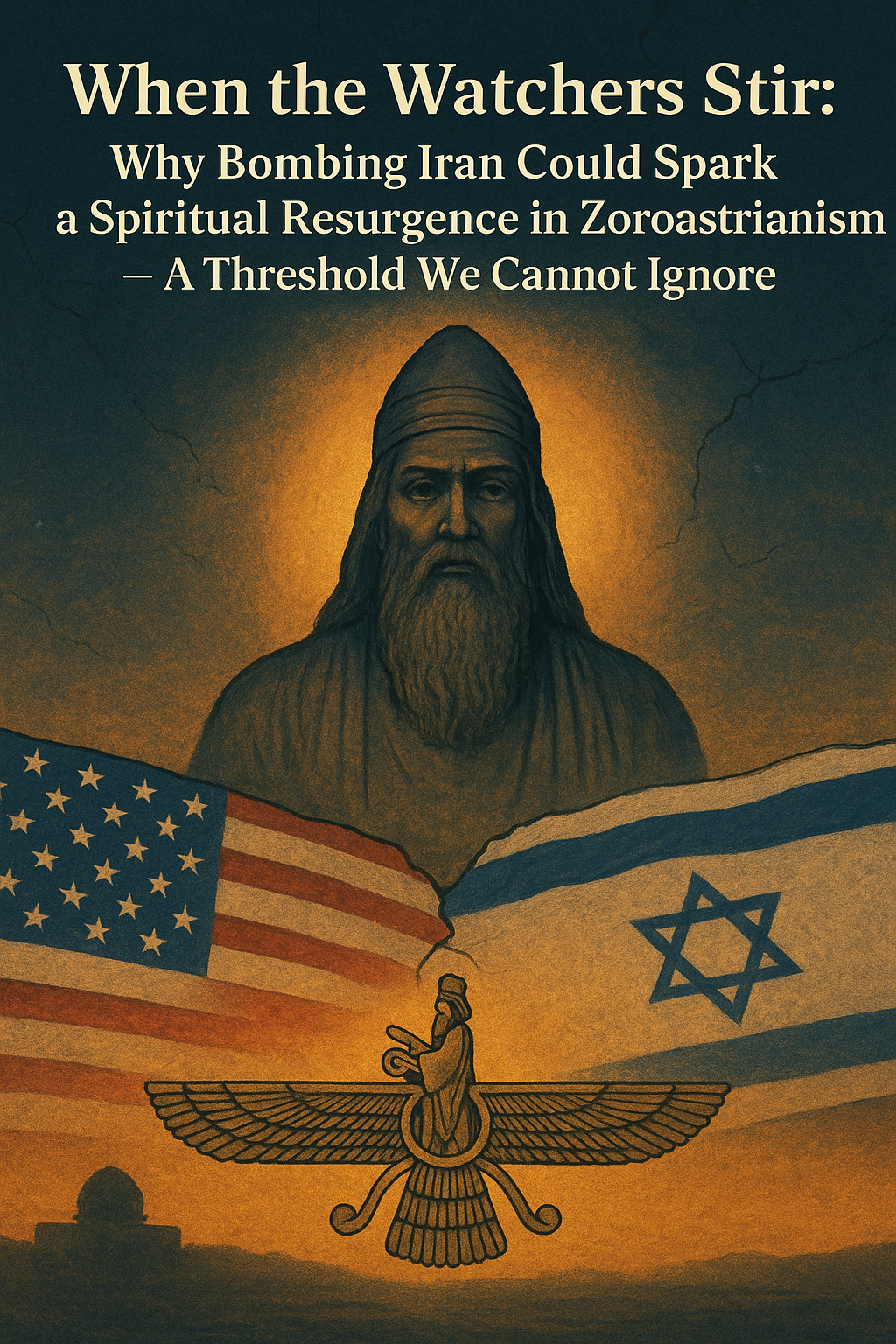
  • When the Watchers Stir: Why Bombing Iran Could Spark a Spiritual Resurgence in Zoroastrianism – A Threshold We Cannot Ignore, Rooted in the Quran, Bible, Old Testament, and Beyond

    When the Watchers Stir: Why Bombing Iran Could Spark a Spiritual Resurgence in Zoroastrianism – A Threshold We Cannot Ignore, Rooted in the Quran, Bible, Old Testament, and Beyond

    There are moments in history when silence hums louder than speech—when the world stands at a quiet threshold, and choices made in the shadows shape centuries to come. Today, as ancient tensions and modern misunderstandings intertwine, America and Israel approach such a moment. It is not yet a rupture, but a tremor; not yet a collapse, but a shift that, if ignored, could become irreversible. Recent global polls underscore this fragility: a median of 62% across surveyed countries express unfavorable views of Israel, with only 29% favorable, according to Visual Capitalist’s analysis of 2025 data. In the U.S., this has risen to 59% unfavorable toward the Israeli government per Pew’s October 2025 survey. This essay expands upon that pivotal observation, delving deeply into the historical foundations of the U.S.-Israel alliance now under strain, the contemporary currents eroding it—including escalating risks from potential conflicts with Iran—the insidious rise of antisemitism, the timeless wisdom of Zoroastrianism as a metaphorical lens, the grave allegations of genocide in Gaza and international condemnations, and the imperative paths forward for renewal. A stark warning emerges: further military escalations, such as bombing Iran, could accelerate this decline, ultimately benefiting only those who align with truth and justice in the eyes of global conscience—potentially igniting a spiritual resurgence in Zoroastrianism as a symbol of Iranian resilience and cultural revival, echoing themes that reverberate through the Quran, the Christian Bible (encompassing the Old and New Testaments), and back to Zoroastrian roots. These connections matter profoundly because they illustrate a shared spiritual heritage of moral choice, light versus darkness, and divine guardianship, reminding us that modern geopolitical choices carry eternal ethical weight. In an era where digital echoes amplify divisions, generational perspectives redefine alliances, and global scrutiny intensifies over humanitarian crises, we must confront these dynamics with unflinching clarity. What follows is an exploration that weaves together geopolitics, cultural memory, spiritual philosophy, societal responsibility, and the weight of international law, urging us to act before the tremors become earthquakes.

    To understand the present threshold, we must first trace the roots of the U.S.-Israel bond, a relationship forged in the fires of post-World War II global reconfiguration but increasingly viewed through lenses of critique and reevaluation. The establishment of Israel in 1948 emerged amid the displacement of hundreds of thousands of Palestinians, an event known as the Nakba, which set the stage for enduring conflicts. The United States, emerging as a superpower, recognized Israel swiftly, driven by strategic interests in the Middle East, domestic political pressures, and Cold War calculations. President Harry Truman’s decision reflected lobbying from Zionist groups and evangelical Christians interpreting biblical prophecies, but it also overlooked the humanitarian costs to indigenous populations. In the ensuing decades, this alliance deepened through geopolitical exigencies, with Israel positioned as a counterweight to Soviet influence. U.S. military aid escalated from modest beginnings to billions annually, funding systems like the Iron Dome amid ongoing regional tensions. Shared intelligence operations, often targeting perceived threats like Iran’s nuclear program, further entrenched the partnership, though critics argue this has perpetuated cycles of instability.

    However, complexities have always shadowed this narrative. Early U.S. policy wavered; Dwight Eisenhower condemned Israel’s role in the 1956 Suez Crisis, forcing a withdrawal, while John F. Kennedy approached arms sales with caution amid concerns over nuclear proliferation. The 1967 Six-Day War expanded Israeli territory but drew international condemnation for occupations deemed illegal under international law. By the 1970s, under Richard Nixon and Henry Kissinger, U.S. support intensified during the Yom Kippur War, with airlifts that saved Israel from defeat but also fueled Arab resentment and oil embargoes. The rise of AIPAC ensured congressional backing, often overriding concerns about human rights. Culturally, portrayals in media emphasized Israel’s narrative, but this has been challenged by accounts highlighting Palestinian perspectives. The 1980s and 1990s saw joint exercises and trade, but the Oslo Accords’ failure amid settlements and violence exposed the alliance’s limitations. Post-9/11, both nations aligned against terrorism, yet U.S. wars in the region paralleled Israel’s conflicts, drawing parallels in critiques of overreach.

    Fissures have widened over time. Barack Obama’s tensions over the Iran deal highlighted divergences, while aid persisted despite settlement expansions violating UN resolutions. Donald Trump’s moves, like Jerusalem recognition, alienated global allies. Joe Biden faced party pressures over Gaza, and the 2025 administration navigates sharper divides amid calls for conditioned aid. As of October 2025, this history reveals a bond increasingly strained by humanitarian concerns and shifting global norms. The alliance has endured through conflicts and changes, but its sustainability depends on addressing ideological and ethical critiques, including genocide allegations that have galvanized international opposition—and the risks of bombing Iran, which could provoke a profound cultural and spiritual backlash, including a surge in Zoroastrianism as Iranians rally around their ancient heritage, drawing on shared themes with the Bible and Quran that underscore the spiritual stakes.

    A Changing Current

    For generations, the bond between the United States and Israel has been seen as unshakeable—woven through shared memory, strategy, and moral conviction. But beneath the surface, new currents flow. A younger generation, shaped by a digital age and weary of inherited narratives, sees the world differently. Political divides sharpen. Online storms blur fact and feeling. And in the midst of this, antisemitism—a poison as old as civilization itself—finds new language and new platforms. Recent polls underscore this transformation. A Pew Research Center survey in October 2025 reported that 59% of Americans hold an unfavorable view of the Israeli government, up from 51% in early 2024. Globally, Pew’s spring 2025 data shows unfavorable views in 20 of 24 surveyed countries, with medians around 62% unfavorable per Visual Capitalist. Sympathy for Israelis has hit lows, with U.S. figures below 50% in Gallup’s 2025 data. The Gaza conflict, following the October 7, 2023, Hamas attacks, has been a catalyst, with images of devastation fueling perceptions that Israel is “going too far,” as 39% of Americans now believe per Pew.

    Generational differences are at the heart of this change. Millennials and Gen Z, immersed in social media platforms like TikTok and Instagram, encounter narratives emphasizing Palestinian suffering, often framed through lenses of colonialism and human rights. Unlike older generations shaped by Holocaust education and Cold War alliances, younger Americans view Israel through contemporary conflicts, with 40% under 30 believing U.S. aid is “too much,” according to Pew. This is compounded by campus activism, where protests against Israeli policies have intensified, sometimes blurring into antisemitic rhetoric. Political divides exacerbate this: Democrats, once staunch supporters, now show cratering approval, with a Quinnipiac poll finding a plurality sympathizing more with Palestinians. Republicans maintain backing, but isolationist sentiments question endless entanglements.

    The digital age amplifies these currents. Algorithms prioritize sensational content, spreading misinformation about the conflict. Hashtags like #FreePalestine garner billions of views, while pro-Israel voices struggle against accusations of bias. This online ecosystem fosters echo chambers, where fact and emotion entwine, eroding nuanced discourse. Moreover, economic factors play a role; younger Americans, burdened by debt and inequality, resonate with critiques of U.S. foreign aid priorities. As Brookings notes, support for Israel continues to deteriorate among Democrats and youth, with unfavorable views doubling in recent years. If unchecked, these shifts could manifest in policy changes, such as conditioned aid or reduced military cooperation, as hinted in analyses.

    Adding to these dynamics are the severe allegations of genocide in Gaza, which have reshaped international perceptions and further strained the U.S.-Israel alliance. As of October 2025, a UN Independent International Commission of Inquiry has explicitly concluded that Israel has committed genocide against Palestinians in Gaza, citing acts such as killings, serious harm, and conditions calculated to destroy the group, along with evidence of intent. This finding, released in September 2025, marks a significant escalation in official UN scrutiny. The report details how Israel’s military operations, including widespread destruction and restrictions on aid, meet four of the five acts outlined in the 1948 Genocide Convention.

    Substantial international criticism has mounted, with countries such as South Africa, Bolivia, Brazil, Chile, Colombia, Cuba, Jordan, Turkey, and others—totaling over two dozen—accusing Israel of genocide or supporting related legal actions at the International Court of Justice (ICJ). The ICJ’s ongoing case, initiated by South Africa in 2023, has seen provisional measures ordering Israel to prevent genocidal acts, with hearings continuing into 2025. Additionally, organizations like Amnesty International, the International Association of Genocide Scholars, and even groups within Israel have affirmed that Israel’s actions constitute genocide. UN resolutions in 2025 have condemned Israel’s actions in Gaza, with the General Assembly passing measures calling for ceasefires and aid access, often with overwhelming majorities (e.g., 142 votes in favor for the New York Declaration in September 2025, with only 10 against).

    Public opinion polls reflect this growing consensus. In the U.S., an Economist/YouGov poll from August 2025 found 45% of Americans believe Israel is committing genocide in Gaza. Another poll indicated half of U.S. voters agree, with 67% of Democrats holding this view. Strikingly, polls among American Jews show 39-40% believing Israel has committed genocide, alongside 60% acknowledging war crimes. Globally, similar sentiments prevail in Europe and the Global South, where majorities in countries like the UK and France view Israel’s actions critically. These condemnations represent a significant portion of the international community and have fueled calls for accountability, including arms embargoes and boycotts.

    Israel rejects these accusations, asserting self-defense against Hamas and pointing to civilian protection measures. However, the mounting evidence from UN reports and NGOs has intensified the debate, contributing to the erosion of support. This is not merely a foreign policy question. It is a spiritual and cultural test. The erosion reflects broader societal fractures—polarization, identity politics, and a reevaluation of America’s global role. Israel, once positioned as a key ally, now faces scrutiny as a source of regional instability amid these genocide allegations. Yet, this current is not inevitable; it invites reflection on how to bridge divides through education, dialogue, and adherence to international law. Moreover, escalating tensions with Iran—such as potential bombings—could exacerbate this shift, alienating even more global opinion and ensuring outcomes favor only those who stand with truth, justice, and de-escalation, while potentially catalyzing a massive revival of Zoroastrianism in Iran, with spiritual echoes in the Christian Bible.

    A Warning Without Hatred

    To speak of these shifts is not to assign blame or sow fear. It is to face reality with moral clarity. Antisemitism must be condemned—always, without qualification. Critique of state policy must be distinguished from hatred of a people. Confusing the two leads to ruin. If the rifts deepen unchecked, the U.S.–Israel relationship could fracture in ways diplomacy cannot easily heal. Bonds forged through shared history can be unmade through neglect and ignorance. The rise of antisemitism in America is a stark manifestation of this danger. According to the Anti-Defamation League (ADL), over 50% of American Jews faced antisemitism in 2024, a figure corroborated by joint studies with Jewish Federations. The ADL’s 2024-2025 report paints a grim portrait: incidents surged, with Jewish Americans experiencing harm at rates significantly higher than before, particularly in schools, workplaces, and online.

    This resurgence is multifaceted. Post-October 7, 2023, attacks saw a spike in hate crimes, with the FBI reporting that nearly 70% of religion-based incidents target Jews. Social media platforms have become breeding grounds, where tropes like “Jewish control” of media or finance proliferate, often tied to criticisms of Israel. The AJC’s 2024 report reveals that 90% of American Jews believe antisemitism has increased since the Hamas attacks, with 33% personally targeted. Young Jews are especially vulnerable; 41% of those aged 18-29 reported incidents, and 35% of college students faced it on campus. This has led to behavioral changes: 56% altered habits to avoid identification as Jewish, up from previous years.

    Distinguishing policy critique from hatred is crucial, especially amid genocide allegations. Legitimate debates on Gaza operations are democratic rights, but when they devolve into calls for Israel’s destruction or invoke blood libels, they cross into antisemitism. The IHRA definition, adopted by many institutions, helps delineate this, classifying denial of Israel’s right to exist as antisemitic—a view held by 85% of Americans per AJC. Yet, conflations persist, fueling polarization. The UN’s genocide finding has been weaponized in some discourses, but experts emphasize that condemning actions does not equate to hating a people. If ignored, this could erode not just U.S.-Israel ties but American social cohesion, as hatred rarely confines itself. Balancing condemnation of potential atrocities with anti-antisemitism efforts is essential for moral clarity. Furthermore, any escalation toward bombing Iran risks amplifying these divisions, tipping the scales in favor of those who champion truth and restraint over aggression, and could inadvertently fuel a dramatic spiritual resurgence in Zoroastrianism, with parallels in the Christian Bible’s teachings on moral vigilance.

    The Ancient Flame: Spiritual Connections Across Scriptures

    Long before modern borders and alliances, a different kind of wisdom guided civilizations. The Zoroastrian tradition—older than empires, older than maps—spoke of asha: the order of truth and righteousness. It taught that humanity stands between light and darkness, not as spectators, but as participants. Zoroastrianism, originating in ancient Iran around 1500-1000 BCE, was founded by the prophet Zoroaster, who reformed polytheistic practices into a monotheistic framework centered on Ahura Mazda, the wise lord and creator. Asha, meaning truth or cosmic order, is the bedrock of this faith, opposing druj (falsehood and chaos), and guiding adherents through good thoughts, words, and deeds.

    The Magi, keepers of this flame, once watched empires rise and fall. They did not act through conquest but through quiet guardianship of knowledge. As hereditary priests, the Magi maintained fire temples, interpreted sacred texts like the Avesta, and advised rulers in the Achaemenid, Parthian, and Sasanian empires. Their role as “watchers” symbolized vigilance over moral order, influencing rituals and ethics. Zoroastrianism’s dualism—good versus evil, culminating in Frashokereti (final renovation)—profoundly shaped Judaism, Christianity, and Islam, introducing concepts like resurrection, judgment, and a messiah (Saoshyant). During the Babylonian Exile, Persian Zoroastrian ideas likely influenced Jewish eschatology.

    To say “the Magi are watching closely and waiting” is not to invoke some hidden power—it is to remind us that the memory of civilizations is long, and wisdom endures long after political certainties fade. In today’s context, this ancient flame illuminates the U.S.-Israel tensions and Gaza allegations: just as Zoroastrians chose asha amid chaos, modern societies must choose truth over division, confronting atrocities with justice. The Magi’s guardianship evokes a call to moral participation, warning that neglect of light—whether through ignoring genocide claims or fostering hatred—invites darkness. Zoroastrianism’s decline after the 7th-century Muslim conquest, with migrations to India forming the Parsi community, underscores resilience—today, 100,000-200,000 adherents worldwide preserve its teachings. Its emphasis on ecology, equality, and free will offers timeless lessons for navigating contemporary rifts, urging accountability in the face of international condemnations.

    These themes matter spiritually because they echo across sacred texts, from Zoroastrianism to the Old Testament, the Christian Bible, and the Quran, forming a tapestry of shared human struggle for righteousness. In Zoroastrianism, the cosmic battle between good and evil is central, with humanity’s moral choices determining the triumph of light, as in the Avesta where Ahura Mazda calls for good thoughts, words, and deeds to oppose Angra Mainyu (the evil spirit). This dualism influenced Judaism during the Persian period, evident in the Old Testament’s emphasis on choosing good over evil. For example, Deuteronomy 30:15-19 presents life and death, blessings and curses, urging: “Choose life, so that you and your children may live,” highlighting free will’s role in moral order. Isaiah 5:20 warns, “Woe to those who call evil good and good evil, who put darkness for light and light for darkness,” mirroring Zoroastrian light-darkness motifs and stressing the peril of moral inversion.

    The “watchers” in the Old Testament, as in Daniel 4:17 where “watchers, holy ones” decree judgments, symbolize divine vigilance, akin to Zoroastrian guardians. This extends to the Christian Bible’s New Testament, where Jesus in Matthew 5:14-16 calls believers “the light of the world,” urging good deeds to glorify God, echoing Zoroastrian ethical dualism and Old Testament choices. Revelation’s apocalyptic visions of final judgment and resurrection draw from Zoroastrian eschatology, where good triumphs over evil.

    In the Quran, these threads continue: Surah An-Nur 24:35 describes Allah as “the Light of the heavens and the earth,” a parable of divine guidance piercing darkness. Surah Al-Baqarah 2:257 contrasts Allah guiding from darkness to light versus Satan leading to darkness, emphasizing righteousness. Hadiths reinforce: “Truthfulness leads to righteousness, and righteousness leads to Paradise.” These interconnections matter because they reveal a universal spiritual call to moral agency—choosing light over darkness amid trials—relevant to today’s conflicts, where ignoring ethical imperatives risks cosmic imbalance.

    Yet, in the shadow of potential escalations like bombing Iran, Zoroastrianism could experience a spiritual resurgence, tied to the Christian Bible’s warnings. Historical precedents show aggressions catalyze revivals; the Arab conquests suppressed Zoroastrianism, but remnants persisted as Persian identity symbols. Today, Iranian youth turn to it for ethical purity, framing reversion as ancestral faith. Bombing could unite groups under nationalism, amplifying Zoroastrian sites and philosophies, inspiring conversions. This rise—swelling adherents through awakening—stems from its peaceful alternative, defying asha’s neglect. Thus, the watchers wait for reclamation.

    “When societies forget their light, the watchers do not vanish. They wait—for a generation ready to listen again.” This proverb encapsulates Zoroastrian endurance, urging us to heed ancient wisdom in modern crises, including the ethical imperatives raised by Gaza.

    The Path Forward

    We cannot afford apathy. The path of repair begins with education, dialogue, and courage. It means confronting antisemitism wherever it appears, not out of obligation but out of recognition that hatred unleashed never remains contained. It also means addressing allegations of genocide head-on, supporting international investigations and humanitarian aid. It means learning deeply—not just about Israel and Judaism, but about all the ancient currents that shaped our shared world, including Zoroastrianism, whose concepts of good, evil, and moral choice seeded the spiritual soil of entire civilizations. Initiatives like AJC’s Translate Hate glossary educate on antisemitic tropes, while calls for updated national strategies against hate are vital. On campuses, centers like AJC’s for Education Advocacy empower students against discrimination.

    Dialogue must bridge generational gaps, fostering forums where critiques of policy—including genocide accusations—are aired without descending into hatred. Revitalizing Holocaust education and incorporating Zoroastrian influences can enrich understanding of shared ethical roots, while also teaching about contemporary conflicts. Policy-wise, conditioning U.S. aid on human rights compliance, as suggested amid UN findings, could realign the alliance with American values. Social media accountability—reforming Section 230 to curb algorithmic hate—is essential. Globally, supporting ICJ processes, two-state solutions, and countering threats like Hamas and Iran can stabilize relations. Encouraging more countries to join condemnations or push for ceasefires, as seen in joint statements from 25+ nations, builds momentum for peace. Critically, avoiding escalations like bombing Iran is paramount; such actions could deepen global unfavorability, ensuring long-term gains only for those who stand with truth and de-escalation, while sparking Zoroastrianism’s spiritual rise with biblical ties.

    If we do this, the coming shift can be one of renewal, not fracture. If we do not, we may stand decades from now and wonder how a bond once thought unbreakable was allowed to fade amid unaddressed atrocities. Renewal requires collective action: communities hosting interfaith dialogues, schools teaching diverse histories including Gaza’s humanitarian crisis, and leaders condemning both antisemitism and potential genocide unequivocally.

    A Threshold of Choice

    The watchers stir, not to judge, but to witness. History has set the stage; the present holds the pen. Whether we build bridges or fracture fault lines depends not on distant powers, but on the choices made in classrooms, communities, and conversations today. As Zoroastrian asha reminds us, truth prevails through active participation. In this threshold moment, let us choose light over shadow, forging a future where alliances endure through understanding, justice, and accountability for all sides. Heed the warning: bombing Iran or ignoring these currents will only empower those aligned with truth, potentially sealing the alliance’s fate and ushering in Zoroastrianism’s spiritual resurgence, deeply intertwined with the Christian Bible’s moral imperatives.
  • The Greeks and the 6000-Year Mystery: Zoroastrianism’s Profound Influence on Western Thought

    The Greeks and the 6000-Year Mystery: Zoroastrianism’s Profound Influence on Western Thought

    The eFireTemple is a digital sanctuary dedicated to preserving and sharing the eternal wisdom of Zoroastrianism. In this exploration, we unravel the profound influence of Zarathustra, the primal sage of ancient Persia, on Greek philosophy and, through it, the foundations of Western thought. Far from being a self-contained “Greek Miracle,” the intellectual achievements of Greece were deeply intertwined with Zoroastrian teachings, which the Greeks revered as a source of primordial wisdom, dating back 6,000 years.

    The Primal Source of Wisdom

    The narrative of Western intellectual history often celebrates Greek philosophy as a self-originating phenomenon, a “Greek Miracle” that birthed rational thought. Yet, the Greeks themselves told a different story. Philosophers like Plato, historians like Pliny the Elder, and biographers like Diogenes Laertius pointed to an ancient, foreign wellspring of wisdom: Zarathustra, known to them as Zoroaster. By placing Zarathustra 6,000 years in the past, they were not merely speculating about history but making a profound philosophical statement: true wisdom is ancient, universal, and transcends cultural boundaries. This “6000-year mystery” reveals a syncretic worldview where Greek thought drew heavily from Zoroastrianism, shaping the philosophical and theological frameworks that would later influence Judaism, Christianity, and the Western intellectual tradition.

    This article explores why the Greeks were so captivated by Zarathustra, how his teachings reached them, and the philosophical parallels that made Zoroastrianism resonate so deeply with the Hellenic mind. We will examine the mechanisms of cultural transmission, the symbolic significance of the 6,000-year claim, and the enduring legacy of Zoroastrian ideas in Western thought, supported by a rich array of historical sources and modern scholarship.

    The Greek Testimonies: Zarathustra as the First Philosopher

    The Greeks’ reverence for Zarathustra is well-documented in their texts, reflecting a deep respect for his wisdom as a foundational influence on their own intellectual pursuits. Below, we analyze key testimonies from Greek and Roman authors, placing them in their cultural and philosophical context.

    Plato (427–347 BCE): The Philosopher-King and Zoroastrian Wisdom

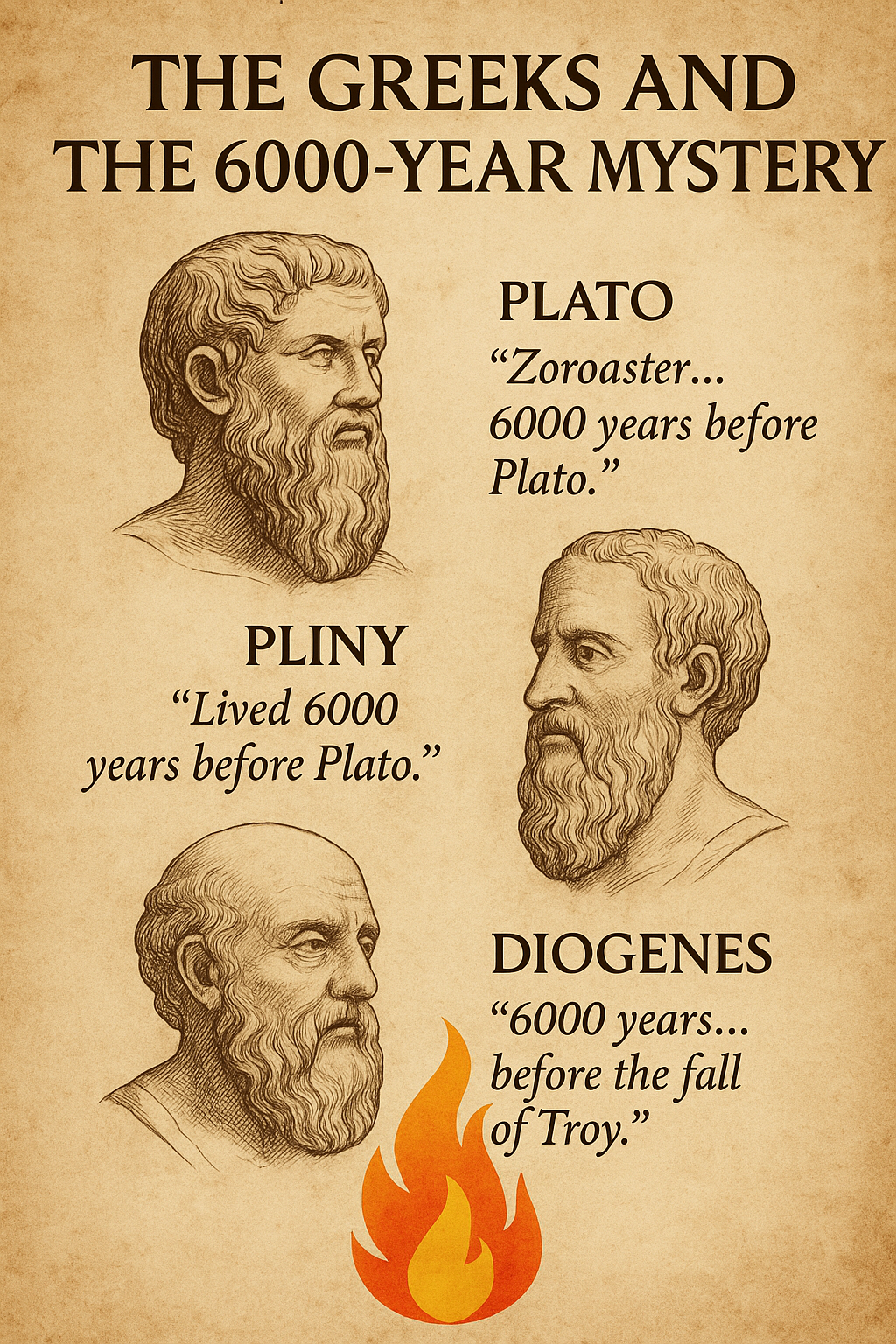
    In Plato’s First Alcibiades (122a), Socrates discusses the education of Persian kings, noting that they are instructed by four “royal tutors” from the Magian priesthood in the “wisdom of Zoroaster, the son of Oromazes.” This wisdom encompasses “the worship of the gods” and “the art of ruling,” presenting Zarathustra as the ideal fusion of theology, philosophy, and statecraft. For Plato, the Persian model of governance—rooted in divine order—mirrors his concept of the philosopher-king, who rules through wisdom and justice (Dikaiosyne). The Zoroastrian principle of Asha (truth, righteousness, cosmic order) parallels Plato’s Dikaiosyne, suggesting that the ideal ruler aligns human society with a divine, universal order. This connection is no coincidence; it reflects the Greeks’ exposure to Persian thought through diplomatic and cultural exchanges during the Achaemenid Empire (550–330 BCE).

    Pliny the Elder (23–79 CE): The Authority of Antiquity

    In his encyclopedic Natural History (XXX.1.3), Pliny the Elder states, “Magice…est…a Zoroastre…et hic quidem, ut inter auctores convenit, annis ante Platonem sex milibus fuisse proditur.” (“Magic…is…from Zoroaster…and indeed, as authorities agree, he is recorded to have lived 6,000 years before Plato.”) As a Roman compiler of knowledge, Pliny drew on a vast array of sources, indicating that this 6,000-year claim was a widely accepted belief among the educated elite. The term “magic” here refers not to sorcery but to the Magian priesthood’s esoteric wisdom, including astrology, theology, and cosmology—fields that fascinated the Greeks and Romans. Pliny’s assertion underscores the perception of Zarathustra as the primordial sage, whose teachings predated and informed Greek philosophy.

    Diogenes Laertius (3rd Century CE): Mapping the Origins of Philosophy

    In the proem to his Lives and Opinions of Eminent Philosophers, Diogenes Laertius explores the origins of philosophy, noting that some Greeks believed it began with “barbarians” (non-Greeks), including the Magi of Persia, the Chaldeans of Babylon, and the Gymnosophists of India. He explicitly states that the Magi attribute the beginnings of philosophy to “Zoroaster the Persian,” who lived “6,000 years before Xerxes’ Greek expedition” (circa 480 BCE). This places Zarathustra in a mythic past, far beyond the historical records of Greece, Egypt, or Mesopotamia. Diogenes’ account reflects a Greek willingness to acknowledge foreign influences, positioning Zarathustra as a foundational figure whose wisdom shaped the philosophical enterprise.

    Other Voices: Eudoxus, Aristotle, and Hermippus

    Additional Greek sources reinforce this reverence. Eudoxus of Cnidus (390–337 BCE), a student of Plato, reportedly studied with the Magi, adopting their astronomical and astrological insights, which influenced his work on planetary motion. Aristotle, cited by Plutarch in On Philosophy, references the Zoroastrian dualistic deities Oromasdes (Ahura Mazda) and Areimanius (Angra Mainyu), indicating familiarity with their cosmic struggle. Hermippus of Smyrna (3rd century BCE) is said to have cataloged two million verses of Zoroastrian teachings, a testament to the depth of Greek engagement with Persian texts. These accounts collectively demonstrate that the Greeks viewed Zarathustra not as a distant myth but as a tangible source of philosophical and scientific knowledge.

    The Symbolism of 6,000 Years: A Cosmic Chronology

    The repeated claim that Zarathustra lived 6,000 years before Plato or Xerxes is not a historical assertion but a symbolic one, rooted in Zoroastrian cosmology and adopted by the Greeks to signify authority and universality.

    The Zoroastrian Cosmic Cycle

    In Zoroastrian cosmology, as detailed in texts like the Bundahishn and Denkard, the universe unfolds over a 12,000-year cycle, divided into four 3,000-year phases. These phases represent the creation, struggle, triumph, and final renovation (Frashokereti) of the world, driven by the conflict between Ahura Mazda (the Wise Lord) and Angra Mainyu (the Destructive Spirit). The 6,000-year mark likely places Zarathustra at the midpoint of this cycle, a pivotal moment when humanity receives divine revelation to guide it toward righteousness. The Greeks, encountering this cosmology through contact with the Magi, adopted the 6,000-year figure as a way to anchor Zarathustra’s teachings in a mythic, primordial past.

    Hellenistic Syncretism and Cultural Exchange

    The transmission of this chronology was facilitated by extensive Greco-Persian interactions following Alexander the Great’s conquest of the Achaemenid Empire (330 BCE). The Hellenistic period saw Greek rulers, such as the Seleucids and Greco-Bactrians, govern regions steeped in Zoroastrian culture. Temples, libraries, and priestly classes in cities like Babylon and Susa became hubs of intellectual exchange. Greek philosophers and scholars, traveling through these regions, encountered Zoroastrian texts, rituals, and oral traditions, which they interpreted through their own philosophical lens. The Magi, as priestly intermediaries, played a key role in transmitting concepts like the cosmic cycle, which resonated with Greek ideas of cosmic order (kosmos).

    Primordial Authority in the Ancient World

    In antiquity, age conferred legitimacy. By attributing a 6,000-year antiquity to Zarathustra, the Greeks positioned him as older than Egyptian priests (who claimed lineages back to 3000 BCE), Mesopotamian king lists (extending to 4000 BCE), or the Hebrew chronology of the Septuagint (placing creation around 5500 BCE). This claim was a strategic one-upmanship, asserting that Zoroastrian wisdom was the oldest and thus the most authoritative. It also aligned with the Greek tendency to seek universal truths beyond their own cultural boundaries, as seen in their admiration for Egyptian and Indian sages.

    Why the Greeks Were Fascinated: Philosophical Parallels

    The Greek fascination with Zarathustra was not merely a matter of exoticism but stemmed from profound philosophical and theological parallels between Zoroastrianism and Greek thought. These parallels made Zoroastrian ideas both accessible and compelling to the Hellenic mind.

    Metaphysical Dualism: A Solution to the Problem of Evil

    Zoroastrianism’s dualistic worldview, pitting Ahura Mazda against Angra Mainyu, offered a structured explanation for the existence of evil, which was lacking in early Greek religion. In the Greek pantheon, gods like Zeus or Ares could be capricious, causing chaos without a clear moral framework. Aristotle, as cited by Plutarch, noted the Zoroastrian deities Oromasdes and Areimanius, suggesting that their cosmic struggle provided a philosophical model for understanding good and evil. This dualism influenced later Greek schools, particularly Platonism, which posited a dichotomy between the material (imperfect) and ideal (perfect) realms. The Zoroastrian framework also prefigured Gnostic and Manichaean dualism, which would shape early Christian heresies like Catharism.

    Astrology and Astronomy: The Order of the Heavens

    The Magi were renowned as master astronomers and astrologers, a reputation that captivated Greek scholars like Eudoxus. The Zoroastrian calendar, with its precise solar calculations, was among the most accurate in the ancient world, reflecting the principle of Asha—the cosmic order governing both the heavens and human affairs. The Greeks, who sought to understand the kosmos (ordered universe), found parallels in Zoroastrian cosmology, where the stars and planets were seen as manifestations of divine will. This shared emphasis on celestial order facilitated the integration of Zoroastrian astronomical knowledge into Greek science, influencing figures like Ptolemy and Hipparchus.

    Eschatology and the Afterlife

    Unlike early Greek religion, which often depicted the afterlife as a shadowy Hades, Zoroastrianism introduced a linear view of history culminating in Frashokereti—a final renovation where the world is purified, and souls are judged based on their deeds. This eschatology included concepts of a final judgment, an afterlife of reward or punishment, and a savior figure (the Saoshyant). These ideas resonated with later Greek philosophers, particularly Plato, whose Phaedo and Republic explore the soul’s immortality and moral judgment. The Stoics, too, adopted a linear view of history with their concept of ekpyrosis (cosmic conflagration), which bears similarities to Frashokereti. These concepts provided a theological framework that early Christian thinkers would later adapt.

    Ethics and the Good Life

    Zoroastrianism’s ethical triad of Humata, Hukhta, Hvarshta (Good Thoughts, Good Words, Good Deeds) offered a practical framework for living a righteous life, which paralleled Greek philosophical concerns. Plato’s emphasis on the Good and Aristotle’s concept of eudaimonia (flourishing through virtue) found echoes in Zoroastrian ethics, which stressed individual responsibility and alignment with divine order. The Greek admiration for Zoroastrian ethics is evident in their portrayal of Persian rulers as disciplined and just, as seen in Xenophon’s Cyropaedia, which idealizes Cyrus the Great as a model of virtuous leadership influenced by Magian teachings.

    Mechanisms of Transmission: How Zoroastrian Ideas Reached Greece

    The transmission of Zoroastrian ideas to Greece was not a singular event but a complex process spanning centuries, facilitated by cultural, political, and intellectual exchanges.

    Achaemenid Empire and Early Contact (550–330 BCE)

    The Achaemenid Empire, founded by Cyrus the Great, brought Persian culture into direct contact with Greek city-states in Asia Minor (modern-day Turkey). Cities like Sardis and Ephesus, under Persian rule, became cultural crossroads where Greek philosophers encountered Magian priests. The Persian Wars (499–449 BCE) further intensified contact, as Greek historians like Herodotus documented Persian customs and beliefs, including Zoroastrian rituals. Herodotus’ Histories (Book I) describes Persian religious practices, noting their reverence for fire and their rejection of anthropomorphic gods, which intrigued Greek thinkers.

    Hellenistic Period: The Great Synthesis (330–146 BCE)

    Alexander the Great’s conquest of Persia in 330 BCE opened the floodgates for cultural exchange. Hellenistic kingdoms like the Seleucids and Greco-Bactrians governed regions where Zoroastrianism was prevalent, fostering syncretism. Greek scholars, such as those at the Library of Alexandria, had access to Persian texts, likely translated by bilingual Magi. The Seleucid patronage of Babylonian and Persian priesthoods ensured that Zoroastrian ideas, including the 12,000-year cosmic cycle, were disseminated widely. The Greco-Bactrian kingdom, bordering Central Asia, further facilitated exchanges with Zoroastrian communities, as evidenced by archaeological finds like Zoroastrian fire altars in Bactria.

    The Role of the Magi

    The Magi, Zoroastrian priests, were key intermediaries. Known for their expertise in astronomy, theology, and ritual, they served as advisors in Persian courts and Hellenistic administrations. Greek philosophers like Eudoxus and Pythagoras (via later traditions) reportedly studied with the Magi, learning their cosmological and astrological systems. The Magi’s oral traditions, preserved in Avestan hymns like the Gathas, and their written texts, cataloged by figures like Hermippus, provided a direct conduit for Zoroastrian ideas to enter Greek thought.

    Trade and Travel

    The Achaemenid Royal Road and later Hellenistic trade routes connected Greece with Persia, India, and Central Asia. Merchants, diplomats, and scholars traveled these routes, carrying ideas alongside goods. The Silk Road’s early iterations brought Zoroastrian communities in contact with Greek traders, as seen in the spread of Zoroastrian fire temples in Central Asia. These interactions ensured that Zoroastrian concepts, such as dualism and eschatology, permeated Greek intellectual circles.

    Implications for Today: Zoroastrianism’s Enduring Legacy

    The influence of Zoroastrianism on Greek philosophy has profound implications for understanding the foundations of Western thought. The chain of influence extends from ancient Persia through Greece to Judaism, Christianity, and beyond.

    Theological Debt to Zoroastrianism

    • Angelology and Demonology: During the Babylonian Exile (597–539 BCE) and Persian period, Jewish theology absorbed Zoroastrian concepts of a structured hierarchy of angels and demons. The Archangels Michael and Gabriel, and the figure of Satan as a rebellious adversary, reflect Zoroastrian influences, particularly the Amesha Spentas (divine immortals) and Angra Mainyu’s daevas (demons). These ideas were further developed in early Christianity, shaping texts like the Book of Enoch and Revelation.
    • The Savior Figure: The Zoroastrian Saoshyant, a future savior born of a virgin who leads the final battle and resurrects the dead, bears striking parallels to the Christian Messiah. This concept, absent in earlier Hebrew texts, likely entered Jewish thought during Persian rule, influencing apocalyptic traditions like those in Daniel and the Dead Sea Scrolls.
    • Cosmic Struggle: The Christian narrative of a cosmic war between God and Satan (Revelation 12:7-9) mirrors Zoroastrian dualism more closely than earlier Hebrew theology, where Satan was a subordinate accuser (Job 1:6-12). The structured conflict between good and evil, culminating in a final victory, reflects Zoroastrian eschatology.

    Influence on Christianity via Greek Philosophy

    When early Christian apologists like Justin Martyr used Plato’s concept of the Logos (divine reason) to explain the Gospel of John’s “Word made flesh” (John 1:1-14), they were, perhaps unknowingly, drawing on a tradition influenced by Zarathustra. Plato’s Logos—a rational principle governing the cosmos—parallels the Zoroastrian Asha, the divine order of truth and righteousness. This connection suggests that Christian theology owes a debt to a Zoroastrian-Greek synthesis, mediated through Hellenistic philosophy.

    Modern Relevance

    Today, Zoroastrianism’s influence is often overlooked in discussions of Western intellectual history. Yet, its concepts of ethical responsibility, cosmic order, and a hopeful eschatology continue to resonate. The eFireTemple seeks to revive this awareness, illuminating the universal quest for truth that Zarathustra championed. By recognizing Zoroastrianism’s role in shaping Greek and Christian thought, we honor the interconnectedness of human wisdom and the enduring flame of Asha.

    Zarathustra, the Primal Sage

    The “6000-year mystery” is more than a chronological curiosity; it is a testament to the ancient world’s syncretic pursuit of wisdom. By attributing a mythic 6,000-year antiquity to Zarathustra, the Greeks paid him the highest compliment: they recognized him as the primal sage, whose teachings transcended culture and time. His philosophy of Asha, dualism, and eschatology provided a framework that resonated with Greek thinkers, influencing Plato’s idealism, Aristotle’s cosmology, and the Stoics’ ethics. Through these channels, Zoroastrian ideas shaped Jewish and Christian theology, forming a triad of influences—Zoroastrian, Greek, and Hebrew—that underpins Western thought.

    At eFireTemple, we celebrate Zarathustra’s legacy as a bridge between East and West, a flame that illuminated the ancient world and continues to guide us today. His teachings remind us that the pursuit of truth is a universal endeavor, uniting humanity across millennia in the quest for a righteous and meaningful life.

    Further Reading and Sources

    • Primary Sources:
      • Plato. First Alcibiades. Translated by W.R.M. Lamb. Loeb Classical Library, 1927. Available at: Loeb Classical Library.
      • Pliny the Elder. Natural History, Book XXX. Translated by H. Rackham. Loeb Classical Library, 1940. Available at: Loeb Classical Library.
      • Diogenes Laertius. Lives and Opinions of Eminent Philosophers. Translated by R.D. Hicks. Loeb Classical Library, 1925. Available at: Loeb Classical Library.
      • Herodotus. Histories, Book I. Translated by A.D. Godley. Loeb Classical Library, 1920. Available at: Loeb Classical Library.
      • Plutarch. On Isis and Osiris. Translated by Frank Cole Babbitt. Loeb Classical Library, 1936. Available at: Loeb Classical Library.
    • Zoroastrian Texts:
      • The Avesta. Translated by James Darmesteter. Sacred Books of the East, 1880. Available at: Avesta.org.
      • Bundahishn. Translated by E.W. West. Sacred Books of the East, 1880. Available at: Avesta.org.
    • Secondary Sources:
      • Beck, Roger. Zoroastrianism: A Guide for the Perplexed. Bloomsbury, 2011. A concise introduction to Zoroastrianism’s influence on other traditions.
      • De Jong, Albert. Traditions of the Magi: Zoroastrianism in Greek and Latin Literature. Brill, 1997. The definitive study on Greco-Roman perceptions of Zoroastrianism.
      • Hultgård, Anders. “Persian Apocalypticism.” In The Encyclopedia of Apocalypticism, Vol. 1, edited by John J. Collins. Continuum, 1998. Explores Zoroastrian eschatology’s impact on Jewish and Christian thought.
      • Kingsley, Peter. Ancient Philosophy, Mystery, and Magic: Empedocles and Pythagorean Tradition. Clarendon Press, 1995. Examines Eastern influences on Greek philosophy.
      • Stausberg, Michael, & Yuhan Sohrab-Dinshaw Vevaina (eds.). The Wiley Blackwell Companion to Zoroastrianism. Wiley-Blackwell, 2015. A comprehensive resource on Zoroastrian history and theology.
      • Boyce, Mary. A History of Zoroastrianism, Vol. I: The Early Period. Brill, 1975. A foundational text on early Zoroastrianism.
      • Duchesne-Guillemin, Jacques. The Western Response to Zoroaster. Oxford University Press, 1958. Analyzes Zoroastrianism’s influence on Western thought.
    • eFireTemple Resources:

    © 2025 eFireTemple – Digital Sanctuary of Truth

  • The Peaceful Return: A Global Strategy to End the Islamic Republic Without War

    eFireTemple

    A Turning Point for Civilization

    Iran stands at a crossroads—not of war and peace, but of death and rebirth.

    The Islamic Republic, a regime born of violence and sustained through deception, has ruled Iran for 45 years with fear, brutality, and lies. But its grip is no longer absolute. It survives not by the will of the people, but by the illusion of power.

    That illusion is crumbling.

    Now, a peaceful path is not only possible—it is necessary. The people are ready. The numbers are in their favor. And the world, if it chooses, can help guide this transition without bombs, without civil war, and without vengeance.


    This Does Not Have to Be a War of Death

    Consider the truth:

    • Over 80 million Iranians live under the Islamic Republic.
    • Of those, fewer than 1 million actively support or enforce the regime’s power.
    • Within the IRGC, the Basij, and the intelligence forces, many are coerced, demoralized, or waiting for a signal to defect.
    • The majority of the country—especially the youth—want freedom, dignity, and a future.

    This is not a military stalemate. This is a spiritual imbalance. And that imbalance can be corrected without war, if the right forces align.


    The Role of Reza Pahlavi: A Return Not of Rule, but of Restoration

    Reza Pahlavi, son of Iran’s last monarch, does not seek to reign as a king. He has stated repeatedly that he will not accept a throne. Instead, he offers to serve as a transitional guide—a symbolic figure to unite Iranians across all regions, religions, and backgrounds, and to help facilitate free, secular elections.

    His journey mirrors that of Jamshid, the mythic king of light who once fell to pride and returned humbled—not to rule, but to redeem a fallen kingdom.

    This is not a return to monarchy. It is a return to meaning.


    A Peaceful Strategy to End the Islamic Republic

    Here is a detailed roadmap for a nonviolent collapse of the regime—through truth, coordination, and global support:


    1. Digital Uprising and Secure Coordination

    • Equip Iranian resistance networks with encrypted apps, satellite internet, and blockchain-based communication.
    • Launch nationwide peaceful strikes, labor slowdowns, and mass boycotts of regime-owned businesses.
    • Mobilize artists, students, athletes, and influencers to ignite a cultural rebellion.

    2. Strategic Civil Disobedience

    • Mass refusal to comply with hijab laws, propaganda events, and public rituals of obedience.
    • Organize symbolic gatherings: day of silence, day of song, day of mourning, day of fire.
    • Turn daily acts—like walking unveiled, singing banned songs, or placing flowers in public squares—into rituals of resistance.

    3. Targeted Regime Isolation

    • Cut off the regime’s economic arms by exposing and boycotting IRGC-owned companies.
    • Use cyber campaigns to reveal corruption, offshore accounts, and human rights abuses.
    • Dismantle the propaganda machine by distributing open-source truth platforms inside Iran.

    4. International Recognition of a Transitional Council

    • The world must formally reject the Islamic Republic’s legitimacy and recognize an Iranian Provisional Council for National Renewal—with Reza Pahlavi as its symbolic head.
    • Invite respected Iranian thinkers, exiled leaders, and grassroots voices to participate.
    • Give this council a platform at the UN, EU, and global summits.

    5. Defections and Institutional Collapse

    • Actively support and protect IRGC, police, and judicial officials willing to defect and testify.
    • Offer immunity and dignity to those who step away from the regime peacefully.
    • Document and archive testimonies for a future truth commission, not vengeance.

    6. A People’s Flame, Not a Party’s Flag

    • Reclaim the Lion and Sun not as a royal banner, but as a symbol of unity and sovereignty.
    • Replace calls for monarchy or republicanism with calls for freedom, justice, and renewal.
    • Let Asha, the Zoroastrian principle of truth and order, guide the foundation of Iran’s next chapter.

    A Message to the World

    • To the United States, especially Donald Trump: You challenged the regime’s terror with strength. Now challenge it with truth. Declare your support for the people of Iran and their right to choose a new path—with Reza Pahlavi as their bridge, not their king.
    • To Europe: End your silence. Stop shaking hands with tyrants for oil and contracts.
    • To the United Nations: Demand the release of political prisoners. Open your platforms to the Iranian people—not just their unelected jailers.
    • To all global citizens: Share their stories. Raise their voices. The greatest revolution is the one that spreads without fire—except the fire of the heart.

    Iran Can Be the Light of the World Again

    A free Iran would mean:

    • No more nuclear threats.
    • No more proxy wars.
    • No more moral police.
    • No more lies in the name of God.

    It would mean a rebirth of the world’s first civilization of rights, order, and dignity.


    A Flame, Not a Gun

    This moment does not need bullets. It needs clarity.
    It does not need civil war. It needs civil will.
    It does not need another Shah. It needs Jamshid reborn—humble, healing, human.

    And it needs the world to stand not above Iran, but beside her.

    Let this be the revolution without death.
    Let this be the fall of the regime without the fall of the nation.
    Let this be the peaceful return.

  • Zarathustra and the Prophets of Islam: A Messenger Among Messengers?Reclaiming a Forgotten Prophet of Divine Truth


    The Veiled Figure in the House of Prophethood

    In the Islamic tradition, reverence is given to a long line of prophets—from Adam to Muhammad—each sent to a particular people, with a message of truth tailored to their time. The Qur’an states:

    “And We certainly sent into every nation a messenger…”
    (Qur’an 16:36)

    Yet one name is conspicuously absent from the Qur’an’s list of prophets, despite being the spiritual founder of one of the world’s oldest monotheistic religions: Zarathustra (Zoroaster). Was he a prophet in the Islamic sense? Did Muslim scholars view him as such? And what happens when we place him within the broader Abrahamic narrative?

    This article investigates how Islamic thinkers understood Zarathustra, the tensions in recognizing his prophethood, and how his teachings align with—and diverge from—those of the Qur’an and Hadith.


    1. Zarathustra in Zoroastrianism: The First Prophet of Righteousness

    Zarathustra (Zartosht, Zardosht) is regarded in Zoroastrianism as:

    • The first monotheistic prophet, who proclaimed Ahura Mazda as the singular wise Lord.
    • The bearer of a moral revelation, emphasizing truth (asha), free will, ethical responsibility, and the coming victory of good over evil.
    • The composer of the Gathas, poetic hymns that form the theological core of the Avesta.

    Zarathustra’s teachings are prophetic, rational, and deeply ethical—qualities mirrored in Qur’anic messengers.


    2. Qur’anic Inclusivity: The “Unmentioned Prophets”

    The Qur’an names 25 prophets but acknowledges many more:

    “And We sent messengers about whom We have related [their stories] to you before, and messengers about whom We have not related to you…”
    (Qur’an 4:164)

    “There was never a nation without a warner…”
    (Qur’an 35:24)

    These verses leave open the possibility that Zarathustra was indeed a messenger (rasul or nabi), though his name is not explicitly stated.


    3. Islamic Scholarly Opinions on Zarathustra

    Islamic scholars across centuries held divergent views on Zarathustra:

    a. Al-Biruni (973–1048)

    In Chronology of Ancient Nations, he refers to Zarathustra as a wise lawgiver and prophet of the Magians, noting the reverence Persians had for him.

    b. Al-Shahrastani (1086–1153)

    In Kitab al-Milal wa al-Nihal, he describes Zoroastrians as Ahl al-Kitab (People of the Book), though with some doubts over textual corruption.

    c. Ibn Hazm (994–1064)

    A controversial Andalusian scholar who argued that Zoroastrians may have had a prophet, but lost their scriptures and fell into fire-worship.

    d. Al-Tabari (838–923)

    In his History of Prophets and Kings, he refers to Zoroastrianism as an ancient revealed religion, later corrupted by the priesthood.

    Thus, while Islamic orthodoxy stopped short of canonizing Zarathustra as a prophet, many scholars left the door open for his inclusion among the “forgotten” or “unmentioned” messengers.


    4. Doctrinal Similarities: A Case for Prophethood

    Zoroastrianism (Zarathustra)Islam (Prophets)
    Belief in One God: Ahura MazdaTawhid: Allah as sole Creator
    Dual moral forces: Asha vs. DrujDivine vs. Shaytan / Nafs
    Prophetic teaching through hymnsQur’anic revelation
    Day of Judgment and resurrectionYawm al-Qiyamah, resurrection
    Ethical imperative: good thoughts, words, deedsTaqwa, righteous action, charity
    End-time savior (Saoshyant)Mahdi / Isa as eschatological figures

    These similarities affirm the structure of revelation across time and space—a key Qur’anic theme.


    5. Zoroastrians as Ahl al-Kitab: Scriptural Recognition?

    The Qur’an commands:

    “Indeed, those who believe, and those who are Jews, and the Sabians, and the Christians, and the Magians, and those who associate others with Allah—Allah will judge between them on the Day of Resurrection…”
    (Qur’an 22:17)

    The inclusion of Magians (Majus) here is critical. Most jurists interpreted this to mean:

    • Zoroastrians are recipients of a divine message.
    • They deserve dhimmi status (protection under Islamic rule).
    • They are not polytheists, despite fire symbolism.

    This indicates implicit recognition of Zarathustra as a prophet, or at least as a bearer of divinely inspired ethics.


    6. Why Was Zarathustra Not Named? Political and Theological Pressures

    Several possible reasons for Zarathustra’s omission from the Qur’an include:

    • Arab-Persian tensions post-conquest—naming him might empower a resistant Persian identity.
    • Ambiguity about Zoroastrian cosmology, especially its dualism.
    • Fear of syncretism or theological confusion due to Zoroastrian use of fire, angelic hierarchies, and ancient rites.

    Nonetheless, Sufi thinkers and Persian Muslim poets often referenced Zoroastrian wisdom favorably—as part of the broader spiritual heritage of Iran.


    7. Reclaiming Zarathustra: A Messenger for the Age of Ethics

    In an age of increasing interfaith understanding and spiritual rediscovery, Zarathustra’s message—centered on truth, choice, justice, and the fight against deceit—resonates with core Qur’anic values.

    His recognition as a prophet may remain ambiguous in jurisprudence, but theologically and morally, he stands firmly among those who:

    “…enjoin righteousness and forbid evil, and hasten to good deeds. They are among the righteous.”
    (Qur’an 3:114)


    A Prophet Veiled in Fire

    Zarathustra, the ancient voice of Persia, may have been forgotten by name in Islamic scripture, but not in spirit. His teachings anticipated the great Qur’anic truths: divine unity, ethical struggle, and eschatological hope. Whether we name him prophet or sage, the light of his message—like the sacred fire of his temples—continues to burn within the soul of Islamic civilization, especially in its Persian heart.


    References

    1. Al-Biruni. Chronology of Ancient Nations, trans. C. E. Sachau. London, 1879.
    2. Al-Shahrastani. Kitab al-Milal wa al-Nihal.
    3. Ibn Hazm. Al-Fasl fi al-Milal wal-Ahwa’ wal-Nihal.
    4. Al-Tabari. Tarikh al-Rusul wa al-Muluk.
    5. Boyce, Mary. Zoroastrians: Their Religious Beliefs and Practices. Routledge, 2001.
    6. Shaked, Shaul. The Magi in Islamic Tradition. Jerusalem Studies in Arabic and Islam.
    7. Nasr, Seyyed Hossein. The Heart of Islam. HarperOne, 2002.
    8. The Qur’an: Surahs 4:164, 16:36, 22:17, 35:24, 3:114.
  • Mazdak and the Seeds of Islamic EgalitarianismZoroastrian Radicalism and the Roots of Islamic Social Justice


    Firebrands Before the Caliphate

    Centuries before the rise of Islam, the Persian world was shaken by a spiritual and social movement that challenged the hierarchy of kings, priests, and landlords. Its leader, Mazdak, a reformer rooted in Zoroastrian tradition, proclaimed a message of equality, compassion, and communal sharing. Though violently suppressed by the Sassanian state, his ideas survived—and echoed later in Islamic sects, especially those promoting justice, economic equality, and revolutionary faith.

    This article uncovers the often-overlooked influence of Mazdakism on early Islamic egalitarian movements, tracing a hidden lineage from Zoroastrian radicalism to the soul of Islamic social reform.


    1. Who Was Mazdak? Prophet, Heretic, or Revolutionary?

    Mazdak (fl. late 5th–early 6th century CE) emerged in the late Sassanian period, claiming divine inspiration and positioning himself as a reformer of Zoroastrianism.

    He taught:

    • Equality of all people before Ahura Mazda
    • Communal ownership of property and even women (though this may be polemic exaggeration)
    • A rejection of greed, violence, and hierarchical oppression
    • A return to original Zoroastrian values of compassion, simplicity, and Asha (truth)

    Supported for a time by Sassanian King Kavadh I, Mazdak’s movement gained thousands of followers but was brutally crushed under Khosrow I, who viewed it as a threat to aristocratic power.


    2. Mazdakite Ideals and Zoroastrian Roots

    While some later Islamic sources portray Mazdak as a heretic or communist, his teachings were deeply grounded in Zoroastrian principles:

    Zoroastrian CoreMazdakite Interpretation
    Asha (truth, order)Social justice and equality
    Free willMoral choice to reject hierarchy and corruption
    Spenta Mainyu (Beneficent Spirit)Compassion as highest virtue
    Cosmic dualismFraming economic injustice as alignment with Druj (the Lie)

    Mazdakism reclaimed Zoroastrian ethics and reinterpreted them through socioeconomic activism—a prophetic rebellion against injustice.


    3. Islamic Echoes: From Equality to Revolution

    Mazdakite ideas reemerged covertly and overtly in early Islamic thought:

    a. Mu’tazilite Rationalism and Free Will

    • Emphasized justice and moral agency—God cannot be unjust.
    • Rejected predestination, much like Zoroastrian emphasis on human choice.
    • Advocated for egalitarian ethics, echoing Mazdakite responsibility-driven cosmology.

    b. Shi‘a and Proto-Shi‘a Movements

    • Revolts like those of Mukhtar al-Thaqafi and later Alid uprisings used religious rhetoric to oppose corrupt elites and defend the poor and marginalized.
    • Shi‘ism’s focus on the Imamate as a guide for the oppressed mirrors Mazdak’s idea of divinely guided reformers.

    c. The Qarmatians: Radical Echoes of Mazdakism

    • An 8th–10th century Isma‘ili Shi‘a movement based in Bahrain.
    • Known for abolishing private property, rejecting pilgrimage, and even attacking Mecca to protest the corruption of the Abbasids.
    • Established a utopian egalitarian state, recalling the Mazdakite ideal of communal justice.

    Islamic sources—like those of al-Tabari and al-Mas‘udi—directly link Mazdak to Qarmatian ideology, though often with disapproval.


    4. Mazdak’s Legacy in Islamic Political Thought

    Even after his death, Mazdak became a symbol:

    • To some, he represented heretical chaos.
    • To others—especially Persian converts to Islam—he was a proto-martyr for justice.

    Later Islamic thinkers, particularly in Persia, could not ignore the memory of a man who challenged power in the name of divine ethics. His ideals filtered into:

    • Persian revolutionary poetry and folklore
    • Sufi rejection of wealth and power
    • The concept of zuhd (asceticism) in Islamic spirituality
    • Modern Iranian religious reform movements, some of which directly reference Mazdak

    5. Continuity of Thought: Divine Justice and Economic Ethics

    MazdakismIslam
    Redistribution of wealthZakat (obligatory charity), prohibition of hoarding
    Rejection of corrupt elitesProphetic condemnation of tyrants
    Moral economy rooted in divine willShariah-based economic ethics
    Emphasis on compassion and communal careRahmah (mercy) as core divine attribute

    Islam institutionalized many ideals that Mazdak demanded—though within a different theological structure. But the moral fire remained the same.


    The Flame Beneath the Ashes

    Mazdak may have been executed and his followers dispersed, but his vision of a divinely ordered society based on justice, compassion, and equality did not die. It survived in whispers—through Persian folklore, Sufi renunciation, Shi‘a martyrdom, and revolutionary calls for reform.

    By recognizing Mazdak’s influence on Islamic thought, we reconnect with a Zoroastrian revolutionary spark that continues to challenge unjust systems, remind us of our moral duties, and call us back to the sacred rhythm of Asha and mercy.


    References

    1. Crone, Patricia. God’s Rule: Government and Islam. Columbia University Press, 2004.
    2. Boyce, Mary. Zoroastrians: Their Religious Beliefs and Practices. Routledge, 2001.
    3. Shaked, Shaul. Dualism in Transformation. SOAS, 1994.
    4. Madelung, Wilferd. The Succession to Muhammad: A Study of the Early Caliphate. Cambridge University Press, 1997.
    5. Al-Tabari. History of the Prophets and Kings. Vol. 5–6.
    6. Lewis, Bernard. The Origins of Ismailism. AMS Press, 1970.
    7. Corbin, Henry. History of Islamic Philosophy. Kegan Paul, 1993.
  • The Rise of Persian Islam: How Zoroastrianism Persianized the Islamic Golden AgeFrom Empire to Enlightenment


    From Conquered to Cultural Vanguard

    When Arab armies swept across Persia in the 7th century, they brought with them a new faith—Islam. But over time, something unexpected happened: the conquered transformed the conquerors. The Persians, once subjects of the mighty Zoroastrian Sassanian Empire, did not simply adopt Islam—they infused it with their own philosophical, spiritual, artistic, and administrative traditions.

    This article explores how Zoroastrian cosmology, ethics, kingship, and intellectual spirit helped shape what we now call the Islamic Golden Age, turning it from a primarily Arab project into a Persianized civilizational renaissance.


    1. The Abbasid Revolution: A Persian-Led Shift

    The Abbasid Caliphate (750 CE onward) marked a clear break from Umayyad Arab dominance. The revolution was largely Persian-led, particularly by the Khorasani movement, which sought to restore a more just and inclusive Islamic leadership.

    Under the Abbasids:

    • The capital moved to Baghdad, near old Persian centers like Ctesiphon.
    • Persian viziers, scholars, and bureaucrats filled court positions.
    • Zoroastrian administrative models were retooled to serve the Islamic state.

    Thus, the Abbasid period became a civilizational fusion, where Persian ideas revived under an Islamic banner.


    2. From Khvarenah to Caliphate: Persian Concepts of Kingship

    In Zoroastrianism, kingship was legitimized through Khvarenah—divine radiance and destiny granted by Ahura Mazda. Kings were seen as upholders of cosmic order (Asha).

    This concept survived in:

    • The caliphal image as the “shadow of God on Earth.”
    • The Shi‘a doctrine of Imamate, where Imams possess hidden knowledge and divine light (Nur Muhammadi).
    • Persian epics like the Shahnameh, where just rule, divine favor, and moral authority are deeply connected.

    Islamic rulers in Persia borrowed the mantle of Zoroastrian legitimacy, even as they denounced its theology.


    3. The Persianization of Islamic Philosophy and Science

    Persian thinkers helped translate, preserve, and transform the ancient world’s knowledge—especially Greek, Indian, and Zoroastrian texts.

    • Avicenna (Ibn Sina): Fused Greek logic with Islamic metaphysics, but also preserved Zoroastrian medical and ethical concepts.
    • Suhrawardi: Created the Illuminationist (Ishraqi) School, which blended Zoroastrian light cosmology with Neoplatonism and Qur’anic mysticism.
    • Al-Farabi, Al-Razi, and Nasir al-Din Tusi all operated within a Persian intellectual framework, drawing from pre-Islamic sources.

    Zoroastrian rationalism and cosmic structure found new life in Islamic metaphysics.


    4. Ethics and Adab: Zoroastrian Moral Order in Islamic Garb

    The Zoroastrian concept of Asha (truth, order, righteousness) continued in the Islamic idea of Adab—proper conduct, etiquette, and spiritual discipline.

    • Persian literature (e.g., Saadi’s Gulistan, Rumi’s Masnavi) emphasized justice, humility, and cosmic balance—hallmarks of Zoroastrian ethical thought.
    • The Islamic principle of ‘Amr bil ma’ruf wa nahy ‘an al-munkar (“enjoining good and forbidding evil”) echoes Zoroastrian moral dualism.
    • The Persian courtly ideal of the just ruler (Shahanshah) deeply influenced Islamic kingship across Iran, India, and Central Asia.

    5. Persian Mysticism and the Flame of Inner Knowledge

    Zoroastrianism, especially in its later Sassanian and Manichaean forms, cultivated a mystical path where the soul ascended through light, purity, and knowledge.

    Sufism absorbed this through:

    • Fire as a symbol of divine love (e.g., Rumi, Hafez).
    • The belief in hidden knowledge (batin) accessible only to the purified heart.
    • Celestial hierarchies of angels and lights, reminiscent of Zoroastrian angelology.

    This culminated in a Persian Sufism that blended Islamic devotion with Zoroastrian cosmology—seen in the writings of Suhrawardi, Attar, and others.


    6. Artistic and Architectural Persianization

    Islamic architecture in Persia evolved to include:

    • Zoroastrian spatial design: symmetry, domes, sacred geometry.
    • Emphasis on light, water, and fire motifs, especially in mosques and madrasas.
    • Calligraphy and miniature art as spiritual practices—echoing Avestan sacred inscription.

    The mosque became the new fire temple—a sacred space where ritual order and divine presence met.


    7. Persian Languages and Literature: The Qur’an in Persian Soul

    Though Arabic remained the language of the Qur’an, Persian became the vehicle of Islamic culture. In doing so, it Zoroastrianized the emotional and philosophical language of Islam.

    • The Shahnameh revived ancient Persian values under Islamic motifs.
    • Persian poets used Islamic forms (ghazals, qasidas) to express pre-Islamic mystical yearnings.
    • Persian Islamic texts integrated Zoroastrian ideas of cosmic struggle, soul testing, and divine guidance into mainstream Islamic discourse.

    Islam’s Persian Rebirth

    Islam in Persia was not merely a religion imposed from outside—it became a luminous continuation of Persian spiritual genius. Zoroastrianism did not vanish; it transfigured—its ethics, cosmology, and culture woven into the very fabric of Islamic civilization.

    The Islamic Golden Age was golden because it was Persianized—infused with the fire of Asha, the beauty of Khvarenah, and the soul of an ancient people who never let their light go out.


    References

    1. Boyce, Mary. Zoroastrians: Their Religious Beliefs and Practices. Routledge, 2001.
    2. Nasr, Seyyed Hossein. Science and Civilization in Islam. Harvard University Press, 1968.
    3. Corbin, Henry. History of Islamic Philosophy. Kegan Paul, 1993.
    4. Shaked, Shaul. Dualism in Transformation. SOAS, 1994.
    5. Suhrawardi, The Philosophy of Illumination, trans. Walbridge & Ziai. BYU Press, 1999.
    6. Tuck, Richard. The Shahnameh and the Construction of Persian Identity. Harvard Iranian Studies Journal, 2007.
    7. Yarshater, Ehsan. Persian Literature and Spirituality. Encyclopaedia Iranica.
  • Taqwa and Asha: Zoroastrian Ethics in Qur’anic RighteousnessTwo Visions, One Moral Flame


    Walking the Path of the Righteous

    In both Zoroastrianism and Islam, the heart of the spiritual journey lies not merely in belief—but in ethical action. These two ancient monotheistic traditions place moral responsibility at the core of divine worship, offering frameworks for human beings to align with higher truth.

    For Zoroastrians, this path is governed by Asha—the principle of truth, righteousness, and cosmic order. For Muslims, the equivalent is Taqwa—conscious reverence for God expressed through moral discipline and obedience. While theologies differ, these ethical concepts reflect deep spiritual parallels, revealing the enduring influence of Persian moral philosophy on Islamic thought.


    1. Asha: The Sacred Order of Truth

    In Zoroastrianism, Asha (Avestan: aša) is not simply “truth” in a factual sense—it is the underlying law of reality: moral, spiritual, and cosmic.

    Asha governs:

    • The physical universe (seasons, stars, fire, water)
    • The moral law (honesty, justice, compassion)
    • Human conduct, especially through the Zoroastrian maxim:
      “Good Thoughts, Good Words, Good Deeds”

    Asha is both objective truth and subjective righteousness—to live by Asha is to live in harmony with the divine will and help in the cosmic battle against Druj (the Lie).


    2. Taqwa: Reverence in Action

    In Islam, Taqwa is often translated as piety, God-consciousness, or fear of God—but at its root, it means protecting oneself from evil through mindfulness of the Divine.

    The Qur’an calls Taqwa:

    • The criterion of virtue: “Indeed, the most noble of you in the sight of Allah is the one with the most Taqwa” (Qur’an 49:13).
    • A shield against sin and error.
    • A luminous quality that distinguishes the righteous: “Allah is with those who have Taqwa” (Qur’an 2:194).

    Like Asha, Taqwa is both spiritual and practical—manifesting through prayer, honesty, humility, generosity, and justice.


    3. Ethical Parallels: Inner Truth and Outer Action

    ZoroastrianismIslam
    Asha – Truth, righteousness, cosmic orderTaqwa – Piety, God-consciousness, moral protection
    Requires free will and responsibilityRequires choice and accountability
    Asha is lived through Good Thoughts, Words, DeedsTaqwa is shown in righteous action and character
    Opposes Druj (falsehood, evil)Opposes Iblis, ego, and injustice
    Aligns with Ahura Mazda’s willAligns with Allah’s commands (Shariah)

    Both traditions emphasize that ethics are not arbitrary rules—they reflect the structure of the universe and the nature of divine justice.


    4. The Judgment of the Soul: Ethics as Eternal Destiny

    In Zoroastrianism, souls are judged after death based on how closely they lived in accordance with Asha. If their deeds reflect Asha, they cross the Chinvat Bridge into paradise. If they lived in Druj, they fall into hell.

    Islam teaches the Mizan (balance)—deeds are weighed, and those who practiced Taqwa are promised Jannah (Paradise), while those who rebelled face Jahannam (Hell).

    This shared emphasis on moral consequence, rather than mere belief, highlights the profound ethical continuity between the two.


    5. Prophetic Teachings: Righteousness in Word and Deed

    • Zarathustra, the prophet of Zoroastrianism, taught that humans must choose the path of Asha freely. His ethical sermons (especially in the Gathas) are filled with calls to justice, truth, and integrity.
    • Muhammad, the Prophet of Islam, was called al-Amin (the trustworthy) even before his prophethood. His teachings and example (Sunnah) centered around mercy, fairness, and spiritual humility.

    Both prophets were moral revolutionaries in societies dominated by corruption and falsehood. They called people not just to worship, but to transform their character in line with divine order.


    6. Persian Influence on Islamic Ethics

    After the Islamic conquest of Persia (7th century), Zoroastrian ethical values persisted—especially through:

    • Persian scholars and philosophers, who integrated Asha-like concepts into Islamic ethics.
    • Sufi mysticism, which emphasized purification of the soul (tazkiyah)—akin to aligning with Asha.
    • Adab (ethical etiquette) literature, especially in Persian, which reflects ancient moral codes of justice, nobility, and moderation.

    The Islamic world absorbed the Zoroastrian sense of moral cosmology, where good conduct is not just social virtue—it is cosmic alignment.


    Living in Light

    Asha and Taqwa are not only ethical imperatives; they are spiritual compasses, guiding the soul toward the divine. Both demand truthfulness, integrity, and reverence—not just in ritual, but in every action and intention.

    In a world full of confusion and temptation, the one who lives by Asha or Taqwa does not walk in darkness. They become, in Zoroastrian and Islamic terms, a torchbearer of light—illuminating the world through righteous living.


    References

    1. Boyce, Mary. Zoroastrians: Their Religious Beliefs and Practices. Routledge, 2001.
    2. Dhalla, Maneckji N. History of Zoroastrianism. OUP, 1938.
    3. Nasr, Seyyed Hossein. The Heart of Islam. HarperOne, 2004.
    4. Choksy, Jamsheed K. Purity and Pollution in Zoroastrianism. University of Texas Press, 1989.
    5. The Qur’an: Surahs 2:194, 2:282, 49:13, 57:28, 91:7–10.
    6. Corbin, Henry. Spiritual Body and Celestial Earth. Princeton University Press, 1977.
    7. Shaked, Shaul. Dualism in Transformation. SOAS, 1994.
  • The Light Verse of the Qur’an and the Khvarenah of PersiaZoroastrian Radiance in Islamic Metaphysics


    Light as Divine Signature

    Among the most mystical and widely interpreted verses in the Qur’an is Ayat an-Nur (The Light Verse):

    “Allah is the Light of the heavens and the earth…”
    — Qur’an 24:35

    This verse has inspired centuries of Islamic metaphysics, art, and Sufi mysticism. Yet long before Islam, ancient Persia was shaped by an equally powerful vision of divine light: the Khvarenah, or Farrah—the radiant glory of Ahura Mazda that surrounded kings, heroes, and the righteous.

    This article explores how the concept of Khvarenah in Zoroastrianism—a blend of divine favor, cosmic light, and spiritual charisma—laid the foundation for Islamic notions of divine illumination, especially as developed in Persian mystical and philosophical traditions.


    1. What is Khvarenah?

    Khvarenah (Avestan: xᵛarənah) is a central Zoroastrian concept meaning “glory,” “splendor,” or “divine light.” It is:

    • A spiritual radiance granted by Ahura Mazda to kings, priests, and heroes.
    • A sign of divine election and favor—to lose it is to fall from grace.
    • Described as visible, fiery light that accompanies the worthy and flees from the wicked.
    • Associated with royal legitimacy (the “glory of kingship”) and the cosmic order of Asha.

    In the Yashts (hymns), Khvarenah is portrayed almost as a divine entity—capable of departing from an unworthy soul or settling upon one chosen for divine work.


    2. Ayat an-Nur: Allah as Light

    The Qur’anic verse (24:35) reads:

    “Allah is the Light of the heavens and the earth. The example of His light is like a niche within which is a lamp…”

    This rich imagery paints divine light as the medium of all existence, the source of knowledge, and the inner reality behind outward appearances.

    Key metaphors:

    • Niche (mishkat) = vessel of receptivity
    • Lamp (misbah) = source of illumination
    • Glass, shining star = purified container
    • Blessed Tree = symbolic of spiritual life

    The verse emphasizes that divine presence is best understood through light—subtle, radiant, infinite. This light is not physical, but metaphysical: the Light of Being, or Nur al-Wujud.


    3. Khvarenah and Qur’anic Nur: Comparative Themes

    Khvarenah (Zoroastrianism)Nur (Islam)
    Radiance from Ahura MazdaLight from Allah
    Sign of divine legitimacySymbol of divine essence
    Attached to kings, sages, heroesAssociated with prophets, righteous
    Flees from the wickedDenied to those in spiritual darkness
    Sometimes visible (flame, star)Described metaphorically (lamp, niche)

    Both are not just symbols, but subtle realities. To bear Khvarenah or be touched by divine Nur means being aligned with truth, worthy of guidance, and part of the cosmic moral order.


    4. Suhrawardi and the School of Illumination

    Zoroastrian light metaphysics reached full expression in Islam through Shihab al-Din Suhrawardi (1154–1191), founder of the Ishraqi (Illuminationist) school.

    Suhrawardi:

    • Merged Zoroastrian, Platonic, and Qur’anic ideas into a radiant cosmology.
    • Saw light as the principle of all existence, graded in intensity from the Light of Lights (Nur al-Anwar) down to darkness (non-being).
    • Cited ancient Persian wisdom explicitly, referring to Khvarenah-like ideas in discussing the light of kingship and prophets.
    • Developed a hierarchy of angelic lights, echoing Zoroastrian Yazatas and Amesha Spentas.

    For Suhrawardi, the Nur of Allah and the Khvarenah of Persia were not contradictory but complementary expressions of the same metaphysical truth.


    5. Sufi Mysticism: Inner Light and the Return to Source

    In Sufism, light becomes the very essence of the soul’s return to God:

    • The heart is a mirror—it must be polished to reflect divine Nur.
    • True guidance is not taught, but illuminated from within (kashf).
    • The journey from darkness (ego) to light (unity) parallels the soul’s alignment with Asha in Zoroastrianism.

    Poets like Rumi and Attar use fire, radiance, and shining stars to describe spiritual realization, echoing the Khvarenah’s luminous role in awakening divine identity.


    6. Royal Light: From Persian Kingship to Islamic Imamate

    Khvarenah was also political—the “divine radiance” that legitimized rulers. In Islamic Iran, this transformed into:

    • The Nur of the Prophet Muhammad (Nur Muhammadi)—a pre-eternal light passed through the prophets.
    • The Shi‘a concept of Imamate, where each Imam is a bearer of divine light and knowledge.
    • The idea that true leadership is recognized not by force, but by inner radiance—a visible or felt presence of divine favor.

    This transition from Khvarenah of kings to Nur of the Imams represents a Zoroastrian legacy refracted through Islamic theology.


    Light upon Light—Two Traditions, One Radiance

    The Qur’an proclaims: “Light upon Light—Allah guides to His light whom He wills” (Qur’an 24:35). But long before this verse was revealed, Persian sages and priests spoke of a similar light: Khvarenah, the splendor of divinity reflected in the world.

    Far from being lost, Khvarenah transmuted into Islamic metaphysics—most clearly through the Light Verse, Illuminationist philosophy, and Sufi mysticism. This enduring radiance reveals a deeper truth: that across traditions, Light remains the sign of the Divine, the guide of souls, and the glory of righteous existence.


    References

    1. Boyce, Mary. Zoroastrians: Their Religious Beliefs and Practices. Routledge, 2001.
    2. Corbin, Henry. En Islam Iranien: Aspects Spirituels et Philosophiques. Gallimard, 1971.
    3. Suhrawardi, Shihab al-Din. The Philosophy of Illumination, trans. Walbridge & Ziai. Brigham Young University Press, 1999.
    4. Nasr, Seyyed Hossein. Three Muslim Sages. Harvard University Press, 1964.
    5. The Qur’an: Surah 24:35, 39:22, 57:28
    6. Choksy, Jamsheed K. Purity and Pollution in Zoroastrianism. University of Texas Press, 1989.
    7. Hujwiri, Ali ibn Uthman. Kashf al-Mahjub (The Unveiling of the Hidden), trans. R.A. Nicholson
  • Sraosha and the Qur’anic Command: The Zoroastrian Roots of Prophetic Obedience


    The Voice of the Divine

    In every sacred tradition, the voice of the Divine must find a bridge—between the unseen and the seen, between the cosmic and the human. In Zoroastrianism, this bridge is Sraosha, the divine embodiment of conscience, discipline, and sacred listening. In Islam, the equivalent function is fulfilled through revelation (wahy), carried by Jibril (Gabriel) and realized through prophetic obedience to God’s command.

    Though Islam and Zoroastrianism differ theologically, the structure of revelation and submission in both traditions reveals a fascinating continuity. The figure of Sraosha, central to Zoroastrian liturgy and moral consciousness, offers a compelling precursor to the Qur’anic model of prophecy and divine guidance.


    1. Who is Sraosha?

    Sraosha (Avestan: “Hearing” or “Obedience”) is one of the most important Yazatas (divine beings) in the Zoroastrian pantheon. He:

    • Guards the Chinvat Bridge, judging souls after death.
    • Serves as the personification of divine obedience and moral awareness.
    • Receives the words of Ahura Mazda and transmits them to humanity.
    • Is invoked daily in Zoroastrian prayers (notably in the Sraosha Yasht, Yasna 57).

    He is not merely a messenger; he is the force within the human soul that hears, discerns, and obeys divine truth. In this way, he is both cosmic and internal, divine and psychological.


    2. Sraosha and the Inner Ear of Revelation

    Zoroastrian tradition emphasizes the purity of mind and hearing as the means of divine contact. Listening—not just passive hearing—is a sacred act. Sraosha enables the soul to hear the voice of Ahura Mazda and align with Asha (truth, order).

    This resonates with the Qur’anic emphasis on:

    • Wahy (Revelation): The process by which God speaks to prophets (Qur’an 42:51).
    • The heart and ears as instruments of spiritual discernment (Qur’an 7:179, 22:46).
    • The phrase “Sam‘ana wa ata‘na” (“We hear and we obey”) in Muslim devotional language (Qur’an 2:285), which mirrors the function of Sraosha in facilitating sacred obedience.

    3. The Role of Jibril and Prophetic Mediation

    In Islam, Jibril functions as the supreme messenger between Allah and the prophets, particularly Muhammad. He:

    • Delivers the Qur’an directly to the Prophet’s heart (Qur’an 2:97).
    • Acts as the spirit of truth and bearer of divine command (Qur’an 16:102).
    • Is called Ruh al-Amin—the “trustworthy spirit”—similar to how Sraosha is seen as faithful to Asha.

    Yet unlike Sraosha, Jibril is more external; he is a distinct, angelic being, not a presence within the soul. However, in Sufi interpretation, Jibril’s function becomes more inward—representing the intuitive, illuminated part of the soul that receives divine light, much like Sraosha.


    4. The Sacred Chain: Sraosha, Asha, and the Prophet’s Word

    The Zoroastrian triad of Ahura Mazda → Sraosha → Zarathustra is structurally echoed in Islam’s Allah → Jibril → Muhammad. Both systems depend on a sacred transmission of truth, delivered not just through speech, but through deep inner alignment.

    ZoroastrianismIslam
    Ahura Mazda (Source of Truth)Allah (Source of Revelation)
    Sraosha (Divine Hearing & Transmission)Jibril (Angel of Revelation)
    Zarathustra (Prophet who obeys and transmits)Muhammad (Seal of the Prophets)
    Asha (Cosmic Truth & Righteousness)Haqq (Ultimate Truth & Justice)

    In both traditions, the prophets are not passive recipients; they are active listeners, vessels of sacred obedience. The divine word is meant not only to be heard but enacted.


    5. The Psychological Dimension: Obedience as Inner Light

    Zoroastrianism teaches that Sraosha lives in the inner world of the just person. Obedience is not submission under compulsion—it is an alignment of the soul with cosmic harmony.

    Islamic mysticism, especially in Sufism, echoes this. Obedience (ta‘a) becomes an act of spiritual surrender, where the heart, once purified, becomes a receptacle of divine speech. The famous Hadith Qudsi says:

    “When I love My servant… I become his hearing with which he hears…”

    This profound resonance shows how the Zoroastrian ideal of sacred hearing persisted into Islamic formulations of spiritual receptivity.


    Listening as a Path to Light

    In both Zoroastrianism and Islam, revelation is not merely a transmission of words—it is a discipline of the soul. Whether through Sraosha or Jibril, the Divine Voice calls us to listen, discern, and obey—not blindly, but in alignment with the higher truth that sustains the universe.

    Sraosha, the angel of sacred listening, may not be named in Islam—but his essence lives on in every verse recited, in every obedient heart, and in the deep Qur’anic command: “So give ear to it and be silent, that you may receive mercy” (Qur’an 7:204).


    References

    1. Boyce, Mary. Zoroastrians: Their Religious Beliefs and Practices. Routledge, 2001.
    2. Dhalla, Maneckji Nusservanji. Zoroastrian Civilization. Oxford University Press, 1922.
    3. Shaked, Shaul. Dualism in Transformation: Varieties of Religion in Sasanian Iran. SOAS, 1994.
    4. Nasr, Seyyed Hossein. The Heart of Islam: Enduring Values for Humanity. HarperOne, 2004.
    5. Corbin, Henry. Spiritual Body and Celestial Earth: From Mazdean Iran to Shi‘ite Iran. Princeton University Press, 1977.
    6. The Qur’an: Surahs 2:97, 2:285, 7:179, 7:204, 16:102, 22:46, 42:51.
  • The Dualism Dilemma: Ahriman’s Shadow in Islamic TheologyUnveiling the Zoroastrian Origins of Evil in Islam


    Light and Shadow in the Spiritual World

    Zoroastrianism’s most defining theological feature is its cosmic dualism—a universe structured around the eternal opposition between Ahura Mazda (the Wise Lord) and Angra Mainyu (Ahriman), the spirit of destruction and deceit. This binary framework shaped Persian consciousness for centuries before Islam’s arrival. Yet despite Islam’s strict monotheism (tawhid), echoes of Zoroastrian dualism reemerged in Islamic theology—particularly in the evolving concept of Shaytan (Satan), the nature of evil, and the struggle for the human soul.

    This article explores how Islamic understandings of evil, free will, and divine justice subtly carry the imprint of Persian dualism, raising profound questions about the origins of darkness in a monotheistic universe.


    1. Zoroastrian Dualism: Ahriman vs. Ahura Mazda

    In classical Zoroastrian cosmology, the universe is divided between two primal spirits:

    • Spenta Mainyu: The Beneficent Spirit, an aspect of Ahura Mazda, representing light, truth (asha), and creation.
    • Angra Mainyu (Ahriman): The Destructive Spirit, representing darkness, deceit (druj), and corruption.

    These opposing forces battle not just in the cosmos but within every human soul. The purpose of life, according to Zoroaster, is to choose Asha over Druj, thereby aiding the final victory of good in the eschatological event of Frashokereti (Final Renovation).


    2. Islam’s Absolute Monotheism and the Problem of Evil

    Islam, by contrast, rejects the idea of two eternal principles. Allah is One, sovereign over all creation—including Shaytan. Yet, Islamic sources present Satan (Iblis) as a powerful being who refuses to bow to Adam and is granted respite until the Day of Judgment to mislead humanity (Qur’an 7:11–18, 15:32–43).

    Here arises the dilemma:
    If Allah is the sole creator, how can genuine evil exist independently? And if Shaytan has real agency, does that not threaten divine unity?

    Islam resolves this through limited dualism:
    Shaytan is not equal to God—he is a creation, a fallen jinn—but he embodies a real force of temptation and deception, much like Ahriman in Zoroastrianism.


    3. Ahriman and Shaytan: Parallels in Function

    ZoroastrianismIslam
    Angra Mainyu (Ahriman) – spirit of destructionIblis/Shaytan – jinn who rebels
    Created falsehood (druj), darkness, and diseaseWhispers to the soul (waswasa), leads to dalal (error)
    Opposes Spenta Mainyu in every thought and actOpposes angelic guidance and prophetic truth
    Ultimately defeated in FrashokeretiCast into Hell after Yawm al-Qiyamah (Day of Judgment)

    In both systems, the evil figure is active in the world, influencing human decision-making but not beyond divine oversight. Both religions uphold the moral responsibility of the individual to resist evil and align with truth.


    4. Free Will and the Cosmic Struggle

    Zoroastrianism centers moral life on choice: to side with Asha or Druj. This spiritual freedom is foundational—no one is predetermined.

    Islam, too, teaches free will (ikhtiyar) within divine foreknowledge. The Qur’an affirms that Allah created good and evil but allows humans to choose their path (Qur’an 91:7-10). This view—a monotheistic dualism of responsibility—resonates with the Zoroastrian paradigm.

    Sufi philosophers like Suhrawardi and Nasir Khusraw, influenced by Persian thought, even proposed hierarchies of light and darkness, drawing implicitly from Zoroastrian metaphysics while maintaining Islamic monotheism.


    5. Mutazilite Debates: The Rationalists Who Resurrected Dualism

    The Mu’tazila, an early Islamic school of rationalist theology, emphasized human free will and justice. They argued that God cannot create evil—evil is the result of human misuse of choice.

    This sharply mirrors the Zoroastrian stance that Ahriman is the author of evil, and Ahura Mazda cannot be blamed for human suffering.

    While orthodox Sunni theology (e.g., Ash’arism) rejected this view, Persian-influenced regions often preserved Mutazilite ideas, showing the long tail of Zoroastrian ethical reasoning in Islamic intellectual life.


    6. The Sufi Shadow: Inner Ahriman vs. Inner Shaytan

    In Sufism, Shaytan becomes more than a cosmic figure—he represents the nafs al-ammara (the commanding self), the dark ego that must be disciplined. This internalization of the battle mirrors the inner dualism of Zoroastrian ethics, where the soul becomes a battlefield between light and darkness.

    Sufi writings, especially in Persian (e.g., Attar, Rumi, Suhrawardi), often frame this struggle in Zoroastrian terms—fire, light, shadow, and purification—further demonstrating the convergence of traditions.


    A Monotheistic Dualism with Zoroastrian Roots

    Though Islam remains fundamentally monotheistic, its portrayal of evil—through Shaytan, temptation, and moral choice—reflects Zoroastrian dualistic influence, especially in its Persian expressions. Rather than a contradiction, this influence enriched Islamic theology, allowing it to confront the problem of evil in a way that resonates deeply with human experience.

    The legacy of Ahriman lives on—not as a deity—but as a shadow archetype within Islamic thought, reminding believers of the daily struggle to choose truth over falsehood, light over darkness.


    References

    1. Boyce, Mary. Zoroastrians: Their Religious Beliefs and Practices. Routledge, 2001.
    2. Shaked, Shaul. Dualism in Transformation: Varieties of Religion in Sasanian Iran. SOAS, 1994.
    3. Corbin, Henry. The Man of Light in Iranian Sufism. Omega, 1994.
    4. Nasr, Seyyed Hossein. An Introduction to Islamic Cosmological Doctrines. SUNY Press, 1993.
    5. Al-Qur’an, Surahs: 7:11–18, 15:32–43, 91:7–10.
    6. Amir-Moezzi, Mohammad Ali. The Divine Guide in Early Shiʿism. SUNY Press, 1994.
    7. Widengren, Geo. The Accadian and Iranian Dualism in the Light of Gnostic and Manichaean Traditions. Uppsala, 1951.