The Most Important Question No One Asks
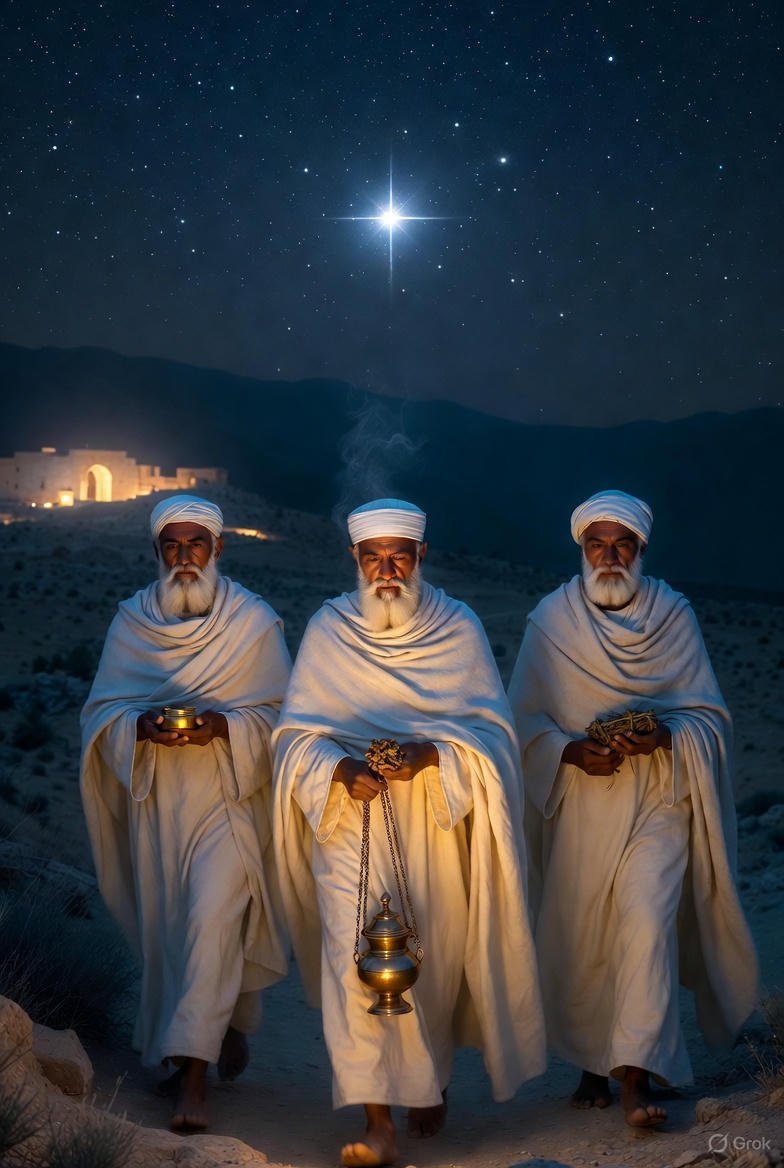
The Magi appear in Matthew 2:
They come from the East. They follow a star. They recognize the newborn Jesus as king. They present gifts of gold, frankincense, and myrrh. They worship him. They receive a dream warning them about Herod.
Then they depart for their own country “by another way.”
And that’s it.
No follow-up. No continued relationship. No mention in Acts, the Epistles, or any later Gospel. The most important witnesses to Jesus’s birth — the only people who recognized him as the prophesied savior at his arrival — simply vanish from the narrative.
Why?
The silence is not an oversight. It’s a cover-up.
What We Know They Knew
The Magi Were Zoroastrian Priests
This is not disputed by scholars:
- “Magi” (μάγοι) is the Greek term for the Zoroastrian priestly class
- They came from Persia/Parthia (“the East”)
- They practiced astrology/astronomy (following the star)
- They had prophetic knowledge (they knew what the star meant)
They Recognized Jesus as Saoshyant
The Magi didn’t just see a baby. They saw the fulfillment of their own prophecy:
- The Saoshyant — the future savior
- Born of a virgin (Zoroastrian prophecy)
- Marked by celestial signs
- Destined to defeat evil and renew the world
They traveled vast distances, bearing royal gifts, to worship him. This wasn’t curiosity — this was recognition.
They Had a Continued Relationship?
Consider what would logically follow:
The Magi had just witnessed the fulfillment of their central prophecy. Would they simply go home and forget about it? Would they not:
- Keep track of this child?
- Send emissaries or reports?
- Maintain contact with his family?
- Return when he began teaching?
- Be present at his death or resurrection?
The silence of the Gospels on these questions is deafening.
The Possible Explanations
1. There Was No Continued Contact
Perhaps the Magi really did just leave and never return. Perhaps the distance was too great, or political conditions prevented contact.
Problem: This makes the Magi story a strange isolated incident with no narrative purpose. Why include it at all if it leads nowhere?
2. Contact Was Maintained But Not Recorded
Perhaps the Magi or their representatives did maintain contact, but the Gospel writers didn’t know about it.
Problem: Matthew knew about the initial visit in detail. If there was continued contact, why wouldn’t he know?
3. Contact Was Maintained But Deliberately Suppressed
Perhaps the Magi were involved throughout Jesus’s life and ministry — but recording this would have made the Zoroastrian connection too obvious.
This explanation fits the evidence.
What Would the Church Need to Hide?
If the Magi maintained contact with Jesus:
1. Jesus Would Be Confirmed as Saoshyant
The Magi’s continued endorsement would validate Jesus as the fulfillment of Zoroastrian prophecy — not just Jewish messianic expectation.
This would mean: Christianity is not a Jewish sect that became universal. It’s the continuation of Zoroastrian revelation recognized by Persian priests.
The Church needed Christianity to be Jewish + Greek. Adding Persian openly would complicate the narrative.
2. Jesus’s Teaching Would Be Linked to Persia
If the Magi were present during his ministry, they might have:
- Confirmed that his teachings matched Zoroastrian principles
- Provided theological context for his words
- Explained that “the Father” was Ahura Mazda
This would undercut the Church’s claim that Christianity was a unique revelation rather than Persian wisdom repackaged.
3. The Crucifixion Would Need Persian Interpretation
Did the Magi interpret Jesus’s death through Zoroastrian categories?
- Sacrifice of the righteous one?
- Defeat of Druj through suffering?
- Cosmic battle enacted in history?
If so, their interpretation might differ from later Church orthodoxy. Better to leave them out.
4. The Resurrection Would Confirm Zoroastrian Doctrine
If the Magi witnessed or learned of the resurrection, they would recognize it as:
- Confirmation of the Saoshyant’s triumph
- Proof of resurrection doctrine (which came from Persia)
- Validation of Zoroastrian eschatology
Again, this would make the Persian origin too obvious.
The Alternative Tradition
Legends of the Magi
Despite the Gospel silence, later traditions did develop around the Magi:
Western tradition gave them names (Caspar, Melchior, Balthasar), made them kings, and created elaborate legends about their later lives and martyrdoms.
Eastern tradition (Syriac, Persian) preserved different names and stories, often claiming they returned to Persia to spread news of the Messiah.
The Syrian Connection
Syria and Mesopotamia — regions between Persia and Palestine — preserved traditions about continued Magi involvement. Some Syriac texts suggest the Magi or their disciples maintained contact with early Christian communities.
These traditions were marginalized as the Roman church standardized its narrative.
What Was Lost?
We know the early Church suppressed texts:
- Gnostic gospels
- Jewish-Christian writings
- “Heretical” accounts
Were there Magi-connected texts that were destroyed? Accounts of continued contact that made the Persian connection too explicit?
We can’t prove their existence, but the pattern of suppression makes it plausible.
The Gifts as Clues
The Magi’s gifts are often allegorized (gold for kingship, frankincense for deity, myrrh for death). But consider them literally:
Gold
Wealth to support the family. Practical.
Frankincense
Used in Zoroastrian fire worship. A gift with religious significance — suggesting the child would be a priest/prophet.
Myrrh
Used for burial. A gift anticipating death — suggesting the Magi knew the Saoshyant’s path involved suffering.
The gifts suggest the Magi knew the complete arc of Jesus’s life from the beginning. They didn’t just recognize a birth — they foresaw the death and its meaning.
This level of prophetic knowledge suggests ongoing involvement, not a one-time visit.
The “Other Way” — What It Might Mean
Matthew 2:12: “And being warned in a dream not to return to Herod, they departed to their own country by another way.”
The Greek “by another way” (δι’ ἄλλης ὁδοῦ) could mean:
- A different road (to avoid Herod)
- A different method (hidden, secretive)
- A different approach (changed relationship)
Some esoteric interpreters see this as the Magi going “underground” — maintaining hidden contact rather than open presence.
Speculation? Yes. But the language permits it.
What the Magi Represent
Regardless of what literally happened, the Magi’s role is clear:
They Authenticate the Zoroastrian Connection
The presence of Zoroastrian priests at Jesus’s birth — recognizing him through their prophecies — establishes that Christianity fulfills Zoroastrian expectation.
The Church included this story because it couldn’t be excluded — it was too well known. But they minimized it by cutting off the narrative.
They Disappear Because Continuing Would Reveal Too Much
If the Magi stayed in the story, they would:
- Interpret Jesus through Zoroastrian categories
- Confirm that his teachings were Asha-aligned
- Validate his death and resurrection as Saoshyant-fulfillment
- Make the Persian origin undeniable
Better to have them arrive, worship, and vanish — leaving just enough to establish credibility, not enough to establish origin.
The Question for Scholars
If a group of respected religious authorities:
- Traveled from far away to recognize a prophetic fulfillment
- Brought significant gifts
- Worshipped the child as king
- Received divine warning in dreams
Would they simply leave and never return? Never send representatives? Never check on the child’s development? Never appear at his public ministry?
The silence strains credulity.
The Magi didn’t disappear. They were disappeared — edited out of the narrative to protect the claim of Christian uniqueness.
Conclusion
The Magi are the most important witnesses to Jesus’s identity — and the least explained.
They appear suddenly. They recognize what no one else recognizes. They worship. They leave.
And then, silence.
That silence is not accidental. It’s the sound of a connection being severed — a source being obscured — a fire being hidden.
What happened to the Magi after Jesus? They likely maintained contact. Their testimony was likely preserved. Their interpretation of Jesus’s life, death, and resurrection probably existed.
And then the Church — which needed Christianity to be Greek and Jewish, not Persian — made them disappear.
But the fire remembers. And the question remains:
What did the Magi see? What did they teach? What did they write?
Somewhere, that testimony may still exist. Buried in archives. Hidden in traditions. Waiting to be found.
The Magi came from Persia. They recognized the Saoshyant. They didn’t just vanish.
They were erased. Asha remembers.
Sources
Biblical Texts
- Matthew 2:1-12
On the Magi
- Brown, Raymond E. The Birth of the Messiah. Doubleday, 1993
- Molnar, Michael. The Star of Bethlehem: The Legacy of the Magi. Rutgers, 1999
On Zoroastrian Connections
- Boyce, Mary. Zoroastrians: Their Religious Beliefs and Practices. Routledge, 1979
- Yamauchi, Edwin. Persia and the Bible. Baker, 1990
On Magi Traditions
- Monneret de Villard, Ugo. Le leggende orientali sui Magi evangelici. Vatican, 1952
- Syriac traditions on the Magi (various Syriac texts)
At eFireTemple, we ask the questions the Church won’t. The Magi didn’t disappear — they were erased. And their testimony, though hidden, still speaks.